

UPI has become ordinary enough to disappear into daily life, yet that familiarity conceals a difficult policy question: who should pay to keep a national payment network secure, dependable and competitive when its visible price is usually zero?
The next phase of Digital India therefore requires two linked shifts. Payment policy must move from adoption incentives to durable infrastructure economics, while financial inclusion must be judged by useful, trustworthy participation rather than account and transaction counts alone.
Scale has changed the policy question
The supplied DharmaRenaissance Blog article describes Digital India as the convergence of several complementary layers: Aadhaar for identity, Jan Dhan for access to formal bank accounts, affordable mobile connectivity for reach, and UPI for rapid transfers between participating accounts. The significance lies in the interaction among these layers. Identity or connectivity on its own does not create an accessible payment system; together, they can support government delivery as well as private services.
According to the article, Digital India was launched on July 1, 2015, and broadband subscriptions had reached 106.58 crore by March 2026. It also reports approximately 24,162 crore UPI transactions worth ₹314 lakh crore during the 2025-26 financial year. The network expanded from 21 participating banks in April 2016 to 703 by March 2026; the same source cites a subsequent NPCI report of 720 participating banks and more than 2,320 crore transactions in May 2026 alone.
Those reported figures establish scale, but scale is no longer the most revealing test. Once households and businesses depend on a payment rail, its public value increasingly rests on availability during demand peaks, accurate settlement, prompt reversals, fraud controls and credible complaint resolution. A temporary service failure is no longer merely an inconvenience for an application provider; it can interrupt routine commerce across a wide network.
Zero-MDR created adoption, not zero-cost infrastructure

The Merchant Discount Rate compensates institutions involved in processing a merchant payment. The source reports that ordinary BHIM-UPI and RuPay debit-card transactions have operated under a statutory Zero-MDR framework since January 2020. Removing the merchant charge lowered a conspicuous barrier for small businesses and helped QR-based acceptance spread without the expense and formality associated with conventional card terminals.
This was effective market-building policy. Consumers gained a reason to use UPI as acceptance widened, while merchants gained a reason to accept it as consumer use increased. The resulting network effect made digital payment practical in settings ranging from household bills to neighbourhood commerce.
Zero-MDR, however, removed a price rather than the underlying expenditure. As the article explains, a transaction can involve the payer’s application, the issuing bank, NPCI’s switching infrastructure and the acquiring side. Behind the brief user interaction are authentication, routing, settlement, encryption, capacity management, fraud monitoring, regulatory compliance, disaster recovery, merchant support and reconciliation. Failed or disputed transfers add investigation and reversal costs.
Volume can reduce the average cost of some operations, but greater dependence also raises the required standard of resilience. More transactions create a larger target for fraud, and a system carrying a substantial share of retail payments needs redundancy capable of surviving failures. Sustainability is therefore not simply a question of recovering a small processing expense; it is about funding the spare capacity, security and support that prevent individual problems from becoming systemic ones.
Public reimbursement has partly filled the gap. The article reports that the Union Cabinet approved a ₹1,500 crore incentive programme for 2024-25, including a 0.15 per cent incentive on eligible UPI payments of up to ₹2,000 to small merchants. It further notes that part of the reimbursement was connected to uptime and low technical-decline rates. Linking support to service quality is a useful principle, but annually renewed incentives do not by themselves give banks and payment companies a predictable, long-term investment horizon.
A tiered model can preserve access while sharing costs

The policy choice need not be between charging every merchant and subsidising every transaction indefinitely. A more proportionate model would protect the uses most closely connected to inclusion while asking commercially stronger transactions to make a limited contribution.
| Payment segment | Possible treatment | Policy rationale |
|---|---|---|
| Person-to-person transfers | Remain free | Protects UPI’s role as broadly accessible payment infrastructure. |
| Low-value purchases and genuinely small merchants | Remain free, with targeted public support where needed | Limits barriers for users and businesses most sensitive to transaction costs. |
| Large-ticket commercial and business-to-business payments | Consider a low, capped and transparent fee | Allows transactions that generate substantial commercial efficiency to contribute to network costs. |
| Consumer-facing payments generally | Keep any infrastructure charge separate from convenience fees | Reduces confusion and the risk that merchants or platforms impose opaque surcharges. |
This approach would also improve the distribution of public support. Under a blanket subsidy, a large corporate payment can receive the same price treatment as a modest sale by a neighbourhood vendor. Targeting assistance by transaction value, merchant turnover and use case would direct public money toward inclusion rather than subsidising every commercial exchange equally.
Design details would determine whether such a model succeeds. The fee would need to be small enough to avoid a return to cash, capped so that it does not grow disproportionately with payment value, and reviewed as technology and costs change. Small-merchant eligibility should be simple to establish; a complicated exemption process could impose a larger burden than the charge it removes. Clear rules would also be needed to distribute revenue among issuing banks, acquiring banks, payment service providers, application providers and the network operator according to the functions they perform.
Transparent payment revenue may be preferable to relying excessively on advertising, cross-selling, lending or the monetisation of customer attention. Those activities can support innovation, but dependence on unrelated income may favour the largest platforms and obscure the actual economics of the payment service. A defined funding mechanism would make it easier to ask whether infrastructure revenue is producing measurable gains in reliability, security and redress.
Meaningful inclusion depends on trust after enrolment
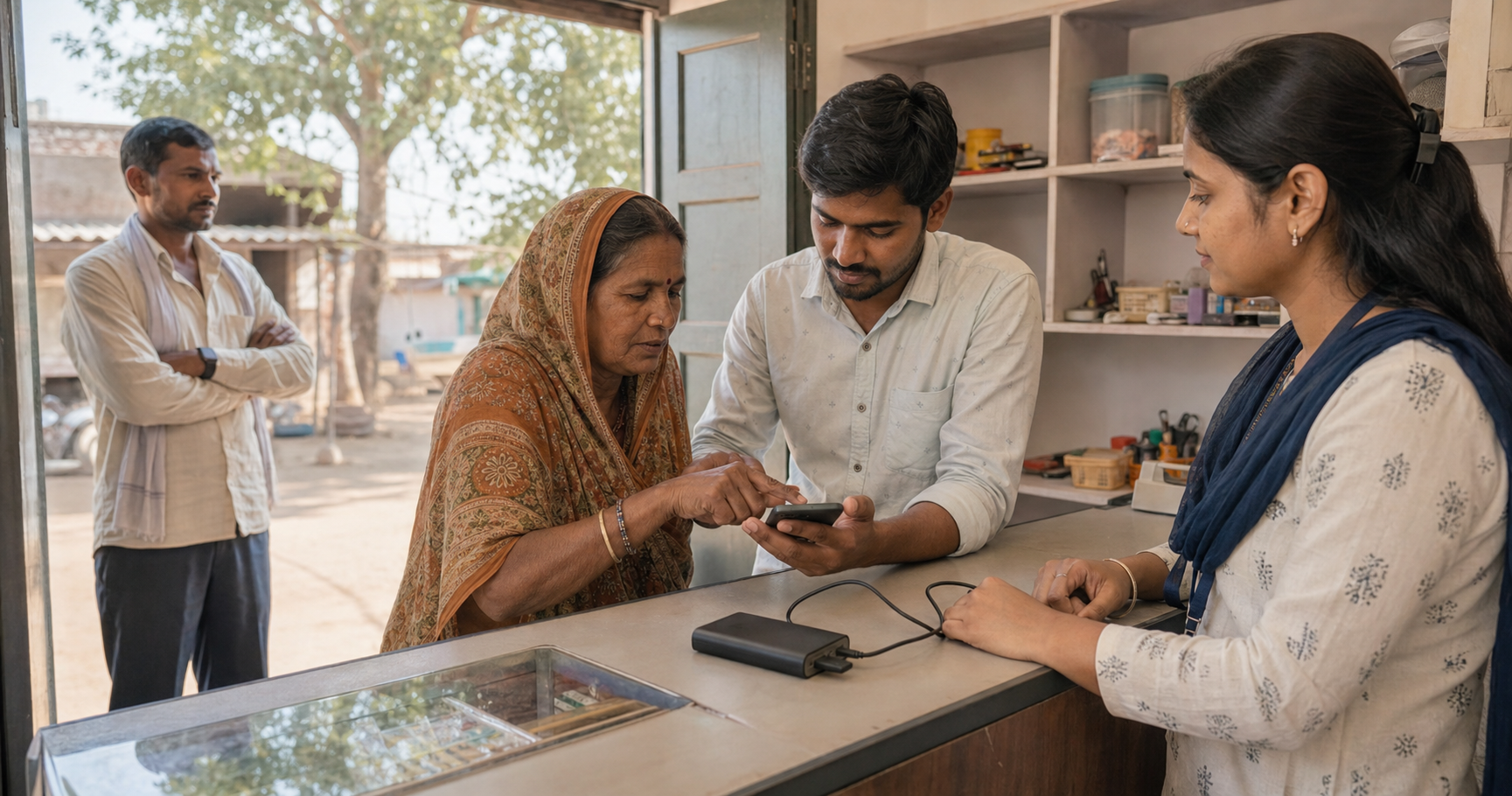
The same distinction between access and durability applies to financial inclusion. A bank account, a mobile connection and a nearby QR code create the possibility of participation. They do not establish that a person can use the system repeatedly, understand a failed payment, recover money when appropriate or obtain help after suspected fraud.
Meaningful inclusion should consequently be evaluated through the quality of ordinary use. Relevant questions include whether payments succeed consistently, whether customers receive understandable status information, whether reversals arrive without prolonged uncertainty, whether merchants can reconcile receipts, and whether complaints reach an accountable institution. These are not peripheral customer-service matters. For a first-time or financially vulnerable user, one unresolved loss can undermine confidence in the entire digital channel.
Funding and inclusion are therefore inseparable. Strong authentication and fraud analytics protect users, redundant capacity protects availability, and well-supported dispute systems protect trust. If providers lack a stable way to finance these functions, the apparent achievement of free payments can be offset by declining service quality or growing dependence on business models unrelated to payments.
Governance should connect money to outcomes. Public incentives and any future commercial fee can be accompanied by clearly disclosed performance expectations covering availability, technical declines, reversals and complaint handling. The source-reported use of uptime and decline rates in the 2024-25 incentive scheme offers a starting principle: support should purchase demonstrable public value, not simply reward higher volume.
Key takeaways
- UPI’s reported scale makes resilience, security and redress central economic infrastructure concerns rather than optional service enhancements.
- Zero-MDR was an effective adoption policy, but it shifted processing costs instead of eliminating them.
- A tiered framework could keep person-to-person, low-value and small-merchant payments free while allowing selected commercial transactions to contribute through a low, capped fee.
- Any revenue mechanism needs simple exemptions, transparent allocation and safeguards against consumer-facing surcharges.
- Financial inclusion should be measured through dependable use and effective problem resolution, not access statistics alone.
Digital India’s next benchmark will be whether UPI can remain inexpensive at the point of use without becoming underfunded behind the screen. A carefully targeted settlement among public support, limited commercial contributions and enforceable service standards could give the network room to grow while preserving the accessibility that made it valuable.