
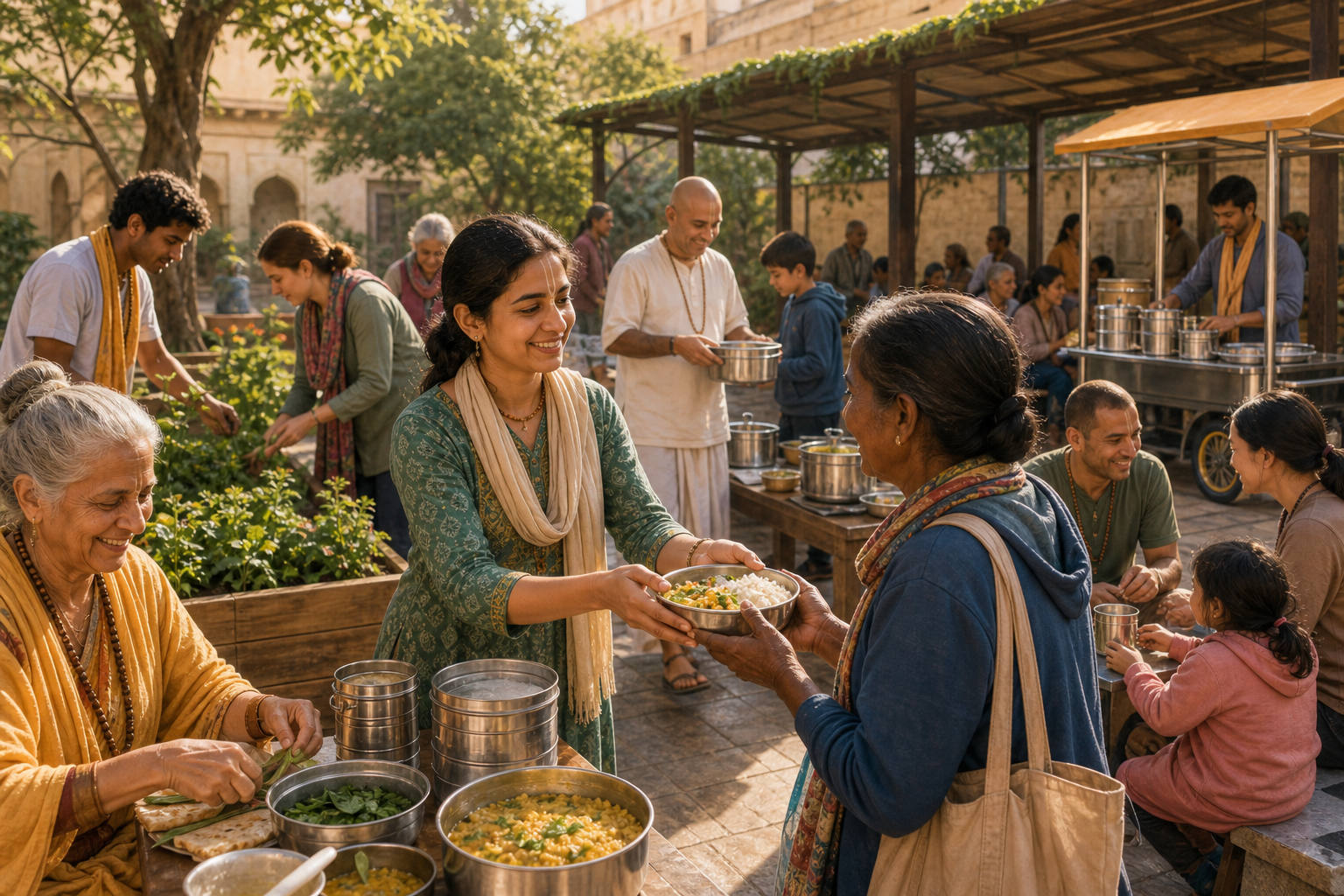
Your ISKCON centre may be deciding whether limited energy should go into a kitchen, a festival, farm education, temple tours, or another public programme. Start with a harder question: which service will still matter if the venue, footfall, supply chain, or volunteer capacity changes?
Resilient cultural outreach keeps its devotional purpose steady while allowing its public form to adapt. It gives newcomers an easy way to encounter Krishna bhakti, gives regular visitors a reason to return, and gives volunteers a service structure they can sustain. The aim is not to preserve every activity unchanged. It is to protect the relationship between seva, community, and spiritual meaning.
Anchor outreach in a service people can rely on
A large celebration can introduce many people to a temple, but an institution becomes part of community life through dependable service. A meal, class, garden, gosala, or regular gathering gives people something they can return to without waiting for a special occasion.
Higher Taste in Wellington continued serving through post-Covid disruption even as the central city faced closure, office footfall recovered slowly, and hybrid work altered demand. Its public value did not rest only on selling vegetarian food. The combination of prasadam, attentive hospitality, and a calm setting made the venue a place of nourishment and connection. Its continuation at a nearby location also shows why the mission cannot be tied too tightly to one premises.
The lesson is not that every ISKCON community needs a restaurant. It is that every community needs an anchor service: a recurring activity whose value is understandable to a newcomer and whose spiritual purpose is clear to the devotees delivering it.
Choose that anchor by asking:
- Does it meet a recurring human need, such as food, companionship, learning, worship, or contact with the land?
- Can it still be offered at a modest scale when attendance or volunteer capacity falls?
- Does it express a recognisably Dharmic principle through conduct, rather than depending entirely on explanation?
- Can a first-time visitor see an appropriate next step, such as returning for a meal, joining a tour, attending a class, or volunteering?
Then separate what is fixed from what is flexible. For a prasadam kitchen, the devotional intention, reverent preparation, responsible food handling, hospitality, and clarity about prasadam belong at the centre. The menu, room, serving method, and public schedule may change. For a farm community, cow protection and stewardship may remain fixed while the tour route, educational format, or seasonal activity changes.
This distinction prevents two common errors. One is preserving a familiar format after it has stopped serving people well. The other is changing so much in pursuit of reach that the activity no longer communicates why it exists. Keep the purpose firm and let the delivery respond to conditions.
Design a continuity mode before disruption arrives
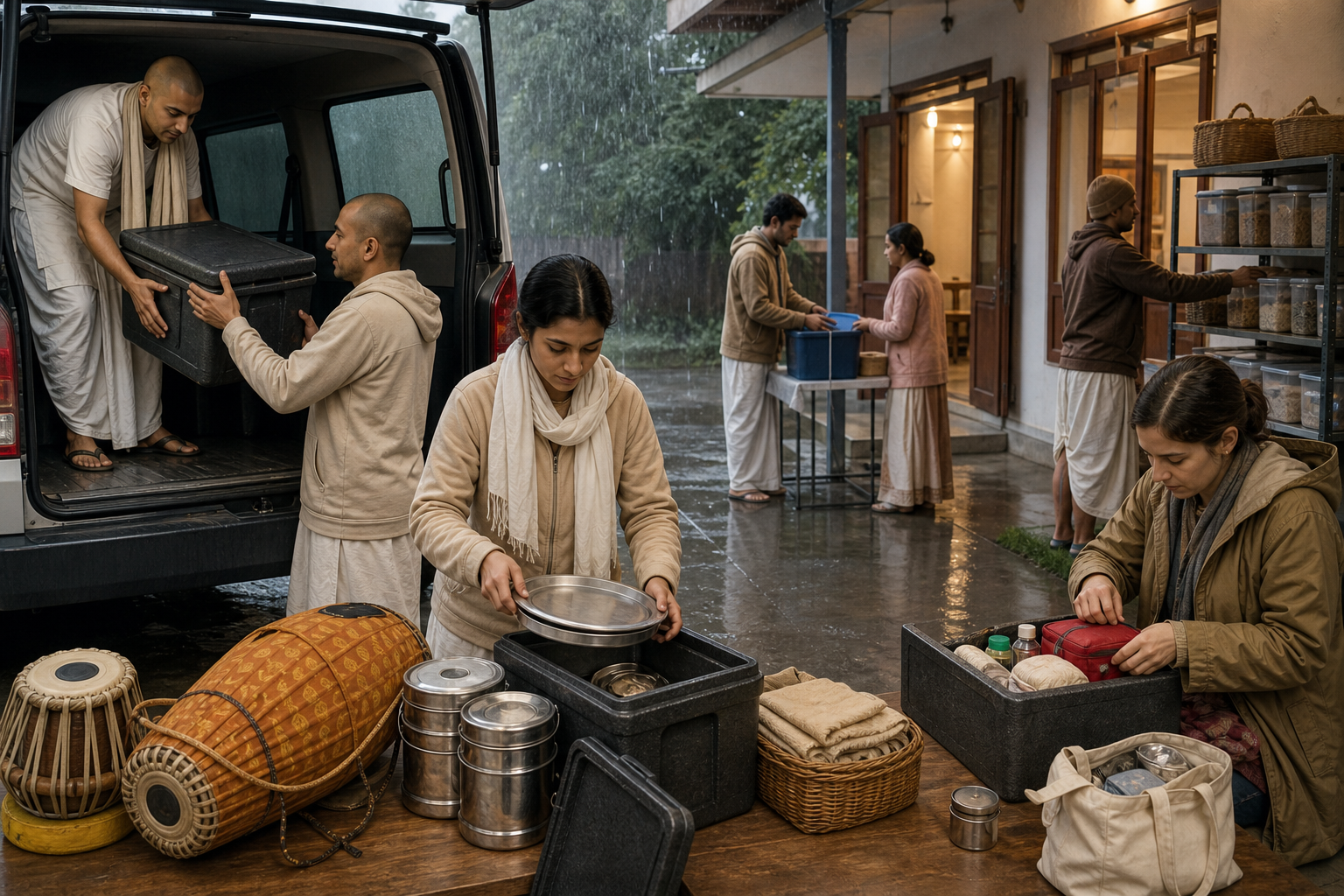
A resilient programme needs more than goodwill. It needs an agreed way to continue when its normal operating conditions disappear. Wellington’s experience is useful because the pressure was structural: commuter habits changed, inner-city demand weakened, and the venue itself changed. Waiting for the old pattern to return would not have been a continuity plan.
For each public-facing service, write a short continuity sheet that answers these questions:
- Purpose: What spiritual and community function must continue?
- Minimum offer: What is the simplest form of the service that remains worthwhile and honest?
- Responsibility: Which roles must be covered, and who understands each role well enough to step in?
- Alternative setting: How could the service operate if its usual room, building, or visitor flow became unavailable?
- Communication: Which official channel will carry accurate changes to opening times, location, bookings, or participation?
- Pause and restart conditions: What would require a temporary pause, and what must be ready before the service resumes?
Keep this sheet operational. A statement such as “we will continue serving the community” is an intention, not a plan. A useful entry names the essential role, the fallback format, the place where current information will appear, and the person responsible for updating it.
Volunteer continuity deserves the same attention. If menu knowledge, visitor communication, supplier relationships, opening procedures, or newcomer follow-up live entirely in one person’s memory, the programme is fragile even when attendance looks healthy. Write down recurring tasks, let volunteers shadow one another, and review responsibilities after demanding periods. Resilience built on permanent emergency effort is only hidden exhaustion.
Demand also needs to be read as it is, not as the community remembers it. If commuters are no longer the main public, ask who is present now: nearby residents, students, families, travellers, people seeking vegetarian food, or those looking for contemplative space. Adapt the point of access without changing the devotional centre. That might mean changing how the service is explained, where current information is published, or which activity becomes the first invitation.
Make sustainability visible, specific, and teachable
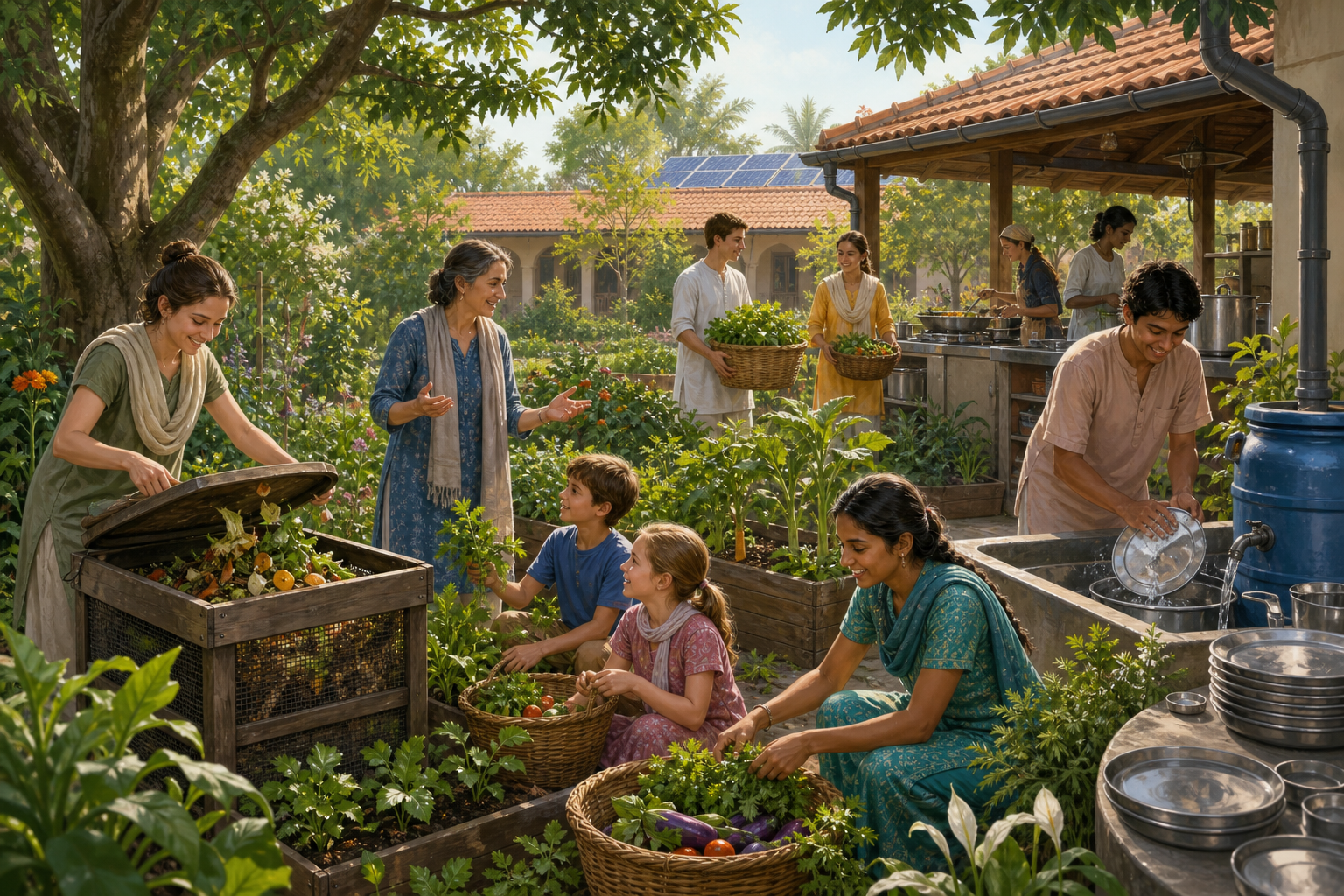
Sustainability becomes cultural outreach when a visitor can see how a Dharmic principle shapes an actual practice. A generic claim that a community is green teaches very little. A visible relationship between ahimsa, cow care, soil, food, reuse, and responsible consumption gives the visitor something concrete to understand.
At Krishna Valley in Hungary, India’s Ambassador to Hungary encountered the temple, gosala, horticulture, and features of a circular ecological economy during the same visit. That combination matters. The sacred, agricultural, educational, and practical parts of community life could be understood as one connected system rather than as unrelated attractions.
Turn each part of your own site into a teachable station by answering:
- What does the visitor see happening here?
- Which Dharmic principle informs the practice?
- What resources enter, circulate, and leave this part of the community?
- What limitation or trade-off should be stated honestly?
- What can an interested visitor learn, support, or participate in next?
A gosala, for example, should not be presented merely as a picturesque stop. Explain the responsibilities created by cow protection, the daily character of care, and the place of that care within a wider ethic of ahimsa. A horticulture area should show the practices through which the community seeks to care for soil and biodiversity. A reuse system should identify what is actually reused rather than allowing the word “circular” to carry more weight than the operation can support.
The same discipline applies to food. Vegetarian cooking is publicly accessible, but prasadam has a devotional meaning that should not disappear from the explanation. Tell visitors, in plain language, that the food is prepared and offered with devotion before it is shared in a spirit of seva. This gives a newcomer enough context to receive the meal respectfully without requiring prior theological knowledge.
Before making a sustainability claim public, ask the people doing the work how they describe it and what they observe. If you speak of soil regeneration, identify the practices and signs the horticulture team uses. If you speak of resource efficiency, name the materials being reused and acknowledge what still becomes waste. Precise modesty is more credible than a sweeping claim.
Visits by diplomats, educators, neighbours, and civic leaders can then become more than ceremonial occasions. A working kitchen, garden, or gosala gives cultural diplomacy substantive content. Recognition may amplify the work, but it should follow the work rather than substitute for it.
Build bridges without flattening the tradition
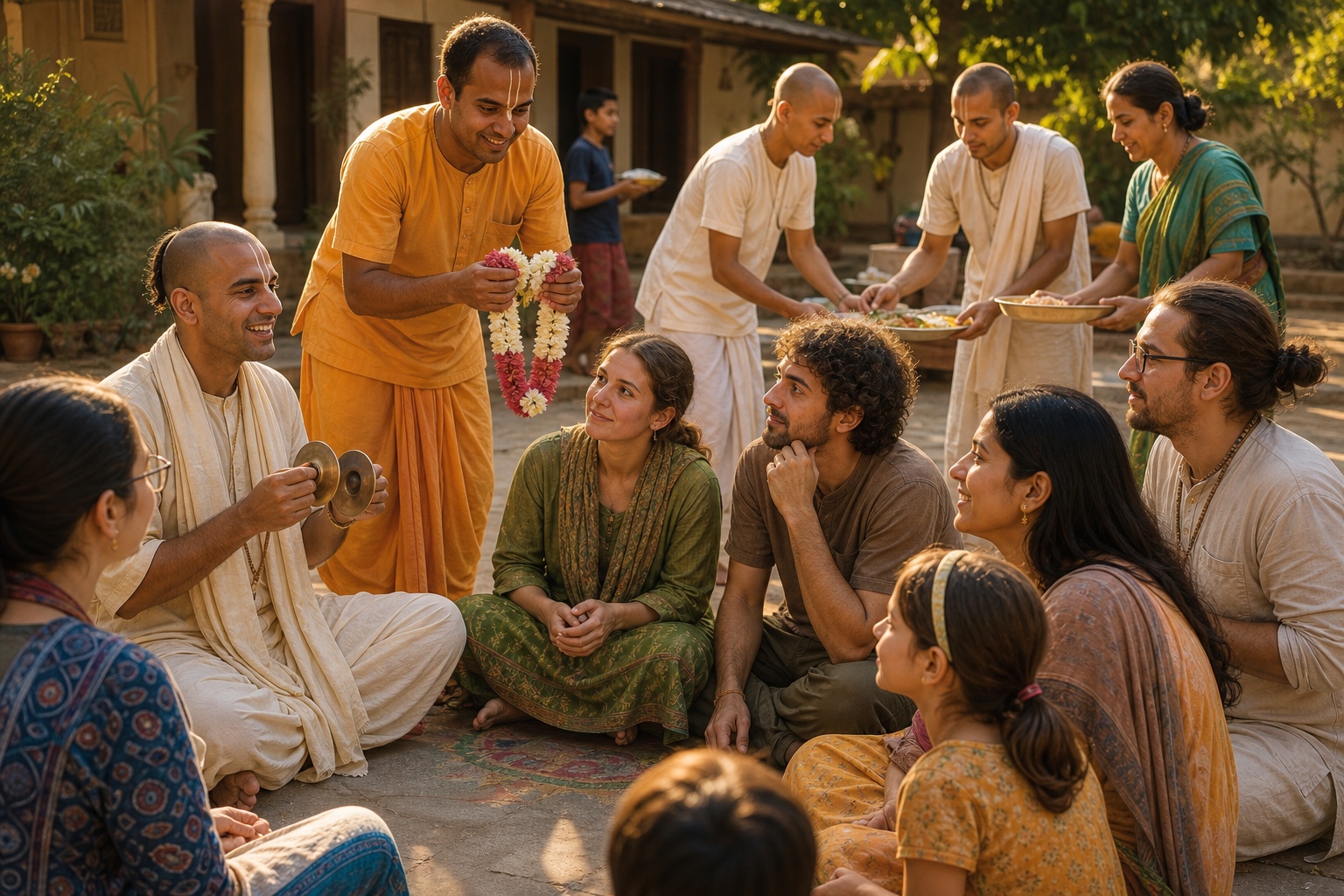
Ahimsa, seva, hospitality, compassion, and responsible consumption provide an accessible ethical vocabulary for many visitors. People from Hindu, Buddhist, Jain, and Sikh backgrounds can recognise familiar values in sattvic food and community hospitality. That recognition is a doorway, not a claim that the traditions are interchangeable.
ISKCON outreach should therefore be welcoming and particular at the same time. You do not need to conceal Krishna bhakti to make a newcomer comfortable. You need to explain it without assuming that the visitor already knows its language, customs, or theology.
A clear public message can move through these layers:
- Encounter: State what the person can experience now: a meal, temple visit, discussion, garden walk, kirtan, or opportunity for service.
- Meaning: Explain how that experience relates to prasadam, seva, ahimsa, stewardship, or devotion to Krishna.
- Invitation: Offer an appropriate next step without pressure or ambiguity.
For a kitchen, the encounter is wholesome vegetarian food and hospitality. The meaning is that the meal is prasadam, connected to offering and devotion. The invitation might be another meal, a temple programme, or a chance to help serve. For a gosala, the encounter is visible care for cows. The meaning lies in ahimsa, responsibility, and the sacred place of the cow within Dharmic life. The invitation could be an educational visit or suitable seva.
Review every public description with two readers in mind. Can someone with no ISKCON background understand what will happen? Can a practising devotee still recognise the spiritual centre of the activity? If only the second reader can understand it, the language is too closed. If only the first can recognise it, the language may have become so generic that the tradition has disappeared.
Do not judge outreach only by initial attendance, social attention, or the prominence of a guest. Notice whether newcomers return, whether they know how to take the next step, whether volunteers remain able to serve, and whether the public-facing activity strengthens the temple’s devotional life. Cultural visibility without continuity is an event. Cultural outreach becomes resilient when relationships endure beyond the first encounter.
Key takeaways
- Choose an anchor service that meets a recurring need and expresses Dharma through practice.
- Keep the devotional purpose fixed while allowing the venue, schedule, format, and public entry point to adapt.
- Write a continuity mode before a disruption affects the building, audience, volunteers, or supplies.
- Document essential roles so the service does not depend on one person’s memory or constant emergency effort.
- Make sustainability visible as a chain connecting principle, practice, resources, and honest limitations.
- Use shared Dharmic values as a welcoming doorway while naming ISKCON’s Krishna-bhakti centre plainly.
- Look beyond first-time attendance and notice return visits, participation, volunteer continuity, and deeper engagement.
At your next planning meeting, place one public-facing activity on the table. Write down its purpose, non-negotiable promise, continuity mode, and next step for a newcomer. If those answers are unclear, strengthen that service before adding another campaign. A community becomes resilient when its seva can absorb change without losing its spiritual centre.
References
- Dandavats – Higher Taste Wellington: Resilient Temple Kitchen Nourishing Community in a Post-Covid City
- Dandavats – Ambassador of India to Hungary Visits ISKCON Krishna Valley, Celebrating Culture and Sustainability
