
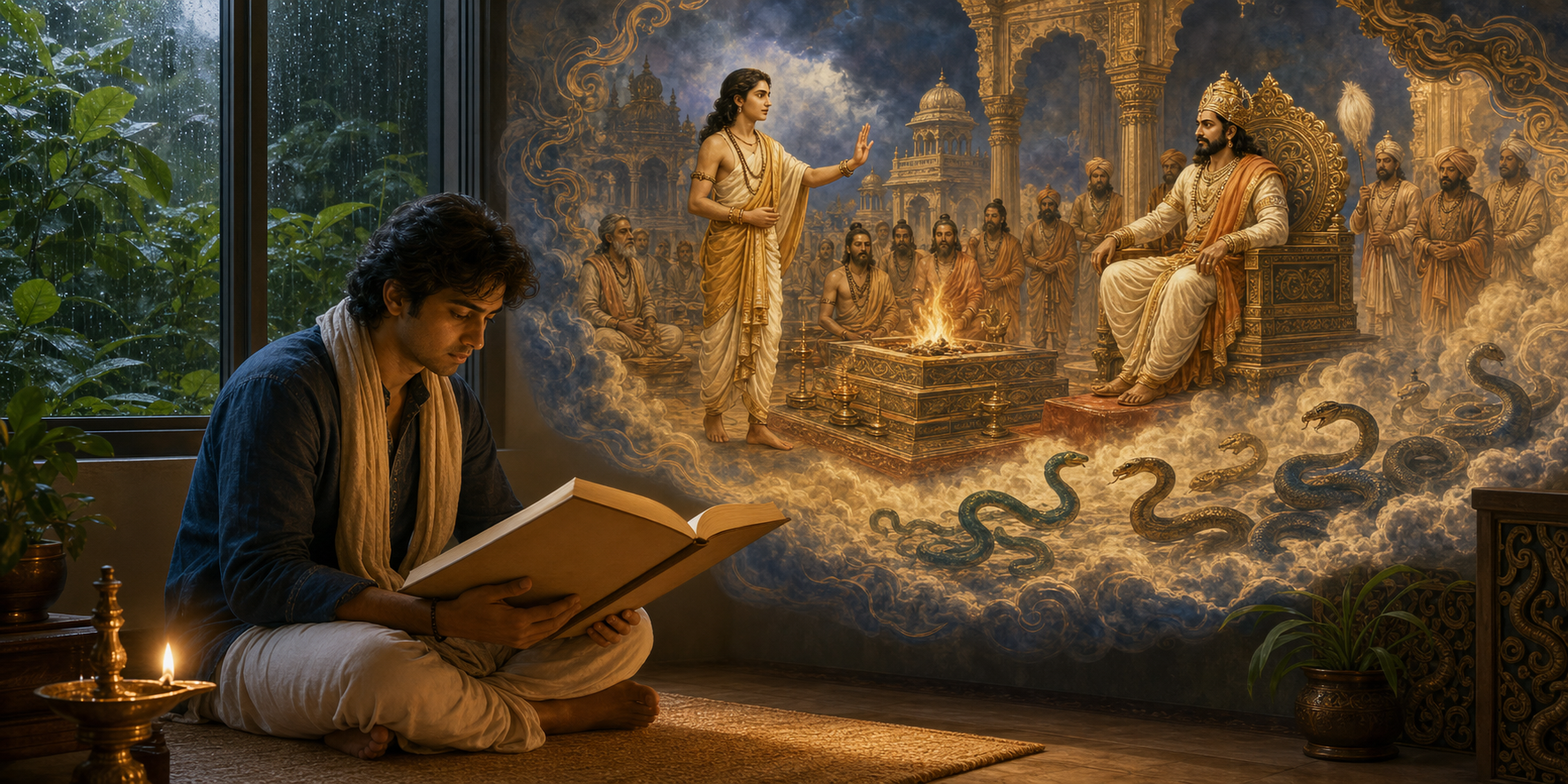
If Nag Panchami is approaching and you have been told to read the Mahabharata, the immediate problem is practical: the epic is vast, the observance may be unfamiliar, and nobody has told you where to begin. You do not have to rush through an enormous text or reproduce an elaborate temple ceremony at home.
The most coherent approach is to read the episode that joins the festival to the epic: King Janamejaya’s serpent sacrifice and Astika’s intervention. The tradition regards Mahabharata recitation on Nag Panchami as an especially meritorious observance. Choosing the relevant passage, understanding its moral crisis, and reading it attentively will serve you better than measuring devotion by page count.
The connection begins inside the Mahabharata
The Mahabharata does not mention serpents merely as decorative symbols. Naga beings, human families, vows, curses, kinship, fear, and political power intersect throughout its narrative world. This matters because Nag Panchami honors nagas as sacred beings, not merely as animals that humans happen to fear.
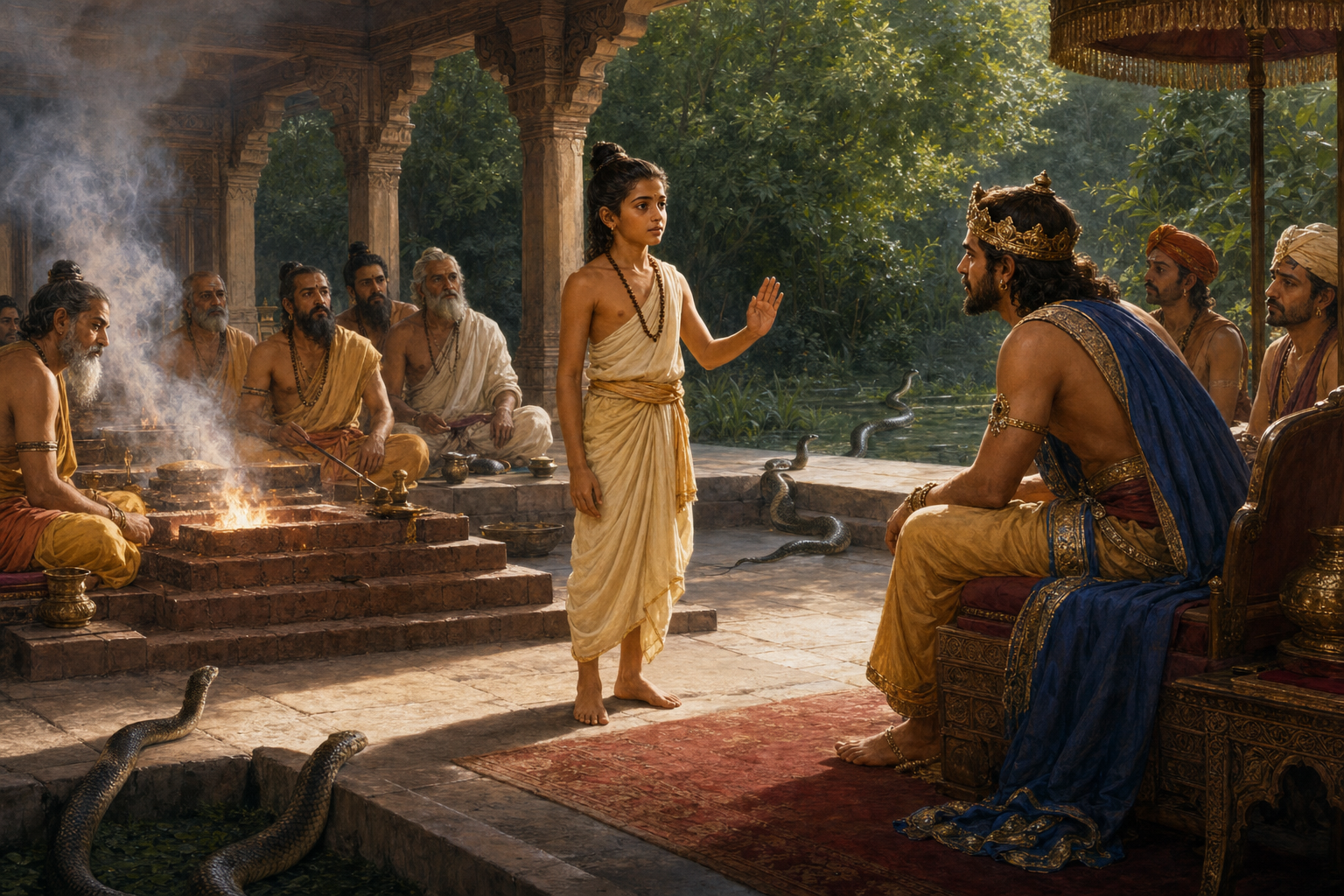
A major narrative setting of the Mahabharata is King Janamejaya’s sarpa satra, or serpent sacrifice. Janamejaya seeks vengeance after Takshaka causes the death of his father, Parikshit. The sacrifice, however, expands from punishment of one offender into the destruction of an entire class of beings. What begins as grief and retribution becomes indiscriminate annihilation.
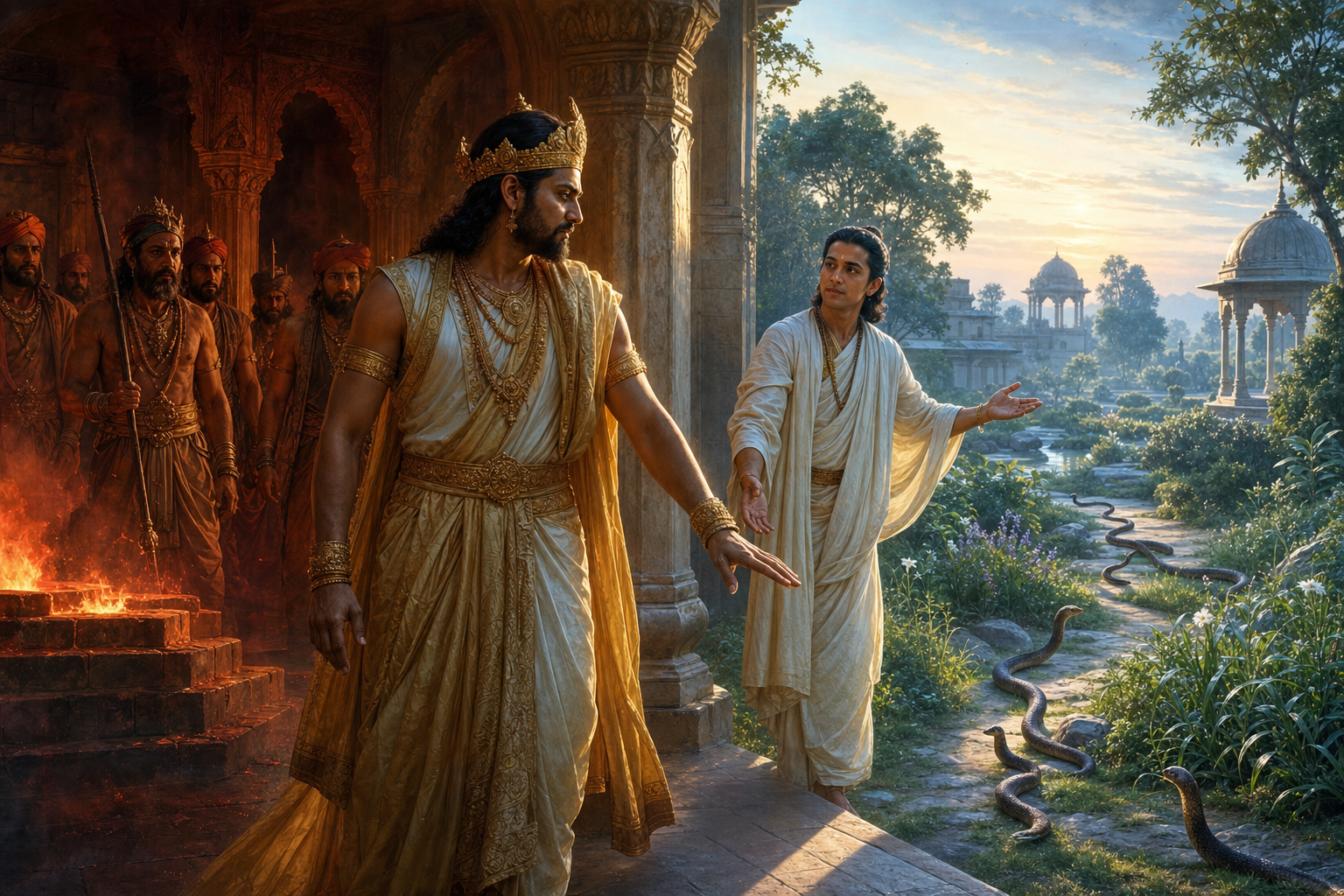
Astika enters this crisis as an intercessor. After winning the king’s regard, he asks that the sacrifice be stopped. Janamejaya honors the request, and the surviving nagas are spared. The Mahabharata is narrated by Vaishampayana in the setting of Janamejaya’s sacrifice, so the serpent episode is part of the frame through which the larger epic reaches its audience.
This is why the pairing of Nag Panchami and the Mahabharata is more than a convenient festival custom. The epic places vengeance under the judgement of dharma. It asks whether a real injury licenses limitless retaliation and shows that power can stop without pretending the original wrong never occurred. On a day of reverence for nagas, that is the passage worth hearing closely.
Choose a reading you can complete with attention

You do not need to begin at the first page and attempt the entire epic in one day. Unless your family, guru, or sampradaya has prescribed a particular recitation, choose a portion that fits the time you can give without rushing.
- For the essential observance: Read the Astika episode in the Adi Parva. In a contents page or index, look for Astika, Janamejaya, sarpa satra, serpent sacrifice, or snake sacrifice.
- For fuller narrative context: Begin with the events surrounding Parikshit’s death and Takshaka, then continue through Astika’s request and Janamejaya’s decision to stop the sacrifice.
- For an extended family reading: Include the surrounding passages that establish the sacrifice as a setting for the narration of the Mahabharata. Divide the reading among family members rather than turning one reader’s fatigue into the central feature of the observance.
- If you already follow a continuing Mahabharata recitation: Keep your established sequence and dedicate that day’s reading to Nag Panchami. You need not abandon a disciplined vrata merely to create a separate performance.
Do not depend on a chapter number copied from another edition. Divisions and numbering can differ among Sanskrit editions, regional retellings, and translations. The episode name and its principal figures are safer guides than an isolated number.
Use a language you understand. Sanskrit recitation has its own dignity, but pronunciation without comprehension should not prevent you from engaging the episode’s meaning. If Sanskrit is important in your household, read the Sanskrit aloud and follow it with a trusted translation in your strongest language. If several people are present, one can read while the others listen with the text open. Attentive listening is more valuable than a room full of parallel, hurried voices.
A simple home recitation without invented ritual rules
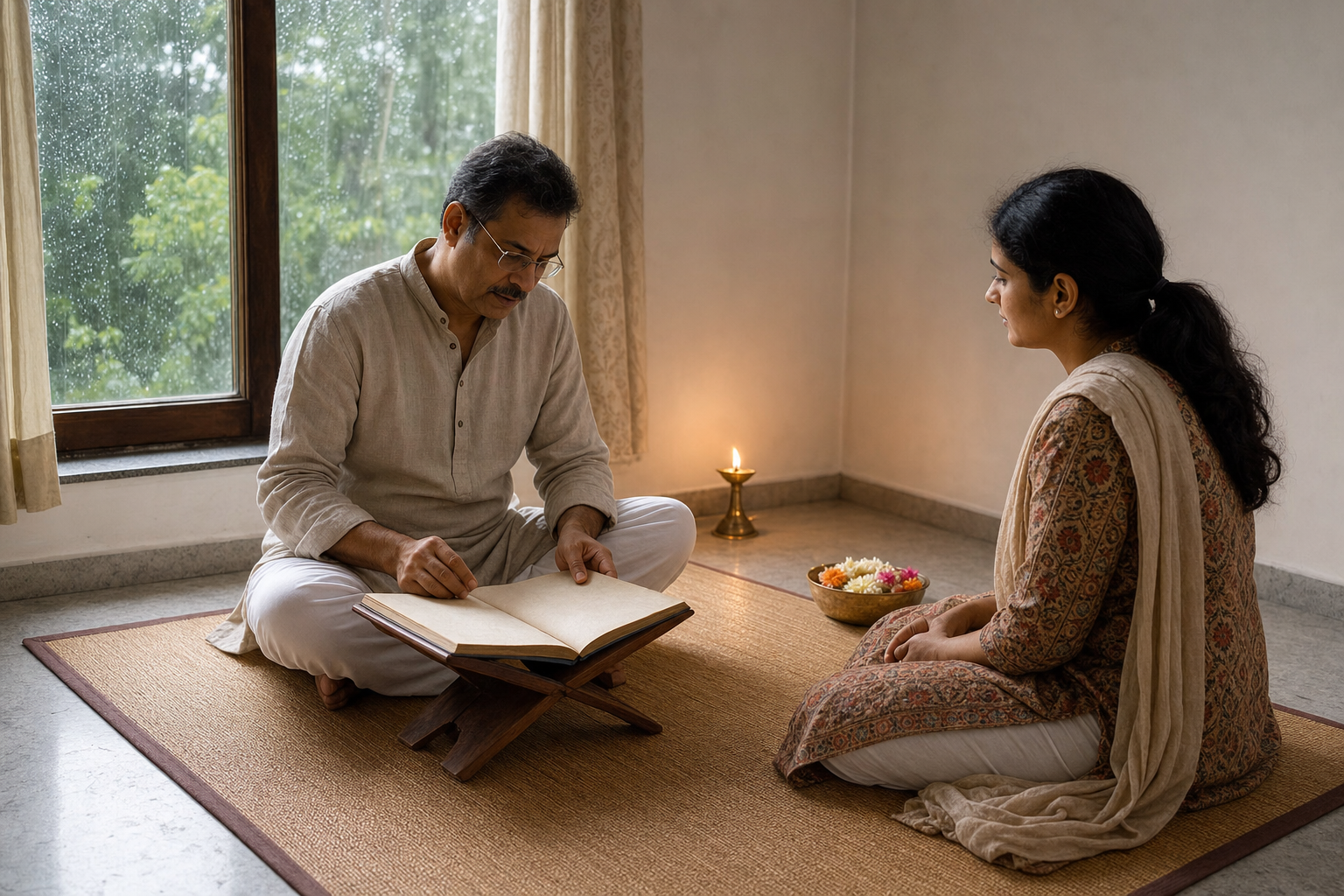
Regional and family practices for Nag Panchami vary. A simple home reading should support your inherited practice, not pretend to replace it with a newly manufactured universal procedure. If your household has a paddhati given by a guru, priest, elder, or temple, retain it.
- Confirm the observance locally. Check the Panchami tithi in the panchanga used by your family or temple. A civil calendar date by itself may not settle the ritual timing, especially when a tithi crosses parts of two days.
- Mark the passage beforehand. Find the beginning and end of the Astika narrative before the observance. Keep a bookmark in the printed volume or prepare the correct digital section so the gathering does not become a search exercise.
- Prepare a quiet, clean place. Place the text securely and remove avoidable interruptions. A lamp, an image, a naga representation, flowers, or other customary items may accompany the reading, but do not present optional household arrangements as requirements for everyone.
- State the purpose plainly. You may express an intention to remember dharma, restraint, and reverence for naga beings. If you use your own words, treat them as an intention, not as a newly invented mantra attributed to scripture.
- Read aloud at a sustainable pace. Pause when the narrative turns from Janamejaya’s grievance to collective destruction, when Astika makes his request, and when the king agrees to stop. Those are the hinges of the episode.
- Close without haste. Allow a short silence, offer the customary prayer or namaskara of your household, and dedicate the good intention of the recitation. If children participated, ask one concrete question about the story instead of testing their memory of names.
If you encounter a wild snake during the festival, reverence does not require approaching, capturing, feeding, or handling it. Keep people and animals away and contact an appropriate local wildlife responder. A sacred image or murti allows worship without turning an unpredictable animal encounter into a ritual act.
Understand merit through the choice the story demands
Calling the recitation meritorious should not reduce it to a transaction: pages read in exchange for immunity from danger or the automatic cancellation of consequences. Punya is a religious category, not a measurable guarantee. The practice becomes spiritually serious when the listener allows the narrative to examine conduct.
Janamejaya has a genuine grievance. The Mahabharata does not need to deny his loss in order to question his response. That distinction is important. Dharma is not indifference to injury, but neither is it permission to make every member of a group answer for one being’s act. Astika’s intervention interrupts the movement from grief to extermination.
Listen also for the role of speech. Astika does not possess the king’s military or royal power. He enters at the right moment, gains a hearing, and uses a promised boon to save life. Janamejaya, for his part, remains answerable to the word he has given. The episode therefore presents restraint as an active achievement: someone must speak wisely, and someone with power must still be capable of stopping.
After the recitation, choose one of these questions for discussion or private reflection:
- At what point does Janamejaya’s pursuit of justice become collective vengeance?
- Why is Astika able to accomplish what force alone could not?
- What does it cost a powerful person to stop an action already set in motion?
- Where do fear and inherited hostility tempt us to treat a whole community as one offender?
- What would reverence for life require from you after the festival is over?
You do not need to force a single answer. The Mahabharata is valuable partly because it makes you remain with competing duties, wounded loyalties, and the consequences of action. The practical test is whether the reading sharpens your judgement rather than merely completing a festival item.
Key takeaways for Nag Panchami
- If you can read only one portion, choose the Astika episode in the Adi Parva.
- Locate the passage by names and episode titles, because chapter numbering differs across editions.
- Read in a language you understand, or pair Sanskrit recitation with a clear translation.
- Follow your family’s or sampradaya’s established ritual instructions where they exist.
- Treat the promised merit as an invitation to reverence, restraint, and ethical reflection, not as a mechanical guarantee.
- Honor naga beings without approaching or handling wild snakes.
Before Nag Panchami, do one small piece of preparation: open your edition, find Astika’s intervention, and mark the complete narrative arc. When the day arrives, you can give the story your attention instead of giving your attention to logistics.
References
