

You may have read about Mother Kali, compared interpretations, and reasoned through every theological question you can name, yet still feel that She remains outside your reach. The difficulty may not be a lack of information. You may be asking thought to accomplish something thought cannot do.
The answer is not to abandon reason. It is to stop treating reason as the final authority over spiritual reality. Let the intellect bring you to the threshold with clarity and discrimination. Then let prayer, presence, and surrender take you where explanation cannot.
The intellect can point to Kali, but it cannot contain Her
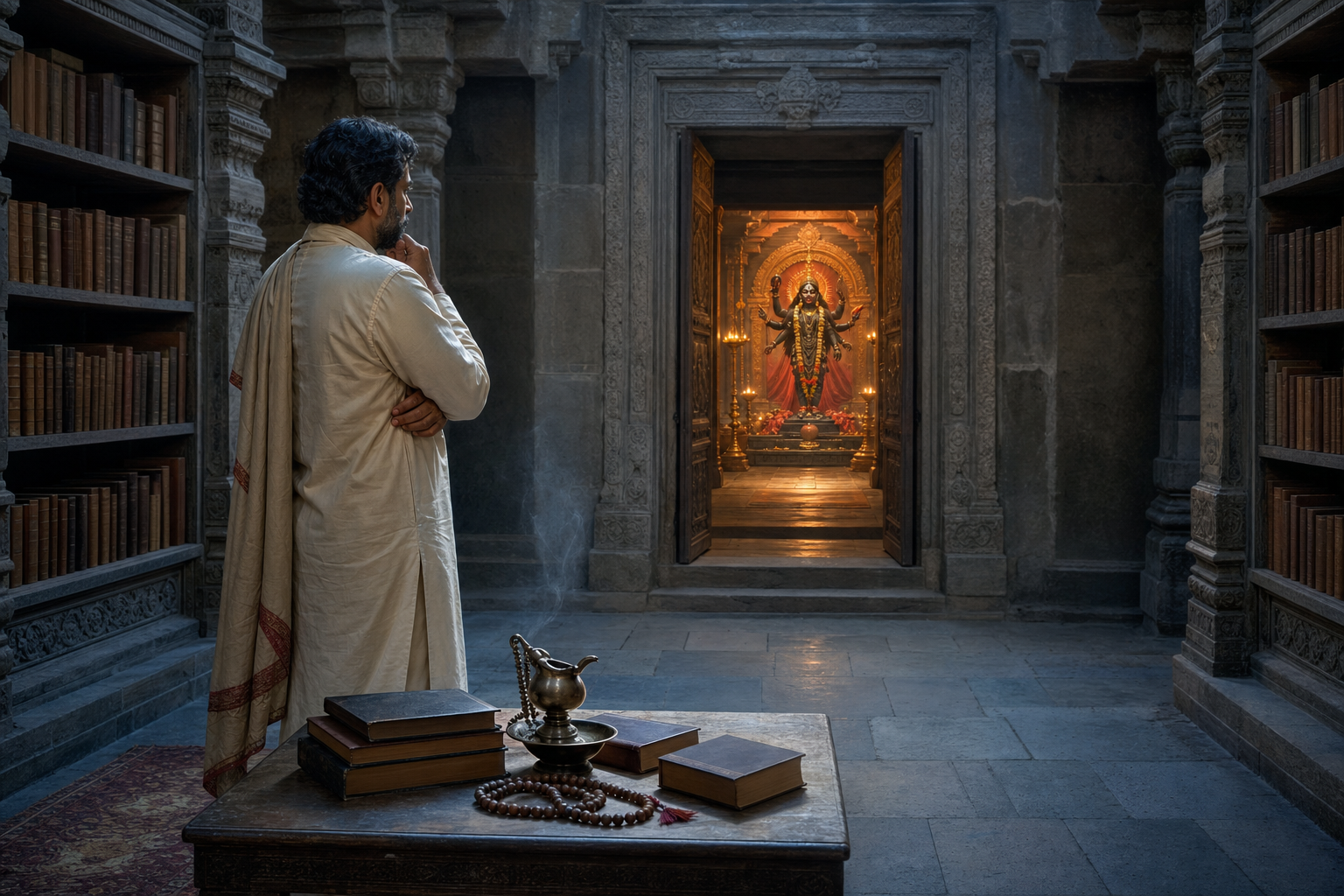
The intellect works by making distinctions. It compares one claim with another, separates appearance from reality, tests consistency, and places experience into categories. These are genuine strengths. Without them, devotion can become confused, credulous, or vulnerable to manipulation.
But every concept has a boundary. To define something is to say what it includes and excludes. Mother Kali, approached as the Divine Mother rather than merely as an idea, cannot be reduced to one more object within the mind’s collection. Once She has been made completely manageable by a definition, what you possess is your concept of Kali, not Kali Herself.
This is why Advaita Vedanta, the current of Bhakti, and the paths of Tantra can differ in doctrine and method while still meeting the same humbling limit: the Divine Mother is not reached by intellect alone. The traditions need not be flattened into one system for that shared warning to matter.
Reason can help you ask whether a claim is coherent, whether a practice accords with dharma, and whether your interpretation contradicts itself. It cannot perform surrender on your behalf. It can describe trust without trusting, analyse devotion without becoming devoted, and discuss the loosening of ahankara while quietly preserving the ego’s demand to remain in control.
You have reached the limit of intellect when another explanation would no longer change your understanding or conduct, but you still hope it will make vulnerability unnecessary. At that point, continued analysis is not greater clarity. It is a way of postponing the encounter.
Surrender is neither blind belief nor the rejection of reason
Surrender to Mother Kali means consenting to truth even when it unsettles your preferred account of yourself. It means releasing the demand that the Divine must fit your categories, obey your timetable, or guarantee the outcome you want before you will trust.
That surrender must not be confused with intellectual laziness. It does not require you to believe every spiritual claim, silence every doubt, or obey anyone who presents himself as an authority. Viveka, the capacity to discern, remains necessary. The intellect loses its proper place only when it stops serving truth and begins insisting that nothing can be true unless it can be mastered conceptually.
- Surrender is not fatalism. You still perform the duty in front of you and accept responsibility for your choices.
- Surrender is not passivity. You may need to speak, refuse, apologise, protect someone, or correct a wrong.
- Surrender is not forced certainty. Doubt may remain while you pray and act honestly.
- Surrender is not obedience to every human claimant. If someone asks you to violate conscience or dharma, stepping back is discernment, not spiritual failure.
- Surrender is not emotional performance. You do not need to manufacture ecstasy, tears, visions, or fearlessness.
A useful test is to ask what your supposed surrender is producing. Does it make you more honest about your motives, steadier in duty, and less determined to manipulate every outcome? Or does it give you spiritual language for avoiding responsibility? You surrender self-will to the Divine; you do not surrender moral responsibility to another personality.
Notice when a spiritual question has become a hiding place

A sincere question opens inquiry. An evasive question keeps moving the moment an answer begins to demand practice. The distinction matters because sophisticated overthinking often looks more respectable than ordinary avoidance.
- “Which interpretation is finally correct?” This is useful while a real doctrinal difference affects what you believe or do. It becomes avoidance when you refuse every available practice until all schools can be reconciled to your satisfaction.
- “What am I supposed to experience?” The question can orient a beginner, but it can also turn prayer into constant self-inspection. You begin monitoring whether the proper feeling has appeared instead of addressing the Mother.
- “Have I surrendered enough?” This often converts surrender into an achievement owned by the ego. Look instead at the particular attachment you are unwilling to release.
- “How can I be certain this will work?” If “work” means securing the exact outcome you prefer, the demand for certainty is the demand to retain control.
- “Do I understand Kali correctly?” Keep studying when the answer would correct a real error. Pause when the question merely delays prayer, duty, or an honest decision you already recognise.
When you cannot tell whether you are studying or hiding, write down the answer you believe is missing. Then name the decision that would change if you received it. If you cannot identify any change in belief, practice, or conduct, more information is probably not the immediate need.
You can then replace the unanswerable demand with a living question: “What am I trying to protect by continuing to think?” The answer may be an image of yourself, a desired result, resentment toward another person, or the wish to approach Kali without being changed. That is the material of surrender.
A grounded practice for reaching the edge of thought

You do not need to create an extraordinary state. Begin with one actual knot in your life: a decision you cannot control, a duty you resent, an injury you keep rehearsing, or a fear that sends you back into the same mental loop. Work with that knot rather than with surrender as an abstraction.
- Name the matter plainly. Use one direct sentence without theological decoration. For example: “I want assurance that this choice will protect me from loss,” or, “I know what duty requires, but I do not want to accept its cost.”
- Give reason its proper work. Separate known facts from interpretation. Identify any duty, promise, or ethical boundary that applies. Notice what remains genuinely uncertain. Surrender should begin after honest discernment, not in place of it.
- Name the demand for control. Complete the sentence, “Before I will trust, I am demanding that…” This may reveal that you want a guaranteed result, freedom from discomfort, vindication, or proof that your preferred self-image will survive.
- Turn toward Mother Kali directly. Speak in your own language. A simple prayer is enough: “Mother, I cannot think my way beyond this point. Show me what is true, and help me do what is dharmic.” The value lies in honest address, not verbal ornament.
- Remain present without bargaining. When the mind restarts its argument, notice whether it has found a new fact or merely repeated the demand for certainty. If nothing new has appeared, return to the act of offering the unresolved matter.
- Complete the next dharmic action. Keep the promise, make the apology, finish the neglected duty, decline the dishonest shortcut, or wait without forcing an answer. Do not use the absence of a dramatic sign as permission to avoid what is already clear.
The final step prevents surrender from becoming sentiment. A prayer that leaves conduct permanently untouched may be emotionally sincere, but the attachment itself has not yet been offered. The measure is not how intense the moment felt. Look for a quieter change: less compulsive bargaining, greater honesty, and more willingness to perform the next right action without possessing the whole future.
If fear or doubt returns, that does not erase the practice. Surrender is not a mood you achieve once. It is a direction you choose again whenever the mind tries to convert the Divine into a guarantee. Abhyasa matters here: return to discernment, address the Mother, release the demand, and act according to dharma.
Key takeaways for devotion without anti-intellectualism
- The intellect is a necessary instrument of discrimination, but it cannot possess or contain Mother Kali.
- Study has reached its present limit when another explanation would not change your belief, practice, or conduct.
- Surrender releases the demand to control the Divine; it does not release you from dharma, conscience, or responsibility.
- Blind obedience to a human authority should never be renamed surrender to the Mother.
- When a question becomes repetitive, identify the outcome, identity, or certainty you are trying to protect.
- Ground surrender in one concrete action rather than waiting for an extraordinary spiritual feeling.
The next time your mind circles Mother Kali without drawing nearer, do not declare thought an enemy. Ask whether it has completed its work. If it has, place the unresolved remainder before Her and take the next dharmic step. The intellect can bring you honestly to that edge; surrender begins when you stop demanding that it carry you across.
References
