
If you saw Diwali being celebrated at 10 Downing Street and wondered whether it marked real recognition or merely supplied a ceremonial photograph, that is the right question. You do not have to choose between uncritical applause and automatic cynicism.
The occasion matters because public symbols help define who is seen as belonging. Its lasting value, however, will depend on whether recognition of Hindu life continues after the diyas are removed.
What happened at Downing Street, and why the setting matters
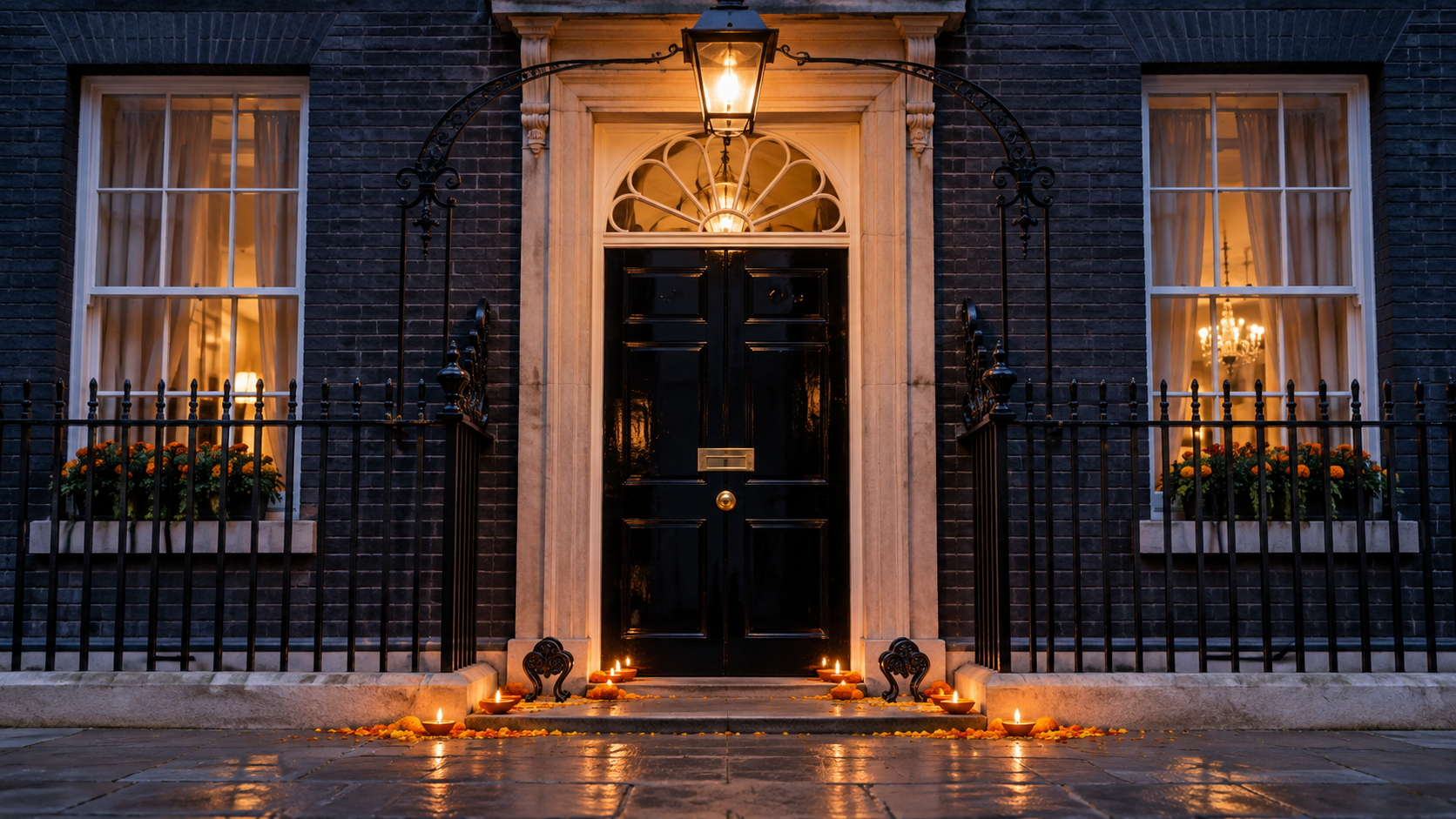
At 10 Downing Street, lights, diyas and floral decorations framed a Diwali gathering hosted by UK Prime Minister Andy Burnham and his wife, Marie-France van Heel, for members of the Indian diaspora. Three features give the occasion its significance: a recognisably Dharmic festival, participation by the country’s political leadership, and a venue identified with the British executive.
The diya is important here. It is not interchangeable with generic festive lighting. It carries religious and philosophical meaning: illumination, discernment and the refusal to let darkness have the final word. Placing diyas in an official setting makes Hindu practice visible on its own terms, provided the symbolism is named accurately and not emptied into a vague celebration of diversity.
The guest list matters as well. Members of the Indian diaspora were received as participants in British public life, not presented as a distant culture being observed from outside. Yet you should keep two categories distinct when describing the event: Indian identity and Hindu identity overlap extensively, but they are not synonyms. Not every Indian is Hindu, and not every Hindu is Indian.
Diwali itself also belongs to a wider Dharmic landscape. Hindus, Jains and Sikhs attach different histories and meanings to observances around this period, while Hindu customs vary by region, family and sampradaya. Respectful recognition does not flatten these differences. If you discuss the celebration publicly, name the particular tradition you are explaining instead of claiming that every Dharmic community understands Diwali in exactly the same way.
Symbolic recognition is meaningful, but it is not policy
Calling the reception merely symbolic understates what public symbolism does. Official ceremonies establish a visible boundary around national belonging. When Hindu sacred forms enter a prominent civic setting without concealment or apology, the message is that Hindu citizens need not leave their religious identity outside the public square.
That message can be especially valuable to a young British Hindu who encounters Diwali at home but rarely sees it treated seriously by major institutions. Recognition at the centre of government cannot settle every political question, but it can challenge the assumption that Britishness has room for Hindu people only when their Hindu identity remains private.
The opposite mistake is to treat one reception as proof that substantive concerns have been resolved. A decorated doorway tells you that a celebration occurred. By itself, it tells you nothing conclusive about education, protection of temples, responses to anti-Hindu hostility, representation in public bodies or the quality of Britain’s relationship with Bharat. Those questions require their own evidence.
You can therefore hold two sound judgements at once: the celebration deserves recognition as a civic milestone, and the government must still be assessed through its conduct. Ceremony and policy perform different jobs. Accepting the first does not require you to suspend scrutiny of the second.
Use four tests to distinguish recognition from tokenism
The word “tokenism” is often used too quickly. A single photograph cannot establish tokenism, just as a single reception cannot establish durable inclusion. If you want to judge this or any future government Diwali event fairly, look for four things.
- Religious accuracy: Are diyas and other observances explained in recognisably Dharmic language, or is Diwali reduced to food, colour and entertainment? Cultural hospitality is welcome, but it should not replace the festival’s sacred meaning.
- Community agency: Are Hindu and other relevant Dharmic participants able to explain their own traditions, or do officials speak for them? Invitations create presence; an authentic voice creates participation.
- Continuity: Does engagement recur only when Diwali offers attractive images, or can community representatives reach decision-makers during the rest of the year? The months between celebrations reveal more than the reception itself.
- Follow-through: If officials make commitments, are those commitments specific enough to check later? A useful commitment identifies an action, the responsible institution and a point at which progress can be reviewed.
Apply these tests to what is actually visible or documented. Do not invent a prayer, speech, promise or controversy that you have not verified. Accurate advocacy is more persuasive than an exaggerated version of either praise or criticism.
How British Hindus can turn the moment into durable recognition
A government reception becomes more useful when the community treats it as an opening for civic work rather than the end of it. If you lead a temple, student society, professional network or cultural organisation, there are several practical moves you can make.
- Record the facts precisely. State who hosted the gathering, where it occurred, who was received and which visible elements were present. Separate those facts from your interpretation of their importance.
- Add the meaning that photographs cannot carry. When sharing the event, include a short explanation of the diya and the Diwali tradition your community follows. This prevents sacred symbols from becoming unexplained decorations.
- Thank and ask in separate sentences. Welcome the recognition clearly. Then name one concrete matter on which you want continuing engagement. Gratitude is not a pledge of political loyalty, and a policy request does not erase gratitude.
- Invite year-round contact. Offer officials a visit or discussion outside the festival season, when there is time to address education, religious literacy, community safety or another clearly defined local concern.
- Keep the occasion institutionally open. A public celebration should not become the property of one party, personality or faction. Governments change; the civic place of British Hindus should endure.
If you are responding as an individual, the same discipline applies. Share the moment without claiming that it solves everything. Correct misdescriptions without manufacturing offence. Ask critics to assess the event by what occurred, and ask supporters to distinguish welcome visibility from measurable government performance.
This balanced response is not political timidity. It protects Hindu interests from two unhelpful extremes: treating every official gesture as a favour that must purchase silence, and rejecting every gesture so reflexively that institutions learn there is no value in serious engagement.
Key takeaways
- Diwali at 10 Downing Street matters because recognisably Dharmic symbols were welcomed in a setting associated with British political authority.
- The occasion affirms civic belonging, but it does not prove that every concern affecting British Hindus has been addressed.
- Indian, Hindu and Dharmic are related categories, not interchangeable labels; accurate public language should preserve the distinction.
- Judge future celebrations by religious accuracy, community agency, continuity and verifiable follow-through.
- Welcome the milestone, explain its sacred meaning and use it to begin specific year-round engagement.
Treat the Downing Street celebration as a door that has opened, not a destination already reached. Preserve the facts, tell the Dharmic meaning accurately, and then ask what serious engagement will look like between this Diwali and the next.

References

Leave a Reply
You must be logged in to post a comment.