
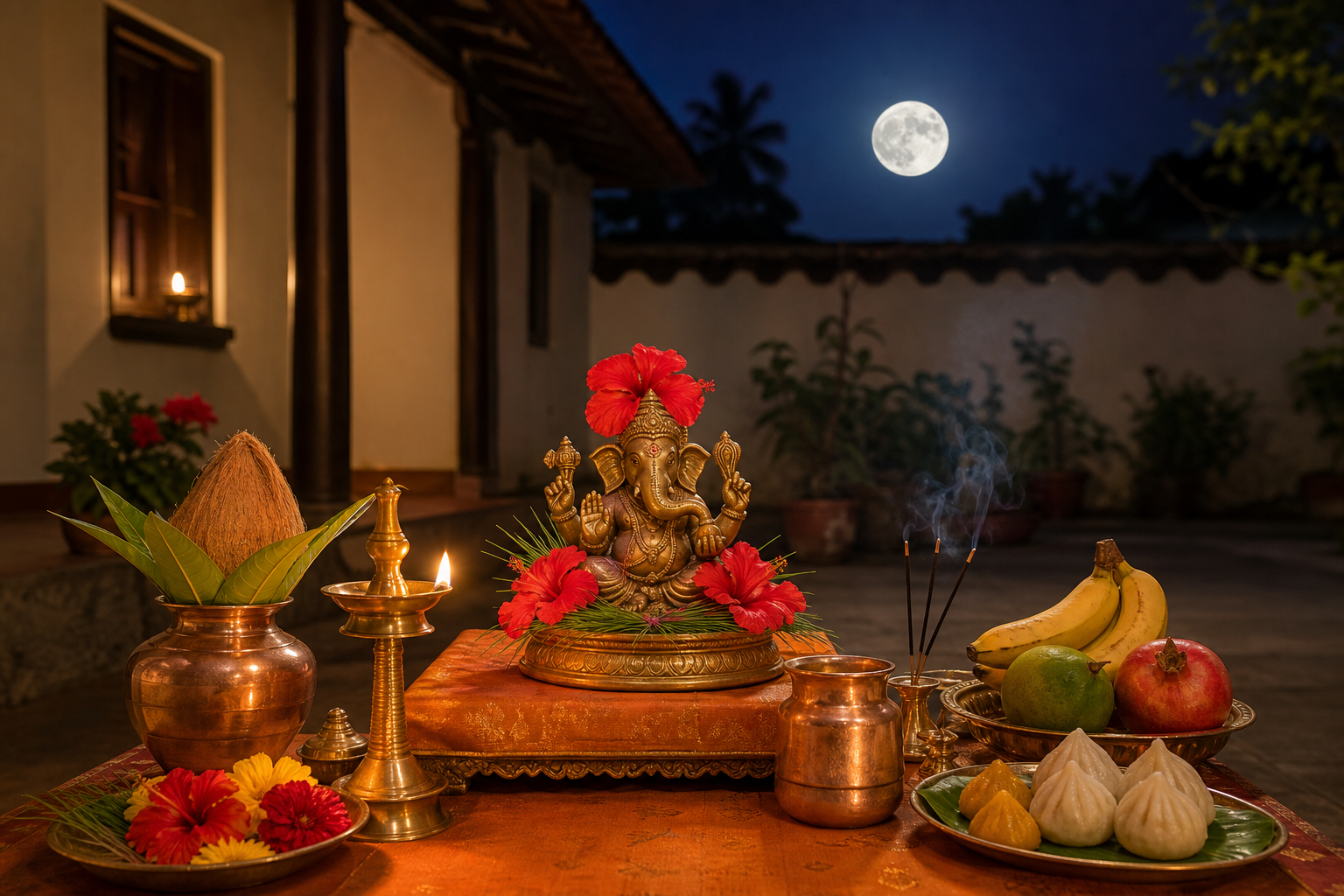
You want to observe Vikata Sankashti Chaturthi properly, but two practical questions come first: which date applies where you live, and when exactly may you conclude the fast? For April 2026, the observance falls on Sunday, 5 April, with moonrise near 9:50 PM in much of India. That time is only a planning reference; your local Chandrodaya must govern the actual observance.
Once you settle the local time, the vrata is manageable: make a realistic sankalpa in the morning, maintain your chosen discipline through the day, worship Shri Ganesha in the evening, offer arghya to Chandra at moonrise, and then take food with restraint. You do not need to make the observance complicated to make it sincere.
Confirm the date by local moonrise, not by midnight
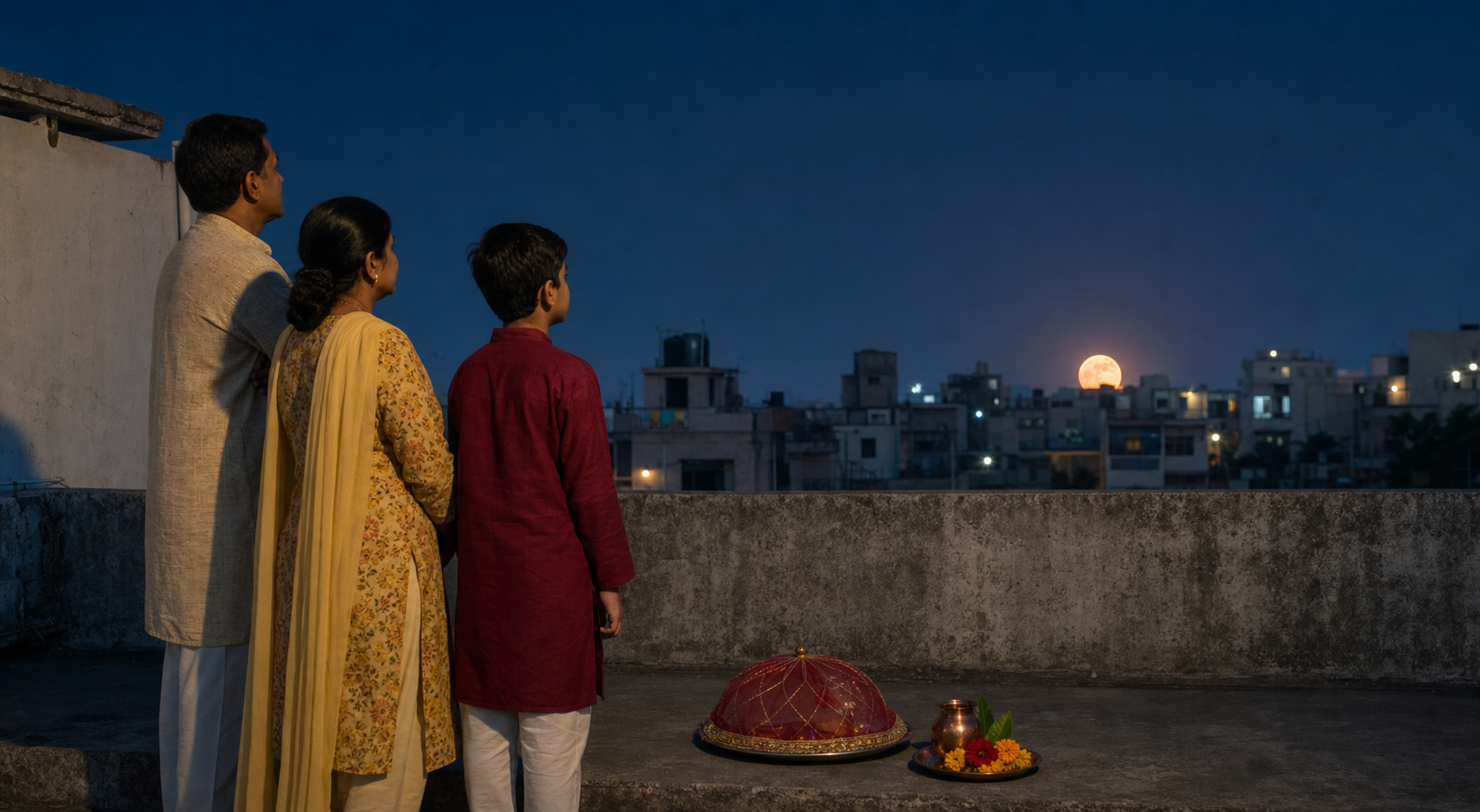
Sankashti follows the Chandrodaya-vyapini rule: Krishna Paksha Chaturthi must be present at moonrise. If the tithi crosses two civil dates, the correct day is the one on which Chaturthi prevails when the Moon rises. This is why copying a date or time from another city can give you the wrong answer even when both calendars appear respectable.
A tithi is determined by the changing angular separation of the Sun and Moon, measured in segments of 12 degrees. It therefore does not begin or end at civil midnight. Moonrise also changes with latitude and longitude. These two moving factors make a location-specific Panchang essential.
For 5 April 2026, a broad planning window of approximately 9:30 PM to 10:10 PM covers many major Indian cities. Eastern locations may see Chandrodaya earlier, while western and northwestern locations may see it later. Do not automatically break the fast at 9:50 PM merely because that is the commonly cited India reference time.
- Find the Krishna Paksha Chaturthi interval in a Panchang calculated for your location.
- Confirm the local moonrise time for the civil date on which Chaturthi is present at Chandrodaya.
- If your family follows a temple schedule, compare it with the temple’s local announcement before making your sankalpa.
- If you live outside India, do not assume the Indian civil date applies. A time-zone shift can place the observance on the preceding local date.
Write the confirmed time down. That one step prevents the evening puja from turning into a hurried search through conflicting calendars.
Choose a fasting discipline you can honor safely
Begin the day with a sankalpa that is definite but sustainable. You may state in your own words that you will observe Vikata Sankashti, remember Shri Ganesha, maintain your chosen form of fasting until local moonrise, and complete the vrata with Chandra arghya. This is a personal declaration of intent, not a contest in austerity.
- Nirjala: abstaining from both food and water. Undertake this only when your health genuinely permits it.
- Phalahara: taking fruit, milk, and similarly simple permitted fare while avoiding ordinary meals.
- Moderated vrata: taking one simple sattvika meal, or fruit and milk, while preserving the evening worship and moonrise conclusion.
If you are elderly, pregnant, nursing, or managing a medical condition, choose a moderated observance and seek appropriate health guidance. Do not select a nirjala fast to prove the seriousness of your devotion. The vrata is meant to cultivate clarity, restraint, and right action; preventable physical harm serves none of those purposes.
Give the daytime discipline a positive content. Repeat a Ganesha mantra when your schedule allows, reduce needless agitation, speak truthfully, and attend to your duties without using the fast as an excuse for irritability. If you are observing Vikata Sankashti because of a difficult situation, name that difficulty precisely in your sankalpa. Then name one ethical action that lies within your control. Prayer for the removal of obstacles is strongest when it is joined to a willingness to correct your own course.
Prepare the altar before the evening puja
Vikata is counted among the eight classical Ganesha forms described in the Mudgala Purana: Vakratunda, Ekadanta, Mahodara, Gajanana, Lambodara, Vikata, Vighnaraja, and Dhumravarna. Vikata is contemplated as agile strength – the ability to negotiate a complicated obstacle without abandoning balance or benevolence. Keep that quality in mind instead of reducing the puja to a request for an inconvenient circumstance to disappear.
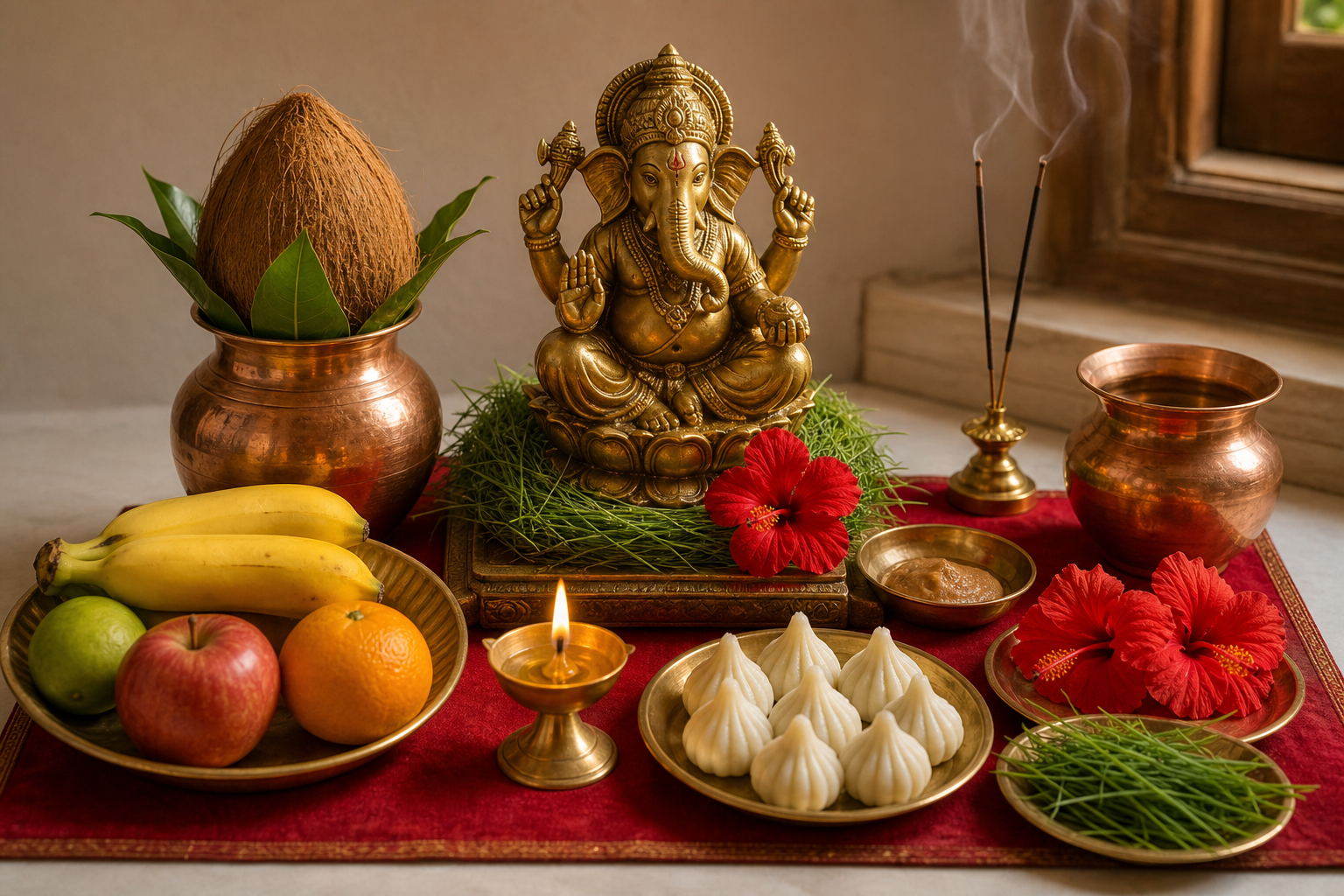
Set up the worship space well before the expected moonrise. A practical home-puja arrangement includes:
- An image or murti of Shri Ganesha on a clean altar.
- A lamp and incense.
- Clean water for achamana and a separate quantity for Chandra arghya.
- Akshata and a suitable vessel for offering the arghya.
- Fresh durva grass.
- Red flowers, including hibiscus where that is customary.
- Modaka, laddu, or another customary sattvika naivedya.
- Your confirmed local moonrise time, kept where you can see it.
Begin the principal worship close enough to moonrise that you can proceed without rushing. Clean the worship space, light the lamp, make or recall your sankalpa, and offer akshata, durva, and flowers to Shri Ganesha. Keep the naivedya ready, but do not begin eating it before the moonrise rites have been completed.
For japa, you may repeat Om Gan Ganapataye Namah. You may also recite the familiar prayer:
Vakratunda Mahakaya Surya-koti Samaprabha, Nirvighnam Kurume Deva Sarva-kaaryeshu Sarvada.
Traditional Ganesha prayer
Read or listen to the Sankashti Vrat Katha if that is part of your household practice. Its practical moral is as important as its ritual place: steady remembrance, truthfulness, restitution, and responsible conduct restore order where careless action has created knots.
Complete the vrata in the right moonrise sequence
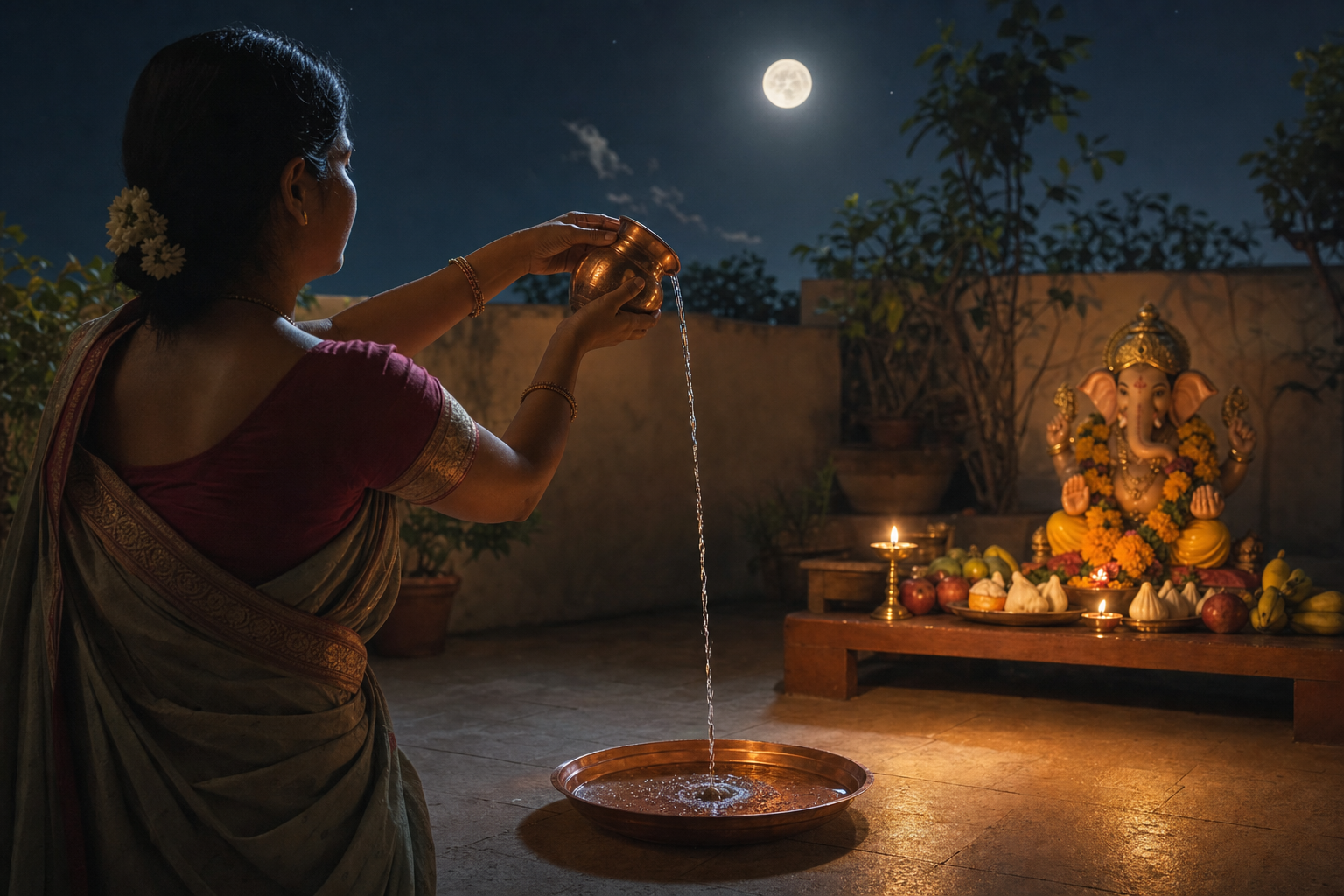
Chandrodaya is not merely a time at which fasting stops. It is the final ritual threshold of Sankashti. Arrange the evening so that you can give the Moon offering your full attention rather than watching the clock from the dining table.
- At the confirmed local moonrise time, move to a place from which you can see Chandra if the sky is clear.
- Offer arghya with clean water. A few grains of akshata and a small amount of sugar or jaggery may be added where this accords with your regional or family custom.
- Make Chandra darshan and recite Om Somaya Namah.
- Return your attention to Shri Ganesha, offer the prepared naivedya, and complete the concluding prayer.
- Break the fast with prasada and simple food, maintaining the gratitude and restraint with which you began the vrata.
If clouds conceal the Moon, use the published Chandrodaya time for your own location rather than waiting indefinitely. Some family traditions permit viewing the Moon’s reflection in a vessel of water. Follow that method only if it is taught in your parampara; otherwise, complete the observance at the verified local moonrise time with the prescribed intention and arghya.
If work prevents an elaborate evening ritual, protect the elements that define the vrata: your morning sankalpa, a sustainable discipline during the day, sincere Ganesha worship, the correct local Chandrodaya, Chandra arghya, and the offering of naivedya before you eat. It is better to perform these calmly than to assemble a large puja and lose the observance’s inner purpose in anxiety.
Four practical questions about Vikata Sankashti
Is Sankashti the same as Ganesh Chaturthi?
No. Monthly Sankashti Chaturthi is observed during Krishna Paksha and concludes at moonrise. Vinayaka Chaturthi, including the widely celebrated Ganesh Chaturthi, belongs to Shukla Paksha. The shared devotion to Ganesha does not make their calendrical rules interchangeable.
Must you offer exactly 21 blades or bunches of durva?
No single count should become a barrier to worship. Twenty-one is especially familiar in Ganesha devotion, but counts such as 5, 7, 9, or 11 are also used according to custom. Follow your family tradition and offer clean, fresh durva with attention rather than treating the number as a mechanical guarantee.
Why might calendars use different month names?
The Purnimanta system, widely used in North India, places this observance in Chaitra Krishna Paksha. The Amanta system used across much of peninsular India can label lunar periods differently around the end of a month. That naming difference does not override the operational rule: observe the vrata when local Chaturthi prevails at Chandrodaya.
Is the April 2026 observance Angarki Sankashti?
No. Angarki Sankashti occurs when the monthly Sankashti coincides with Tuesday. Vikata Sankashti in April 2026 falls on Sunday, 5 April. Its significance comes from the Vikata form and the monthly vrata; it does not need the Angarki designation to be spiritually meaningful.
Before the vrata day begins, write your local Chandrodaya time beside the altar and decide which fasting discipline you can keep honestly. Then you will not be negotiating the essentials late in the evening. You can give your attention to Shri Ganesha, Chandra, and the corrective action to which your sankalpa has committed you.