
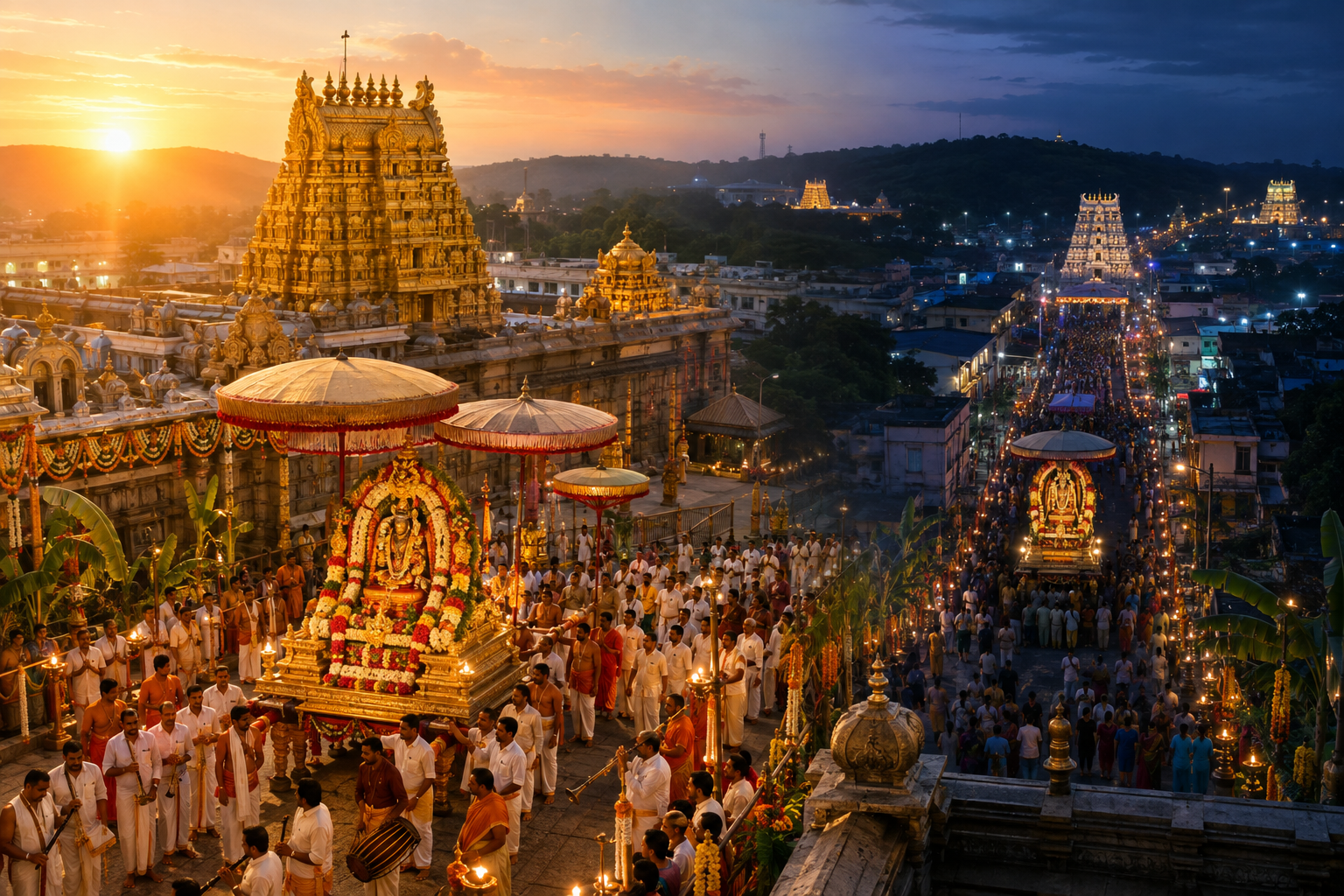
If you are deciding whether to attend one or both Brahmotsavams at Tirumala, don’t begin with travel dates. First understand what the word “twin” establishes, what it leaves unanswered, and which details must come from the program for each observance.
In an Adhika Masa year, Tirumala may hold two Brahmotsavams because an extra lunar month enters the Hindu calendar roughly once every three years. For you, the practical consequence is simple: understand the calendar first, then plan from the temple’s event-specific details rather than assuming that one announcement supplies a complete itinerary.
The extra month preserves the calendar’s order
Adhika Masa is an intercalary month: a month inserted so that the lunar calendar remains aligned with the wider calendrical cycle. It is not an accidental duplication, an arbitrary extension of the year, or a modern adjustment made for visitors. It belongs to the traditional method of keeping sacred time in order.
The phrase “roughly once every three years” describes a recurring pattern, not a promise that every third Gregorian year will contain the extra month on a simple fixed schedule. This matters when you plan ahead. Last year’s festival dates, or dates remembered from an earlier twin-Brahmotsavam year, cannot replace the calendar and temple program for the year you intend to visit.
Adhika Masa also shows why a Dharmic calendar cannot be reduced to a list of holidays printed against civil dates. A tithi, masa, and temple utsava belong to a living system of timekeeping. When that system produces two Brahmotsavams in one year, the second observance should be understood within that order, not treated merely as an extra entertainment date.
“Twin” does not necessarily mean an identical replay
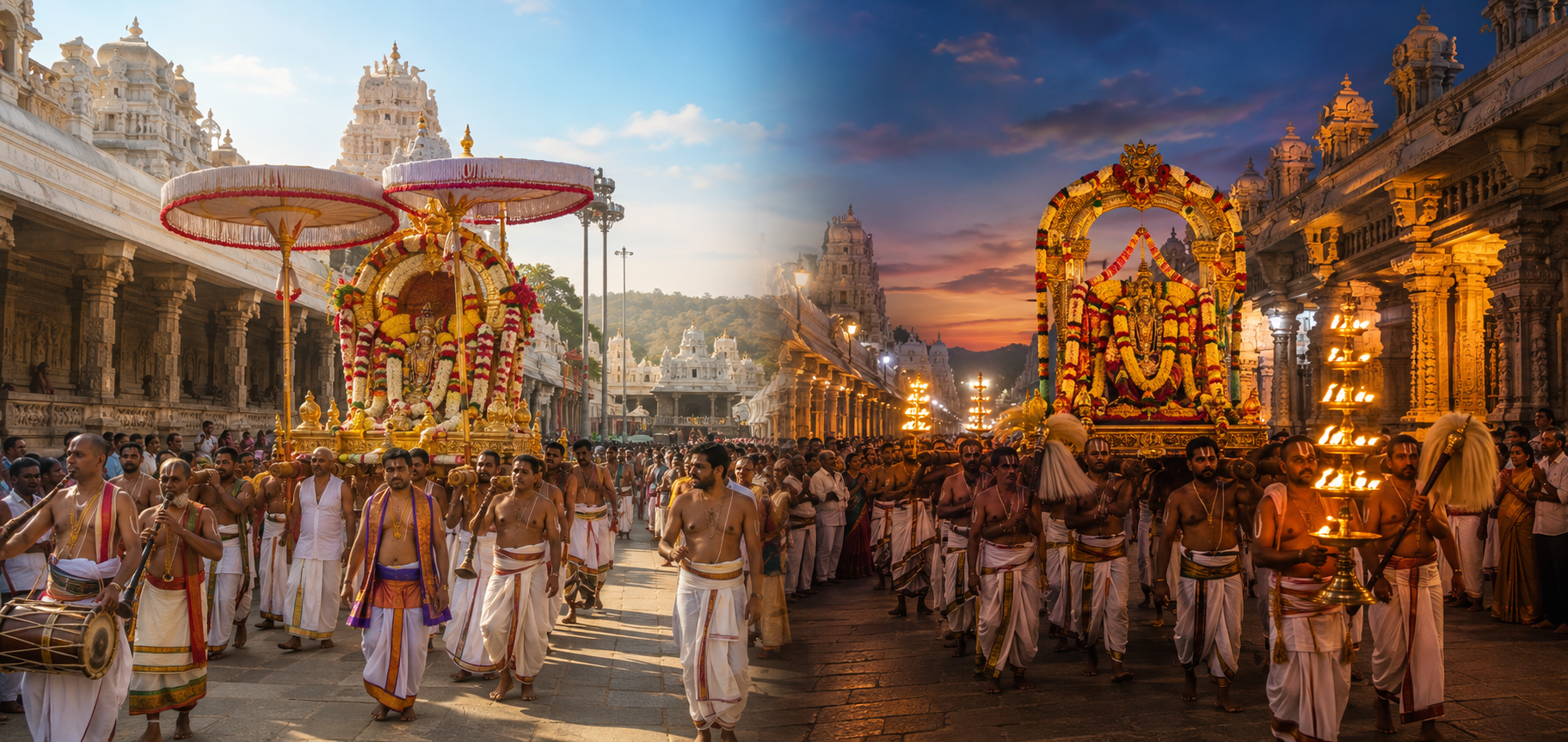
The twin designation gives you one firm piece of information: two Brahmotsavams are being observed in the year because of the Adhika Masa condition. The word alone does not establish that every rite, procession, daily sequence, access arrangement, or pilgrim requirement will be identical on both occasions.
That distinction protects you from the most common planning mistake: learning the details of one Brahmotsavam and silently applying them to the other. Read each announced program independently. If a desired observance is named only in one schedule, plan for that schedule. If entry or darshan instructions are issued separately, follow the instructions attached to your chosen dates.
The label also does not, by itself, establish that one Brahmotsavam is spiritually superior to the other. Such a distinction would have to come from the temple’s own designation, ritual order, or guidance within your sampradaya. Don’t manufacture a hierarchy from travel chatter, and don’t assume that attending both is a universal obligation merely because both are available.
Brahmotsavam is a temple-centred utsava ordered around the deity and the temple tradition. A pilgrim participates by aligning with that order. The better question is therefore not, “Which festival offers more?” It is, “At which observance can I be present attentively, with the correct schedule and a clear devotional purpose?”
Turn the announcement into a workable pilgrimage plan
A general announcement is enough to alert you, but it is not enough to support a paid itinerary. Before committing to travel, make a separate record for each Brahmotsavam and confirm the following:
- Exact dates: record the announced beginning and ending dates for each observance. Do not transfer dates from a previous year.
- Daily program: identify the named observance you most want to witness and confirm which Brahmotsavam and which day contain it.
- Darshan and entry: check the arrangements applying to your chosen day. Do not assume that an ordinary booking, pass, queue plan, or access instruction remains unchanged during a major utsava.
- Arrival timing: arrange transport so that a routine delay does not make you miss the particular observance around which the journey was planned.
- Accommodation: match the booking to the confirmed program, including the night before an early observance when necessary.
- Second attendance: if you intend to attend both Brahmotsavams, repeat every check for the second set of dates. Treat it as a separate planning problem even when both visits form part of one devotional intention.
Do not make a non-refundable booking solely on the strength of the twin-Brahmotsavam announcement. If the exact schedule or access arrangements have not been confirmed, wait or choose a flexible booking. The financial downside of guessing falls on you, while the temple calendar will not change to match an assumed itinerary.
If your main aim is simply to receive darshan during a Brahmotsavam, choose the confirmed dates that your health, family responsibilities, and travel capacity can realistically support. If your aim is a particular ritual or procession, wait for the day-by-day program before choosing. That single distinction prevents enthusiasm from hardening into a badly timed journey.
Families travelling with children, elders, or anyone who cannot remain in a demanding queue should make physical feasibility part of the devotional decision. Two opportunities on the calendar do not require you to create an exhausting itinerary. A workable visit, undertaken with attention and respect, is more sensible than attempting both because the word “twin” creates pressure.
Let the second observance deepen attention, not anxiety
Adhika Masa gives the year an unusual structure, but unusual does not mean competitive. You do not need to turn two Brahmotsavams into a checklist or measure devotion by the number of festival days accumulated.
If you can attend one, choose deliberately. Write down the purpose of the pilgrimage before booking: darshan, participation in a named day of the utsava, family worship, or a vrata undertaken under proper guidance. A clear purpose tells you which schedule details matter and which attractive but impractical options you can release.
If you can attend both, resist treating the second visit as a repetition to be completed mechanically. You may give each visit a distinct devotional focus, such as closer attention to the announced ritual sequence, seva, study, or family participation. The point is not to invent a new rule but to remain awake to the opportunity the calendar has created.
If travel is not possible, don’t claim that a home observance reproduces the temple’s Brahmotsavam. It does not. You can still honour Adhika Masa through the puja, japa, study, dana, or seva recognised in your family and sampradaya. Because vrata rules and devotional customs can differ, confirm unfamiliar practices with a trusted acharya or temple purohit instead of copying a generic online list.
Key takeaways
- Adhika Masa is the extra lunar month that periodically keeps the Hindu calendar aligned; it is not a calendar mistake.
- At Tirumala, its occurrence can result in two Brahmotsavams within one year.
- The word “twin” does not prove that the two daily programs or pilgrim arrangements are identical.
- Choose between one or both observances only after checking the separate dates, named rituals, darshan instructions, transport, and accommodation.
- Use flexible travel arrangements until the details relevant to your visit are confirmed.
- Do not infer either a hierarchy or a duty to attend both from the twin designation alone; follow the temple’s ritual order and your sampradaya’s guidance.
Your next step is concrete: obtain the two event-specific programs, circle the observance that answers your devotional purpose, confirm the access arrangements for that date, and only then lock in travel. That sequence lets the calendar guide the pilgrimage instead of forcing the pilgrimage onto an assumption.
References
