
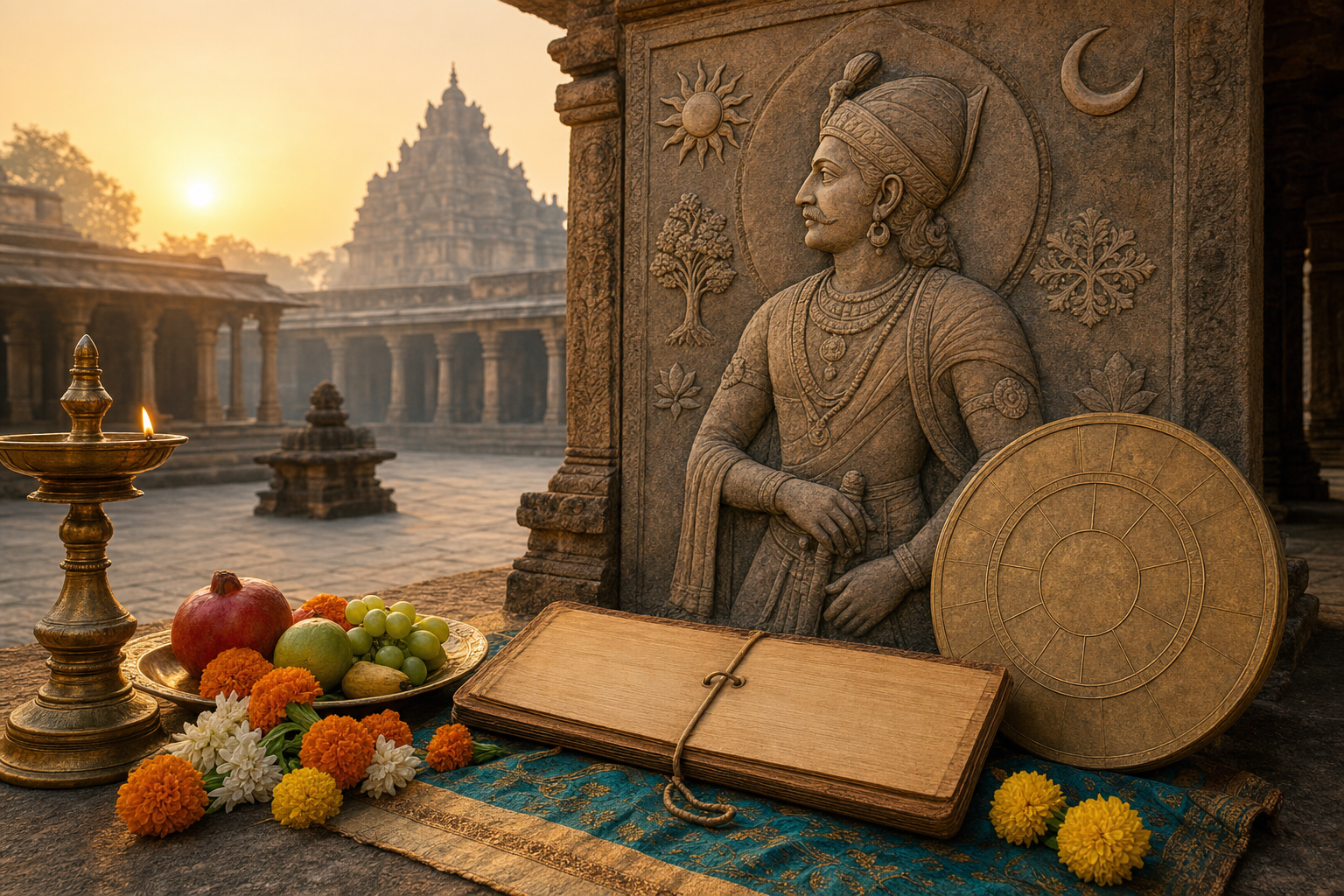
If you came looking for the correct Shalivahana Jayanti date and a respectful way to observe it, begin with two distinctions. The festival follows a lunar tithi rather than a fixed Gregorian date, and the traditional identity of Shalivahana should not be presented as though every historical question about it has been settled.
In 2026, the observance falls on Saturday, March 28, for most locations. A thoughtful celebration can then connect worship with something more enduring: the Shaka calendar, Satavahana history, ethical leadership, and a concrete act of service.
Get the 2026 date right before planning the ritual
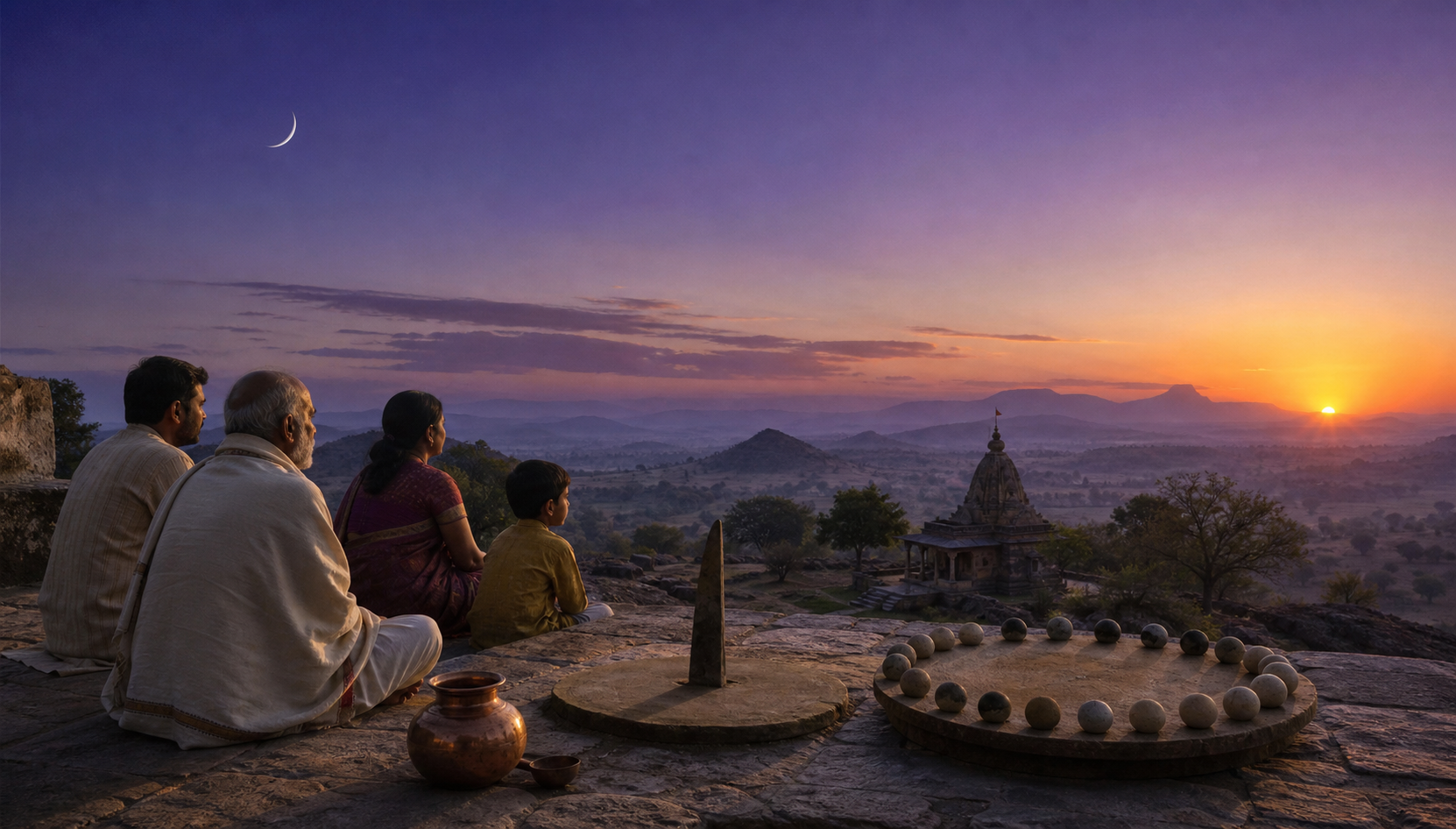
Shalivahana Jayanti is observed on Dashami in the Shukla Paksha, or waxing fortnight, of Chaitra. This is sometimes called Chaitra Vijaya Dashami. In 2026, Chaitra Shukla Dashami falls on March 28 for most locations.
The Saturday date is incidental. The tithi is what governs the observance. Because a lunar tithi can begin or end between two civil midnights, the applicable day is generally determined by the tithi prevailing at local sunrise. A date printed for one city should therefore not be copied automatically by a family living in another country or time zone.
Your practical check is simple: open a Panchang calculated for the city where the puja will occur, find Chaitra Shukla Dashami, and confirm which local sunrise falls within it. If a regional calculation differs from a general festival listing, follow the local tithi rather than the weekday or an overseas calendar graphic.
Do not confuse this spring observance with the better-known Vijaya Dashami of Dussehra. Shalivahana Jayanti belongs to Chaitra, near the beginning of the new-year cycle. Dussehra culminates the autumnal Navaratri period on Ashwin Shukla Dashami. Both invoke the victory of dharma, but they occupy different ritual seasons and carry different immediate associations.
Key takeaways for 2026
- Plan for Saturday, March 28, 2026, unless your city-specific Panchang places the sunrise rule differently.
- Look for Chaitra Shukla Dashami, not merely the words Vijaya Dashami.
- Let the local tithi determine the ritual day; the weekday does not determine it.
- In the Indian national calendar, the observance falls in Saka Samvat 1948.
- Build the day around worship, historical study, and service rather than treating it as a name on the calendar.
How the Saka year converts in 2026
The Shaka, or Saka, era begins from an epoch in 78 CE. For the practical conversion used here, subtract 79 from the Gregorian year before the Saka new year and subtract 78 on or after it. The national-calendar year begins on Chaitra 1, normally March 22 and March 21 in a leap year. In 2026, Saka 1948 begins on March 22.
| Gregorian date in 2026 | Conversion | Saka year |
|---|---|---|
| Before March 22 | 2026 minus 79 | 1947 |
| March 22 and after | 2026 minus 78 | 1948 |
| Shalivahana Jayanti, March 28 | Falls after the Saka new year | 1948 |
Remember Shalivahana without erasing historical nuance

Traditional narratives widely identify King Shalivahana with Gautamiputra Satakarni, the eminent Satavahana ruler of the Deccan around the second century CE. That identification is powerful in popular memory, but historians continue to examine the relationship among the traditional name, inscriptions, coin sequences, Puranic lists, and chronology.
You do not have to choose between reverence and historical care. Commemorate the ruler whom tradition remembers as Shalivahana while stating plainly that Gautamiputra Satakarni is the historical figure most commonly associated with that memory. Avoid the stronger claim that every detail of the identification is beyond dispute.
This distinction also prevents a second mistake: assuming that Gautamiputra personally established the era merely because it is commonly called the Shalivahana Shaka. The era’s epoch is 78 CE, while Gautamiputra is generally placed around the second century. The festival, the remembered king, the historical ruler, and the calendrical epoch are connected in civilizational memory, but they are not four interchangeable labels.
The Nashik Prashasti composed by Gautami Balashri, Gautamiputra’s mother, is central to his remembered stature. It presents a ruler associated with political restoration, protection of subjects and sages, territorial order after conflict, and fidelity to dharma. Read it as a statement of the standards by which kingship wished to be judged: power required moral direction, restraint, justice, and responsibility for social order.
The wider Satavahana world gives that ideal a material setting. Pratishthana, identified with Paithan, served as an important political center. Inland routes connected the Deccan with western ports such as Sopara and Bharuch and with the commerce of the western Indian Ocean. The Periplus of the Erythraean Sea belongs to the record of that trading environment.
Satavahana coins bearing Prakrit legends in Brahmi script point to organized governance and commercial life. Amaravati and the cave complexes of the western Deccan preserve evidence of artistic and religious vitality. Vedic, Buddhist, and Jain traditions could receive patronage within the same broad political milieu. That coexistence is not a decorative footnote; it shows how a Dharmic civilization could sustain distinct paths without requiring cultural emptiness between them.
If you are explaining the day to children, students, or a community audience, use three layers of language:
- Tradition remembers Shalivahana as a restorer of order and a model of Dharmic kingship.
- Popular memory widely associates him with the historical Satavahana ruler Gautamiputra Satakarni.
- The precise historical relationship remains a subject of scholarly examination, so tradition and inscriptional history should be identified rather than blurred together.
That formulation preserves cultural memory without asking an uncertain claim to carry more weight than it can bear.
See the Shaka era as living infrastructure, not a relic
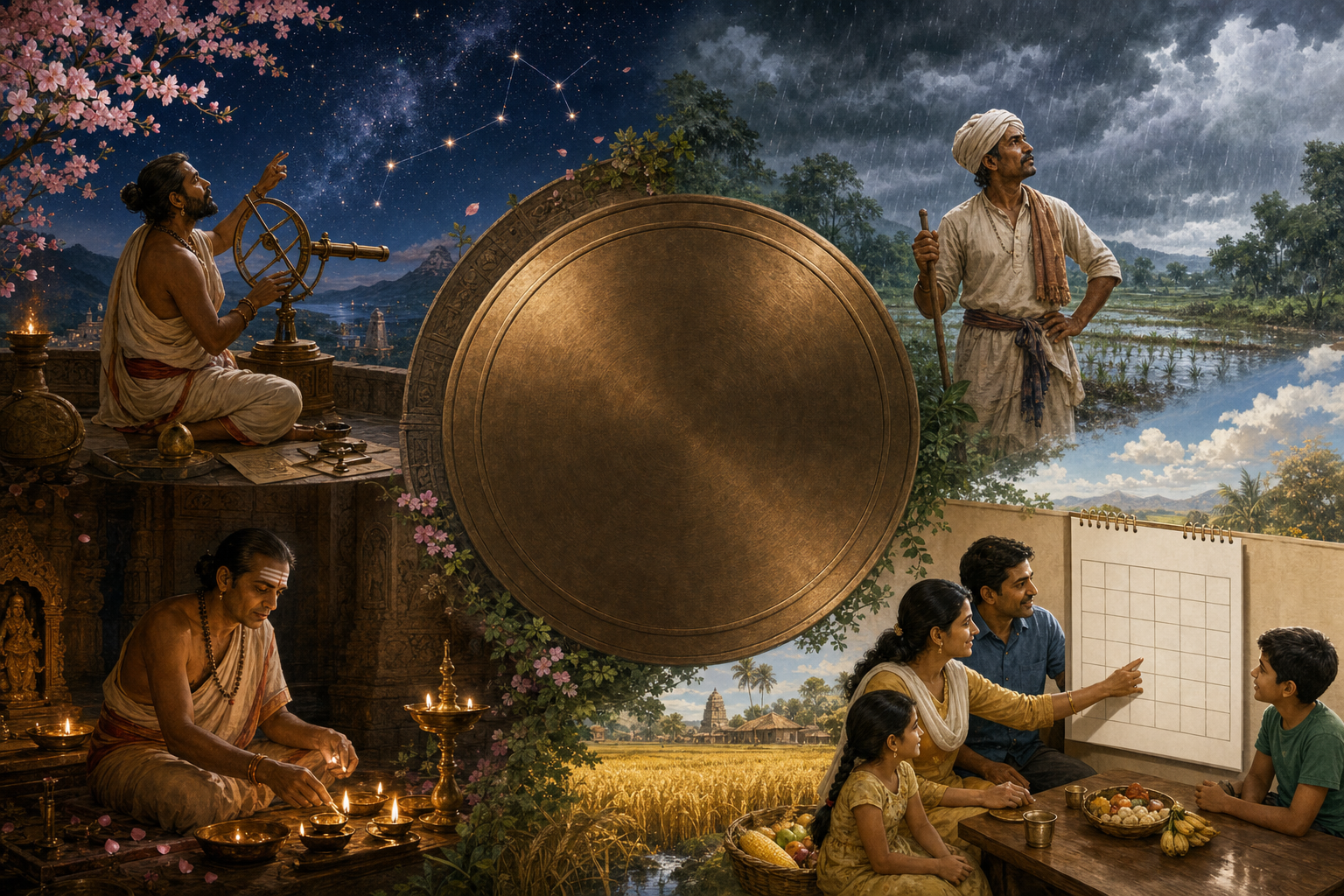
A calendar era is a shared coordinate system. It lets communities place ritual cycles, official dates, reigns, inscriptions, harvest seasons, and collective memory within an ordered sequence. The Shaka legacy matters because it still performs that work.
The Indian national calendar, adopted for official use in 1957, is based on Saka Samvat. Its new year begins with Chaitra 1. This means Shalivahana Jayanti arrives in the first waxing fortnight of the national-calendar year, linking the commemoration with spring renewal rather than leaving it as an isolated royal anniversary.
You can make that continuity visible in a household calendar or community notice by printing both dates: March 28, 2026 and Saka 1948, Chaitra Shukla Dashami. The paired notation teaches more than a paragraph about heritage can. It shows that Bharatiya time-reckoning remains usable in the present.
The influence reaches beyond Bharat. The Balinese Saka calendar remains part of Indonesian life, and the Saka system historically informed Javanese calendrical practice. Related dating also appears in Southeast Asian epigraphy. These connections grew through long interaction involving trade, scholarship, religious ideas, and cultural exchange.
Approach that wider legacy with confidence and precision. It demonstrates the reach of Dharmic civilizational networks, but it should not be reduced to a crude claim that every local Southeast Asian tradition was merely copied from India. Calendars travel, and communities adapt what they receive. The durable achievement lies in a shared framework becoming locally meaningful across regions.
The coexistence of Saka Samvat, Vikrama Samvat, regional solar calendars, and temple or monastic calendars reveals another important habit of Bharatiya civilization: unity did not require one calendar to eliminate all others. Different systems could answer civil, seasonal, regional, and ritual needs at the same time.
This is also a sound basis for inter-traditional participation. Hindu, Buddhist, and Jain communities can approach the period through their connected histories while retaining their own practices. Sikh communities follow distinct calendrical conventions, yet seva, ethical courage, and social welfare provide an honest basis for shared community action. Unity becomes credible when it respects difference instead of concealing it.
Build an observance around worship, study, and service
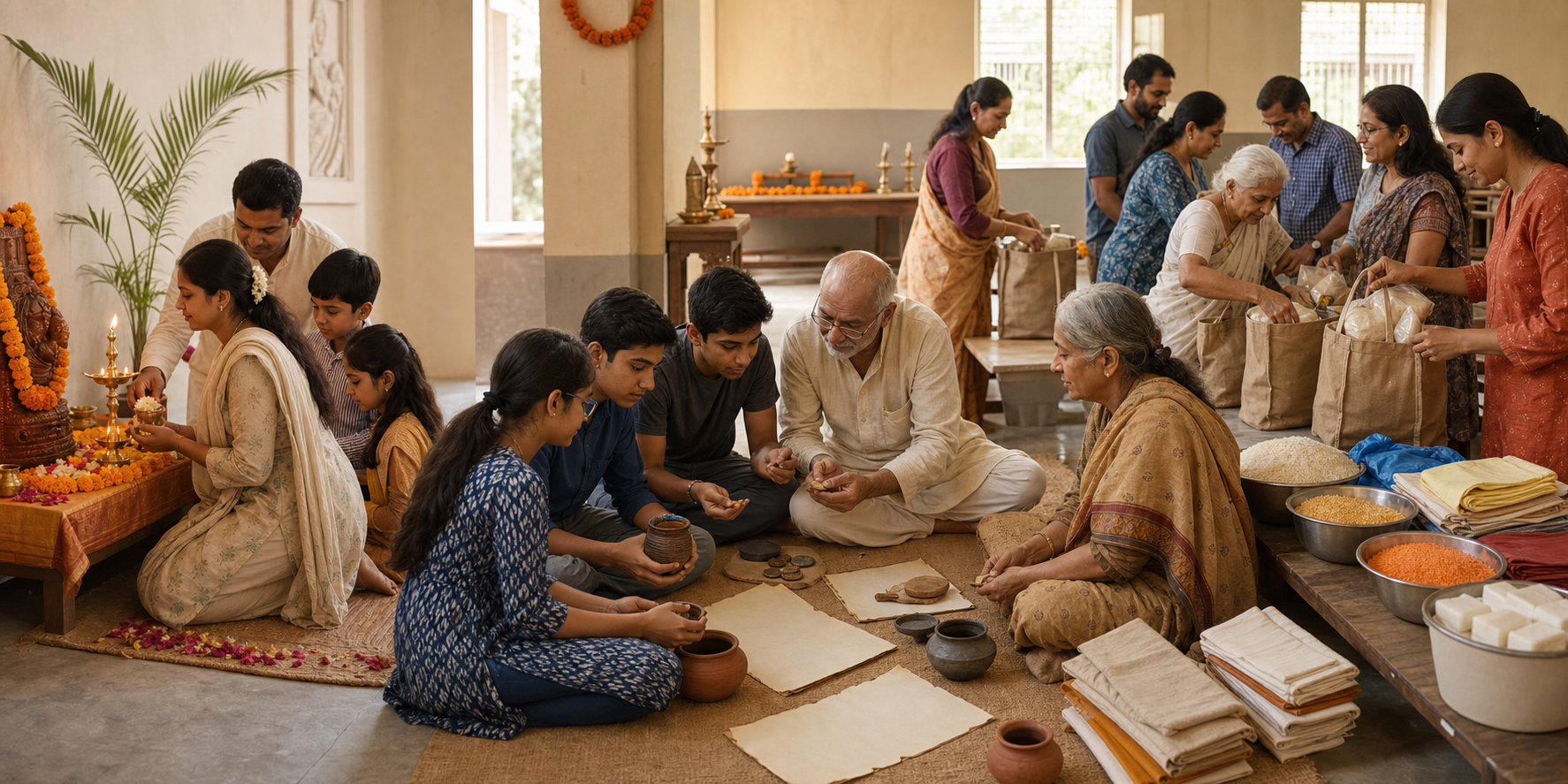
Shalivahana Jayanti does not need an elaborate performance to become meaningful. Treat the following sequence as a disciplined household framework, not as a claim that one mandatory liturgy governs every region or sampradaya.
A practical household sequence
- Verify the local tithi. Before arranging the puja, confirm that Chaitra Shukla Dashami prevails at sunrise in your location.
- Make a clear sankalpa after sunrise. State that the observance is dedicated to dharma, just leadership, historical learning, and the welfare of the wider community. A simple intention understood by the family is better than words recited without attention.
- Offer worship according to your tradition. Perform puja to your Ishta Devata and remember venerable ancestors. Follow the established practice of your household or sampradaya rather than inventing claims about a universal Shalivahana ritual.
- Choose one object of svadhyaya. Read about the Nashik inscription, examine an image of Satavahana coinage, trace the routes linking Paithan with Sopara and Bharuch, or calculate the current Saka year. One focused subject gives the gathering a memory it can retain.
- Discuss the difference between tradition and historical proof. Explain why Shalivahana is associated with Gautamiputra Satakarni and why careful language strengthens, rather than weakens, civilizational confidence.
- Perform annadana or another act of service. Direct food, time, or a contribution toward an educational or health-related need. Decide on the recipient before the day so that service does not remain a ceremonial promise.
- Share a light vegetarian meal. Fresh seasonal preparations suit the Chaitra theme of clarity and renewal. Keep the meal consistent with your family’s dietary and ritual conventions.
- Close with one commitment. Ask each participant to name a duty, act of courage, fair decision, or public-minded service that can be carried into the coming year.
The study portion matters. Without it, the day can shrink into a generic royal tribute. Without worship, it can become only a history lesson. Without service, its language of lokasangraha remains untested. Holding all three together gives the commemoration its proper shape.
A community program that teaches rather than performs
A temple, cultural organization, or student group can organize the day around a short series of connected elements: a traditional invocation, an explanation of the local tithi, a historically careful account of Shalivahana and Gautamiputra Satakarni, and a service activity with a named purpose.
Coins, inscriptions, calendars, maps, and archaeological places should do much of the teaching. Label each item clearly as inscriptional evidence, material culture, traditional memory, or later calendrical legacy. That simple distinction helps visitors understand how knowledge is built and stops a dramatic story from being mistaken for a verified inscription.
Communities in Maharashtra, Telangana, and Andhra Pradesh can connect the program with landscapes carrying Satavahana memory: Paithan, the Nashik caves, and the Amaravati-Nagarjunakonda region. A heritage walk should direct attention to what survives, why it matters, and how it is being preserved. Elsewhere, a museum or epigraphic gallery with Satavahana material can serve the same educational purpose.
If your group mounts an exhibition, give the Saka calendar a central place. Show the 78 CE epoch, the 1957 adoption of the national calendar, the March 22 new year in 2026, the conversion to Saka 1948, and the connections with Bali and Java. Visitors should leave knowing how to use the calendar, not merely having seen its name.
Support for the documentation of inscriptions, temple records, coins, and archaeological collections is another appropriate form of seva. Cultural pride becomes more durable when preservation and careful study accompany commemoration.
Turn four remembered values into an annual civic practice
The Satavahana legacy is often approached through four connected ideals: dharma, kshatra, nyaya, and lokasangraha. These words should not remain ornamental Sanskrit on a festival poster. Each can be turned into a question that affects conduct.
- Dharma: Which responsibility does your role place on you, even when fulfilling it is inconvenient?
- Kshatra: Where is courage required, and what restraint will keep that courage from becoming aggression or vanity?
- Nyaya: Who bears the cost of a family, institutional, or public decision, and has that burden been considered fairly?
- Lokasangraha: What can you do that benefits people beyond your immediate circle?
These questions make ethical kingship relevant even for someone who holds no formal authority. Parents allocate attention and resources. Teachers set standards. Managers shape working conditions. Community organizers decide whose needs receive visibility. Citizens reward or reject public conduct. In every case, power becomes Dharmic only when joined to duty, justice, restraint, and the welfare of others.
For 2026, put March 28 on your calendar now, verify it against the Panchang for your city, choose one Satavahana subject to study, and arrange one act of service before the day arrives. That is enough to turn Chaitra Shukla Dashami from a remembered date into a living practice of civilizational continuity.
References
