
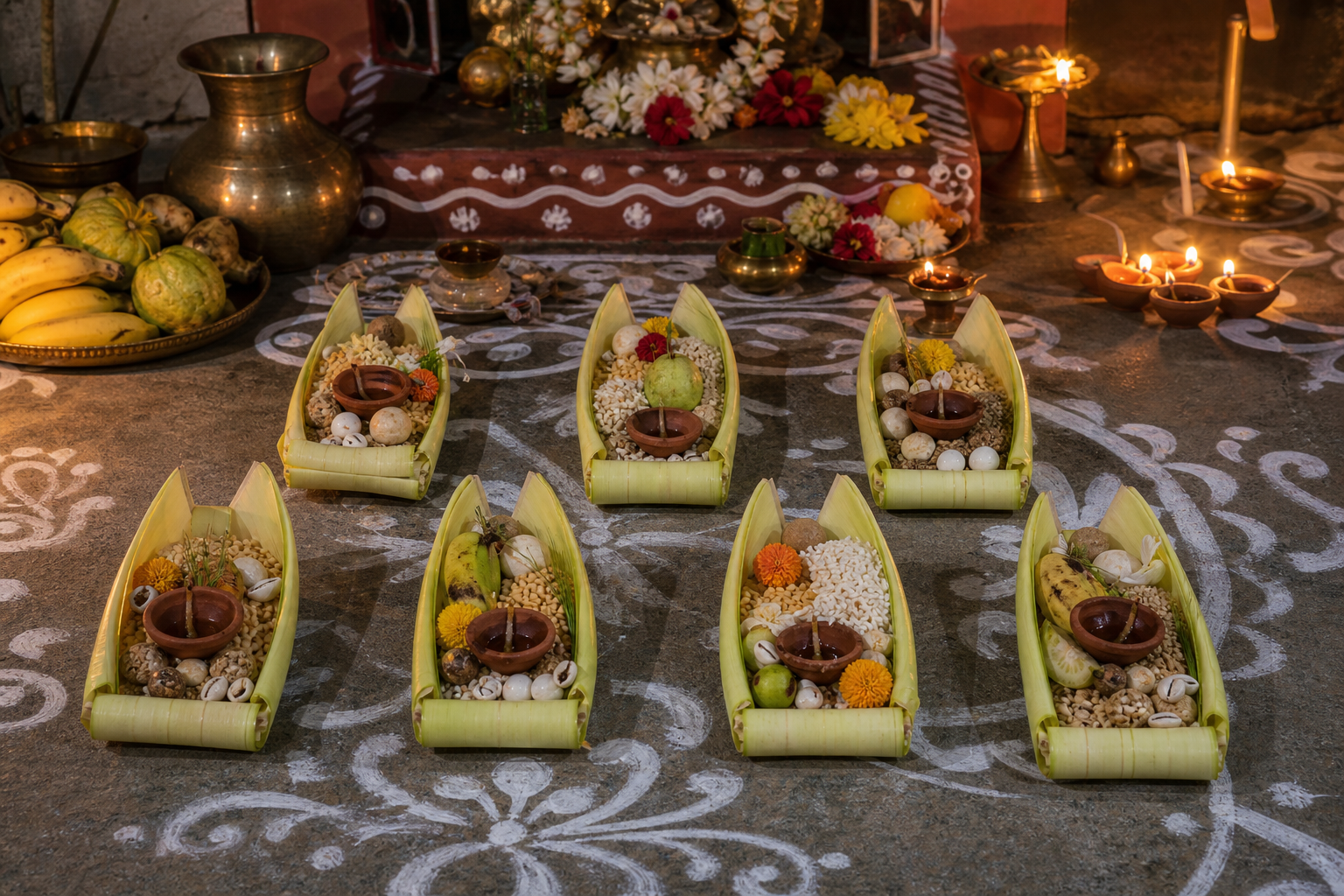
If Kojagari Lakshmi Puja is approaching and you remember tiny banana boats in an elder’s courtyard, the difficult part is probably not cutting the stem. It is deciding which details carry the tradition and which belonged to one family, village, or ancestral home.
You can observe Saptatori faithfully without a large pond, elaborate decorations, or a perfectly remembered script. What you need is a clear sankalpa, seven stable Kolar Nouko, modest offerings, safe lamps, and a plan to leave the water as clean as you found it.
Preserve the inherited form without inventing uniform rules
Saptatori joins sapta, seven, with tori, a small boat. Its recognizable form is an offering of seven small boats made from banana stem and leaves during Kojagari Lakshmi Puja, usually floated after moonrise on the full moon night of Ashwin.
That is the stable center of the custom. The details are not identical in every Bengali household. Families may differ over the shape of the hull, the contents of each boat, the prayers recited, the use of a mast, and whether the offering is floated in a pukur, river, courtyard vessel, or indoor urli. Lineages with roots in present-day Bangladesh, including Jessore and Khulna, may preserve forms that differ from those remembered in Nadia, Murshidabad, or elsewhere in Bengal.
If an elder in your family knows the practice, ask four precise questions before buying anything:
- Did the family prepare exactly seven boats, or use one representative boat or eight for Ashta-Lakshmi?
- Which offerings were placed inside the boats, and which remained at the main altar?
- Was Saptatori performed before or after Lakshmi Panchali?
- Were the boats released into water, kept floating for a short period, or retrieved after the lamps went out?
Record the answers, including regional words and small gestures. Household ritual knowledge often lives in sequencing: who carries the tray, when the lamp is lit, or which item is added last. Those details can be lost even when the visible object survives.
If no family account remains, seven boats is the clearest form to reconstruct. Treat the variations as legitimate lineage practices, not as proof that one household is correct and another is mistaken. Saptatori is sustained by regional custom, vrata practice, and oral memory; it should not be presented as a single standardized command for all Hindus.
Do not confuse the Kolar Nouko with the Nabapatrika of Durga Puja, popularly called Kola Bou. Both use the banana plant within Bengal’s ritual world, but they belong to distinct rites, times, and theological settings.
Build seven boats that will stay upright
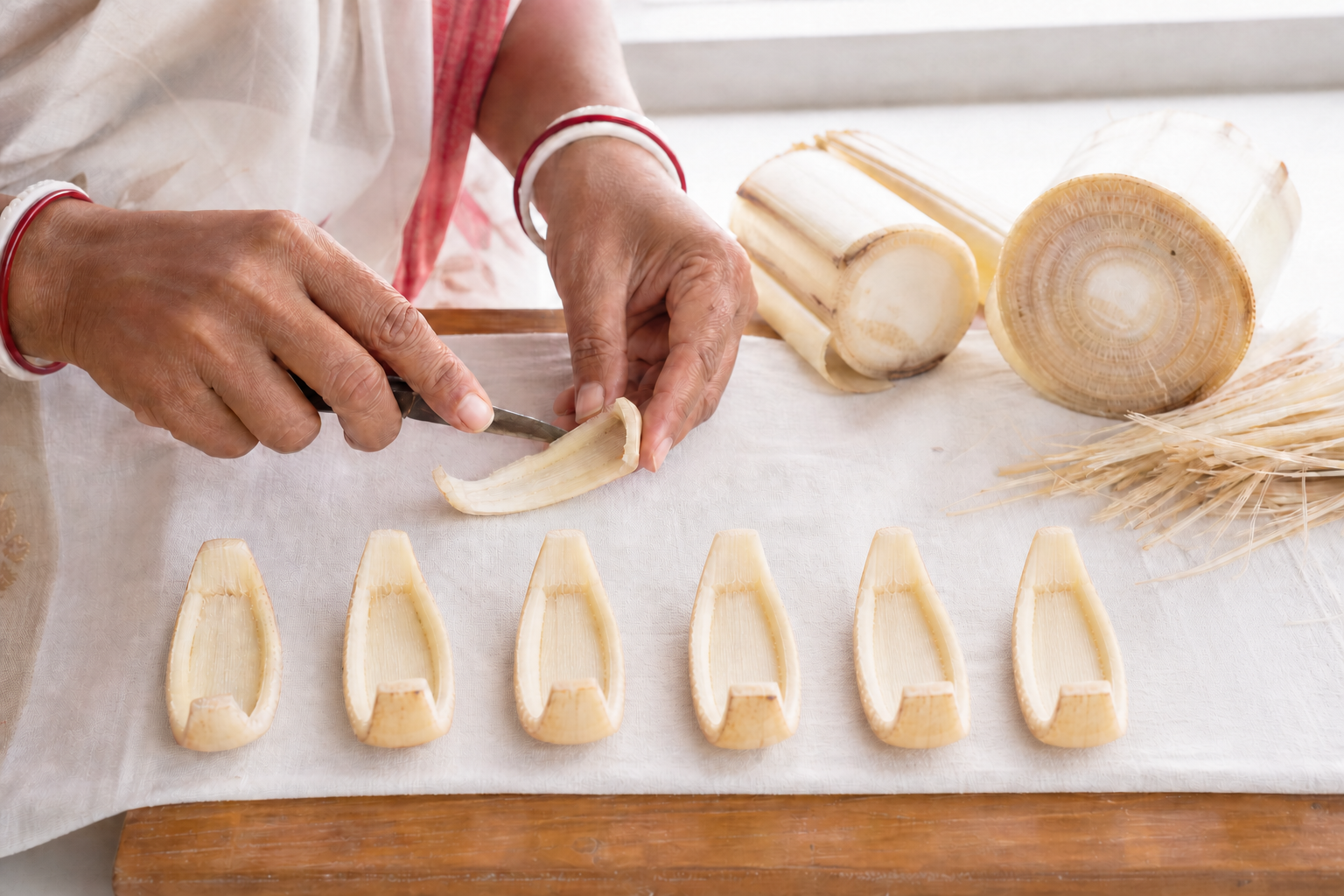
The banana stem is suited to this ritual because its porous inner structure is naturally buoyant. A clean section can serve as the hull, while banana leaf provides a lining or small sail. The aim is not to construct a detailed model ship. It is to make a simple vessel that can carry a few offerings and, where safe, a small diya.
Gather the materials before beginning:
- Seven firm sections of banana stem, commonly about 12-18 inches long
- Clean banana leaves for lining and decoration
- Jute twine or another untreated natural fiber
- Thin banana-stem slivers or leaf midribs for reinforcement
- Seven small clay diyas, cotton wicks, and a small quantity of ghee or sesame oil
- Rice, paddy stalks, turmeric, vermilion, betel leaves and nuts, coins, durva, and flowers according to family custom
- A clean tray large enough to carry all seven boats
- A tub or basin for testing buoyancy before the puja
Avoid thermocol, plastic flags, metallic foil, glitter, synthetic ribbon, painted foam, and strong adhesive. They add nothing essential to the sankalpa and create fragments that are difficult to recover from water.
Make each Kolar Nouko in this order:
- Cut the hull. Place the banana stem on a stable surface and cut a firm section to the required length. An adult should handle the knife. A slightly broader base is more valuable than a dramatic pointed prow.
- Create a shallow recess. Remove only enough soft material to hold a leaf lining and small offerings. A deep hollow weakens the hull and allows water to collect.
- Line the recess. Fold a clean piece of banana leaf into the cavity. Secure it with jute rather than glue.
- Reinforce weak edges. Use stem slivers or leaf midribs where the sides bend. Keep knots underneath or against the hull so they do not catch the diya.
- Add restrained decoration. A small rice-paste alpona, a ring of marigold petals, or a jute thread is enough. Heavy flowers can make the boat list.
- Add a mast only if customary. A thin twig or piece of sugarcane with a small banana-leaf sail can be used, but keep it low and light. A tall mast raises the center of gravity and makes the boat unstable.
- Test every hull. Float each empty boat in a tub. Then repeat the test with an unlit diya and the intended offerings. Move the lamp toward the center until the hull sits level.
The buoyancy test is the step most worth adding to your preparation. Banana stems differ in firmness and water content. A design that works with one section may tilt with another, and the failure becomes much harder to correct once the lamp is burning.
Use only a small amount of oil and a short wick. If wind, dry vegetation, clothing, children, animals, or an unstable vessel make a floating flame unsafe, keep the lit diya at the altar and float the boats without fire. Do not replace a natural lamp with disposable battery lights that may enter the water. No ritual benefit justifies an unattended flame or plastic waste.
Choose offerings that express ethical prosperity
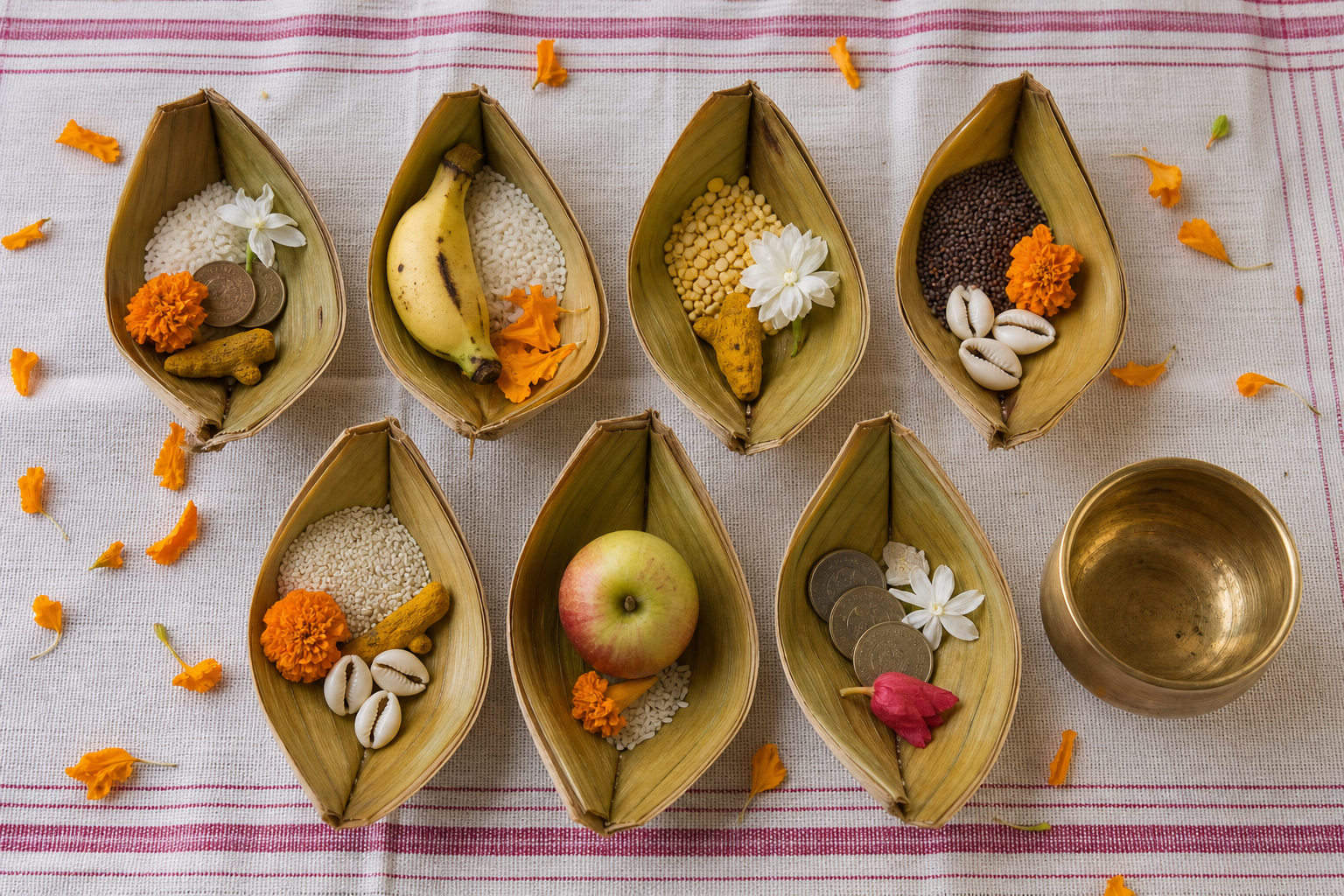
Lakshmi’s abundance is larger than accumulated money. In Saptatori, agricultural produce, household continuity, light, and right livelihood belong in the same field of meaning. The boats should therefore carry small, deliberate offerings rather than a crowded display.
- Rice and paddy: sustenance, agricultural abundance, and gratitude for food
- Turmeric and vermilion: auspiciousness and protection within household worship
- Betel leaf and nut: continuity of custom and a properly offered welcome
- A coin: material prosperity governed by ethical use
- A diya: clarity and inner illumination
- Durva or mixed grains: optional additions where they belong to the family’s practice
- Flowers: reverence expressed without overloading the vessel
A pinch or a few grains is sufficient. If you place a coin in each boat, plan to retrieve all seven. A coin is a symbolic offering, not something that must remain at the bottom of a pond. It can return to the altar, be reused for worship, or be set aside for dana.
Seven boats do not have to represent seven separate blessings. Some families treat them as a collective offering. If you want a structured sankalpa and have no inherited assignment, the following framework draws on seven dimensions associated with well-being. Use it as a reflective aid, not as a supposedly universal liturgy.
| Intention | Question to carry into the puja |
|---|---|
| Sustenance | Do we receive food with gratitude and avoid waste? |
| Learning | Are we using knowledge with humility and responsibility? |
| Health | Does our idea of prosperity include disciplined care for the household? |
| Harmony | Are we addressing conflict truthfully rather than hiding it behind appearances? |
| Right livelihood | Is our income earned without dishonesty or needless harm? |
| Ethical wealth | Can we possess resources without allowing greed to possess us? |
| Communal prosperity | Who beyond our household should share in what we receive? |
This is where the ritual can shape conduct. If you invoke communal prosperity, decide on an act of dana. If you invoke right livelihood, examine one questionable habit connected to earning or spending. If you invoke sustenance, buy the puja materials fairly from local cultivators and artisans where possible. Lakshmi Puja becomes thinner when prosperity is requested but responsibility is left outside the ritual.
Do not force every available auspicious object into the boats. Shell fragments and other sharp items can be omitted, especially in shared water. The strength of Saptatori lies in coherent intention, not in the number of ingredients.
Place Saptatori correctly within Kojagari Lakshmi Puja
Saptatori belongs within the household’s Kojagari observance. It does not replace the preparation of the altar, the ghat or kalash, Lakshmi Panchali, vrata, or the family’s established form of worship.
The name Kojagari is connected with the Sanskrit question ko jagarti, meaning who is awake. Remaining awake has a literal place in many homes, but the question also directs attention toward moral wakefulness: are you alert to how wealth enters the home, how it is used, and who bears its costs?
A practical sequence is:
- Clean the worship space and water vessel. Complete this before arranging food or lighting lamps.
- Draw the alpona. Use rice paste according to the household’s patterns and place the ghat or kalash at the altar.
- Arrange Lakshmi’s offerings. Keep the seven boats together on a clean tray beside the altar. Do not put oil in the diyas so early that it spills while the tray is moved.
- Complete the inherited vrata and recitation. Recite Lakshmi Panchali, stotra, names, or prayers in the form known to the family.
- State the Saptatori sankalpa. Name the household, express gratitude, and ask that prosperity be gained and used through dharma. If using seven intentions, name them without pretending that the wording is an inherited mantra.
- Prepare the lamps after moonrise. Add a small amount of ghee or sesame oil, settle each wick, and light the lamps only when the water and path to it are ready. The rite is traditionally associated with the bright, still period after moonrise; use your household panchang or local practice rather than copying a clock time from another place.
- Float the boats gently. Lower them one at a time from the water’s edge. Do not throw them. Keep enough distance between boats that one flame cannot ignite another boat’s dry decoration.
- Remain present and retrieve the remains. Watch until the lamps are extinguished or the family’s offering period is complete. Collect coins, clay lamps, ties, and any decoration that has separated.
If you do not know a family-specific invocation, a plain-language sankalpa is more honest than presenting an unfamiliar text as ancient. You might ask Lakshmi to grant sustenance, learning, health, harmony, right livelihood, ethical wealth, and the capacity to share prosperity, while promising that what enters the home will be earned and used without harm. This is an intention, not a canonical mantra.
Some Bengali households also prepare kheer or sweetened milk and place it beneath the open sky in connection with Sharad Purnima’s moonlight and dew. That observance can accompany Kojagari, but it is not a required component of the banana boats. Keep parallel customs distinct so that children learn what belongs to Saptatori itself.
Adapt the water setting without turning the ritual into litter
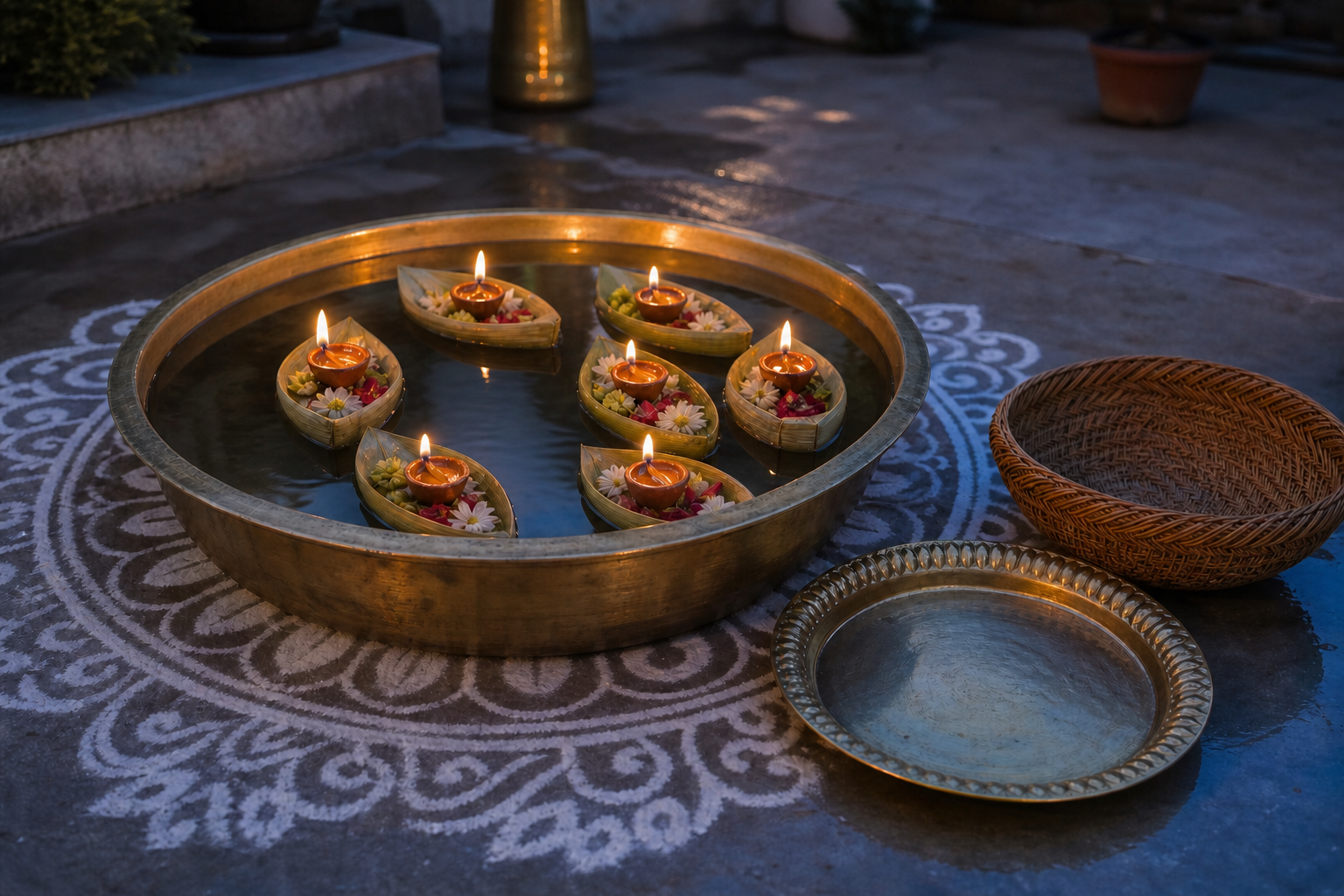
A village pond or river gives Saptatori its most familiar setting, but access to open water is not the measure of devotion. The water body is a shared habitat and community resource, not an empty surface provided for disposal. Your method should protect it.
If you have access to a pond or river
- Use a place where the observance is customary or permitted, and choose a stable, accessible bank.
- Carry a retrieval basket, tongs, or a small net before releasing anything.
- Keep offerings sparse so that they can be recovered easily.
- Do not enter deep, fast, or poorly lit water to retrieve a drifting boat. Prevent drift with a near-shore location rather than creating a rescue risk.
- Account for seven diyas and seven coins before leaving.
- Collect any jute, flowers, leaves, or stem pieces that detach, even when the material is biodegradable. Natural material can still accumulate when many households use the same pond.
If you live in a flat or have no open water
Use a wide brass urli, a large earthen vessel, or another clean, fire-safe basin filled with water. This small-scale household adaptation preserves the relationship among vessel, water, light, and sankalpa.
- Measure the vessel before making the boats. Seven hulls need enough room to float without pressing their lamps together.
- If the basin is too small for 12-18 inch boats, make proportionally smaller hulls rather than stacking them.
- Place the vessel on a level, nonflammable surface away from curtains, doorways, and crowded movement.
- Keep children involved in arranging grains or flowers, but have an adult cut the stems, light the wicks, carry the filled vessel, and supervise the flames.
- After the observance, remove the boats and strain the water. Compost untreated stem, leaves, durva, and flowers where local practice allows. Retain the coins, and dispose of spent clay lamps responsibly.
Do not pour oily water into a pond, storm drain, or soil. Skim or absorb residual oil first and handle it with ordinary household waste according to local arrangements. A home vessel also allows you to retrieve every component instead of assuming that biodegradability makes retrieval unnecessary.
Key takeaways
- Seven banana-stem boats are the clearest default, but an inherited family form takes precedence over a generic checklist.
- Test every loaded boat in advance; stability depends on the particular stem, diya, and weight distribution.
- Keep offerings small and connect prosperity with sustenance, learning, health, harmony, right livelihood, ethical wealth, and the welfare of others.
- Perform Saptatori within the household’s Kojagari Lakshmi Puja sequence, usually after moonrise, rather than treating it as a detached craft activity.
- Retrieve lamps, coins, ties, and loose offerings. Natural construction is the starting point of ecological care, not permission to leave residue behind.
Begin now by calling the elder who remembers the sequence, sourcing an untreated banana stem, and choosing the exact water setting you can supervise. When those three decisions are settled before Kojagari night, the seven boats can carry what matters: gratitude for what sustains the home and a vow to use prosperity with dharma.