
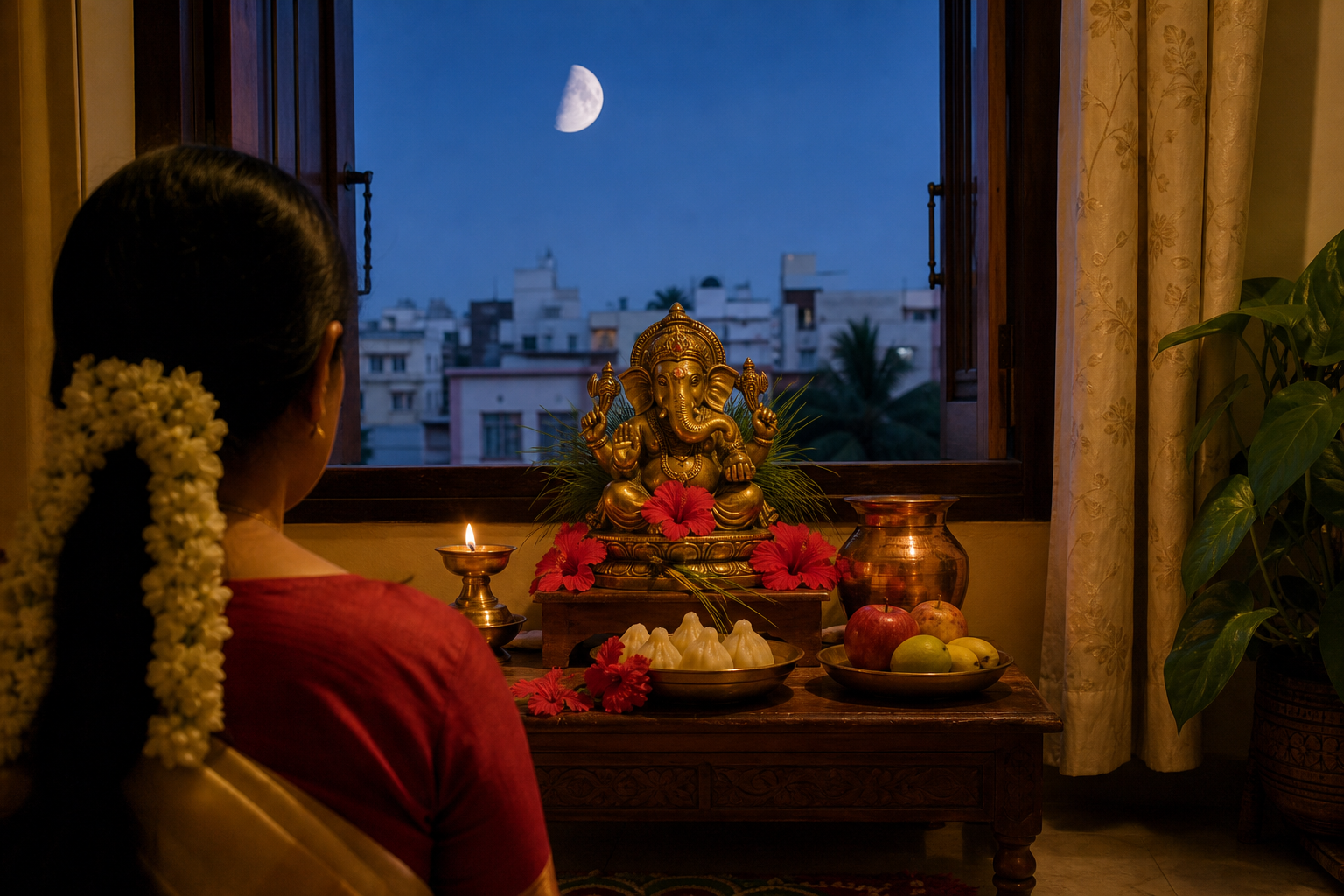
If Sankashti Chaturthi is marked on your calendar but your household no longer has a settled routine, the difficult part is often not devotion. It is knowing which date governs, how to shape the vrata, when moonrise matters, and what you are meant to learn from Ganesha’s encounter with Chandra.
A meaningful observance does not have to be elaborate. Give it four firm anchors: the correct lunar day, a sustainable vow, focused worship of Ganesha, and one concrete response to the obstacle you are placing before him.
Start with the local tithi, not a copied date
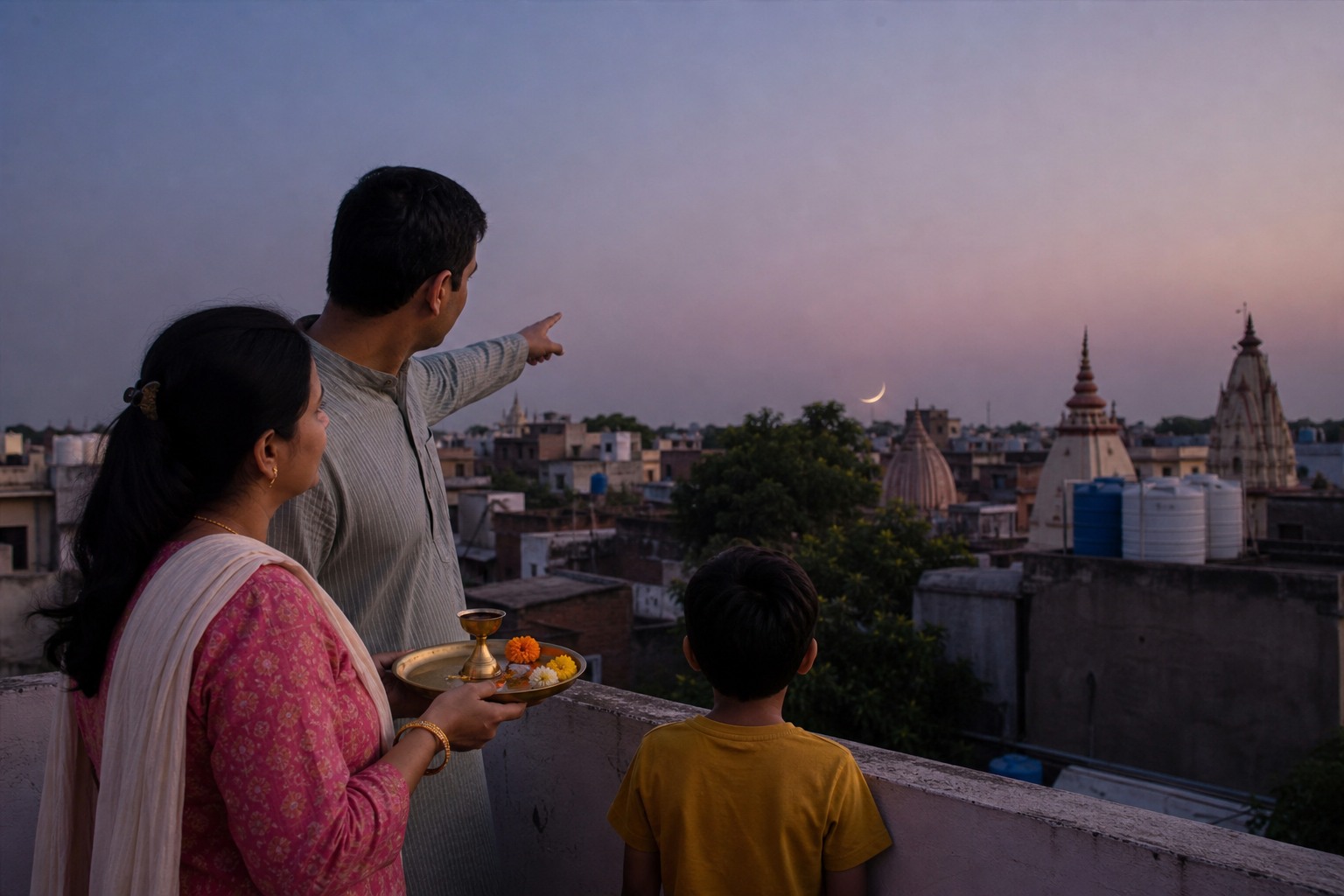
Sankashti is a Ganesha vrata observed during Krishna Paksha in every Hindu month. Its monthly recurrence is important: this is not merely an annual festival placed on a fixed civil date. It is a regular discipline tied to the lunar calendar.
Because the vrata follows a tithi, the date printed for one place should not be transferred casually to another. A lunar tithi can overlap two civil dates, while moonrise varies by location. Regional and family traditions may also differ over which part of the tithi governs the observance.
For September 2026, Sankashti Chaturthi falls on Wednesday, September 30, with moonrise listed at 8:15 p.m. Treat 8:15 p.m. as the time attached to that listing, not as a universal moonrise time. Your city may have a different time.
- Select your actual city or nearest available location in a reliable panchanga.
- Find Krishna Paksha Chaturthi and note when the tithi begins and ends.
- Check the moonrise time for the same location; do not combine a date from one city with a time from another.
- If the tithi spans two dates, follow the convention used by your household, sampradaya, or temple.
- Write the chosen date and local moonrise together so that you do not have to reconstruct the timing during the vrata.
If two trusted calendars produce different observance dates, ask which convention your family or temple follows. Consistency within a living tradition is more coherent than assembling a new rule from several calendars.
Build a vrata you can complete with attention
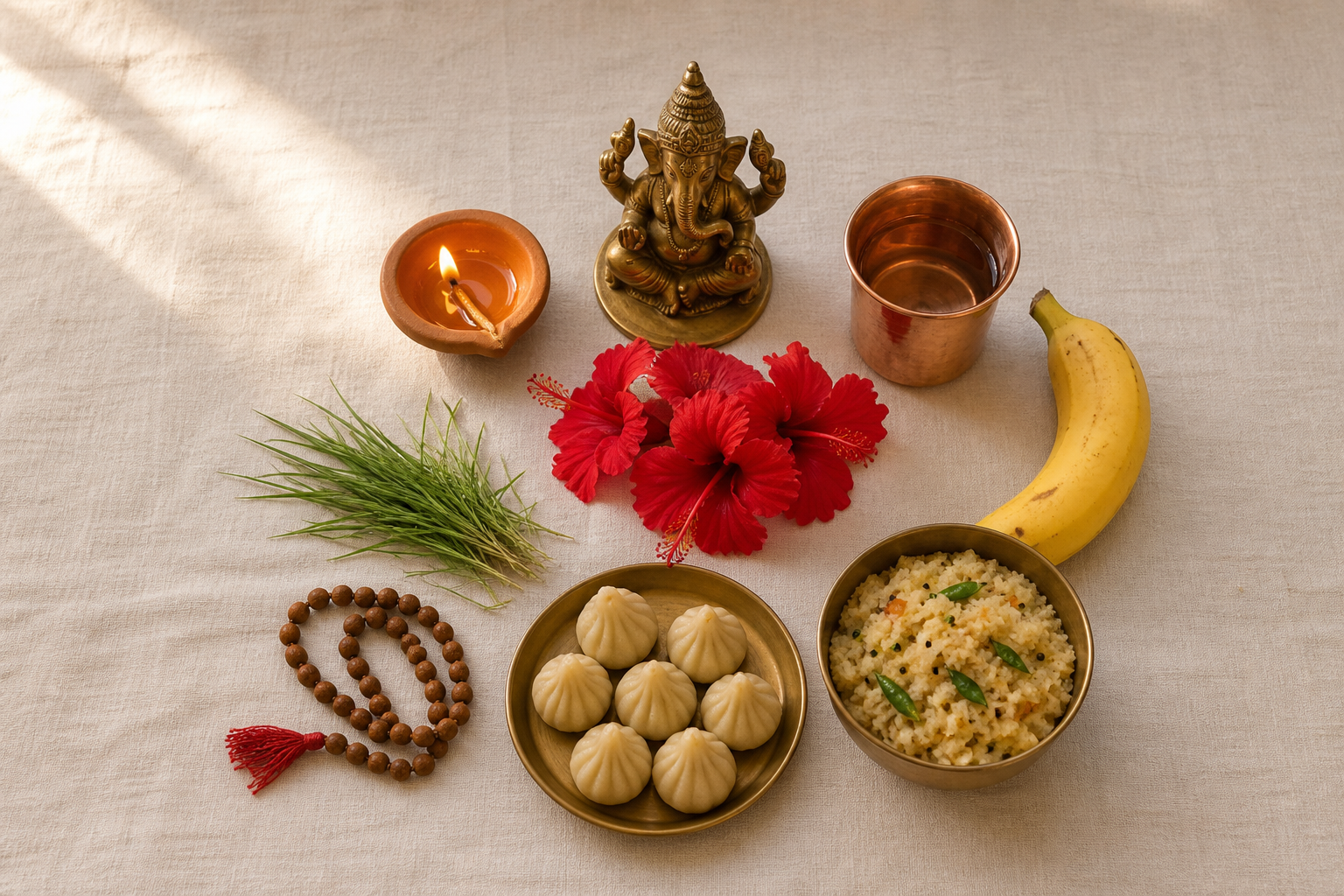
A vrata is a vowed discipline, not a contest in food deprivation. Some households observe a strict fast, while others follow a simpler form of dietary or personal restraint. Begin with the practice transmitted in your family. If that practice is unavailable, choose a modest form you can keep honestly rather than making an impressive promise that collapses halfway through the day.
If food restriction could interfere with a medical condition, pregnancy, prescribed medication, or recovery from an eating disorder, do not copy someone else’s fast. Choose a non-food discipline and seek advice from a qualified clinician when needed. The seriousness of a vrata lies in truthful commitment and remembrance of Ganesha, not in disregarding a real health risk.
- State the sankalpa plainly. Name Sankashti Chaturthi, invoke Ganesha, and identify the discipline you intend to keep.
- Choose one clear boundary. This may concern food where appropriate, but it may also be restraint in speech, distraction, anger, or another habit that strengthens the obstacle you are facing.
- Prepare a clean place for worship. Use the image or murti already honoured in your home and the customary offerings available to you. A shorter puja performed attentively is preferable to an unfamiliar sequence rushed from a screen.
- Recite the Ganesha prayer or mantra you have received or already know. If you do not have an established liturgy, offer a simple prayer in your own language rather than pretending to understand words you have copied mechanically.
- Read or hear a Sankashti katha. Pause long enough to connect its turning point with your own conduct.
- At the local moonrise time, follow your household practice for prayer and for concluding the restraint. If clouds hide the Moon, follow your panchanga and inherited convention rather than waiting indefinitely for a visual sighting.
Keep preparation proportional. A vrata meant to reduce agitation should not become a frantic search for perfect decorations, rare ingredients, or a longer ritual than your circumstances permit. Decide the sequence before the day begins, gather what you already use, and protect the time needed for prayer.
Read the Moon legend as a warning about escalation
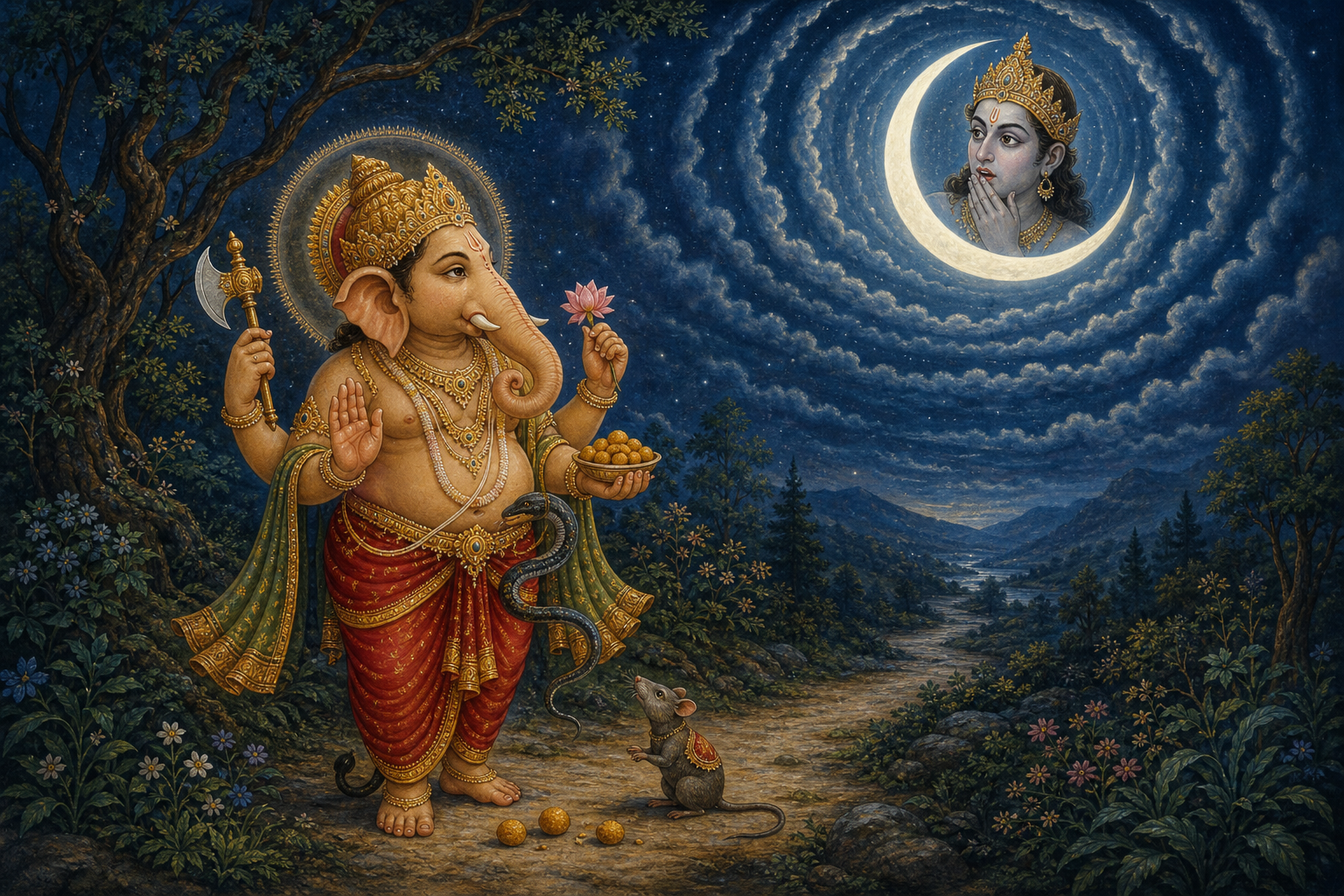
Among the Sankashti narratives associated with the Mudgala Purana is the Chandra Dosh story, which joins Ganesha’s overeating and burst belly to the episode in which he curses Chandra. In a familiar telling, the Moon laughs at Ganesha’s awkward condition, turning a mishap into a confrontation.
The episode can sound comic when told quickly, but its moral structure is severe. Appetite outruns measure. A private loss of composure becomes visible. Ridicule adds injury. Anger then enlarges the incident through speech and power. What began as one lapse spreads because no one stops the sequence.
- At the moment of overeating, ask where appetite or impulse has displaced discernment in your life.
- At the moment of exposure, notice how you behave when your dignity feels threatened.
- At the Moon’s laughter, ask whether another person’s mockery gives you permission to abandon proportion.
- At the curse, examine words spoken in anger that created a larger problem than the original offence.
This reading does not require you to discard the ritual meaning of the katha. A sacred narrative can carry divine lila, ritual memory, and ethical instruction at the same time. The mistake would be to preserve only an external precaution while ignoring the habits of appetite, mockery, pride, and reactive speech that the story exposes.
When telling the legend to children, do not make Ganesha’s body the object of the joke. Direct attention to conduct: losing measure, laughing at another’s vulnerability, and answering hurt with disproportionate anger. That preserves the story’s force without teaching that humiliation is harmless entertainment.
Give the obstacle a name and the prayer an action
The names Sankashti and Sankatahara keep sankata, difficulty or distress, at the centre of the observance. Yet asking Ganesha to remove an obstacle is not the same as waiting passively for the desired outcome. Prayer can reveal where an obstruction is external, where it is reinforced by your conduct, and where you need help beyond your own control.
Before the puja, make a four-part obstacle note:
- Name one obstacle in a single sentence. Avoid a vague request for every problem to disappear.
- Separate the condition you cannot immediately control from the response you can control.
- Choose one action that can be completed or scheduled soon after the vrata.
- Choose one habit to restrain until the next monthly Sankashti because it feeds the same obstacle.
If an application is stalled, for example, the action may be to identify and send the missing document on a named morning. If the obstacle is tension at home, the action may be to request one calm conversation at a specific time. Neither action guarantees the result you want. Each one prevents devotion from becoming a substitute for responsibility.
Return to the note at the next Sankashti Chaturthi. If the obstacle has changed, revise the action. If your conduct has changed, acknowledge it without self-congratulation. If nothing has moved, decide whether the situation calls for greater effort, patient endurance, or competent help from another person. The monthly rhythm gives you a natural point for honest review.
Key takeaways
- Sankashti Chaturthi is a monthly Krishna Paksha vrata dedicated to Ganesha, so use the lunar tithi rather than relying on a recurring civil-calendar date.
- For September 2026, the observance is on Wednesday, September 30; verify moonrise for your own location instead of assuming that the listed 8:15 p.m. applies everywhere.
- Follow your inherited fasting and puja convention where possible. If you must simplify, make the form coherent, safe, and sustainable.
- Read the Moon legend as an examination of how appetite, ridicule, wounded dignity, and angry speech can compound one another.
- Bring one precisely named obstacle to Ganesha and leave the vrata with one scheduled action and one continuing restraint.
Before you close this page, put your local tithi and moonrise in the calendar. Then write the one obstacle you will bring to Ganesha and the first action that belongs to you. That small act of clarity is already part of the vrata.
References
- Hindu Pad – Sankashti September 2026 | Sankatahara Chaturthi
- Hindu Pad – Sankashti Chaturthi Stories in Mudgala Purana
