

If you came looking for a clear account of Badrinarayan Swami’s departure, begin with what can be stated without embellishment. His Holiness departed this world on 26 February 2026 in Sri Vrindavan Dham, peacefully in his room after a brief illness. For devotees, that is both a historical event and a moment carrying deep theological meaning.
The most useful response is not to search for hidden drama in his final hours. It is to notice how his ordinary sadhana continued near life’s threshold, understand why Vrindavan matters in the Gaudiya Vaishnava tradition, and turn admiration into a more faithful way of chanting, serving, studying, and treating other devotees.
What happened in Vrindavan, and what we do not know

On 25 February, the day before his departure, Badrinarayan Swami was in a gentle and composed mood. He attended Mangal arati, returned to his MVT apartment for chanting, and indicated that he would not attend the Srimad Bhagavatam class. His servant, Abhaya Nama Das (GKG), preserved this restrained sequence of events.
Those details are simple, and their limits matter. Attending the morning worship and chanting are established actions. Seeing them as signs of devotional steadiness is a reasonable Gaudiya Vaishnava interpretation. Claiming that every choice encoded foreknowledge of his departure would be conjecture. His decision to miss the Bhagavatam class could reflect a need for rest, conservation of energy, or a preference for quiet remembrance. The act alone does not tell us which.
This distinction gives you a reliable way to handle sacred memories:
- State the event precisely: what happened, when, where, and who witnessed it.
- Identify the devotional meaning as an interpretation grounded in the tradition.
- Leave private intention private unless direct testimony establishes it.
Restraint is not a failure of devotion. It protects satya, avoids turning a teacher’s final hours into spiritual spectacle, and respects the caregivers and servants who were present. A community preserves its history best when reverence sharpens accuracy instead of replacing it.
Why Vrindavan changes the devotional meaning

Vrindavan is not merely the city in which Badrinarayan Swami happened to be staying. In Gaudiya Vaishnavism, Sri Vrindavan Dham is revered as the sacred realm of Sri Krishna’s eternal pastimes. Its temples, kirtana, Deity worship, scriptural hearing, pilgrim paths, and communities of seva continually direct consciousness toward Krishna.
That is why devotees regard departure in Vrindavan as supremely auspicious. The claim belongs to a particular theological understanding: sacred place, sustained practice, and final remembrance meet under Krishna’s grace. It should be expressed as the conviction of the bhakti tradition, not turned into an empirical formula or a ranking system for judging how other people die.
The deeper principle is antima-smriti, remembrance at the end of embodied life. Final remembrance is not a last-minute technique detached from everything that came before it. It is the ripening of daily smarana. The name remembered in difficulty is usually the name practiced in ordinary hours; the spiritual refuge sought at the end is built through repeated acts of surrender long before the end arrives.
This protects you from a common misunderstanding about sacred geography. Vrindavan is not a substitute for sadhana. Its significance lies partly in how the Dham supports remembrance through association, worship, sound, service, and the presence of a living devotional culture. If you visit Vrindavan in Badrinarayan Swami’s memory, give priority to hearing, chanting, darshan, and service. Collecting rumors or treating places connected with his final days as opportunities for intrusive curiosity would contradict the mood you came to honor.
Other dharmic traditions will recognize the wider ethical pattern without needing to collapse their distinctive teachings into Gaudiya theology. Sikh seva and simran, Jain ahimsa and cultivated equanimity, and Buddhist compassion and mindful presence all train a person to meet change through disciplined awareness and care. These parallels can support cooperation in mourning while leaving each path’s account of liberation, sacred place, and the guru-disciple relationship intact.
The final morning taught continuity, not spectacle
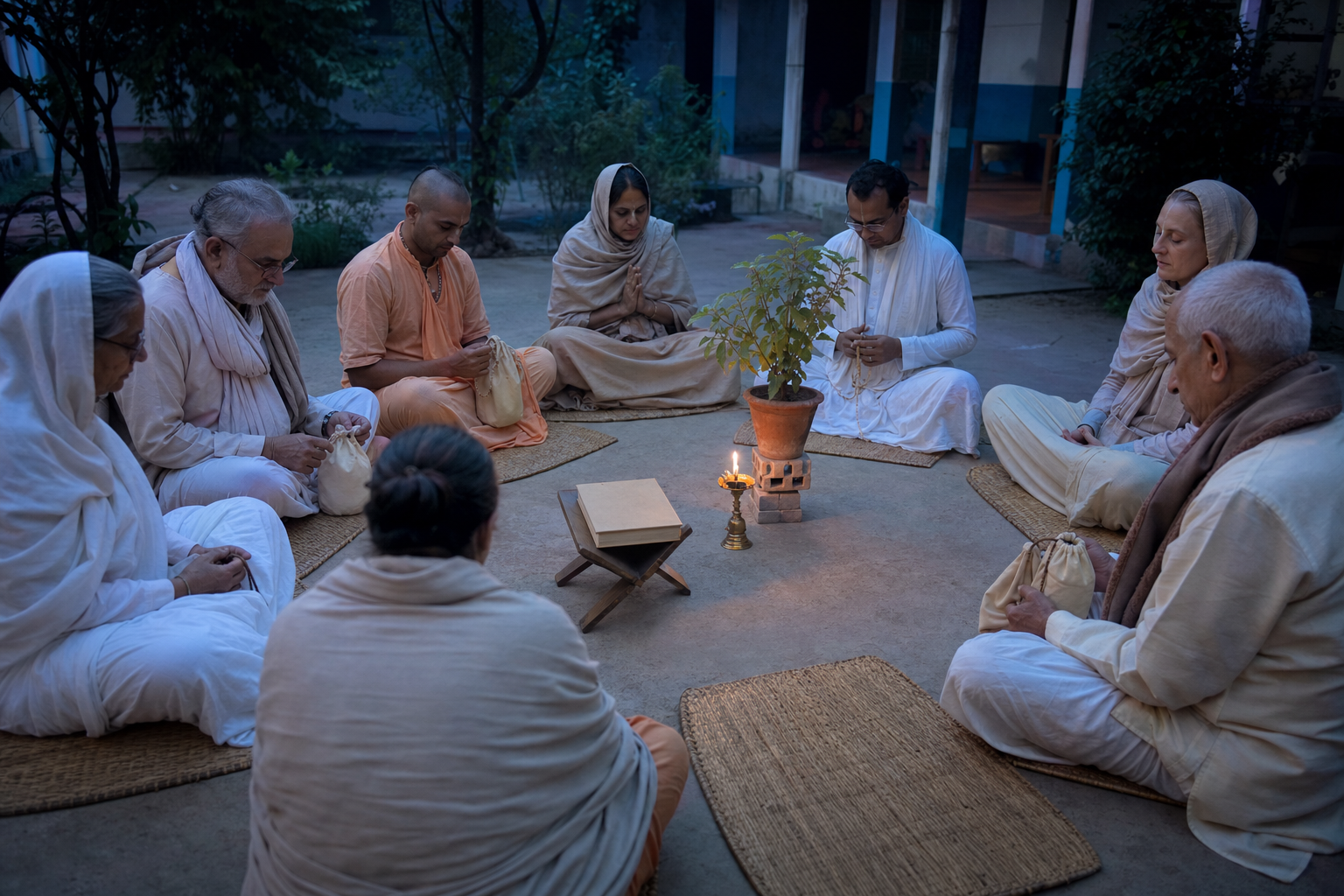
The sequence on 25 February carries force precisely because it was familiar. Badrinarayan Swami went to Mangal arati and then chanted privately. Nothing in that rhythm depended on an audience. The morning began with the same orientation that gives shape to any serious day of bhakti: approach the Lord, hear and utter the holy name, and place consciousness in service before worldly demands scatter it.
Mangal arati brings the devotee into communal worship. In the language of the nine processes of bhakti, it engages arcanam and vandanam through worship and prayer. Japa turns toward kirtanam and smaranam through the repeated holy name and deliberate remembrance. Abhaya Nama Das’s attentive care expresses dasyam, loving service, in practical form. The morning therefore joined public devotion, interior practice, and personal seva without requiring an elaborate event.
His absence from the Bhagavatam class should not be twisted into a dismissal of scriptural hearing. Srimad Bhagavatam remained central to the devotional culture he taught. A single change in schedule shows that mature discipline is not mechanical rigidity. The body may require rest, and circumstances may alter the outward form, while remembrance remains the governing purpose.
You can apply that distinction when your own routine is disrupted. Do not use a missed temple program as permission to abandon the day, and do not treat physical attendance as the only measure of devotion. Protect the core movement of the practice in a form your circumstances permit: remember Krishna, chant attentively, hear shastra when able, and perform the service actually in front of you. Adaptation should preserve the purpose rather than quietly erase it.
The attendant’s role also deserves notice. Guru-seva is not background labor beneath the supposedly important spiritual moment. Bringing what is needed, observing carefully, protecting quiet, and preserving truthful testimony are themselves contemplative acts. If you are caring for an elder, teacher, or grieving devotee, the immediate need may be more sacred than your desire to witness something memorable.
Turn his leadership into a living memorial
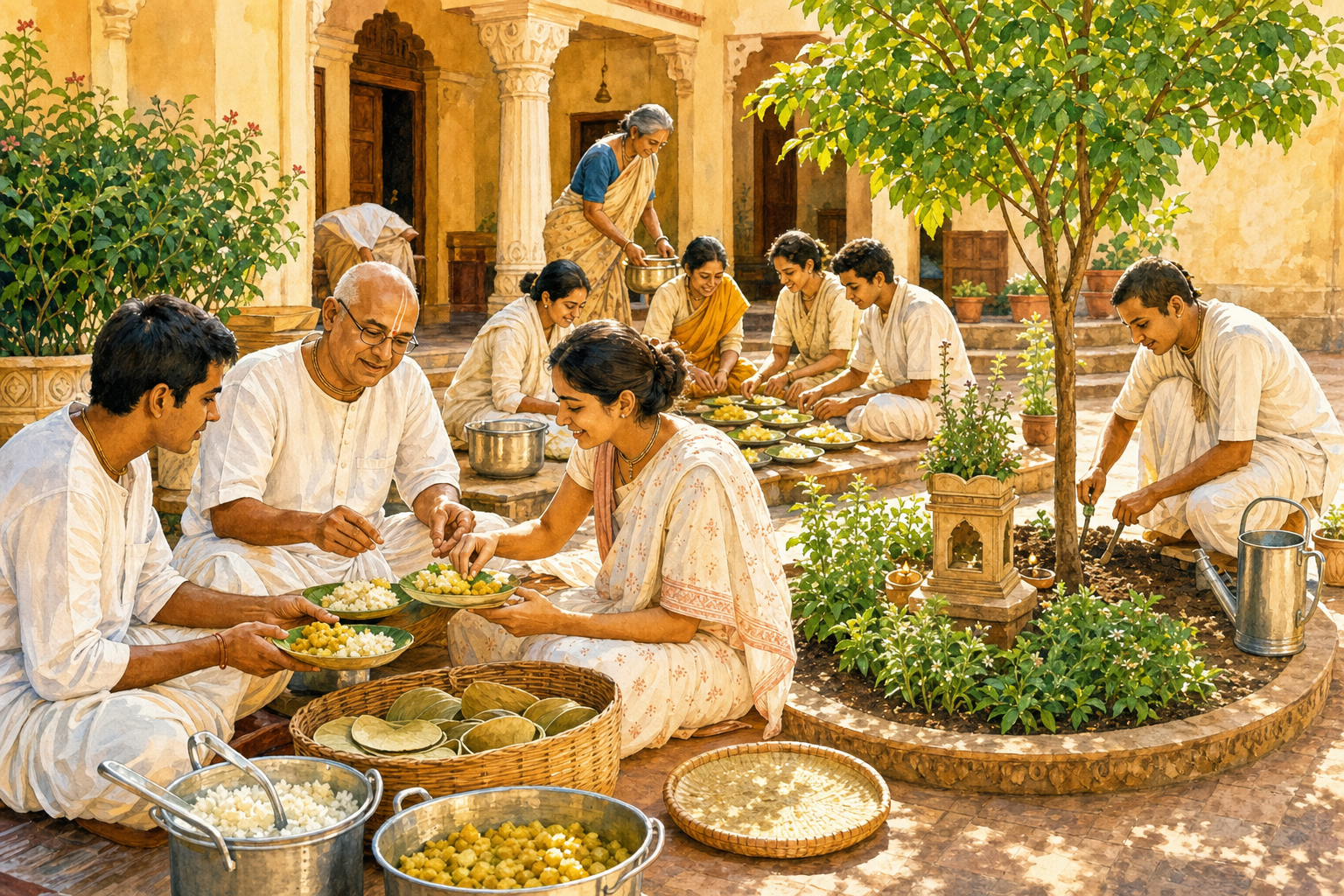
Badrinarayan Swami was respected for clear exposition of Gaudiya Vaishnava philosophy, fidelity to Srila Prabhupada’s mission, intellectual rigor, and pastoral compassion. He could connect scriptural principle with the actual choices confronting a devotee or community. That combination matters because doctrinal accuracy without care can become a weapon, while kindness detached from siddhanta can lose direction.
Three strands offer a practical measure of his legacy: fidelity to shastra over fashion, patience over polemics, and compassion over condemnation. These are not ornamental descriptions. They can change how you handle the next disagreement in a temple committee, family, congregation, or online devotional space.
Begin by identifying the principle before defending a preferred policy. Listen long enough to state the other person’s concern accurately. Then ask whether your proposed response preserves both truth and the dignity of the person hearing it. Invoking guru-sadhu-shastra should discipline your interpretation and ego; it should not turn a quotation into permission to humiliate someone.
A useful memorial can therefore be built from ordinary commitments:
- Protect the beginning of the day. Attend Mangal arati where possible, or reserve the first quiet portion of your morning for prayer and the holy name before messages and duties take over.
- Pair hearing with application. Read or hear from Bhagavad-gita or Srimad Bhagavatam, then identify the decision or habit the teaching should change. Inspiration that never reaches conduct remains incomplete.
- Turn grief into seva. Support affected devotees, help with prasada distribution, assist a temple program, or quietly complete an unglamorous task that strengthens the community.
- Preserve memories responsibly. Record the date, place, context, and names connected with a recollection. Mark exact words as exact only when you are certain; otherwise identify them as a paraphrase. Seek consent before sharing private details.
- Carry patience into conflict. In the next serious disagreement, slow down before advising, distinguish the person from the disputed position, and choose language that leaves room for correction without condemnation.
You do not need to have been his disciple, met him personally, or witnessed his final days to participate honestly. You can honor a Vaishnava teacher without borrowing another person’s intimacy. Chanting, hearing, service, careful speech, and support for the sangha are available to anyone willing to practice them sincerely.
Questions that deserve careful answers
Did Badrinarayan Swami know that his departure was near?
The known sequence does not establish that. His calm mood, attendance at Mangal arati, private chanting, and decision to miss class can be honored without claiming access to his unspoken awareness. Devotional interpretation may see spiritual readiness in his steadiness, but readiness is not the same as demonstrated foreknowledge.
Does leaving the body in Vrindavan prove spiritual attainment?
Gaudiya Vaishnavas regard departure in Vrindavan as an extraordinary blessing because the Dham is inseparable from remembrance of Krishna. Spiritual attainment, however, is not a status that observers can calculate from geography alone. The fitting response is gratitude for the auspicious circumstances, not comparison with devotees whose final moments occurred elsewhere.
What is the most faithful way to remember him?
Let remembrance alter a recurring part of your life. Make your japa more attentive, bring one scriptural principle into a difficult decision, serve without seeking visibility, or become more patient with a devotee you find hard to understand. A memorial becomes a legacy when it changes conduct after the public mourning has passed.
The next time Badrinarayan Swami’s name is spoken, do not stop at a reverential adjective. Protect the accuracy of his memory, protect a place for the holy name in your morning, and make your next difficult act of service both more principled and more compassionate. That is how a peaceful departure in Vrindavan continues to teach.
References
- Dandavats — A Sacred Farewell: HH Badrinarayan Swami’s Final Day of Bhakti, Stillness, and Grace
- Dandavats — Honoring His Holiness Badrinarayan Swami: A Peaceful Vrindavan Departure and Enduring Bhakti Legacy
