
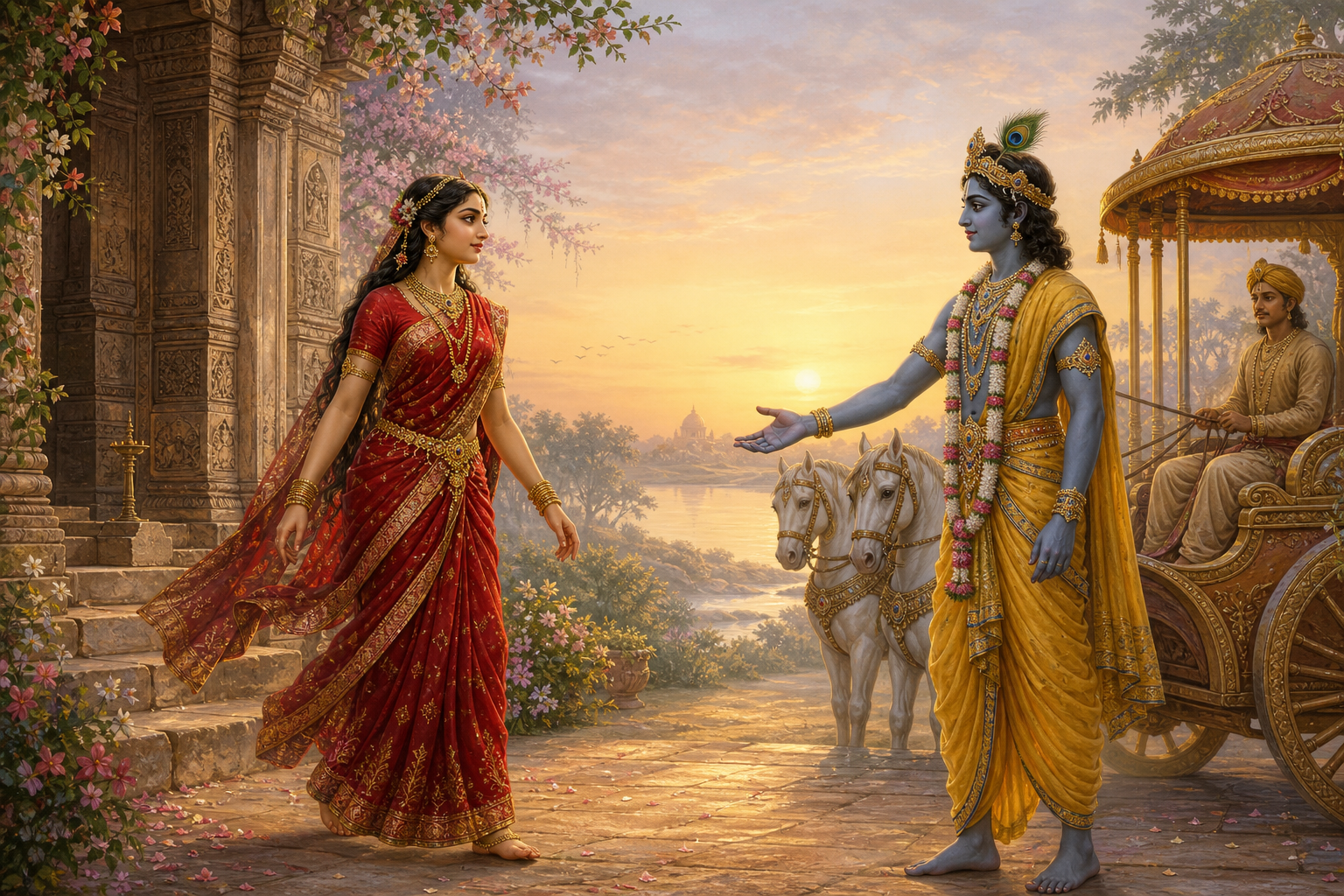
You may have come to Rukmini Harana with a practical question: does this tradition celebrate a wedding, an abduction, or something more difficult to translate? The answer matters, especially if you are explaining the festival to children, introducing it at a temple event, or trying to observe it without reducing Rukmini to a passive bride.
Begin with the fact that gives the narrative its moral direction: Rukmini wants to marry Krishna, while her brother obstructs that choice. The tradition culminates in their marriage. If you keep Rukmini’s will at the centre, the meaning becomes much clearer.
Read the harana through Rukmini’s choice
The word harana is often rendered in English as “carrying away” or “abduction.” On its own, that translation can make the episode sound like the seizure of an unwilling woman. That is not an adequate account of this tradition.
Rukmini is the princess of Vidarbha, and she longs to wed Krishna but faces opposition from her brother. Her desire is therefore not a decorative detail added to a story about Krishna. It is the fact that distinguishes rescue from coercion and chosen union from forced possession.
When you retell the episode, preserve three elements in this order:
- Rukmini desires marriage with Krishna.
- Her brother stands between her and that desired union.
- The harana leads to the marriage of Rukmini and Krishna.
That order prevents a common misreading. If a retelling begins with Krishna carrying Rukmini away and only later mentions what she wanted, the dramatic action overwhelms the ethical distinction. Begin with her choice, because her choice tells the listener what the action means.
This does not require pretending that an ancient sacred narrative uses every category of modern social debate. It requires something simpler: refusing to erase a woman’s stated desire from a story whose resolution fulfils that desire. Rukmini is not a prize transferred between men. Her longing supplies the narrative’s direction.
Why Puri celebrates a marriage, not merely an escape
At the Jagannath Temple in Puri, Rukmini Harana is celebrated as a grand festival of the marriage of Madanmohan and Rukmini. That ceremonial focus is an interpretive guide. The carrying away is the crisis of the narrative; marriage is its destination.
This distinction changes what you should notice at the festival. The event is not important merely because Krishna performs a daring act. Its devotional centre is a union sought by Rukmini and completed despite the obstruction placed before it. Courage serves commitment; it is not spectacle for its own sake.
If you plan to attend the Puri celebration, separate the enduring meaning from the year’s practical arrangements. Confirm the current temple programme rather than assuming that a brief story outline supplies the procession route, access rules, or ritual sequence. Ask concrete questions:
- On which locally observed date will the festival take place?
- Which portions of the observance can visitors witness?
- Are timings given for a ritual, a procession, or general darshan?
- Does the announced time refer to entry, commencement, or the principal ceremonial moment?
Those questions matter because a festival name tells you what is commemorated, not every logistical detail of a living temple observance. Use the temple’s own announcement for attendance decisions.
Use the lunar date, not last year’s civil date
Rukmini Harana at Puri falls on Nirjala Ekadashi, identified calendrically as Jyeshtha Shukla Ekadashi. Ekadashi is the eleventh lunar tithi, while Shukla places it in the bright or waxing half of the month of Jyeshtha.
That description is more useful than memorising a date from a previous year. A lunar tithi does not return on one fixed Gregorian calendar date. If you are planning travel, a community programme, or a home observance, check the relevant year’s panchanga and the Puri temple’s announced date before committing to tickets or invitations.
If two calendars give different civil-date labels, do not resolve the difference by guessing. For attendance at Puri, follow the date announced for the temple celebration. For a home or community observance elsewhere, follow one recognised local panchanga or your sampradaya’s established calendar consistently. State which calendar you are using when inviting others; that one line prevents avoidable confusion.
Nirjala Ekadashi has its own wider religious associations, but the name alone does not establish every person’s fasting duty or the complete ritual procedure for Rukmini Harana. Keep the calendrical identification distinct from any vrata instructions received through your family, temple, or sampradaya.
How to mark Rukmini Harana without inventing a ritual
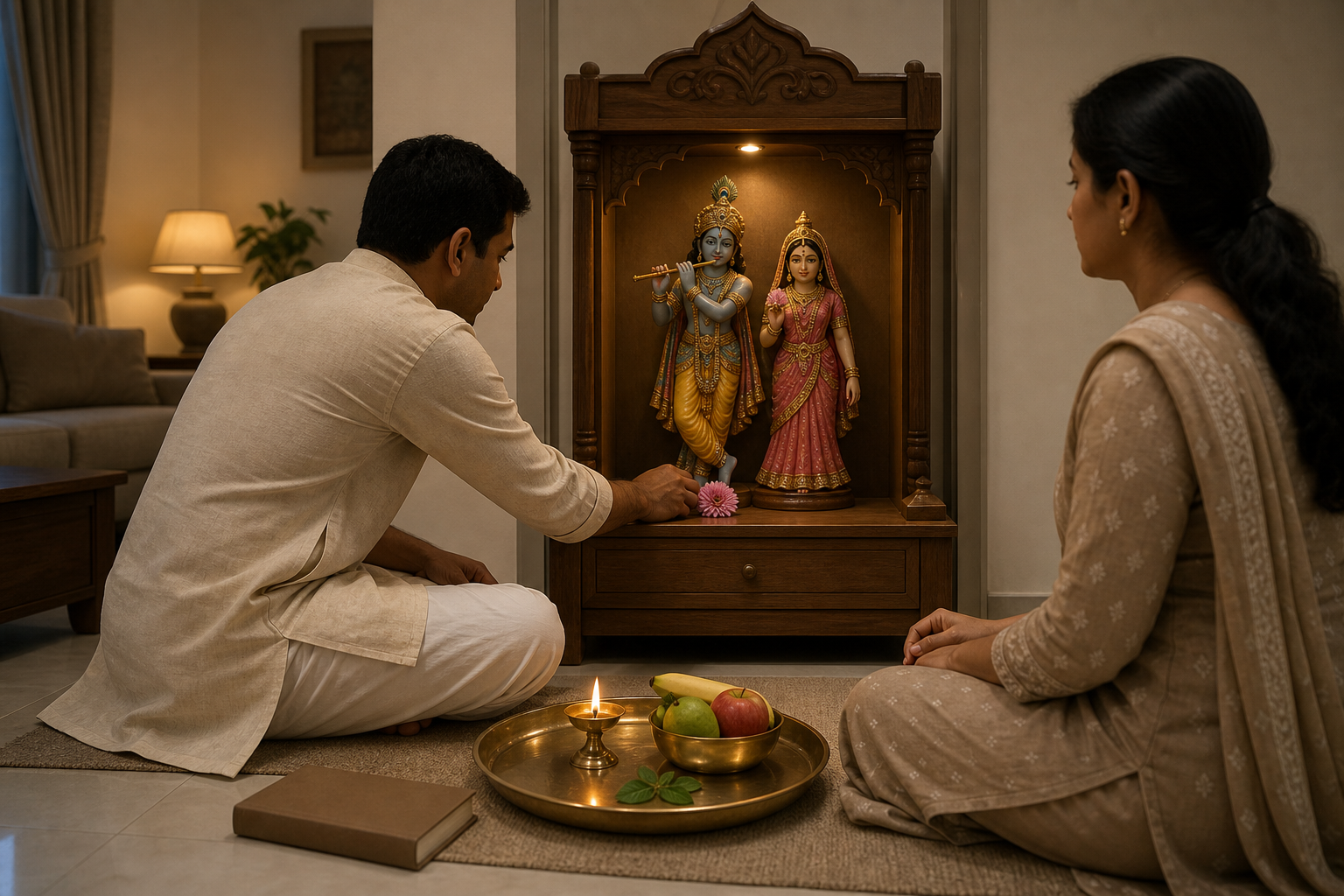
You do not need to manufacture an elaborate ceremony to make the day meaningful. If your family or temple already has an inherited vidhi, follow it. If it does not, describe your gathering honestly as a devotional remembrance rather than presenting newly assembled steps as a canonical Rukmini Harana rite.
A clear home or community observance can be organised in five steps:
- Fix the correct day. Use Jyeshtha Shukla Ekadashi in the current year’s calendar rather than copying a past Gregorian date.
- Name the occasion accurately. Say that you are remembering the desired union and marriage of Rukmini and Krishna, not celebrating the capture of an unwilling bride.
- Retell only what you can support. Establish Rukmini’s longing, her brother’s opposition, the harana, and the marriage. Do not fill gaps with dramatic details and then call them universal tradition.
- Use your ordinary devotional framework. If your household already has a recognised form of puja, nama-smarana, or reading, place the remembrance within that practice. Label optional additions as local or personal choices.
- Discuss the moral hinge. Ask what changes once the listener knows Rukmini’s will. This turns the episode from spectacle into reflection on devotion, agency, obstruction, and rightful action.
For children, one sentence can carry the distinction: “Rukmini wanted Krishna as her husband, and the harana overcame the obstacle to that chosen marriage.” Older participants can examine why leaving out her intention produces a fundamentally different story.
For a public programme, distinguish three layers in your printed or spoken introduction: the narrative being remembered, the Puri temple festival, and any practices your own community has added. This protects both accuracy and diversity. A local custom can be honoured without being presented as mandatory everywhere.
What the tradition asks you to notice
Rukmini Harana is easily flattened in two opposite directions. One version turns it into a romantic adventure and treats Rukmini as scenery. Another sees the word “abduction,” assumes unwillingness, and stops reading. Both approaches discard the fact that interprets the event: Rukmini desires the union that the narrative brings about.
A more careful reading notices the relationship between devotion and decision. Rukmini’s longing is not shown as irrelevant because a family member objects. Nor does Krishna’s action acquire meaning merely from force or daring. It is directed toward the marriage she seeks.
This gives you a practical test for any sermon, performance, social-media caption, or children’s retelling. Ask three questions:
- Does it tell the audience what Rukmini wants?
- Does it identify the brother’s opposition as an obstacle rather than as proof of her unwillingness?
- Does it show that marriage, not seizure, is the culmination?
If the answer to one of these is no, revise the presentation before sharing it. The missing element is not a minor nuance; it controls how the entire episode will be understood.
Key takeaways
- Rukmini Harana commemorates the marriage of Rukmini and Krishna; at Puri, it is celebrated as the marriage festival of Madanmohan and Rukmini.
- Rukmini’s desire to wed Krishna is the key to interpreting the harana. Her brother’s opposition does not make her an unwilling bride.
- The Puri festival falls on Nirjala Ekadashi, or Jyeshtha Shukla Ekadashi. Confirm the current year’s civil date rather than reusing an old one.
- When explaining the tradition, state Rukmini’s choice before describing Krishna’s dramatic action.
- If you have no inherited ritual procedure, hold a plainly labelled devotional remembrance instead of inventing a supposedly universal vidhi.
Before the next Jyeshtha Shukla Ekadashi, put the verified date in your calendar and review the language you plan to use. One deliberate choice will improve any observance: tell Rukmini’s intention first, then let the harana and marriage be understood in its light.
References
