
If you are trying to understand why Tamil New Year arrives in April rather than on 1 January or at the March equinox, the answer lies in what the Tamil calendar measures. Puthandu begins a solar month at a precise sidereal transition; it is not simply a cultural anniversary assigned to a convenient civil date.
Once you understand that distinction, you can read a panchangam more confidently, choose the correct observance date for your location, and preserve the festival’s meaning without turning every regional custom into a compulsory rule.
Why Puthandu falls near 14 April, not the March equinox

Puthandu is also called Varusha Pirappu, Chithirai Pirappu, Chithirai Vishu, or simply Chithirai 1. Each name directs you toward the same calendrical event: the beginning of Chithirai, the first month of the Tamil solar year.
That month begins at Mesha Sankranti, when the Sun moves from Meena Rashi into Mesha Rashi in the nirayana, or sidereal, zodiac. In technical terms, the ingress occurs when the Sun’s sidereal ecliptic longitude reaches 0 degrees 00 minutes of Mesha. Contemporary panchangams commonly calculate this using the Chitrapaksha, or Lahiri, ayanamsa.
This is not the same Aries point used in the tropical zodiac. The tropical system keeps its starting point aligned with the March equinox, while the sidereal system accounts for the long-term shift produced by the precession of the equinoxes. That is why tropical Aries begins around 20-21 March while the sidereal Mesha ingress occurs near 14 April.
| Question | Tropical reckoning | Tamil sidereal reckoning |
|---|---|---|
| What anchors Aries? | The March equinox | The nirayana zodiac |
| When does Aries begin? | Around 20-21 March | Near 14 April |
| Does it begin Chithirai? | No | Yes; Mesha Sankranti begins Chithirai 1 |
So Puthandu is not a delayed version of an equinoctial New Year. It belongs to a different astronomical framework. When someone asks why Tamil New Year is almost four weeks after the March equinox, you can answer directly: one date follows tropical Aries, while Puthandu follows the Sun’s sidereal entry into Mesha.
How to read a Puthandu date without confusing the moment and the day

Mesha Sankranti is an astronomical instant, but families observe Puthandu on a civil day. That distinction matters most when you live outside India or consult calendars prepared for different cities. An ingress calculated for Indian Standard Time may fall at another local hour – and sometimes another local date – where you live.
Use this sequence whenever you check the Tamil New Year date:
- Choose a panchangam for your location. Check the city or time zone printed on the calendar rather than assuming an India-based time applies unchanged throughout the diaspora.
- Find Mesha Sankranti. This is the exact solar ingress. Do not confuse it with a general sunrise time, a temple opening time, or the start of a Western zodiac sign.
- Record the ingress and festival date separately. One identifies the astronomical transition; the other tells you which civil day your community observes as Chithirai 1.
- Confirm the month and year name. The entry should identify Chithirai 1 and may also give the new samvatsara in the traditional 60-year cycle.
- Check your temple’s schedule. A temple may publish a specific puja, abhishekam, alankaram, or punyakala programme around the transition. Use that local notice when planning attendance.
For the 2026 calendar, Puthandu was widely observed on Tuesday, 14 April in India. Chithirai 1 inaugurated Parabhava Nama Samvatsaram for the Tamil solar year extending into 2027.
Parabhava is the year’s name within a repeating 60-year Jovian cycle used by several Indian calendrical traditions. It is not another month, and it does not replace the ordinary month-and-day notation. Nor should the name be treated as a verdict that predetermines personal or national events. Its sound use is calendrical: it gives the year a traditional identity and locates it within a larger cycle.
A shared solar threshold does not make every New Year identical
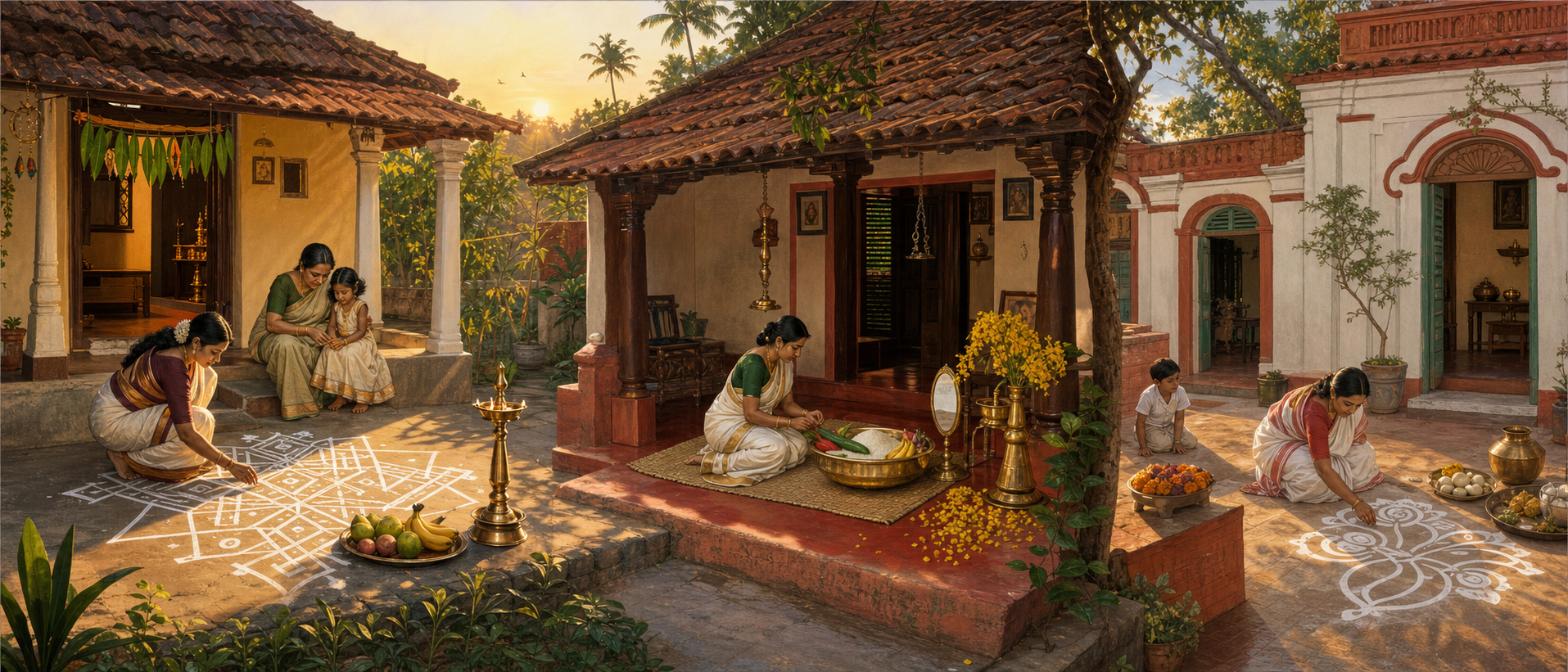
The cluster of New Year observances around mid-April is not accidental. The sidereal Mesha ingress also provides the calendrical setting for Vishu, Vaishakhi, Pohela Boishakh, Bohag Bihu, and the Sinhala and Tamil New Year. Theravada Buddhist New Year observances in parts of Southeast Asia also belong to this wider seasonal neighbourhood.
This convergence reveals a civilizational way of keeping time. Different communities watched the solar year, recognised the seasonal threshold, and expressed renewal through their own languages, foods, sacred institutions, and inherited practices. Hindu, Buddhist, Jain, and Sikh communities do not need identical theology or ritual to participate in a related rhythm of time.
The distinction is important. Puthandu should not be renamed as another region’s festival, and another community’s observance should not be treated as merely a local version of Puthandu. Vishu’s elaborate kani, Sikh traditions surrounding Vaishakhi, Bengal’s Pohela Boishakh, and Assam’s Bohag Bihu each carry their own histories and meanings. What they share is calendrical architecture, not complete ritual interchangeability.
You can therefore recognise unity without erasing difference. That is a particularly Dharmic form of cultural continuity: a common cosmic rhythm allows many legitimate expressions rather than demanding a single standardised ceremony.
Plan an observance that is rooted, manageable, and honest
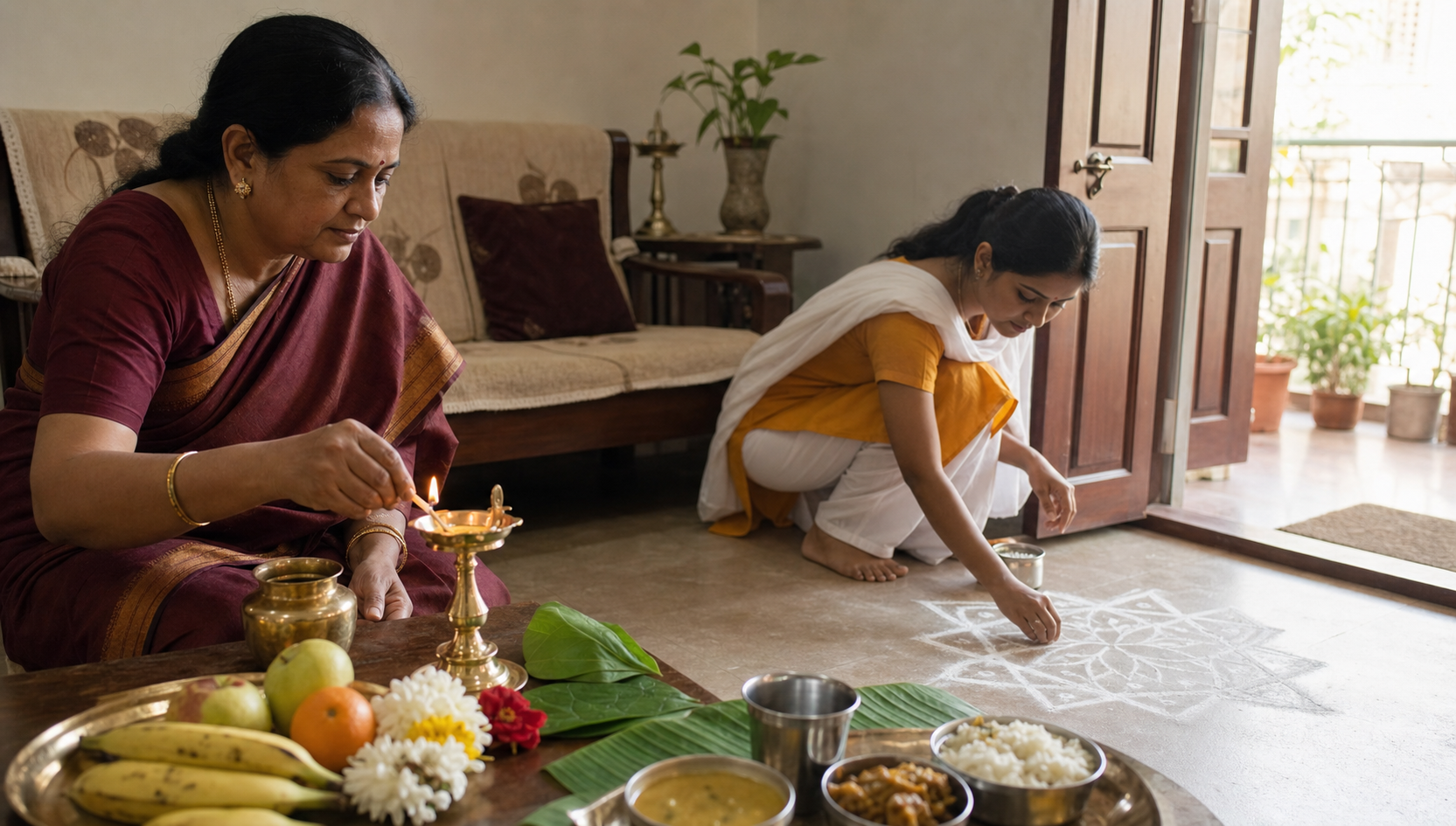
There is no need to collect every custom you see online and perform all of them as though they were universally mandatory. Begin with the practices your family or temple has actually inherited. Then organise the day around preparation, worship, relationship, and generosity.
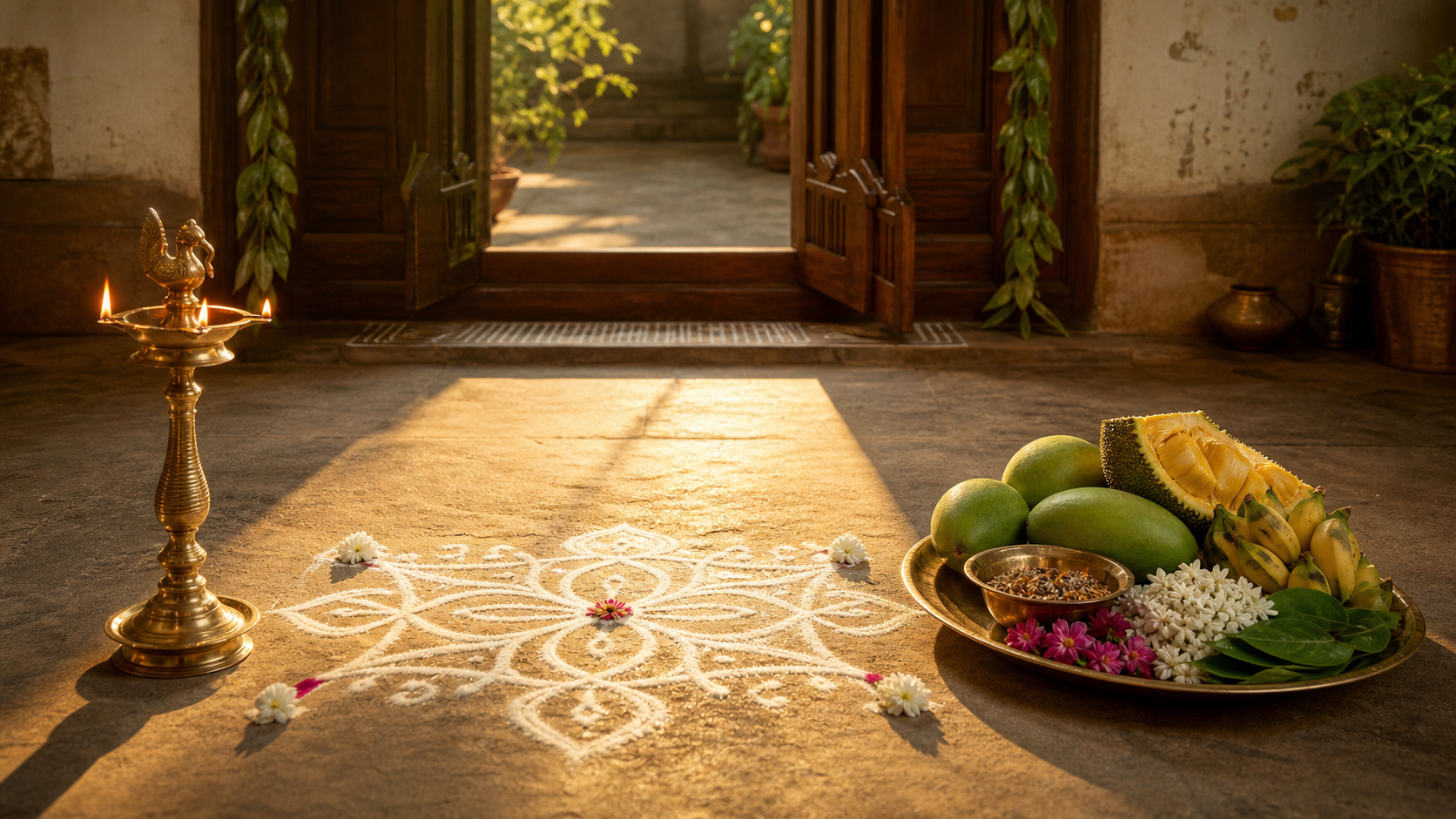
- Prepare the home. Clean the principal living and worship spaces. If they belong to your household tradition, draw a kolam at the entrance and hang a mango-leaf toranam. These acts turn the threshold of the home into a visible sign of renewal.
- Begin with an auspicious sight. Some Tamil households arrange fruits, flowers, coins, jewelry, a mirror, betel leaves and nuts, or sacred books for the first sight of the morning. Treat this as an optional family or regional practice. The highly codified kani is most closely associated with Kerala’s Vishu, although related forms of auspicious first-seeing have existed in Tamil settings.
- Anchor worship to the calendar. Light a lamp, pray, meditate, or sit quietly around the transition or during the locally prescribed punyakala. If exact timing matters to your observance, use the time given by your local panchangam rather than copying a clock time from another country.
- Hear the year’s calendar. Attend a panchanga shravanam where available. It places the new year within its solar, seasonal, and ritual framework instead of leaving Puthandu as an isolated feast day.
- Renew family bonds. Seek the blessings of elders, exchange Puthandu Vazthukal, and give kai-visesham where that custom is observed. A token gift matters less for its price than for the relationship it acknowledges.
- Include dana. Set aside food, money, or useful goods for someone beyond your household. Generosity gives the idea of an auspicious beginning an ethical form rather than leaving it at decoration and consumption.
The festive meal should follow the same principle: preserve what is living in your family rather than assembling an artificial checklist. Payasam, savoury dishes, and preparations using the early summer mango harvest commonly appear. Some households make a pachadi with raw mango and neem flowers, bringing contrasting tastes together as an image of life’s changing experiences. The point of arusuvai, the range of tastes, is not to pretend that a new year will contain only sweetness. It invites you to meet sweetness, bitterness, sharpness, and surprise without abandoning steadiness.
Temple worship can extend the observance beyond the home. Special abhishekams and alankarams mark Puthandu in Tamil temples, while the wider month of Chithirai carries major sacred festivals. In Madurai, the Chithirai Thiruvizha includes Meenakshi Kalyanam and the procession of Kallazhagar toward the Vaigai. Checking the whole Chithirai programme at your local temple may therefore reveal a fuller season of participation, not just a single morning event.
Key takeaways
- Puthandu begins Chithirai at the Sun’s sidereal entry into Mesha, not at the tropical March equinox.
- The ingress is an exact moment; the observed festival date must be checked for your city and time zone.
- In 2026, Puthandu was widely observed on Tuesday, 14 April in India and began Parabhava Nama Samvatsaram.
- The mid-April New Year cluster across Bharat and neighbouring cultures reflects shared solar timekeeping, but the festivals remain distinct traditions.
- Family lineage and local temple practice should guide your rituals; optional regional customs need not be presented as universal obligations.
For your next Puthandu, save a locally calculated panchangam and make a one-page family plan containing four things: the festival date, the Sankranti time, the temple programme, and one act of dana. Add the meal and household customs your elders want preserved. That small record will make the observance easier to practise now and easier to transmit later.
References
