
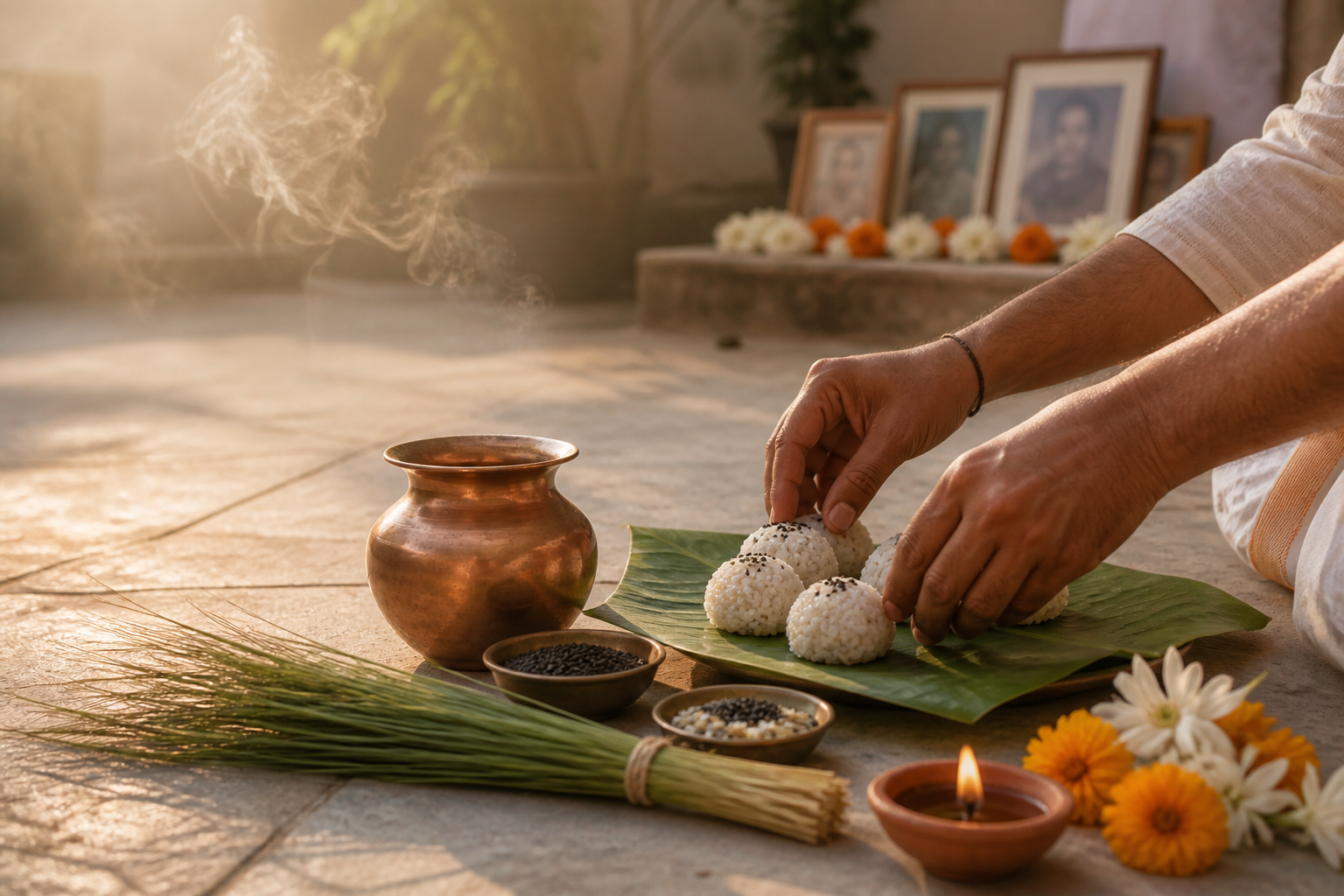
If you are responsible for your family’s ancestral observance this year, the immediate questions are simple: which date should you keep free, whose custom should you follow, and what must be arranged beforehand? For Pitru Paksha 2026, begin those conversations well before the end of September.
You do not need to invent a perfectly uniform ceremony. You need a confirmed local date, reliable guidance for your family’s tradition, the names of the ancestors being remembered, and enough preparation to perform the rite without haste.
Mark the 2026 dates, then confirm the applicable tithi
Pitru Paksha 2026 begins on September 27 and concludes on October 10 with Mahalaya Amavasya tarpan. Keep the whole period visible on your family calendar, even if you expect to perform only one principal observance.
You may encounter the names Pitru Paksha, Mahalaya Paksha and Shraddh Paksha for this period. North Indian calendars place the observance in Ashwin. Regional calendars can label the lunar month differently, however, and a lunar tithi does not necessarily begin at midnight. That is why a civil date copied from a general calendar is the start of your planning, not the end of it.
Before booking a priest, travelling or asking relatives to take time off, give a trusted temple or family priest your city and the calendar tradition your household follows. Ask four precise questions:
- Which civil date corresponds to the required ancestral tithi in our location?
- At what local time should the rite be performed?
- Should we observe the known death tithi, Mahalaya Amavasya on October 10, or both?
- Does our family custom call for tarpan alone or a fuller shraddha procedure?
This distinction matters. Tarpan generally refers to the reverential offering of water, while shraddha can involve a more complete sequence of ancestral offerings and duties. The exact relationship between the two is shaped by lineage, region and the priestly tradition being followed. Do not assume that a checklist from another community is interchangeable with yours.
Let family continuity determine the form of the rite
The first-time organiser often looks online for one definitive ritual. That search usually produces conflicting ingredient lists, mantras and rules because Hindu ancestral practice is not expressed through one household procedure everywhere. A useful decision order is family custom first, established priestly guidance second, and generic instructions only as background.
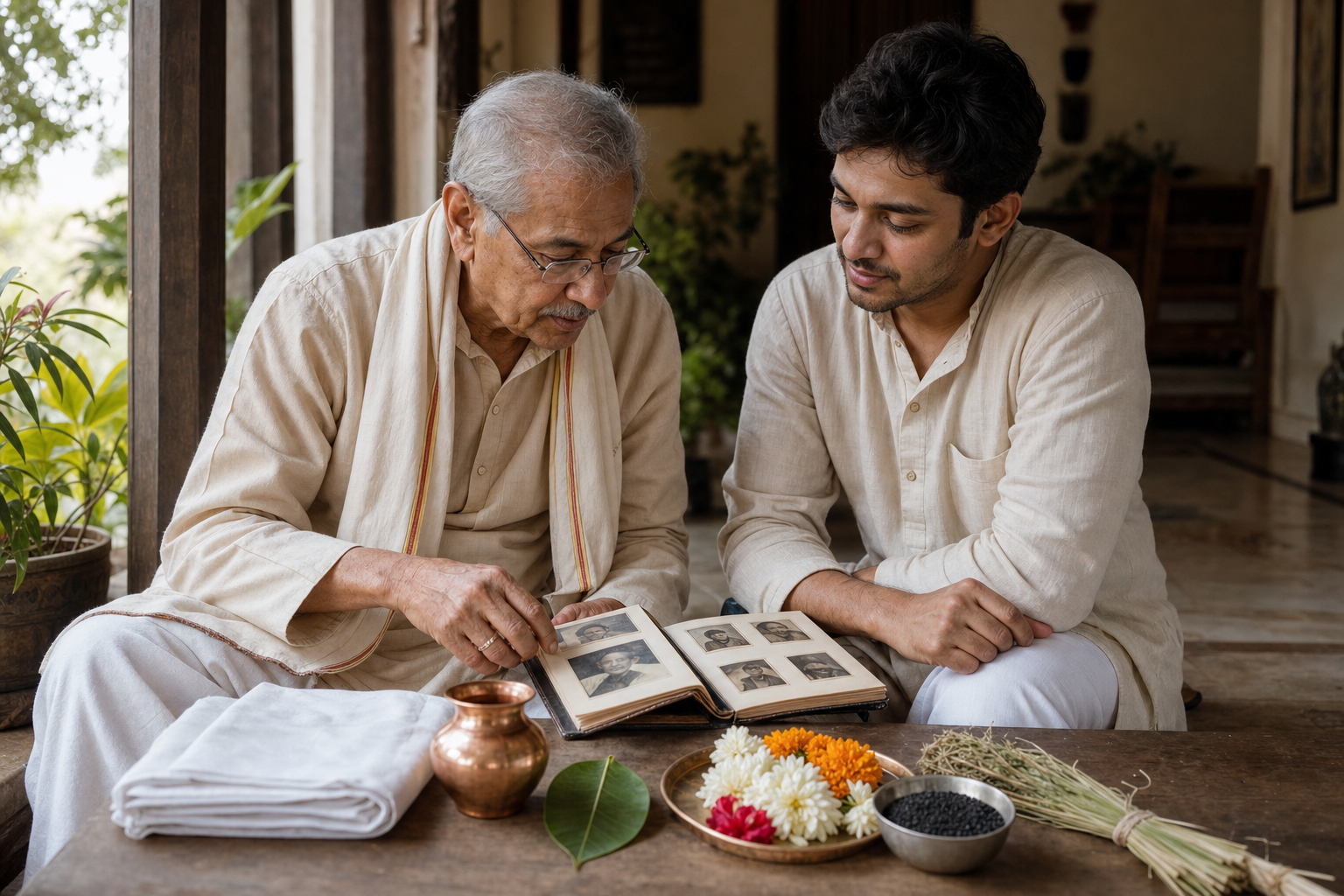
- Speak with the eldest relatives who remember how the family observed Pitru Paksha. Ask where it was performed, who guided it, which ancestors were named and whether food, gifts or feeding formed part of the observance.
- Contact the priest or temple normally associated with the family. If that is no longer possible, find someone familiar with the same regional or sectarian tradition and explain what you know rather than pretending certainty.
- Write down the ancestors’ names and their relationships to the person performing the rite. Include the family’s gotra or other lineage details only if known; do not guess.
- Ask the priest who may perform the rite in your present circumstances. Questions about eligibility can receive different answers across traditions, especially when the customary performer is unavailable.
- Record the agreed procedure in plain language so the next generation does not have to reconstruct it again.
If two branches of the family remember different customs, do not turn Pitru Paksha into a contest over which memory is more authentic. Identify the practice each branch actually inherited, consult the relevant priestly authorities, and allow separate observances when forcing a hybrid ceremony would satisfy no tradition. Shared remembrance does not require every household to use an identical ritual form.
The same restraint applies to mantras. If you have not learned the required recitation, ask for guided pronunciation, a transliteration or the simplest valid procedure accepted in your tradition. Quietly following competent guidance is preferable to reciting unfamiliar words from an unverified recording while losing track of the rite’s purpose.
Prepare a one-page ritual brief before September 27
Most avoidable problems are logistical: a missing name, an unconfirmed time, an ingredient that is unavailable locally, or relatives discovering the plan after travel is impossible. Put the following information on one page and share it with everyone directly involved:
- The confirmed date, local start time and location.
- The name and contact details of the priest or temple providing guidance.
- The names and relationships of the ancestors to be remembered, checked against family records where possible.
- The form of observance being performed: tarpan, fuller shraddha, or a family remembrance conducted while formal arrangements are pending.
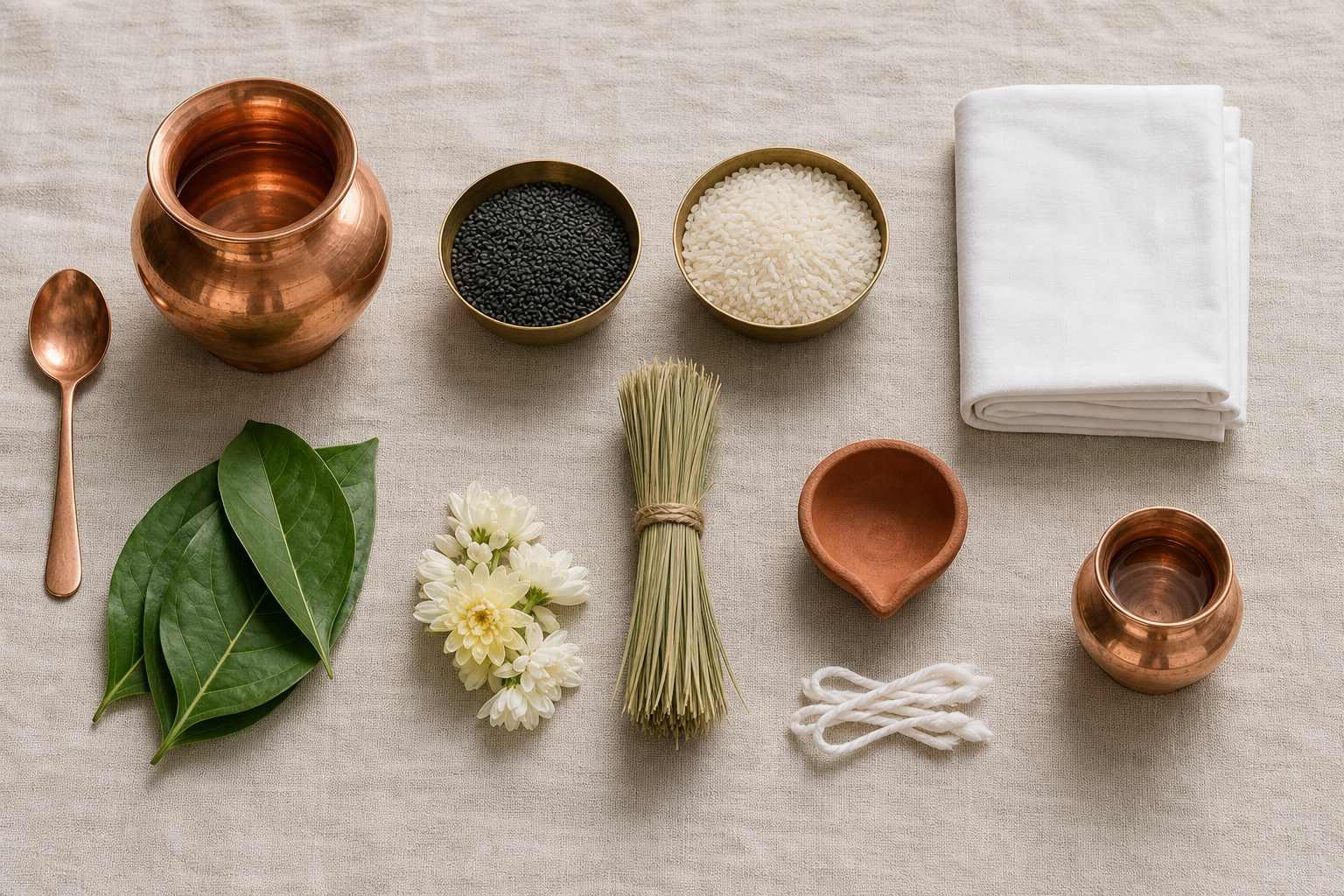
- The exact materials requested by the priest, including acceptable local substitutions.
- Any food preparation, feeding or charitable giving that belongs to the family’s custom.
- The names of relatives attending in person and those joining only for remembrance or prayer.
- Practical needs such as travel, temple booking, time away from work and a clean, quiet place at home.
Ask for the material list directly rather than buying a generic puja kit. A kit can contain items your procedure does not use while omitting something your priest expects. If you live outside Bharat, send photographs or exact product descriptions when asking whether a locally available substitute is acceptable.
On the day, treat the following as a logistical sequence, not as a substitute for ritual instruction:
- Prepare the space, water, vessels, offerings and written list of names before the appointed time.
- Wash, wear clean clothing and silence devices so the rite is not interrupted by preventable distractions.
- Follow the prayer, tarpan and other offerings in the order given by your priest or inherited household practice.
- Complete any associated feeding or giving according to that same guidance rather than adding conspicuous gestures for display.
- Afterward, note the date observed, the instructions followed and any correction needed next year.
That final record is an act of cultural preservation. Store it with family names, regional calendar practice and the temple contact, but avoid recording sensitive family information in a document shared publicly. A short private note can spare children and grandchildren from having to rely on fragments of memory.
What to do when dates, names or formal guidance are missing
Many families now live far from their ancestral village, no longer know the death tithi, or cannot reach the priest who once guided the household. Uncertainty should change how carefully you proceed; it does not have to become an excuse for doing nothing.
- If the death tithi is unknown, ask whether your tradition uses the concluding Mahalaya Amavasya observance on October 10 for collective ancestral remembrance.
- If the ancestor’s formal name or lineage details are uncertain, write down what the family genuinely knows and tell the priest where the uncertainty lies. Do not manufacture a gotra, date or relationship.
- If no local priest knows your tradition, contact a temple connected with your family’s region or sampradaya and request remote preparation guidance before the day.
- If the usual performer cannot participate, obtain a tradition-specific ruling about who may act. Do not let a confident social-media comment settle a question on which family traditions differ.
- If expense is a barrier, ask the priest for the simplest valid form. Do not borrow money or stage an elaborate event merely to imitate another household.
When formal guidance truly cannot be obtained in time, distinguish a sincere home remembrance from a formally prescribed shraddha. You can set aside the date, remember your ancestors by name, pray for them, and undertake respectful giving or feeding consistent with your family’s values. If your custom permits a simple water offering, perform it reverently. Do not claim that an improvised observance reproduces every ritual requirement; use it to preserve remembrance while seeking sound guidance for the future.
Pitru Paksha can also bring unresolved grief or family conflict to the surface. The rite may give that grief a sacred setting, but it is not a replacement for medical or psychological care when someone is struggling to function or remain safe. Keep ritual guidance and personal care in their proper roles.
Key takeaways for Pitru Paksha 2026
- Reserve September 27 through October 10, 2026; the period concludes with Mahalaya Amavasya tarpan on October 10.
- Confirm the applicable local tithi and time with a trusted priest or temple before committing to travel or leave.
- Follow inherited family and regional practice rather than treating a generic online checklist as universal.
- Prepare names, relationships, materials and logistics on one shared page before the observance begins.
- When information is missing, state the uncertainty plainly, choose the simplest properly guided form, and preserve a record for the next generation.
Put the date range on your calendar now, then make one call to the relative who remembers the family practice and one call to the priest who can confirm it. Those two conversations will do more for a composed and faithful observance than a hurried search on the final morning.
References
