
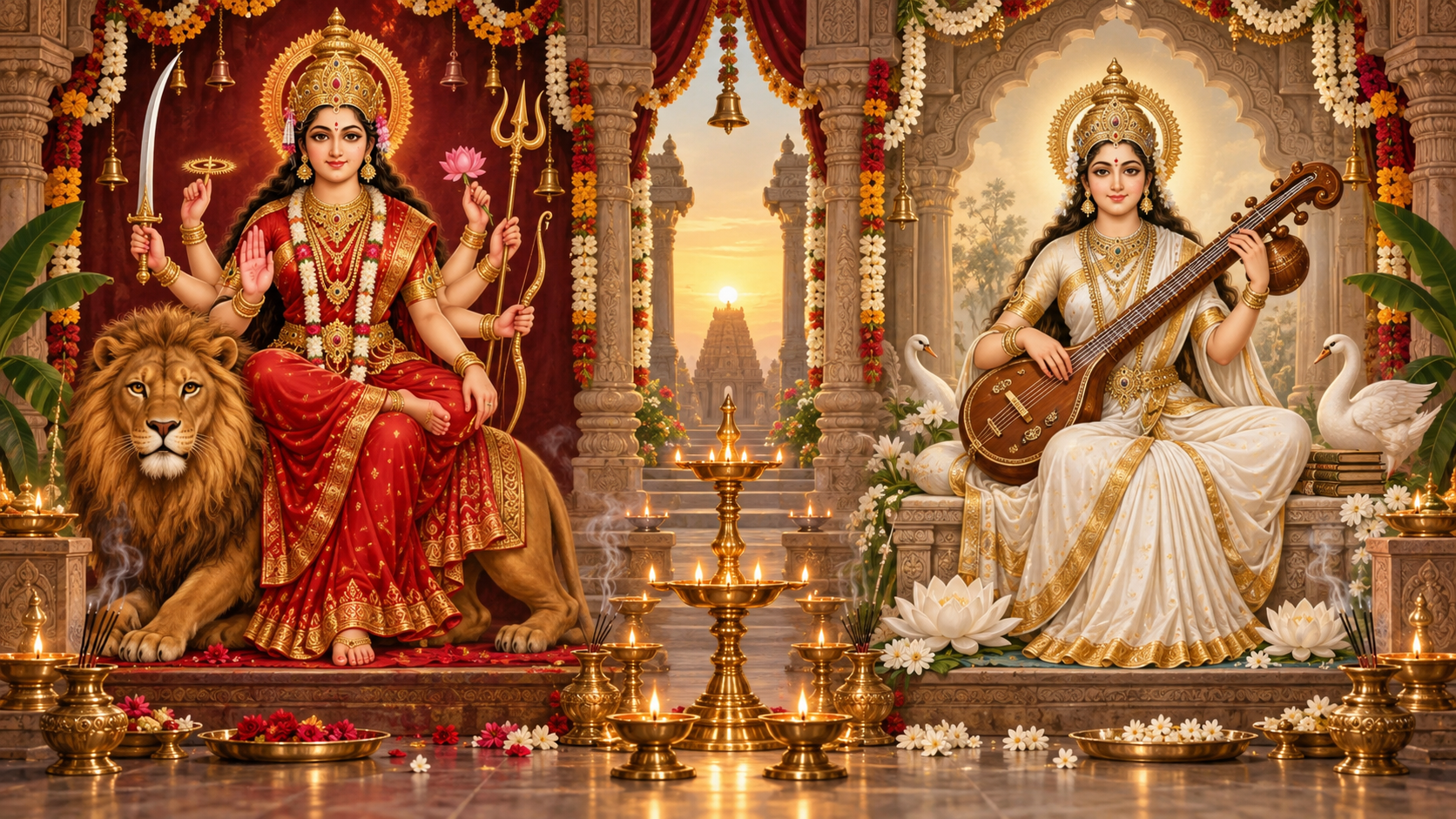
Your Navratri calendar may tell you to worship Maa Katyayani on the sixth day, while the Vijayawada temple observance presents Sri Saraswati Devi as the day’s alankaram. You do not have to decide that one of them is wrong. They belong to two related but distinct ways of approaching Devi.
If you are observing at home, settle one question before arranging the altar: are you following the Navadurga sequence, the Kanakadurga Temple alankaram tradition, or an inherited household method? Once that is clear, the worship becomes coherent rather than a hurried mixture of names and forms.
Two ritual maps are operating on the same day
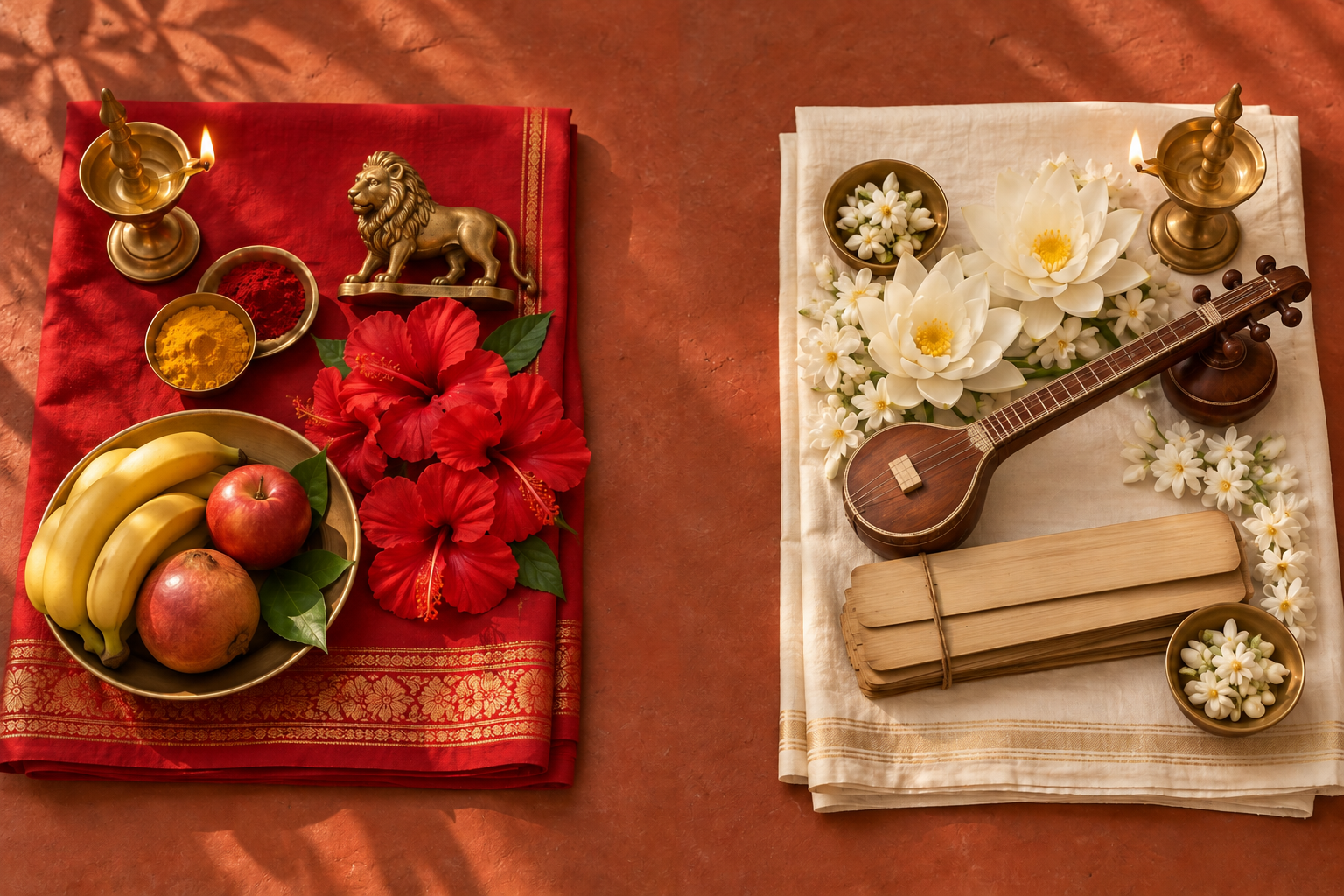
In the Navadurga sequence, the sixth form is Maa Katyayani. She embodies Devi’s warrior power and is approached for courage, strength and the removal of obstacles. Devotional practice also associates her with prayers concerning marriage and relationships, but that association is a basis for sincere sankalpa, not a guarantee of a particular outcome.
The Vijayawada observance follows the day-by-day alankaram of Kanakadurga Mata. On the sixth day of the temple’s 2026 Dasara Navaratri, the presiding Devi is adorned and worshipped as Sri Saraswati Devi. Here, alankaram means the temple’s ceremonial presentation of the Goddess in a particular divine form. It does not cancel the broader Navadurga identification of Day Six with Katyayani.
The cleanest understanding is that the same Shashti can be organised through different devotional frameworks. Navadurga worship asks, “Which of Durga’s nine forms is honoured today?” The Vijayawada alankaram asks, “In which form is Kanakadurga Mata revealed and worshipped in this temple today?” Katyayani and Saraswati therefore need not be treated as competing answers.
The date also depends on which Navratri you mean. In 2026, the sixth day fell on 24 March during Chaitra Navratri and falls on 16 October during Sharad Navratri. The Sharad observance is known as Devi Shashti, Durga Shashti or Maha Shashti, and the Navadurga and Vijayawada alankaram calendars both place their respective Day Six worship on that date. For a time-sensitive vrata or temple visit, confirm the local tithi and puja period through your regional panchanga or temple; a date printed for one place should not automatically be treated as a universal muhurta.
Choose the centre of your observance before you begin
A disciplined puja needs a clear centre. More images, mantras and offerings do not necessarily make worship deeper. Use this order of priority:
- Follow an inherited family, guru or temple method first. If your household already has a Day Six procedure, do not displace it merely because a different calendar uses another alankaram.
- Make Katyayani primary when following Navadurga worship. Name her in the sankalpa, use her image or the established image of Durga on your altar, and direct the principal prayer and recitation to her.
- Make Saraswati Devi primary when consciously following the Vijayawada alankaram. Understand this as the Kanakadurga Temple’s Day Six form, not as a rule that every Navratri tradition must adopt.
- If you have no inherited method, keep the observance simple. Katyayani worship is the clearest starting point for a home practice explicitly organised around the sixth Navadurga.
You may respectfully remember both forms without claiming that two distinct procedures are identical. For example, Katyayani can remain the central deity of your Navadurga puja, followed by a brief prayer to Saraswati for discernment, learning and disciplined speech. If your sampradaya prescribes a fixed method, however, follow that method rather than constructing a hybrid ritual from internet schedules.
The warrior character of Katyayani gives the day’s sankalpa a practical direction. Ask where fear, indecision or avoidance is preventing dharmic action. If your concern is marriage, pray for clarity, worthy compatibility, removal of genuine impediments and the courage to accept the right outcome. Puja should not be framed as a way to override another person’s agency or compel one named individual.
A simple Katyayani puja you can perform at home
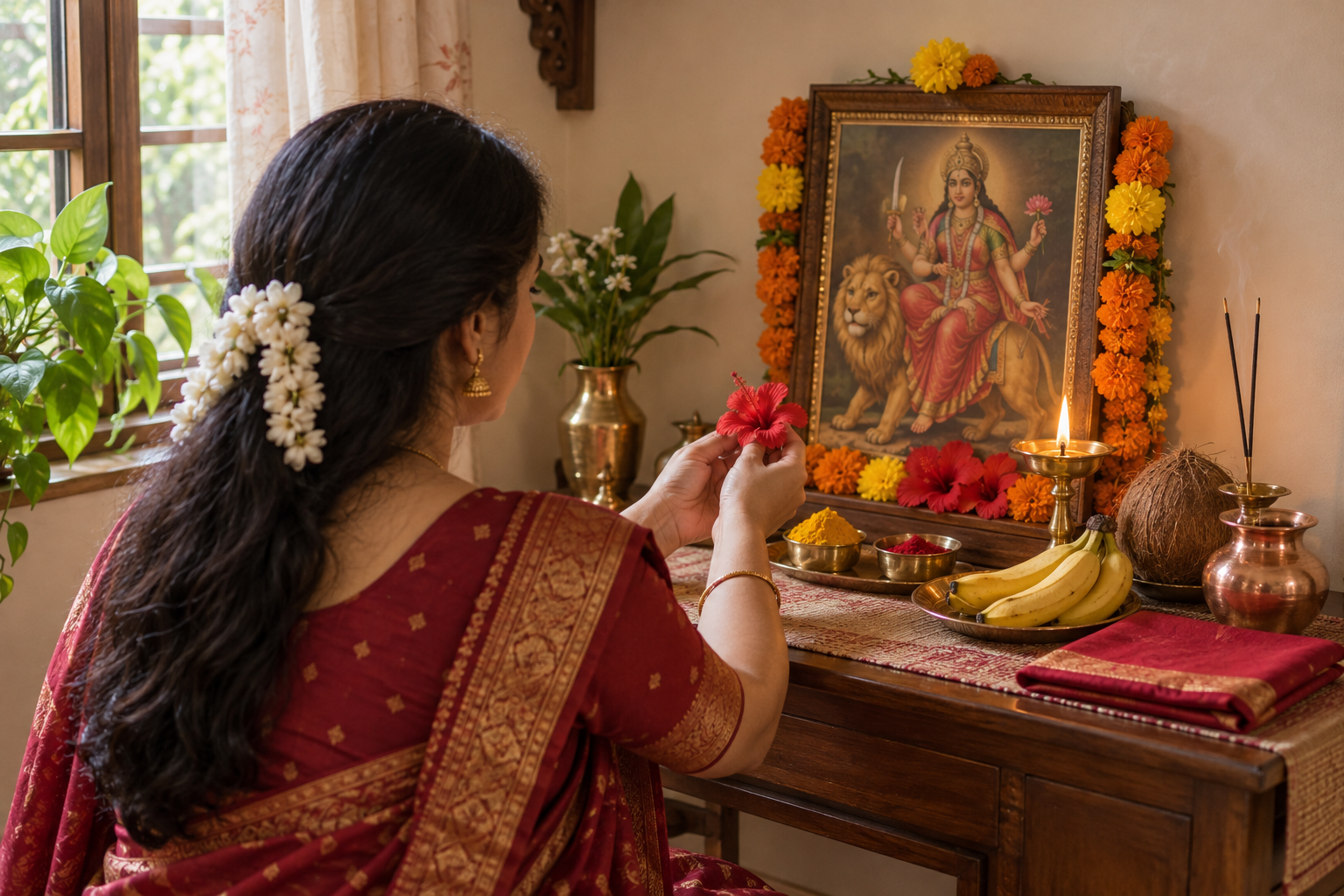
This sequence is suitable for a straightforward household observance. It does not replace an initiated practice, a family paddhati or instructions received from your priest or guru.
- Prepare one clean place. Set out an established image or murti of Devi. Gather only the materials you will use. The customary Katyayani puja materials include turmeric powder, kumkum, rice, a kalash, water and camphor, alongside the usual household offerings. A lamp, flowers and simple naivedya may be included according to your custom. Handle every flame safely.
- State the sankalpa plainly. Identify the occasion as Navratri Shashti and name Maa Katyayani as the central form if you are following Navadurga worship. Add one honest intention: courage for a necessary decision, steadiness in adversity, removal of an obstacle, or clarity in a relationship. Avoid turning the sankalpa into a long wish list.
- Begin with your customary preliminary prayer. Light the lamp and settle your attention. If your household begins with remembrance of Ganesha, guru or the family deity, retain that order.
- Invoke Devi and make the offerings. Offer water, rice or akshata, turmeric, kumkum, flowers and naivedya as available and customary. Make each offering deliberately. A smaller puja completed attentively is better than an elaborate sequence abandoned halfway.
- Recite what you can recite responsibly. Katyayani worship includes a moola mantra, dhyana sloka and stotra. Use a version received through your tradition or one whose pronunciation you trust. If you have not learnt the Sanskrit, repeat Devi’s name with attention and offer a clear prayer in a language you understand instead of racing through unfamiliar syllables.
- Turn the prayer into one commitment. Sit quietly after the recitation and ask what courageous, dharmic action your sankalpa requires from you. Name that action precisely. Prayer for clarity should be followed by an honest conversation; prayer for study should be followed by study; prayer for removal of an avoidable obstacle should be followed by the work needed to remove it.
- Complete the worship. Perform aarti according to your custom, offer pranam, distribute or partake of prasad respectfully, and close the puja rather than simply walking away when the recitation ends.
If the prayer concerns marriage or a strained relationship, keep the spiritual and practical responsibilities together. You can ask Katyayani for courage and discernment, but you must still communicate truthfully, respect consent, examine compatibility and recognise conduct that violates dignity or safety. Devotion strengthens dharmic agency; it does not remove the need to exercise it.
Honour Saraswati Alankaram as more than decoration
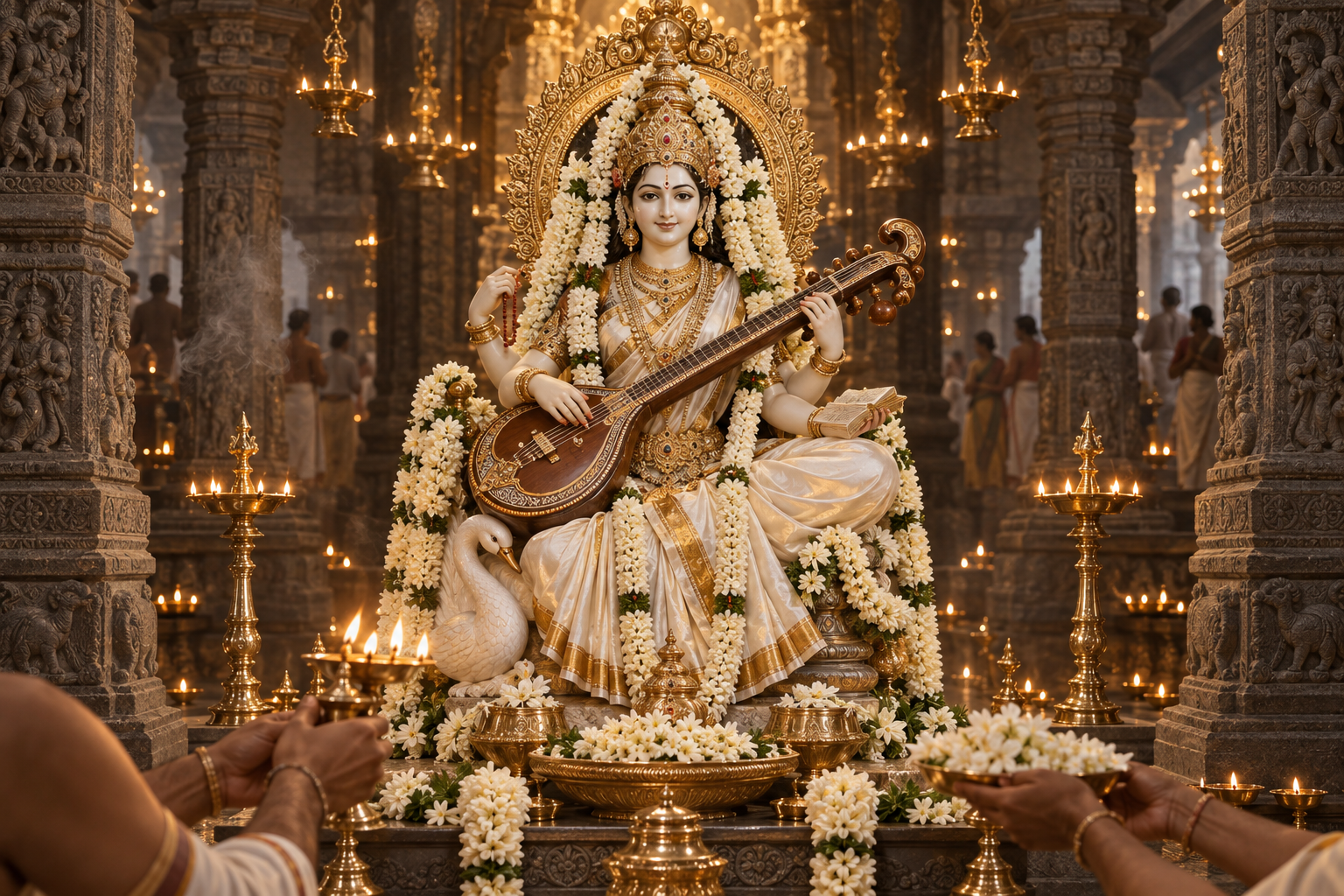
Saraswati Alankaram should direct your attention toward learning, disciplined expression and the responsible use of knowledge. The outward beauty of the form matters, but its purpose is not exhausted by reproducing a temple photograph or matching ornamental details at home.
If this alankaram guides your observance, place a clean book, musical instrument or tool of learning near the altar when that is consistent with your household custom. Offer pranam, then complete one concrete act of learning: return to a neglected text, practise the skill you have been postponing, correct something you have misunderstood, or speak a necessary truth without cruelty. This gives the alankaram a place in your conduct rather than leaving it only in the visual arrangement.
You can also hold Katyayani and Saraswati together as a practical meditation without erasing their distinctions. Katyayani asks whether you have the courage to act. Saraswati asks whether your action is informed, articulate and discerning. Resolve without understanding can become aggression; knowledge without resolve can remain unused. Choose one difficult but dharmic action and one discipline of learning to carry beyond Shashti.
Key takeaways for Navratri Day Six
- Katyayani is the sixth Navadurga and is the natural centre of a Day Six puja organised through the Navadurga sequence.
- Saraswati Devi is the sixth-day alankaram at Vijayawada’s Kanakadurga Temple in the 2026 Dasara observance; this is a temple-specific liturgical form, not a contradiction of the Navadurga order.
- For Sharad Navratri 2026, Day Six and Maha Shashti fall on 16 October. Chaitra Navratri used a different 2026 date.
- Follow your inherited family, guru or temple procedure before borrowing a method from another tradition.
- Keep the sankalpa ethical and actionable: seek courage, clarity and removal of dharmic obstacles, not control over another person.
- Let the puja produce one act of courage and let Saraswati remembrance produce one act of disciplined learning.
Before Shashti begins, write down two short lines: My primary form of worship is… and The quality I will practise after puja is… Prepare only what serves those commitments. Then carry the first concrete action into your day after the aarti is complete.
References
- Hindu Pad – 6th day Alankaram in Vijayawada Dasara Navaratri 2026 – 16 October | Saraswati Devi Alankarana
- Hindu Pad – Katyayani Mantras – Moola Mantra, Dhyana Sloka, Stotra
- Hindu Pad – 6th day of Navratri 2026, October 16
- Hindu Pad – 10 Important Things to do on 6th day of Navratri Vrat, 16 October 2026
- Hindu Pad – Katyayani Puja Vidhi | Procedure of Maa Katyayani Pooja
- Hindu Pad – 6th day Navratri Puja Timings, 16 October 2026

Leave a Reply
You must be logged in to post a comment.