
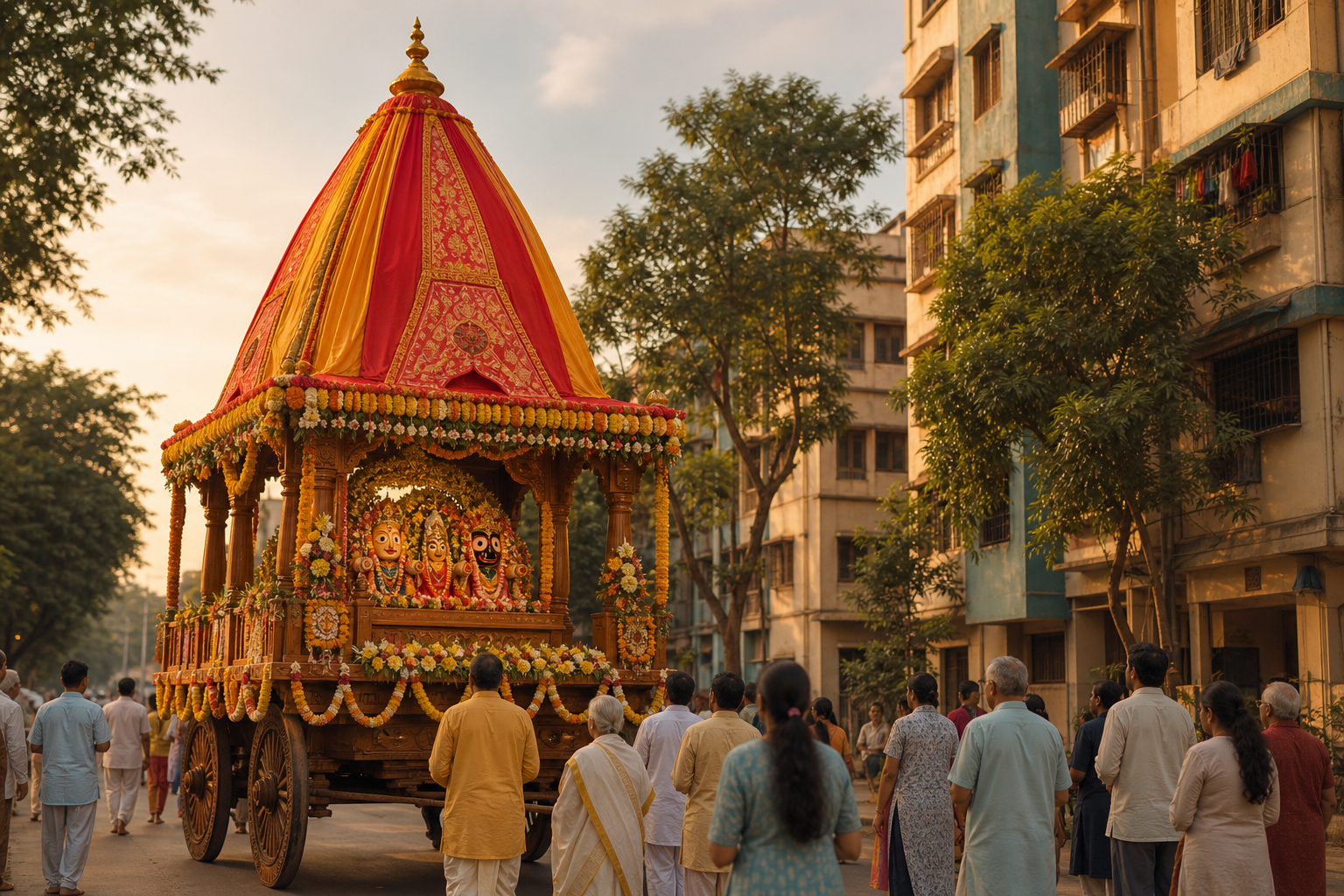
Dandavats presents an image-only post titled around a Rath Yatra at Mira Road in Mumbai and associates it with an ISKCON temple. Because the supplied item contains no written report beyond that title, the reliable factual record is narrow.
This article separates those limited facts from general devotional context, explaining what a Ratha Yatra represents without inventing a schedule, route, crowd estimate, or account of ceremonies.
What the Dandavats item actually establishes
According to the title supplied by Dandavats, the subject is a Rath Yatra in Mira Road, Mumbai, connected with an ISKCON temple. The accompanying source material consists only of a thumbnail. It provides no caption, quotations, organizer statement, participant information, or logistical details.
It would therefore be inaccurate to infer the procession’s date, route, scale, program, or leadership from this post alone. Even details that might be customary at similar celebrations cannot be presented as confirmed features of this particular gathering.
The devotional meaning of Ratha Yatra
In established Vaishnava tradition, Ratha Yatra is a chariot procession especially associated with Lord Jagannath. Its central idea is devotional accessibility: the sacred procession moves into shared public space, allowing worshippers and onlookers to encounter a living expression of bhakti beyond the temple interior.
Such festivals commonly emphasize darshan, congregational chanting, remembrance of the divine, and seva. These are general features of the tradition, not verified details of the Mira Road event. The distinction matters because reverence should be accompanied by accuracy.
Key takeaways
- The source identifies a Rath Yatra in Mira Road, Mumbai.
- Its title associates the subject with an ISKCON temple.
- The supplied post does not establish a date, route, attendance figure, or ceremonial program.
- The wider significance can be explained through established Vaishnava tradition, provided that general context is not confused with event reporting.
A shared Dharmic language of public devotion
Public sacred journeys appear in different forms across the Dharmic family. Hindu sampradayas maintain yatras and temple processions; Sikh communities gather through traditions such as Nagar Kirtan; and Buddhist and Jain communities also sustain collective pilgrimage, recitation, and service. The forms and teachings are distinct, but each can bring disciplined spiritual practice into community life.
This common ground does not require different traditions to surrender their identities. It points instead to a civilizational habit of joining inner cultivation with visible fellowship, ethical conduct, and service. A local chariot festival can therefore be appreciated both as a particular Vaishnava observance and as part of the wider Dharmic culture of sacred movement.
What readers should verify separately
Anyone seeking to attend, document, or support the Mira Road celebration should consult an official temple announcement for the date, time, route, accessibility arrangements, participation guidance, and seva opportunities. None of those practical details can be recovered from the supplied source item.
Until fuller information is available, the responsible approach is to honor the devotional subject while keeping confirmed reporting clearly separate from tradition-based explanation.
Inspired by this post on Dandavats.
