
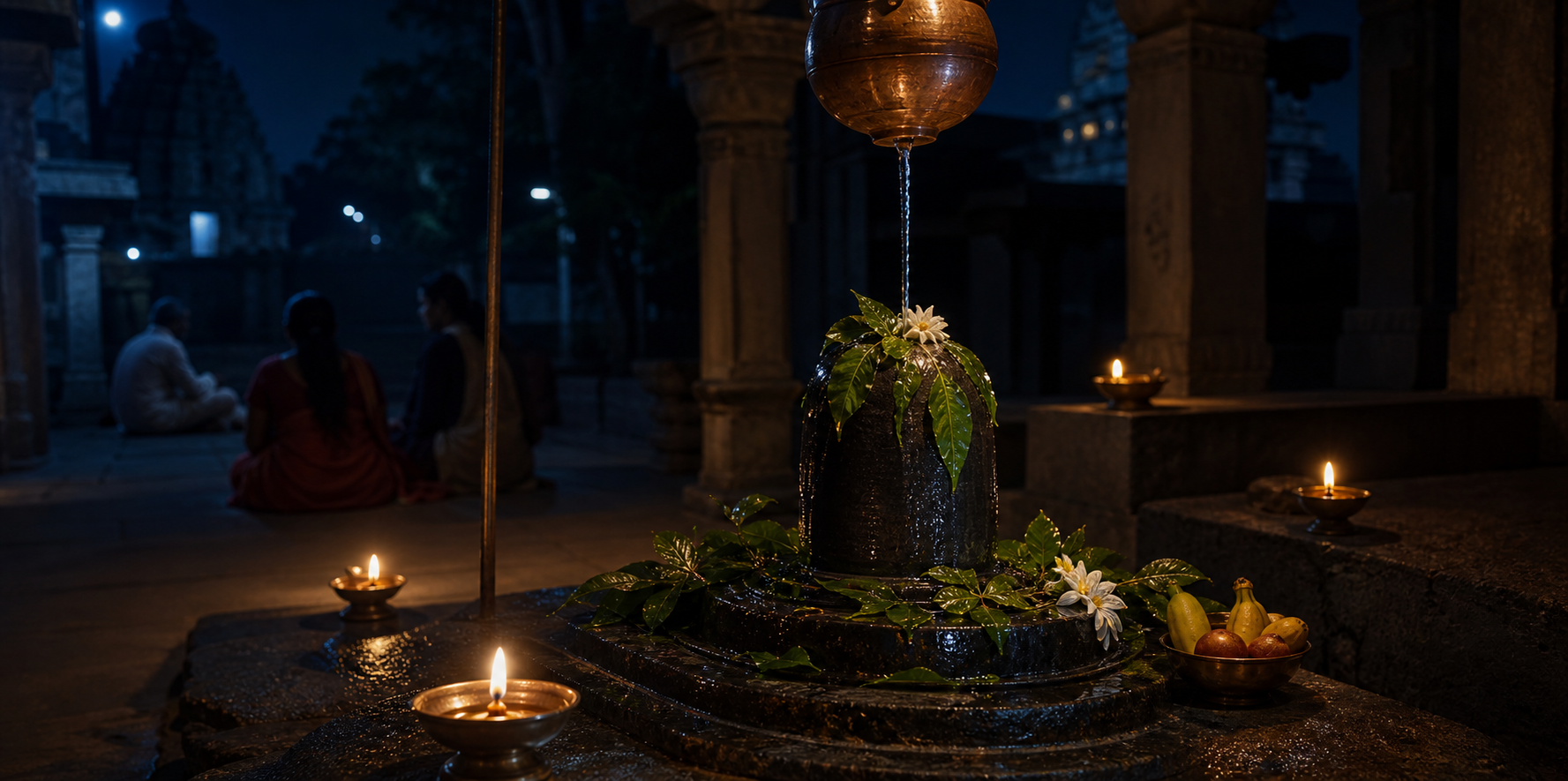
Your most important Maha Shivaratri decision is made before the first lamp is lit: which local night are you observing, and when does its central worship window actually begin? A festival date copied from another city may identify the general occasion while giving you the wrong Nishita Kala, prahara boundaries, or time for breaking the fast.
Once you mark five things – the Chaturdashi night, sunset, the four night watches, Nishita Kala, and the parana window – the observance becomes manageable. You can then choose a fast suited to your health, prepare one repeatable puja cycle, and give your attention to Shiva instead of checking the clock throughout the night.
Choose the local Chaturdashi night, not a borrowed date
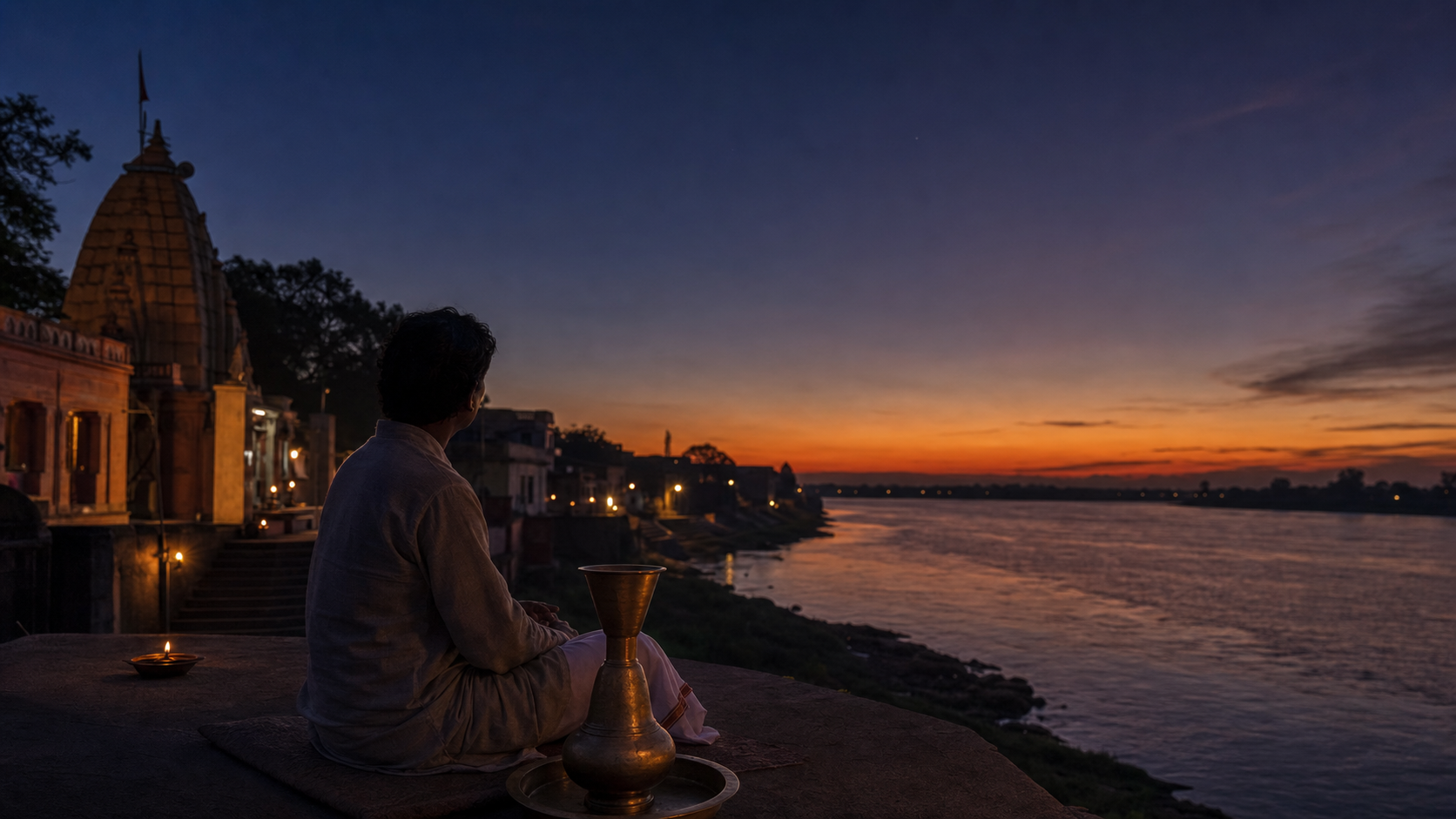
Maha Shivaratri is governed by Krishna Paksha Chaturdashi, the fourteenth tithi of the waning lunar fortnight. It is not tied permanently to one Gregorian date. The same lunar phase may be described as Magha Krishna Chaturdashi in the amanta system and Phalguna Krishna Chaturdashi in the purnimanta system. Those month names reflect different ways of reckoning the lunar month; they do not necessarily indicate two separate festival nights.
The governing consideration is the local night in which Chaturdashi has the required night-time presence, commonly described as Ratri Vyapini Chaturdashi. Start with a reputable panchang calculated for your city. If you will worship in a temple, use that temple’s announced schedule because its Agamic program and local calculation govern the community observance. This matters even more outside Bharat: translating an Indian clock time into your time zone does not establish the correct local tithi.
Calculate the night from sunset to sunrise
After the panchang has identified the correct Chaturdashi night, use local sunset and the following sunrise to understand its ritual structure. The procedure is simple:
- Write down local sunset on the chosen evening. Call this S.
- Write down local sunrise on the following morning. Call this R.
- Measure the complete interval from S to R, carrying the calculation across the civil-date change. This is the ritual night.
- Divide that interval into four equal parts. Those are the four praharas, or watches.
- Find the midpoint of the night: S plus one-half of the sunset-to-sunrise interval. This is Madhyaratri, the center used to locate Nishita Kala.
Madhyaratri is not automatically 12:00 a.m. Civil midnight is a clock convention; ritual midnight is the midpoint between local sunset and the next sunrise. Nishita Kala is commonly treated as a muhurta of approximately forty-eight minutes centered on that midpoint. Your panchang may give the window directly, and its precise local minutes should take precedence over a hand calculation.
Lingodbhava Kalam is observed within this central Nishita window. It therefore falls around the junction of the second and third praharas, not at an arbitrary clock time and not as a separate fifth watch. In many South Indian traditions, the principal abhishekam reaches its culmination around this transition. Different schedules may label the associated rite as belonging to the second or third prahara; the actual Nishita window is more useful than a dispute over numbering.
See the vrata as one complete ritual cycle
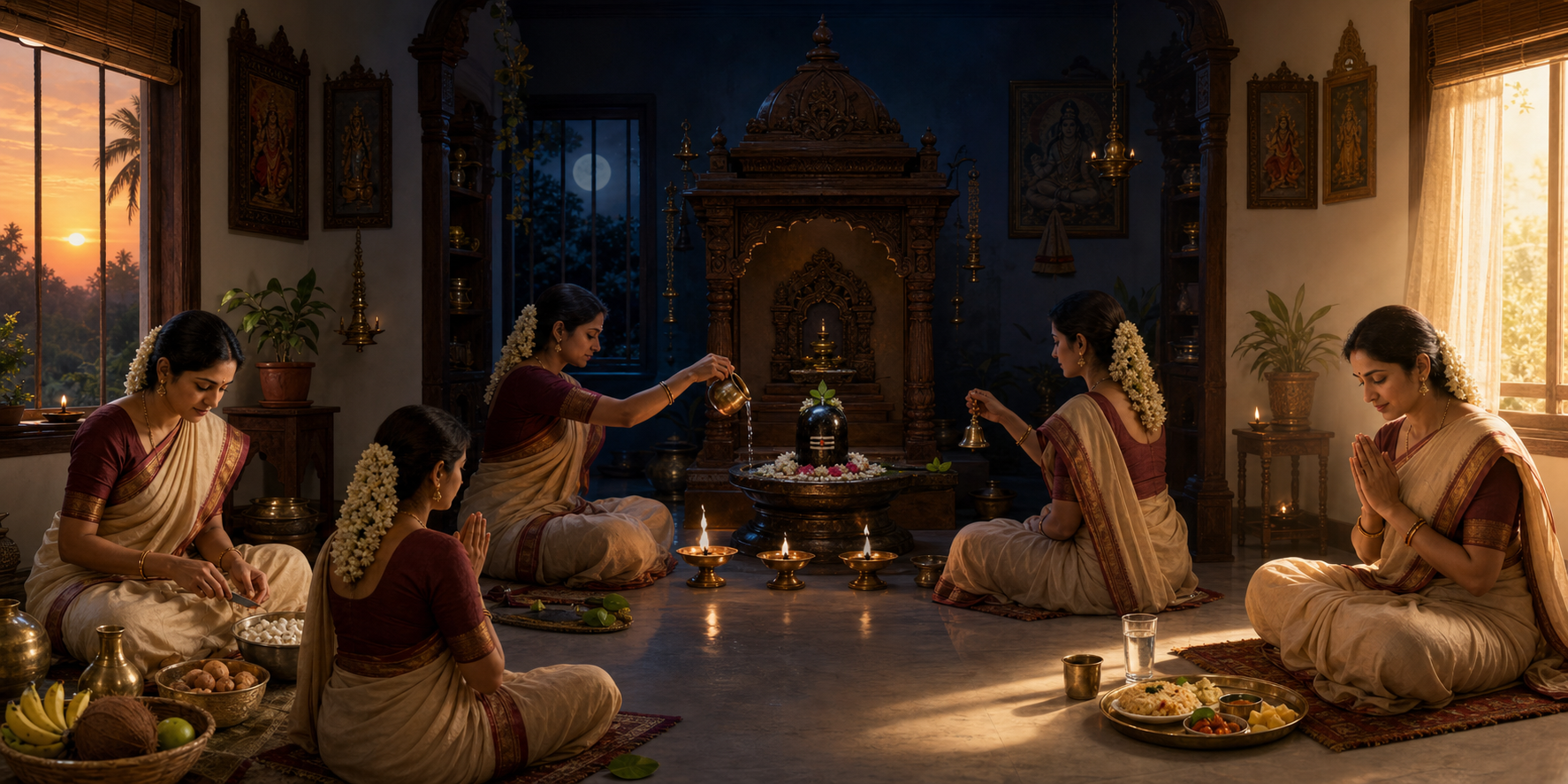
Maha Shivaratri is not only a midnight puja. Its vrata begins with preparation and restraint during the day, turns inward at pradosha, deepens through four watches of worship, reaches its contemplative center at Nishita, and concludes through the final puja and properly timed parana. Some regional temple traditions then continue the arc with Shiva-Parvati Kalyanam.
| Stage | Your practical task | Timing point to verify |
|---|---|---|
| Festival day | Make the sankalpa, begin the form of fasting you can responsibly maintain, observe restraint, and prepare the altar and offerings. | Use the local Chaturdashi observance date. |
| Pradosha and early night | Bathe or wash, wear clean clothing, light the lamp, perform the opening puja, and settle the mind for jagarana. | Use local twilight or the temple’s announced opening worship time. |
| Four praharas | Repeat a manageable cycle of abhishekam, bilva offering, mantra-japa, meditation, and arati in each quarter. | Divide local sunset-to-sunrise time into four equal parts. |
| Nishita Kala | Give your most attentive abhishekam, japa, and silence to Lingodbhava remembrance. | Use the panchang’s local Nishita window around true night-midpoint. |
| Fourth prahara and dawn | Complete the final worship without allowing fatigue to turn the last watch into a hurried formality. | Note the fourth-prahara boundary and local sunrise. |
| Parana | Conclude the fast with simple sattvic food at the prescribed time. | Check that sunrise has occurred and follow the local panchang concerning the end of Chaturdashi. |
| Kalyanam where customary | Attend or perform Shiva-Parvati Kalyanam as a distinct celebratory continuation. | Follow the temple, family, or regional parampara; it is often held the following day in South Indian traditions. |
Pradosha establishes the inward direction of the night. The recurring praharas prevent jagarana from becoming aimless wakefulness. Nishita concentrates the observance at the moment associated with Lingodbhava. Dawn completes the austerity, but it does not by itself settle the parana question: the fast is traditionally broken after sunrise and in accordance with the local end of Chaturdashi. If Chaturdashi continues into the morning, do not assume that the first appearance of daylight is automatically the correct parana time.
Shiva-Parvati Kalyanam belongs to the cycle differently. Many South Indian temples conduct it after the night vigil, expressing a movement from Shiva’s inward stillness to the auspicious union of Shiva and Shakti. Other regions place it differently or do not make it part of the household observance. Local parampara determines its muhurta and ritual form; it should not be treated as a universal replacement for the Chaturdashi-night vrata.
Use one simple puja sequence in all four praharas
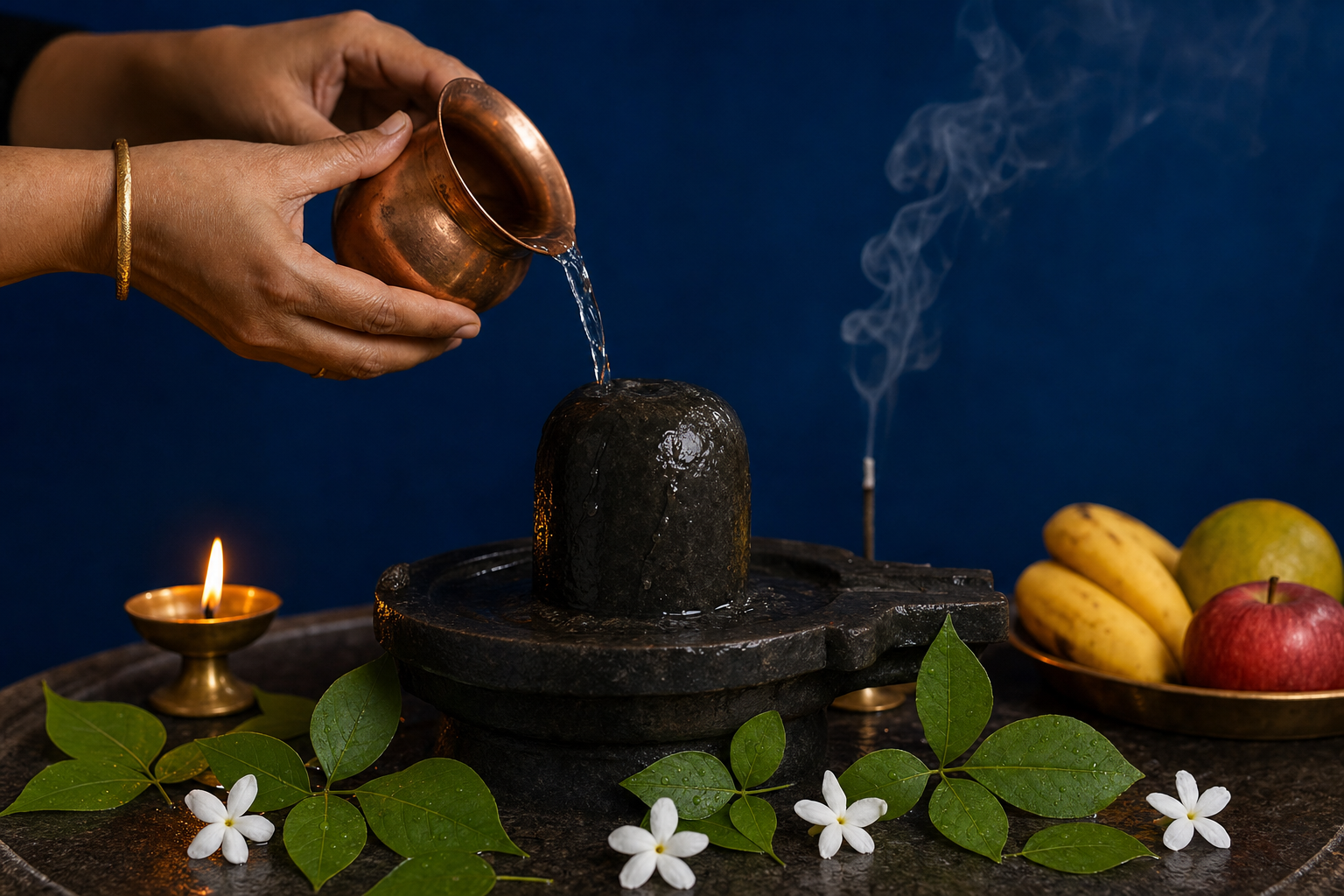
A home observance gains depth through repetition, not through the number of substances on the altar. Choose a procedure you can perform with care four times. If your family or guru has given you a Panchopachara, Shodashopachara, Rudrabhishekam, or Agamic sequence, follow that instruction. Otherwise, a clean and restrained arrangement is more coherent than an elaborate procedure assembled during the vigil.
Prepare the altar before the first prahara
- A clean Shiva linga or Shiva image placed securely on the altar.
- A clean vessel of water, a small pouring vessel, and a basin or tray that will contain abhishekam liquid.
- A steady lamp, with incense if it is suitable for your space.
- Bilva leaves, available flowers, vibhuti or bhasma, and chandana where customary.
- Panchamrita if it belongs to your practice: milk, curd, ghee, honey, and sugar. Keep clean water ready for the concluding rinse.
- A mala, the stotra or scripture you intend to use, and a written note of the four prahara boundaries and Nishita Kala.
- A modest sattvic naivedya for the appropriate point in your observance.
You do not need every listed item. Water, a lamp, bilva where available, and steady mantra-japa can sustain a serious observance. Using modest quantities also prevents the altar from becoming difficult to manage halfway through the night. Water, panchamrita, fragrant offerings, and a final return to pure water are customary possibilities across the four watches, not a single mandatory formula for every lineage.
Repeat this cycle at each watch
- Wash your hands and settle your breath. Perform achamana if it belongs to your practice.
- State or renew the sankalpa briefly. Name the prahara and return your attention to Shiva rather than turning the intention into a long announcement.
- Invoke Ganesha and your guru-parampara where customary, then meditate on Shiva in the linga or chosen form.
- Offer abhishekam. Pure water is the clearest baseline. If you use panchamrita in one watch, complete it with a thorough water rinse.
- Apply vibhuti or chandana as appropriate, then offer bilva and flowers. If your family follows the convention concerning bilva orientation, place the stems away from the linga.
- Offer dhupa and deepa, then begin mantra-japa. Om Namah Shivaya is the central and accessible choice; the Mahamrityunjaya Mantra, Shiva Sahasranama, Lingashtakam, or Sri Rudram may be included according to training and tradition.
- Sit silently after the recitation. Allow the mantra’s cadence to settle instead of reaching immediately for the next activity.
- Conclude the watch with prayer and arati. Clean and reset the worship area before the next boundary so that fatigue does not create disorder.
Rounds of 108, 216, or 1008 repetitions of Om Namah Shivaya are established options, but the count should serve concentration. Choose a number you can complete without racing through the mantra. Four attentive rounds of a sustainable count are more faithful to the vigil’s rhythm than one oversized target that leaves the remaining watches empty.
Let Nishita become quieter, not merely busier
Lingodbhava recalls Shiva’s manifestation as an immeasurable column of light before Brahma and Vishnu. Each sought its limit, and neither could find an end. The linga therefore points beyond an object that can be measured or possessed; the narrative turns rivalry into humility before the boundless.
Prepare the vessels, bilva, lamp, and mala before Nishita begins. During the window, perform your principal abhishekam without haste, chant Om Namah Shivaya, and leave a real interval for silent dhyana. South Indian temple worship often marks this moment through Lingodbhava darshan, special abhishekam, Vedic recitation, lamps, and intensified stillness. At home, you do not need to imitate the temple’s scale. The essential movement is from ritual action toward one-pointed awareness.
Adapt the fast and vigil without emptying them of purpose
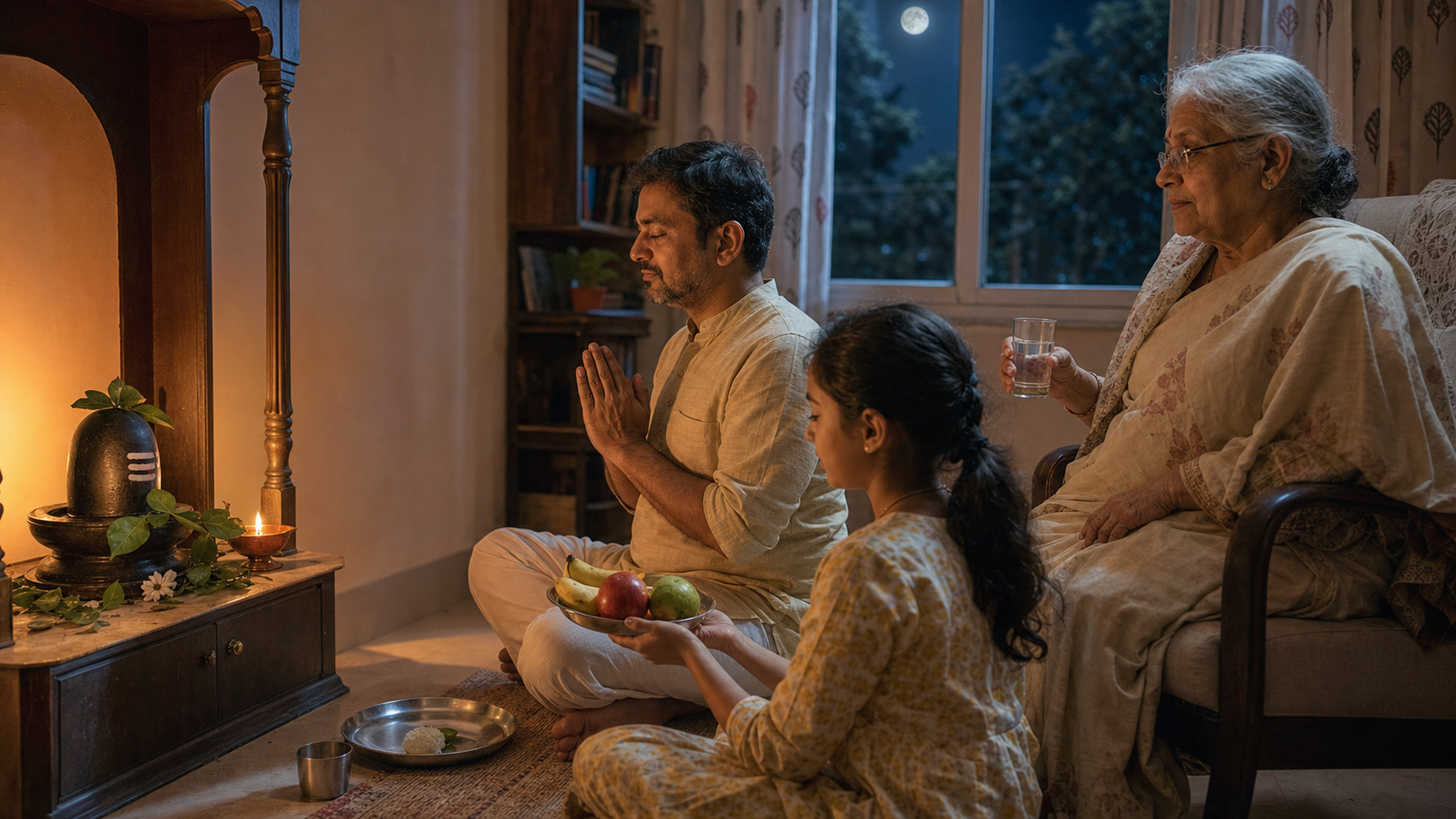
Upavasa supports the vigil when it reduces heaviness and preserves clarity. It defeats its own purpose when the chosen austerity makes you ill, unable to concentrate, or unsafe the following morning. Traditional levels include nirjala fasting without food or water, phalahara with fruit and permitted light items, and lighter sattvic intake adapted to the devotee’s capacity.
If you take medication, have a health condition, are elderly, or face physically demanding duties, do not treat the strictest fast as the only spiritually serious option. Maintain the fluids, food, and medication your health requires, seek individual guidance from an appropriate clinician when needed, and choose a lighter vrata. Lucid devotion, ethical restraint, and focused remembrance remain the core of the observance when fasting or wakefulness must be modified.
The same principle applies to jagarana. Staying awake is not the entire practice; intentional wakefulness supported by japa, puja, dhyana, svadhyaya, or kirtan is the practice. An unstructured night of conversation or entertainment may prevent sleep, but it does not train attention toward Shiva-tattva.
- Alternate mantra-japa with silent sitting so that vocal recitation does not become mechanical.
- Use a stotra, a passage from Shiva Purana, or a trained recitation of Sri Rudram when attention begins to scatter.
- Add congregational bhajan or kirtan if you are observing with family or a sangha.
- Stand, stretch gently, or use a short walking meditation when physical dullness appears.
- Keep the room orderly, ventilated, and quiet enough for attention to recover after each active segment.
- Use periods of mauna to conserve energy and prevent the vigil from dissolving into casual social time.
If a full-night vigil is not responsible for you, keep a partial jagarana centered on the local Nishita and Lingodbhava window. Perform a careful opening puja, remain awake through the principal abhishekam and meditation, and complete what your capacity allows sincerely. This adaptation preserves the center of the vrata without pretending that preventable physical strain is devotion.
Plan the morning as part of the vrata. Sleep deprivation impairs alertness, so do not drive or operate dangerous equipment if you are drowsy after jagarana. Arrange transport, rest, or shared responsibilities beforehand. If you are attending a major kshetra, confirm the current Devasthanam program close to the festival; large temples may use extended darshan hours, controlled queues, and annually adjusted seva timings.
Ethical restraint should accompany physical austerity. Ahimsa, satya, moderation, and care for the worship space give the fast its dharmic frame. Use water and panchamrita judiciously, avoid turning sacred substances into waste, and clean the altar and surrounding area after the final puja. The quality of the offering is measured by attention and purity, not volume.
Key takeaways for planning your observance
- Select Maha Shivaratri through a local panchang and the night-time presence of Krishna Paksha Chaturdashi, not through a copied national or overseas clock time.
- Calculate the ritual night from local sunset to the following sunrise. Its midpoint, not automatically 12:00 a.m., anchors Nishita Kala.
- Divide the entire sunset-to-sunrise interval into four equal praharas. Nishita falls around the junction of the second and third watches.
- Repeat one manageable puja cycle in every prahara: abhishekam, bilva or flowers, lamp, mantra-japa, silence, and arati.
- Make the Lingodbhava window the most attentive part of the vigil, with materials prepared beforehand and time protected for meditation.
- Adapt fasting and wakefulness to health and responsibilities. A partial vigil centered on Nishita is preferable to an austerity that makes you ill or unsafe.
- Do not break the fast merely because midnight or dawn has arrived. Follow the local parana window after sunrise and in relation to the end of Chaturdashi.
- Treat Shiva-Parvati Kalyanam as a regional or temple-parampara continuation where observed, not as a substitute for the Chaturdashi-night vrata.
Your next step is concrete: open a reliable local panchang and write one page containing the chosen night, sunset, all four prahara boundaries, Nishita Kala, sunrise, and parana. Then decide your fasting level and the puja cycle you will repeat. With those choices made before dusk, the clock can recede and the night can become what it is meant to be: an offering of disciplined attention to Shiva.
References
- HinduPad – Shivaratri Jagran & Lingodhbhavam: Sacred Night Vigil, Cosmic Origin, and Ritual Science
- HinduPad – Shiva-Parvati Kalyanam at Maha Shivaratri: Complete Guide to Rituals, Legends, and Meaning
- HinduPad – Maha Shivaratri Jagran: Why Devotees Stay Awake All Night and How It Transforms Sadhana
- HinduPad – Mahashivaratri 2026 at Srisailam Mallikarjuna: Sacred Night, Rituals, Timings, and Pilgrim Guide
- HinduPad – Maha Shivaratri 2026 Puja Muhurat Guide: Exact Date, Nishita Kala & Lingodbhava Insights
- HinduPad – Maha Shivaratri 2026 Lingodbhava Kalam: Sacred Midnight Timings and Puja Guide
