
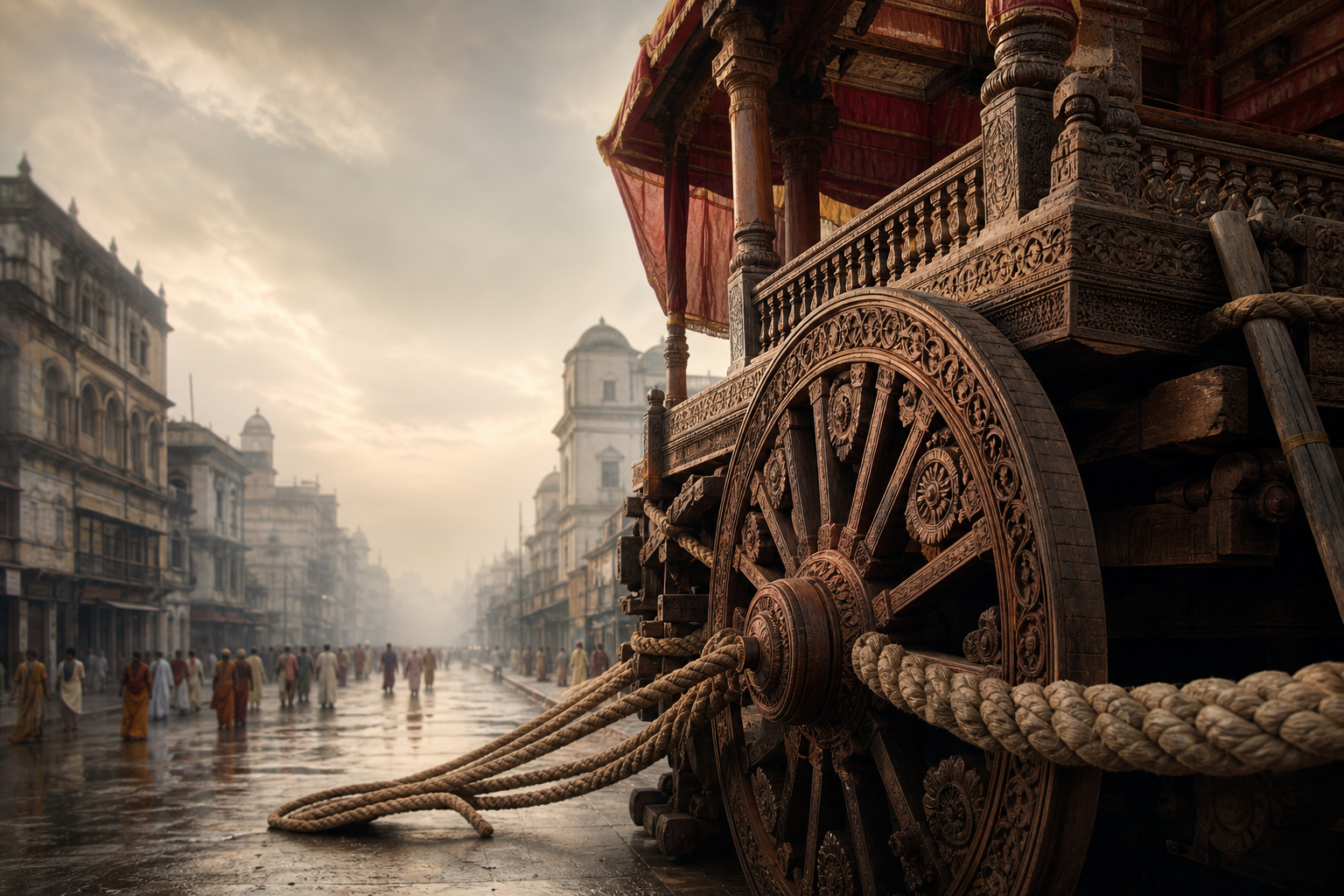
Dandavats identifies the subject of its post as the 55th Kolkata Rath Yatra. The supplied source, however, contains only a linked thumbnail and no written account of the procession.
This source-conscious guide separates that limited report from general background about Rath Yatra, while making clear which event details remain unavailable.
Key takeaways
- Dandavats describes the event as Kolkata’s 55th Rath Yatra.
- The supplied post does not state a date, route, schedule, list of deities, organizer, attendance figure, or program.
- Any broader explanation of Rath Yatra must therefore be treated as general religious context, not as a description of this particular procession.
Why Rath Yatra brings devotion into public space
In general Hindu usage, a Rath Yatra is a sacred chariot procession. The tradition is especially associated with Lord Jagannath, although the term can also be used for processions centered on other deities. Its defining movement is from an enclosed sacred setting into shared public space.
That movement gives the observance both devotional and communal significance. In many processional traditions, worshippers participate through darshan, chanting, service, hospitality, or the disciplined work required to conduct a public festival. These are general characteristics only; the sparse Dandavats item does not confirm which of them formed part of the Kolkata event.
Dharmic unity without erasing distinct traditions
Public observances can strengthen a community’s connection to sacred memory while making its inheritance visible to younger generations. Hindu yatras, Buddhist and Jain processions, and Sikh nagar kirtans are not theologically interchangeable, yet they can express related dharmic commitments: reverence, disciplined participation, collective remembrance, and seva.
A constructive dharmic civilizational outlook respects those differences while recognizing a shared cultural landscape. In that sense, a confident Hindutva protects Hindu festivals and institutions without requiring every sampradaya or neighboring dharmic tradition to surrender its own identity. Unity becomes durable when it is grounded in mutual respect rather than forced sameness.
What a fuller record should preserve
The designation “55th” suggests continuity, but the source provides no history with which to explain or independently assess that milestone. A useful event record would identify the organizing body, participating deities, route, program, accessibility arrangements, forms of seva, and the tradition’s local history. Photographs or video should be accompanied by captions and basic context so that future readers can distinguish documentation from inference.
Until such information is available, the responsible account is necessarily modest: Dandavats reports a 55th Rath Yatra in Kolkata, and the accompanying material confirms no further particulars. More complete documentation could turn that brief notice into a lasting record of devotional continuity and community stewardship.
Inspired by this post on Dandavats.
