
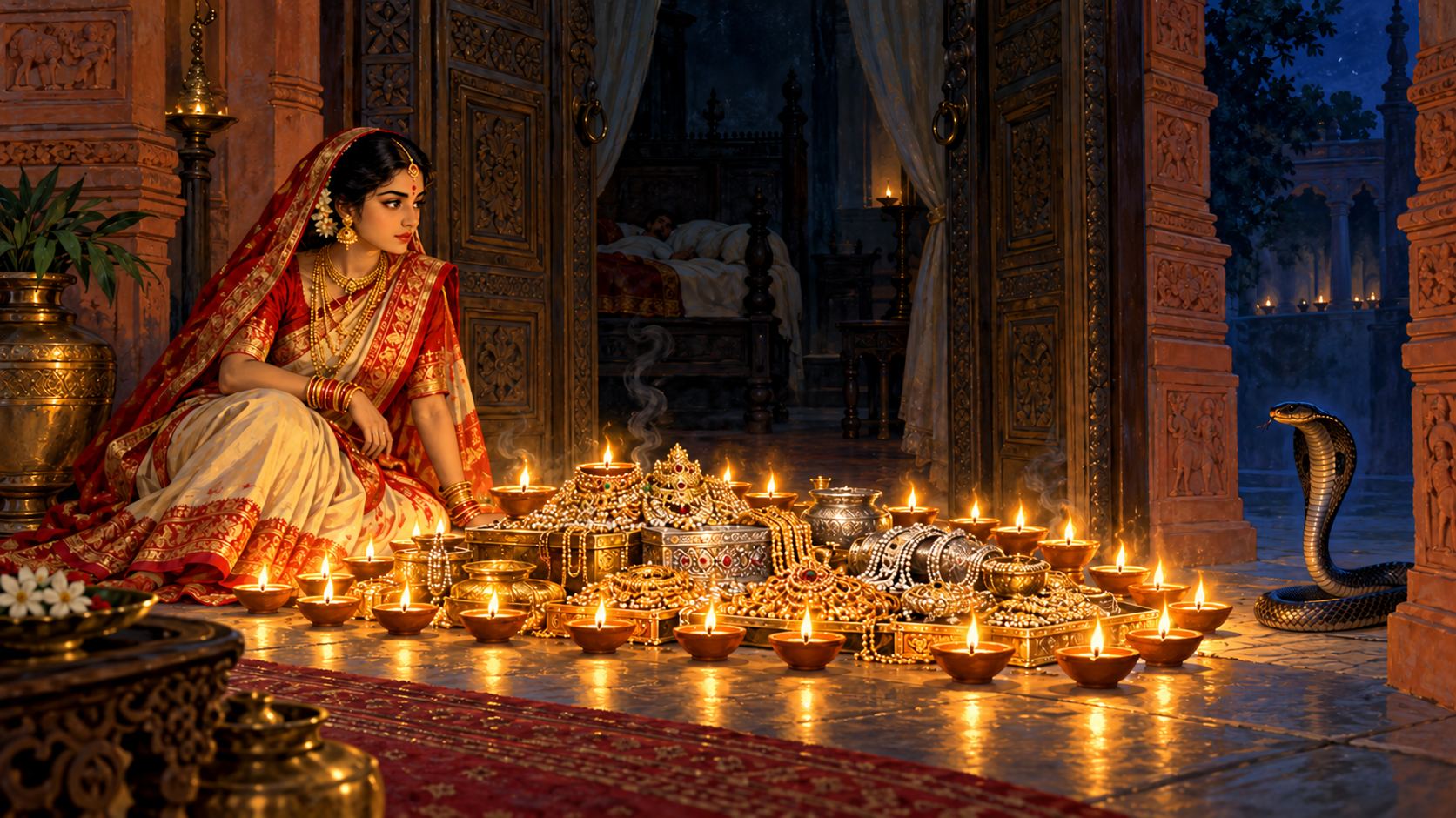
If you came looking for the meaning behind the lamps and precious metals of Dhanteras, King Hemnak’s bride offers a more demanding answer than simply buying something auspicious. Her night watch turns wealth into a tool, light into vigilance, and devotion into intelligent action.
The safest way to approach this account is as Bengali Dhanteras folklore: a meaningful regional telling, not a universal scriptural narrative or the sole explanation for the festival. Once that distinction is clear, you can retell it faithfully and recognise why the bride, rather than the royal family or its wealth, is its moral centre.
The story in its essential sequence
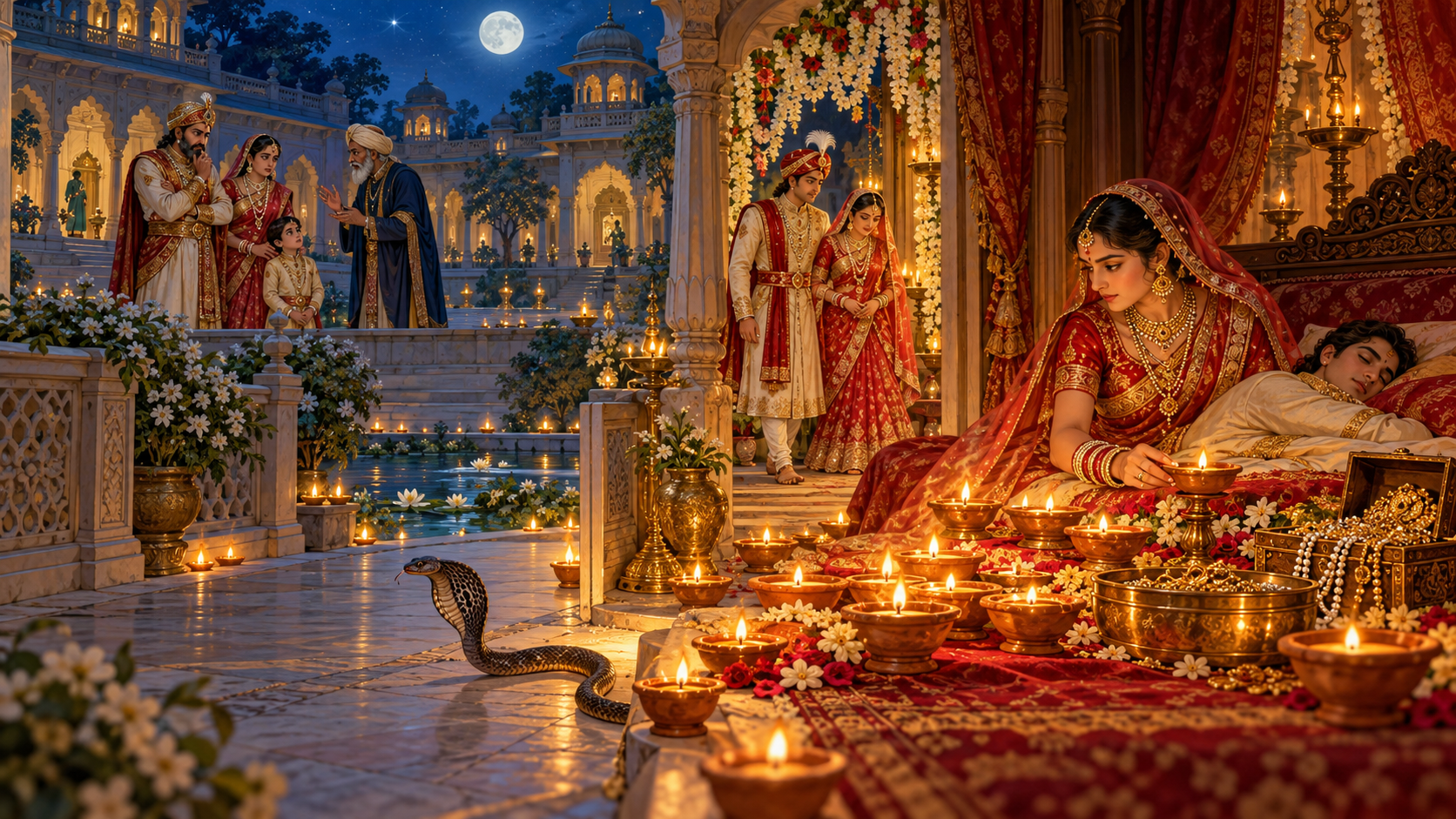
A Bengali tradition associated with Dhanteras, or Dhan Trayodashi, names the king Hemnak and also calls him Him. These are two names for the same king, not two characters. He has one son, and pandits examining the boy’s horoscope foresee that the prince will die from a snakebite on the fourth night after his marriage.
- The prince is born, and the fatal prediction is made from his horoscope.
- He eventually marries, bringing the foretold night close.
- His bride learns of the danger and refuses to meet it passively.
- She places gold and silver at the entrance, lights lamps, and keeps her husband awake.
- She sustains the vigil with songs and stories as the threat approaches in serpent form.
- The brilliance and the bride’s wakeful voice hold the visitor at the threshold until the dangerous night has passed. The prince survives.
The plot works through a threshold. The danger must enter, so the bride takes command of the entrance. She combines material preparation, light, wakefulness and speech. Remove those actions and the story becomes a vague miracle; preserve them and it becomes a disciplined response to a known danger.
Exact counts of lamps, elaborate arrangements and directional rules are not necessary to explain this sequence. If such details belong to your family’s observance, preserve them as family or regional practice. Do not add them to the narrative and then present them as obligations for every Hindu household.
Why the unnamed bride is the central figure
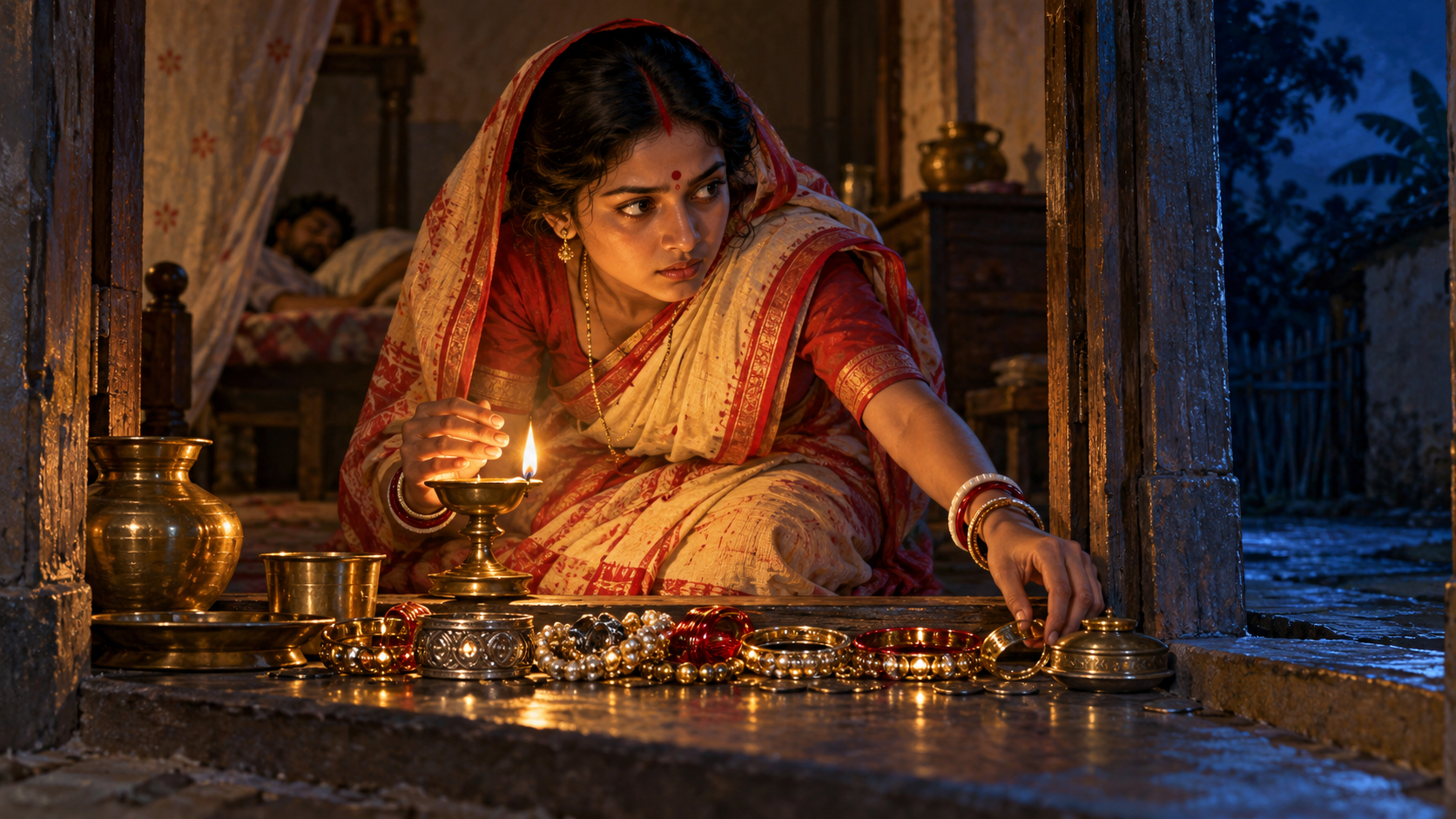
The king gives the story its familiar name, but the bride supplies nearly all its decisive verbs. She learns, prepares, arranges, lights, watches, sings and protects. Her personal name is not preserved in this telling, yet her lack of a name should make you more attentive to her agency, not less.
Gold and silver are not trophies in her hands. Their brightness becomes part of a defence. The lamps are not background decoration; they illuminate the vulnerable boundary. Her songs and stories are not incidental entertainment; they keep the couple awake and occupy the perilous hours until dawn. Wealth matters because she knows how to use it in the service of life.
This changes how you can explain the tale to a child. Do not reduce the bride to someone who merely obeys or waits for rescue. Ask what she notices that others miss. Ask why she uses several forms of protection rather than trusting a single object. Her devotion is expressed as alertness, courage and practical intelligence.
The same reading also prevents a commercial distortion of Dhanteras. Buying metal may be part of a household custom, but possession is not the bride’s achievement. The objects become meaningful only when directed by care. A family that remembers the vigil without making a purchase has not missed the ethical force of the story.
The echo of Behula and Lakhindar
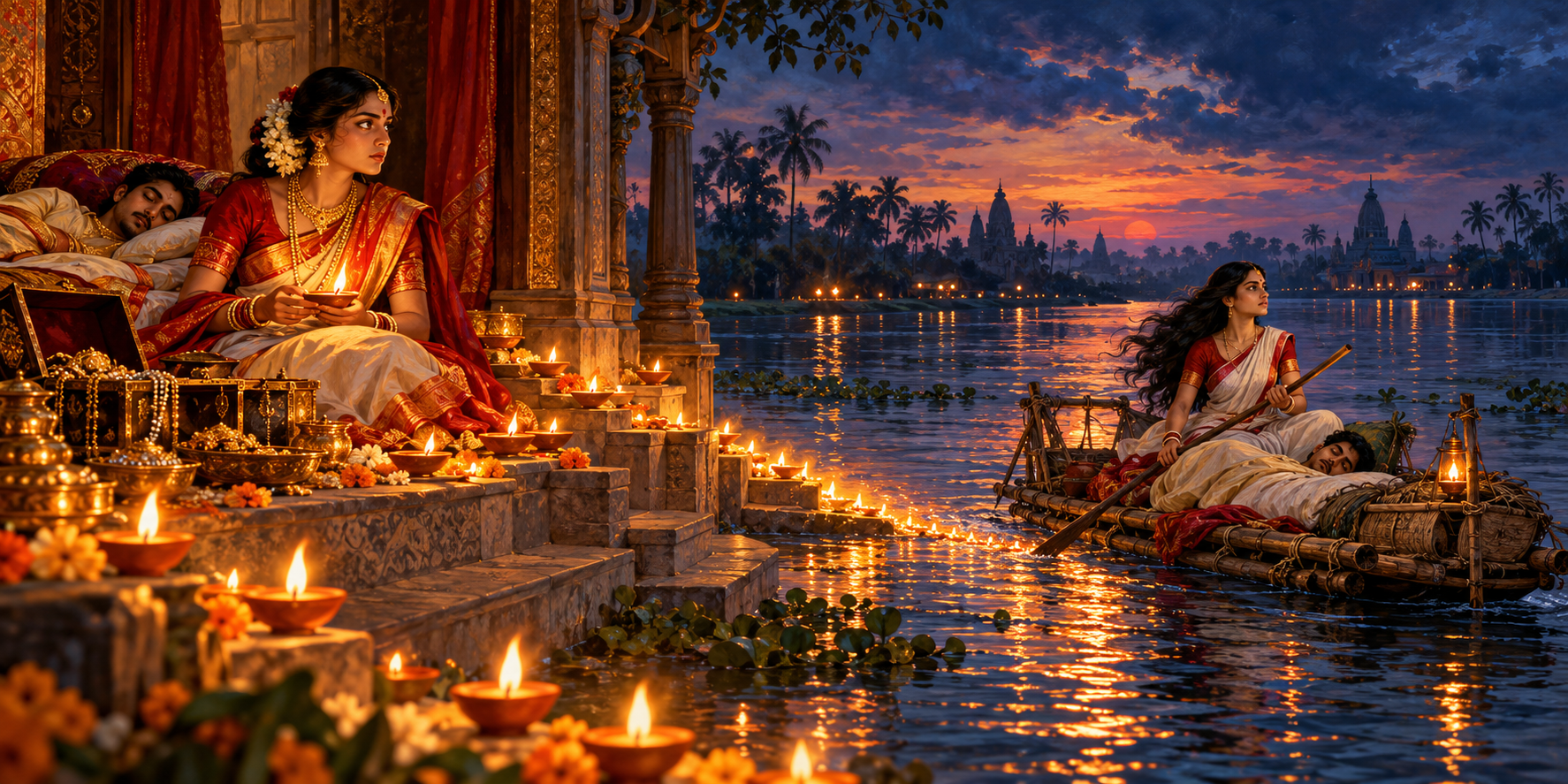
The Hemnak narrative has clear similarities with the story of Behula and Lakhindar from the Manasamangal tradition. Both place a newly married couple beneath the shadow of a serpent-related fate, and both move the bride from the edge of the household to the centre of the action.
That resemblance is worth noticing because it situates the Dhanteras tale within a recognisably Bengali narrative world. The endangered bridegroom is not the only figure who matters. The bride’s resolve determines how the audience understands fidelity, adversity and human action in the presence of fate.
Similarity, however, is not proof that the two are the same story or that one was copied directly from the other. Say that the Hemnak tale echoes Behula and Lakhindar; do not merge their plots or invent a historical genealogy. That wording preserves the cultural connection without claiming more than the comparison can establish.
If you are discussing the two narratives in a family or classroom, compare their structures through three questions: What form does the danger take? What choices remain available to the bride? Does her action prevent the foretold loss, or answer it after it occurs? Those questions make the resemblance visible while keeping each narrative distinct.
How to honour the story on Dhanteras
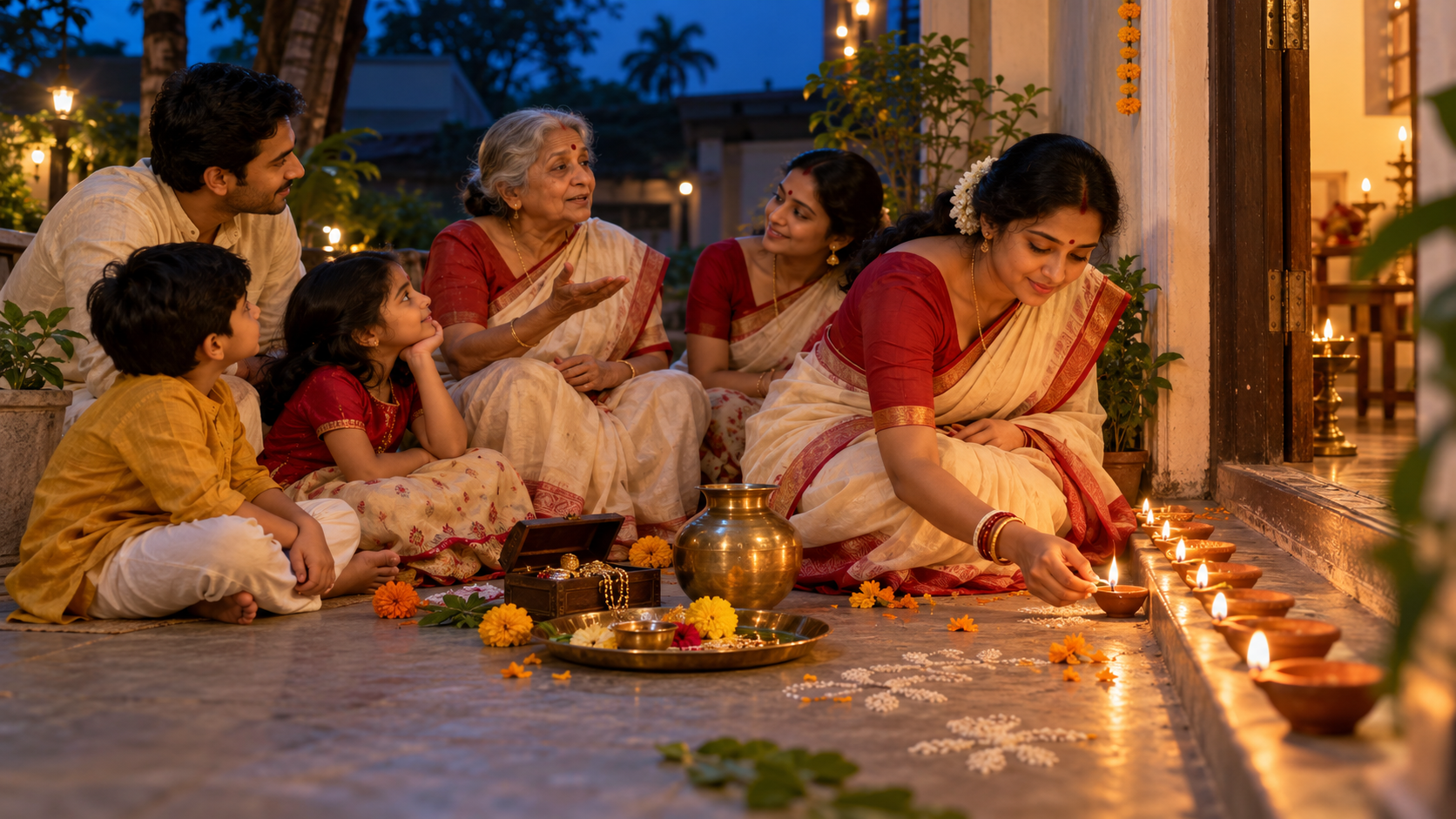
You do not need to manufacture a new ritual to make this folklore part of your observance. A careful retelling, followed by one concrete reflection, is enough to recover what a shopping-centred celebration can obscure.
- Tell the story before discussing purchases. Use the six-part sequence above so the bride’s preparation remains central. Beginning with shopping makes wealth the subject; beginning with the vigil makes wealth a servant of care.
- Let the lamp represent attention. If you light a diya, connect it with the bride’s refusal to sleep through danger. Never leave an open flame unattended. Use a stable, non-flammable surface or an enclosed electric diya when children, pets or building rules make that the safer choice.
- Ask listeners to identify her actions. Have each person name one verb associated with the bride: learning, planning, lighting, watching, singing or protecting. This simple exercise prevents her from disappearing behind the king and prince.
- Separate symbolism from a guarantee. Folklore can give moral meaning to a lamp without promising that a ritual object will prevent illness, accident or death. Present the vigil as a lesson in attentiveness, not as a supernatural warranty.
- Name regional practice honestly. Say, “This is a Bengali Dhanteras story,” or, “This is how our household tells it.” That phrasing honours a living tradition without turning one regional form into a compulsory rule for all Hindus.
You can also use the tale to redirect the customary question, “What should we buy?” Ask instead, “What resources do we already possess, and how can we place them in the service of someone vulnerable?” That is not a rejection of prosperity. It is a Dharmic test of what prosperity is for.
Key takeaways
- Hemnak and Him are names for the same king; the active protagonist is his son’s bride.
- The bride meets a foretold snake-related death with light, precious metals, wakefulness, songs and stories.
- The tale resembles Behula and Lakhindar from Manasamangal, but resemblance does not make the narratives identical.
- Its strongest Dhanteras lesson is not accumulation. It is the intelligent use of available resources to protect life.
- Retell it as Bengali folklore, not as a universal scriptural command or a guaranteed means of averting death.
This Dhanteras, tell the tale before the shopping list comes out. Light safely, keep the bride at the centre, and ask what her vigilance requires from your own household when another person’s well-being is at the threshold.
References

Leave a Reply
You must be logged in to post a comment.