
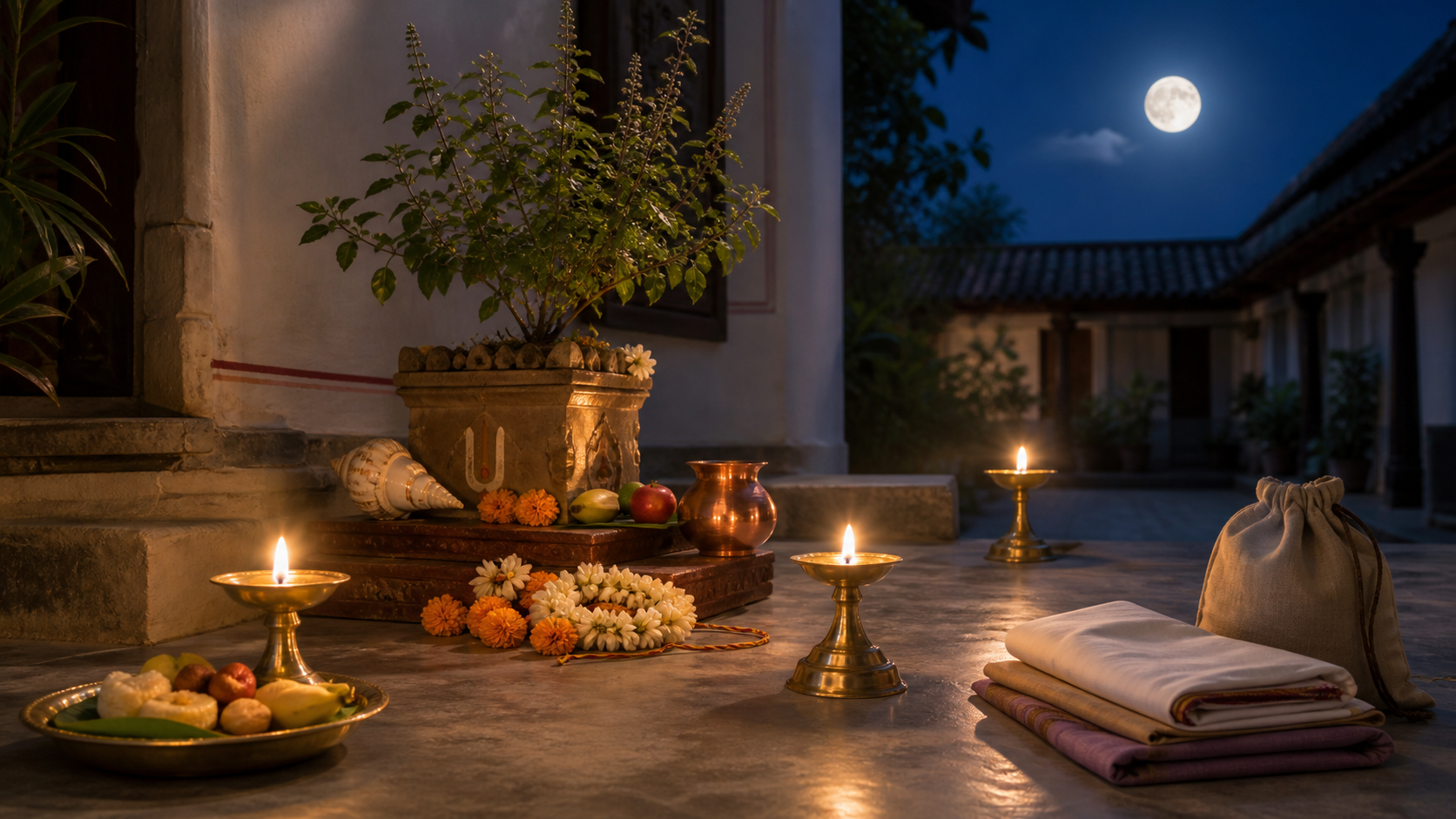
If you are trying to fit Kartik worship around work, family duties, or a Tirumala pilgrimage, do not treat the whole season as one festival with one universal muhurat. Three dates carry the main planning decisions: November 1, November 2, and November 5.
The date tells you which observance is current. Your city-specific Panchang tells you when its tithi, vrata completion, parana, or evening worship should occur. Keeping those two questions separate will help you avoid the most common calendar mistake.
Three dates organize the 2025 Kartik festival sequence
The three dates are related, but they are not interchangeable. November 1 centers on Ekadashi discipline and Vishnu bhakti. November 2 continues the Vaishnava sequence through Dwadashi and Tulsi-Damodar worship. November 5 is the full-moon culmination associated with sacred bathing, lamps, charity, and the completion of longer Kartik vows.
| Date | Main observances | Your planning decision | Core devotional emphasis |
|---|---|---|---|
| November 1, 2025 | Kaisika Ekadashi, Prabodini Ekadashi, and Tulsi Vivah in traditions that use Ekadashi | Decide whether this is your family’s Tulsi Vivah date or primarily an Ekadashi vrata | Vishnu puja, self-restraint, tulsi offerings, recitation, kirtan, and contemplation |
| November 2, 2025 | Ksheerabdhi or Chiluku Dwadashi, also called Yogini Dwadashi, with Tulsi-Damodar or Tulsi-Shaligram Vivah | Use this date if your household or temple places the marriage rite on Dwadashi; confirm parana locally | Ekadashi completion, Tulsi alankara, symbolic marriage, lamps, and sattvik naivedya |
| November 5, 2025 | Kartik Purnima, Tripuri or Tripurari Purnima, Dev Deepavali, and optional Tulsi or Kartik vrata udyapana | Plan the closing observance, especially if you have maintained a Kartik vrata or daily deepa-dana | Snan, Shiva and Vishnu worship, deepa-dana, dana, meditation, and completion |
These are civil dates, not universal clock-time muhurtas. Tithi boundaries depend on place and sunrise calculations, so the correct puja and parana windows must come from a reliable Panchang for your city or from the temple whose tradition you follow. The recognized Tulsi Vivah choices are November 1, November 2, or November 5, depending on sampradaya and household custom.
Key takeaways
- Reserve November 1 for Ekadashi observance and Kaisika-centered Vishnu bhakti.
- Reserve November 2 for Dwadashi parana and Tulsi-Damodar Vivah if that is your inherited practice.
- Reserve November 5 for Kartik Purnima snan, deepa-dana, charity, and any applicable vrata udyapana.
- Choose one principal Tulsi Vivah date. Do not repeat a full marriage rite on all three dates unless your family tradition expressly requires it.
- For Tirumala, the festival date and the practical darshan schedule are separate matters; TTD notifications determine timings and ticketing arrangements.
Observe November 1 and 2 as a connected Vaishnava sequence
Ekadashi and Dwadashi work best as a sequence rather than as two crowded, competing festivals. November 1 establishes restraint and remembrance. November 2 brings completion, nourishment, and household celebration. You can preserve that rhythm even when your family performs Tulsi Vivah on only one of the two days.
November 1: Kaisika Ekadashi and Prabodini observance
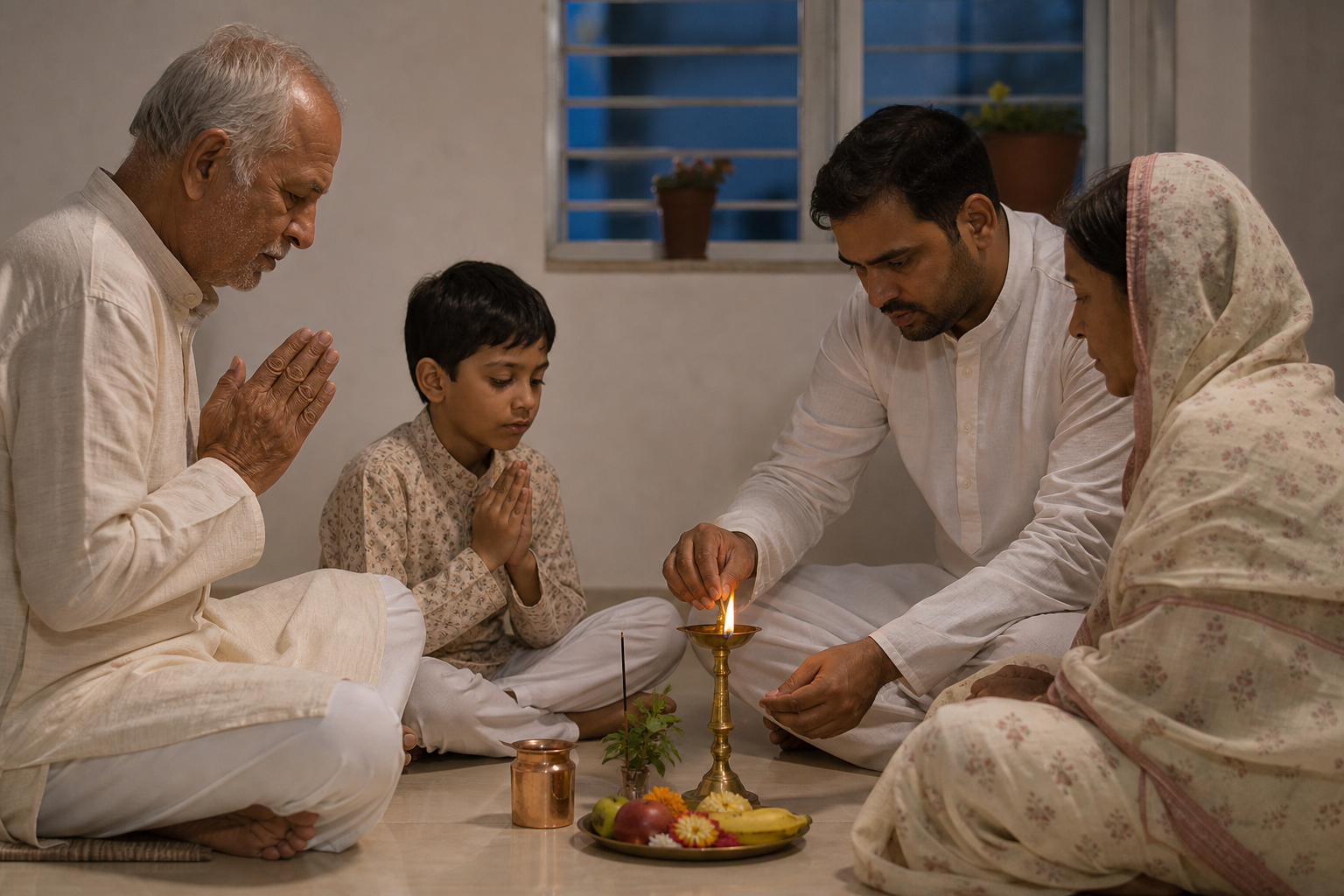
Kaisika Ekadashi has particular importance in South Indian Vaishnava temple life, including at Tirumala and Srirangam. Its practical center is not decorative abundance but disciplined Vishnu bhakti: fasting or another customary vrata discipline, worship with tulsi and sattvik offerings, Vishnu Sahasranama, sacred narration, kirtan, and, where customary, jagaran. The day invites you to turn restraint into better conduct rather than treating fasting as an isolated achievement.
- Begin with snan, a clean shrine, and a clear sankalpa appropriate to your household practice.
- Offer tulsi to Vishnu with flowers, water, a lamp, and simple sattvik naivedya.
- Choose a recitation you can complete attentively, such as Vishnu Sahasranama, rather than assembling an unrealistic program.
- Set aside an evening period for kirtan, japa, or reflection on Vishnu’s compassion and protection.
- If your family performs Tulsi Vivah on Prabodini Ekadashi, make that the day’s principal ceremony instead of adding it as a hurried final item.
Families who do not have an inherited fasting rule should seek guidance from their sampradaya or temple rather than borrowing the strictest practice they find. The spiritual purpose is steadiness, truthfulness, and devotion. A demanding observance that prevents attentive worship or responsible household conduct misses that purpose.
November 2: Dwadashi completion and Tulsi-Damodar Vivah
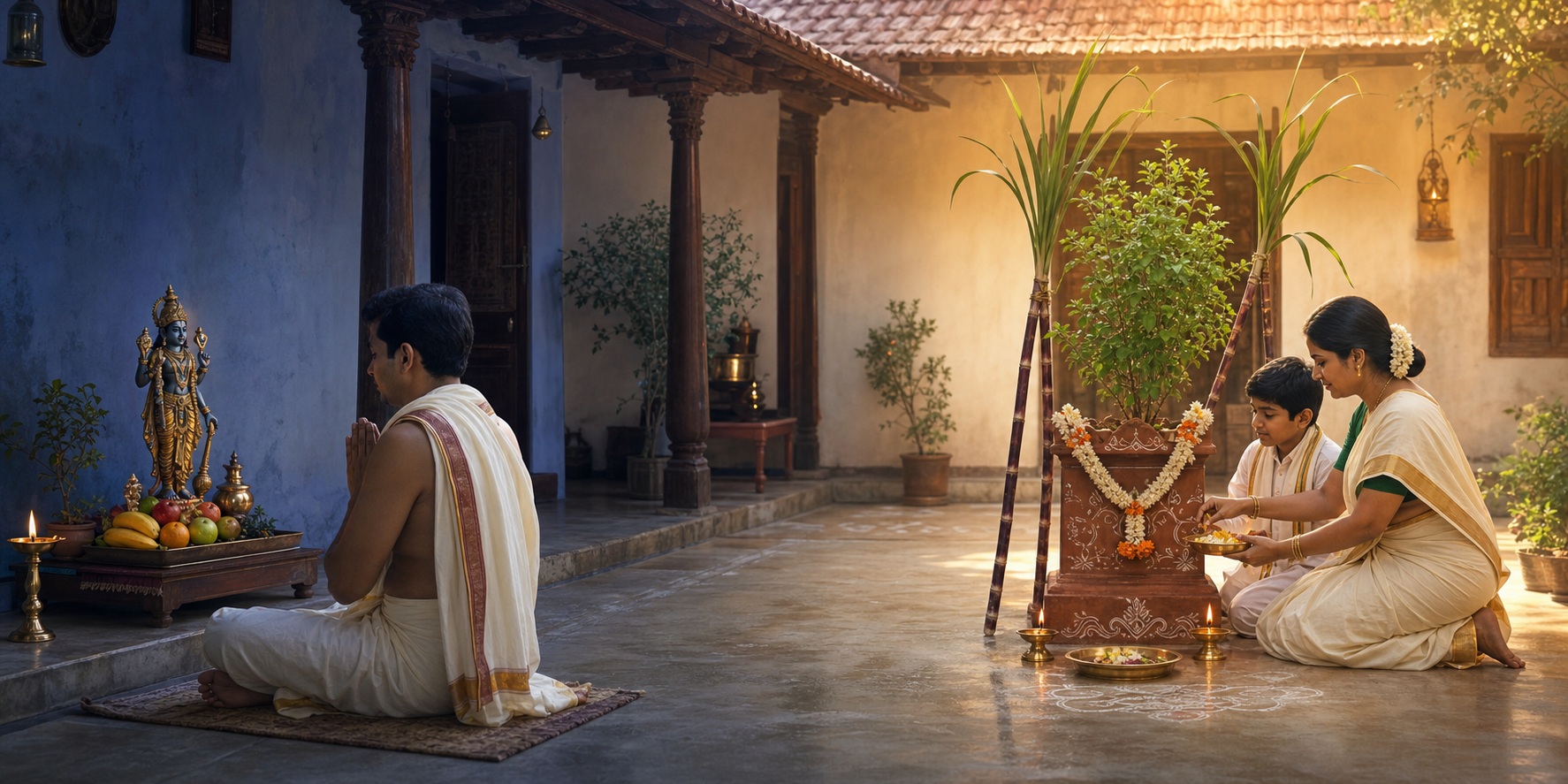
On Ksheerabdhi or Chiluku Dwadashi, the focus moves to Tulsi and Bhagavan Vishnu as Damodar. The association with ksheera, or milk, expresses serenity and nourishment, but local custom still governs the actual offerings. If you observed an Ekadashi vrata, obtain the Dwadashi parana time from your local Panchang before planning the rest of the ceremony.
- Clean and decorate the Tulsi vrindavan with natural, reusable, or minimally wasteful materials.
- Place Shaligram beside Tulsi. If your tradition permits and Shaligram is not available, a Vishnu or Krishna murti can serve as the divine focus for the household rite.
- Perform achamana and sankalpa, followed by Tulsi snana and alankara, the lighting of a lamp, and the offering of flowers, akshata, incense, fruit, or another simple sattvik naivedya.
- Enact the symbolic union according to family custom with the prescribed thread, turmeric, kumkum, mantra, and kanyadana symbolism.
- Complete parikrama, kirtan or Vishnu stotra recitation, arati, and distribution of prasad.
- Where customary, include a ksheera offering to Damodar and conclude with dana or food offered in service.
If November 1 is already your established Tulsi Vivah date, November 2 can remain a quieter Dwadashi observance centered on parana, Tulsi puja, lamps, and gratitude. If your community uses Dwadashi for the marriage, keep November 1 focused on Ekadashi and perform the complete Vivah on November 2. This prevents duplication while preserving the meaning of both tithis.
November 5 is also a recognized Tulsi Vivah date in some traditions. Use it when that is your household custom or when your vrata formally culminates on Purnima. A missed preferred date should not become an excuse to invent a muhurat; consult a trusted temple or local Panchang before moving a tithi-dependent samskara.
Make November 5 a genuine culmination, not another busy puja
Kartik Purnima falls on November 5, 2025. In North Indian Purnimanta calendars it closes Kartik, while Amanta traditions observe it as Kartik’s fifteenth lunar day rather than necessarily treating it as the end of the named month. That distinction matters when you are following a month-long vrata: use the calendar system attached to your own observance.
Begin with purification and deliberate worship
- Take a sacred snan at a river or tirtha if travel is practical and permitted. If it is not, bathe at home with the same attention to cleanliness and sankalpa.
- Prepare the shrine and begin with Ganesha dhyana before the principal Vishnu and Shiva worship.
- Offer tulsi where appropriate in Vishnu puja and bilva leaves where appropriate in Shiva puja, together with flowers, a lamp, and seasonal sattvik naivedya.
- Recite a manageable stotra, such as Vishnu Sahasranama or Shiva Ashtakam, followed by silent japa or meditation.
- Make dana concrete. Food, clothing, lamp oil, or support for annadana gives the month’s discipline a social expression.
Do not assume that sunrise alone settles the ritual time. The Purnima tithi may shape the morning snan, daytime worship, and Pradosh lamp offering differently in your location. Check the Panchang once, write down the relevant windows, and let the household know which part of the observance belongs in each one.
Use the evening for light, Tripurari remembrance, and udyapana
As Tripuri or Tripurari Purnima, the evening remembers Shiva’s destruction of Tripurasura. The image is morally exacting: light must overcome layered ignorance within us, not merely decorate a threshold. Dev Deepavali gives that reflection a public form through lamps at temples, homes, ghats, and water bodies.
If you maintained daily deepa-dana, japa, dietary restraint, or another Kartik vow, review the sankalpa you actually made. Udyapana is the completion of that vow, not a generic ritual that everyone must add. A household conclusion may include Tulsi archana, pradakshina, a lamp, naivedya, Vishnu-related recitation, dana, annadana where possible, and a closing prayer of gratitude to Vishnu and Shiva.
The Kartik full moon also carries distinct meaning beyond Hindu practice. Sikh communities associate it with Guru Nanak Gurpurab and emphasize remembrance, kirtan, and seva. Jain communities connect the period with tirtha-yatra, vrata, prayer, and dana, including pilgrimage associated with Shatrunjaya. Buddhist full-moon observance can center on Uposatha, ethical reflection, meditation, and generosity. Shared commitments to compassion and discipline can deepen mutual respect, but they should not be used to erase the different histories or practices of these traditions.
Plan Tirumala around confirmed access, not the date alone
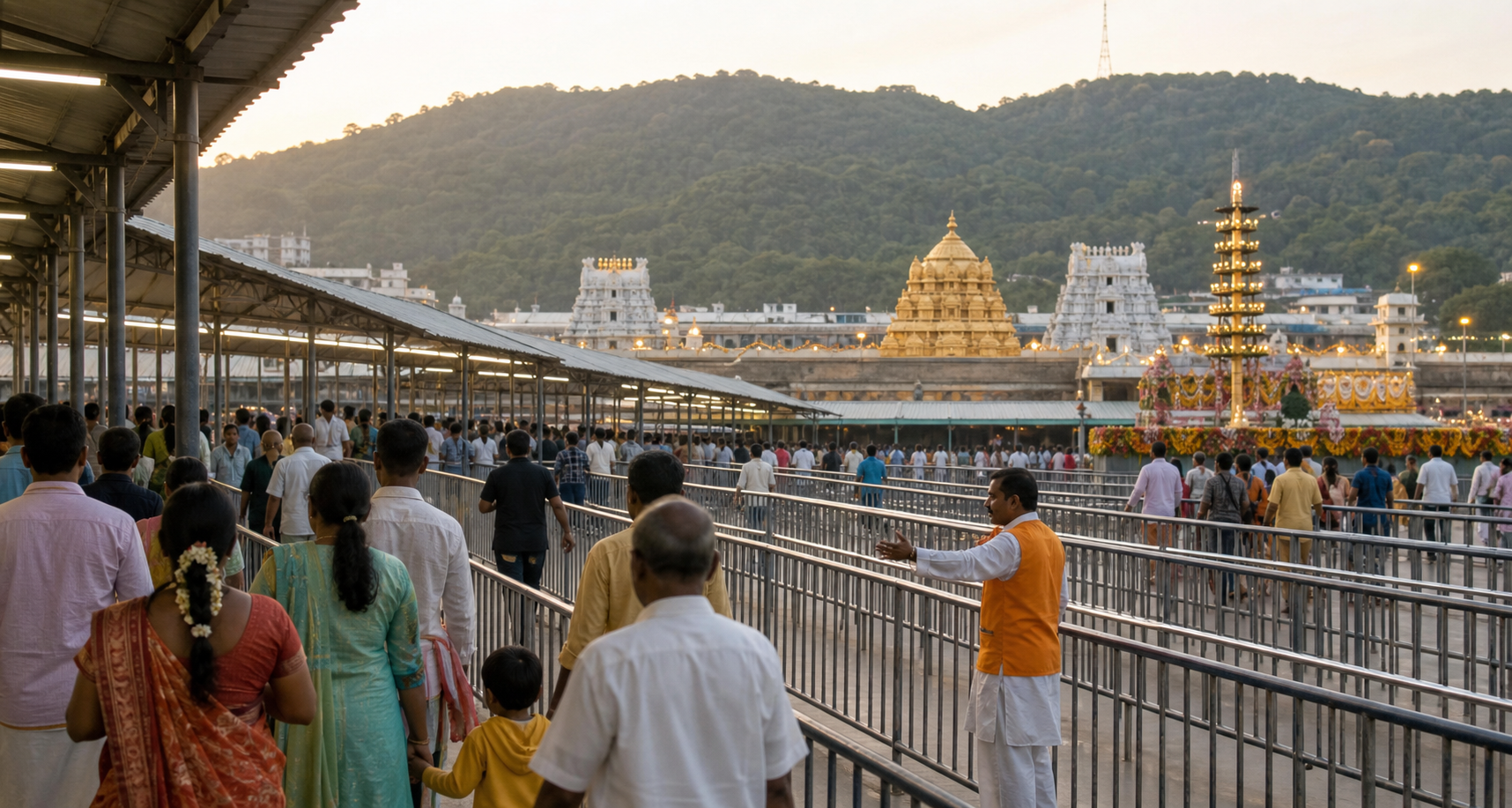
A Tirumala visit during Karthika is not limited to the three household festival dates. The month’s devotional framework includes early aradhana, alankaram and archana, processional utsavams, evening deepa-alankara, and Divya Prabandham recitation. It also honors Sri Vaishnava acharyas and Alwars through Varsha Tirunakshatrotsavams, with Viswaksena receiving special veneration within the temple’s Vaishnava tradition. The specific TTD schedule, timings, and ticketing arrangements remain subject to TTD notifications.
Kaisika Ekadashi on November 1 deserves special attention if your purpose is to encounter the South Indian temple expression of this vrata. Kartik Purnima on November 5 is the stronger anchor if your priority is the full-moon atmosphere of lamps, sacred bathing, and month-end completion. Choose the date by devotional purpose first, then determine whether confirmed access makes the trip workable.
A practical Tirumala planning sequence
- Name your priority: Kaisika Ekadashi, a Karthika temple experience, Kartik Purnima, or ordinary Srivari darshan during the sacred month. Trying to optimize for every observance makes travel decisions less clear.
- Check TTD’s official notification for the relevant date, special observance, darshan arrangements, and ticketing. Until TTD confirms a time, treat it as unconfirmed.
- Check your city or pilgrimage-location Panchang separately. A temple timetable and a tithi calculation answer different questions.
- Build extra flexibility around weekends and Kartik Purnima, when higher footfall is expected. Do not schedule a tightly timed onward journey around an assumed darshan duration.
- Keep your personal sadhana portable: a short stotra, nama-japa, and a simple prayer can continue if movement or waiting changes your planned routine. Light a physical lamp only where it is permitted and safe.
- Follow temple etiquette, staff instructions, and queue discipline. Carry only what you need, minimize waste, and avoid leaving ritual materials in temple or hill areas.
A special festival date does not by itself guarantee a particular view of a procession or entry to a special service. The calendar establishes the sacred occasion; TTD’s current arrangements establish practical access. Keep both in your plan, and do not let an unconfirmed special event jeopardize the darshan you have actually secured.
Build one observance plan your household can complete
The most coherent plan is usually smaller than the most elaborate one. Decide which rite is principal, which practices support it, and which date completes the arc. A family can then participate with attention instead of spending the sacred period recovering from its own preparations.
- For a Vaishnava household sequence: observe Ekadashi on November 1, complete parana and Tulsi-Damodar worship on November 2, and use November 5 for lamps, dana, and a simple Kartik conclusion.
- For a Tulsi-centered observance: select November 1, 2, or 5 according to family custom; perform the full Vivah once; maintain shorter Tulsi puja and deepa-dana on the surrounding dates.
- For a month-long Kartik vrata: retain a written copy of your sankalpa and plan its matching udyapana on November 5 rather than adding unrelated acts at the end.
- For a Tirumala-centered plan: make confirmed darshan the travel anchor and preserve a modest home or lodging practice for any tithi observance that cannot be coordinated with the temple schedule.
Prepare only the materials your chosen plan requires: a clean altar, Tulsi vrindavan, Shaligram or an appropriate Vishnu or Krishna murti, lamps and wicks, natural oil, flowers, akshata, incense, fruit or sattvik naivedya, and the text or recording needed for your recitation. Add ksheera on Dwadashi or bilva for Purnima Shiva puja only where those offerings belong in your custom.
Place every diya on a stable, nonflammable surface. Keep flames away from curtains, balconies, crowded edges, children, animals, and unattended areas near water. Clay lamps and natural oils support a low-waste observance, but an eco-conscious material is not automatically a safe placement.
Put November 1, 2, and 5 into the household calendar now. Beside them, write three verbs: discipline, complete, and illuminate. Then obtain the local Panchang windows and any needed TTD confirmation. You will have a Kartik plan that can be practiced, not merely admired.

References
- DharmaRenaissance Blog – Kartik Purnima 2025: Sacred Guide to Puja Muhurat, Snan, and Vrat Udyapana (5 Nov)
- DharmaRenaissance Blog – Kaisika Ekadashi 2025: Date, Rituals, and South Indian Temple Traditions That Inspire Devotion
- DharmaRenaissance Blog – Tulsi-Shaligram Vivah Muhurat 2025: Key Dates, Ritual Guidance, and Heartfelt Tips for Kartik Observance
- DharmaRenaissance Blog – TTD November 2025 Utsavams: Sacred Karthika Celebrations at Srivari Temple, Tirumala
- DharmaRenaissance Blog – Kartik Purnima 2025 (Tripuri/Tripurari): Auspicious Date, Dev Deepavali, Sacred Rituals, and Unity
- DharmaRenaissance Blog – Chiluku Dwadashi 2025: Sacred Tulsi-Damodar Vivah, Date, Meaning, and Vrat Guide
