

If you are preparing to observe Janmastami at home, the difficult question is not how elaborate the altar should be. It is how to make the lila, the fast, the kirtana, and the midnight celebration part of one coherent act of devotion.
The day becomes much clearer when you follow one movement: hear why Krishna appears, accompany him from confinement in Mathura to loving shelter in Vraja, welcome him at midnight, and let that welcome alter something in your conduct afterward.
Follow the lila from confinement to Vraja
Janmastami is not simply a divine birthday placed on the Hindu calendar. Its lila has an intentional sequence. Each stage discloses something about Krishna, and skipping the later stages can leave you with only half the meaning.
- Bhumi bears the weight of adharma. The earth, personified as Bhumi, suffers under rulers who possess royal power but act demonically. Brahma appeals to Vishnu for relief. Yet the removal of oppressive kings is not the only purpose of Krishna’s descent. His appearance also fulfils the desire to delight Nanda and Yashoda and to reveal the intimate relationships of Vraja. The lila therefore begins with a public crisis but moves toward divine love and closeness. Krishna descends with his eternal associates and Yogamaya, the potency that arranges his earthly pastimes.
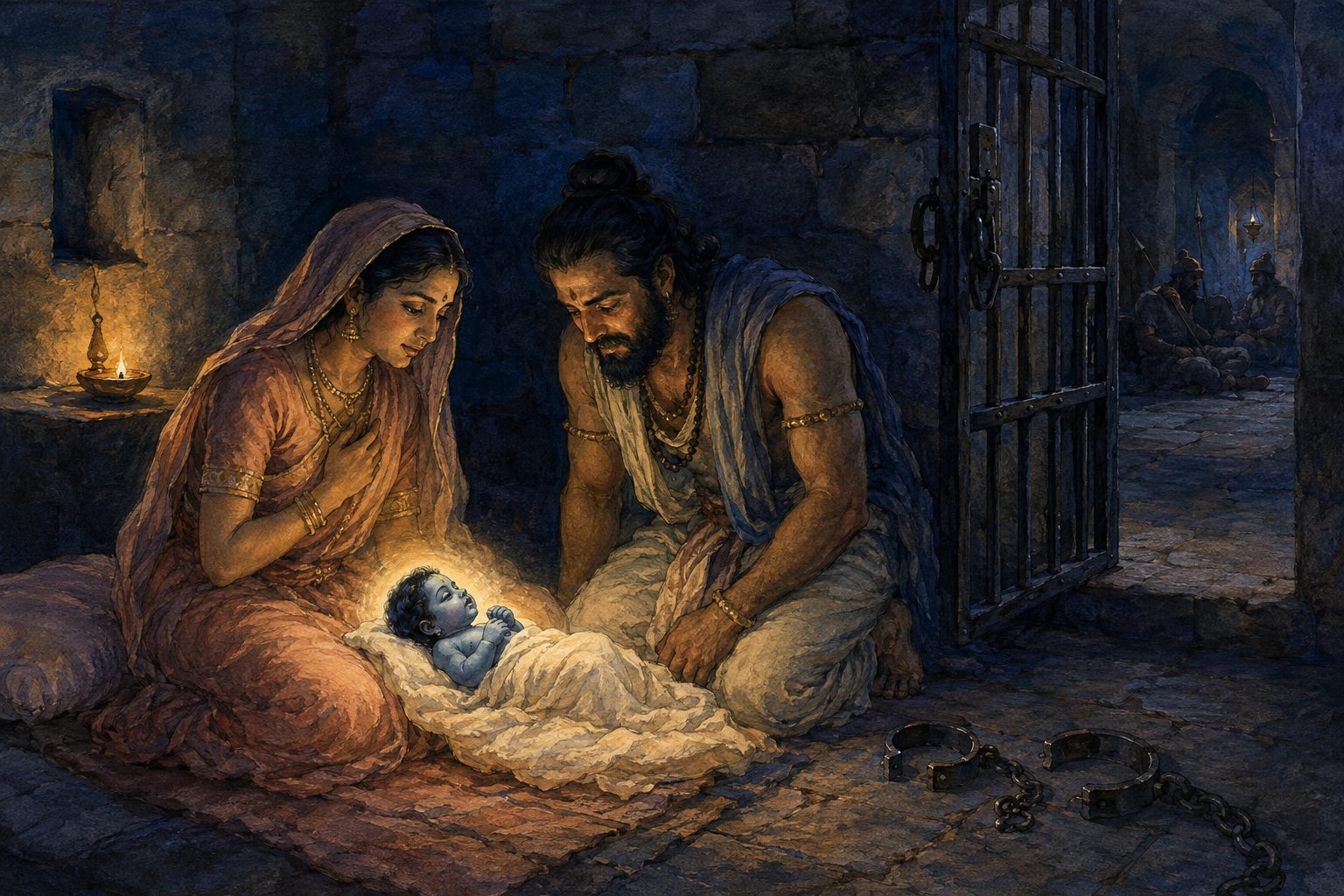
- Devaki and Vasudeva wait within Kamsa’s prison. Kamsa has confined the couple and killed six of their children. Before Krishna’s appearance, Yogamaya transfers their seventh child, Balarama, to Rohini, who is living under Nanda’s protection. What looks politically sealed and humanly hopeless is already being rearranged by a power Kamsa cannot perceive.
- The darkness becomes the hour of appearance. Krishna appears on the eighth day of the waning moon in the month of Bhadra, under Rohini Nakshatra, amid signs of restored auspiciousness. This is why Janmastami follows the sacred calendar rather than a fixed civil birthday. Use the date and observance followed by your temple, guru, family, or sampradaya instead of trying to infer it from the civil calendar alone.
- Krishna reveals freedom rather than helplessness. In the Vaishnava understanding expressed in the lila, Krishna’s janma is divyam: a transcendent appearance, not a birth compelled by karma. Devaki and Vasudeva first encounter divine majesty. Krishna can then be carried as an infant, but his smallness does not make him subject to Kamsa’s power.
- The prison opens and the road to Gokula appears. The shackles fall away, the doors open, and the guards sleep. During a dark, rain-filled night, Vasudeva carries Krishna toward Gokula. The swollen Yamuna gives them passage. The lila does not deny the storm; it shows that the storm cannot prevent Krishna from reaching Vraja. The prison, the river, and the journey all yield before Krishna’s independent will.
- Majesty gives way to parental affection. Under the care of Nanda and Yashoda, Krishna is received not primarily with philosophical analysis or royal ceremony, but as a newborn to be loved. His crying awakens the women of Vraja, who hurry to him, bathe him, anoint him, and surround him with affection. The culmination of the appearance lila is therefore not the humiliation of Kamsa. It is the sweetness of Krishna allowing his devotees to care for him.
Notice the direction: from the burdened earth to divine appearance, from prison to Gokula, and from reverential awe to intimate love. When you read the lila on Janmastami, do not stop at the miraculous escape. Follow Krishna all the way into the household of Vraja. That is where the reason for his coming becomes personal.
Different Vaishnava lineages may emphasize the Mathura and Vraja manifestations in distinct ways. Follow the telling received in your tradition without reducing Krishna’s appearance to an ordinary biological event. The shared devotional point is that Krishna comes by his own will and permits himself to be approached through bhakti.
What Krishna’s appearance asks you to understand
Bhagavad Gita 4.9 gives Janmastami its central discipline: you are asked to understand the divine nature of Krishna’s appearance and activities. The promise attached to that understanding is liberation from repeated material birth and attainment of Krishna. But tattvatah, understanding in truth, means more than memorizing the sequence of events. Bhakti is presented as the way to know Krishna as he is.
Lila means divine play, but play does not mean trivial entertainment. Krishna acts without being forced by karma or lack. His activities reveal relationships that devotees can hear about, remember, serve, and ultimately enter through devotion. Three dimensions belong together:
- The dharmic dimension: Krishna relieves Bhumi of the burden created by demonic rulers and re-establishes the conditions in which dharma can flourish.
- The relational dimension: Krishna increases the joy of his devotees. The parental love of Nanda and Yashoda and the affection of the residents of Vraja are not incidental decorations around the defeat of Kamsa; they reveal the sweetness at the heart of the lila.
- The invitational dimension: Krishna does not need to descend personally merely to destroy one tyrant. His Vraja pastimes draw living beings toward him through love. His conquest is chiefly a conquest of the heart, not a display of force.
This corrects three incomplete readings. Janmastami is more than a cultural birthday pageant. It is more than a story about supernatural protection. It is also more than a psychological allegory. The theological claim comes first: Krishna is divine before, during, and after his appearance. The lila can then illuminate your inner life without being reduced to it.
One useful devotional application is to see the prison as the condition created by unchecked desire, revenge, greed, fear, and the urge to control. Do not use that image mainly to identify a Kamsa in somebody else. Name the tendency that is fastening your own attention to resentment or appetite. Then bring that specific tendency into your prayer at midnight. A general wish to become better is easy to forget; a named attachment gives your sadhana a real place to begin.
The contrast between Kamsa and the residents of Vraja is especially instructive. Kamsa tries to control the divine through surveillance, confinement, and violence. Yashoda receives Krishna through care. Janmastami asks you to notice which posture you carry into religious life: the attempt to control outcomes, or the willingness to serve.
Build a home observance around remembrance
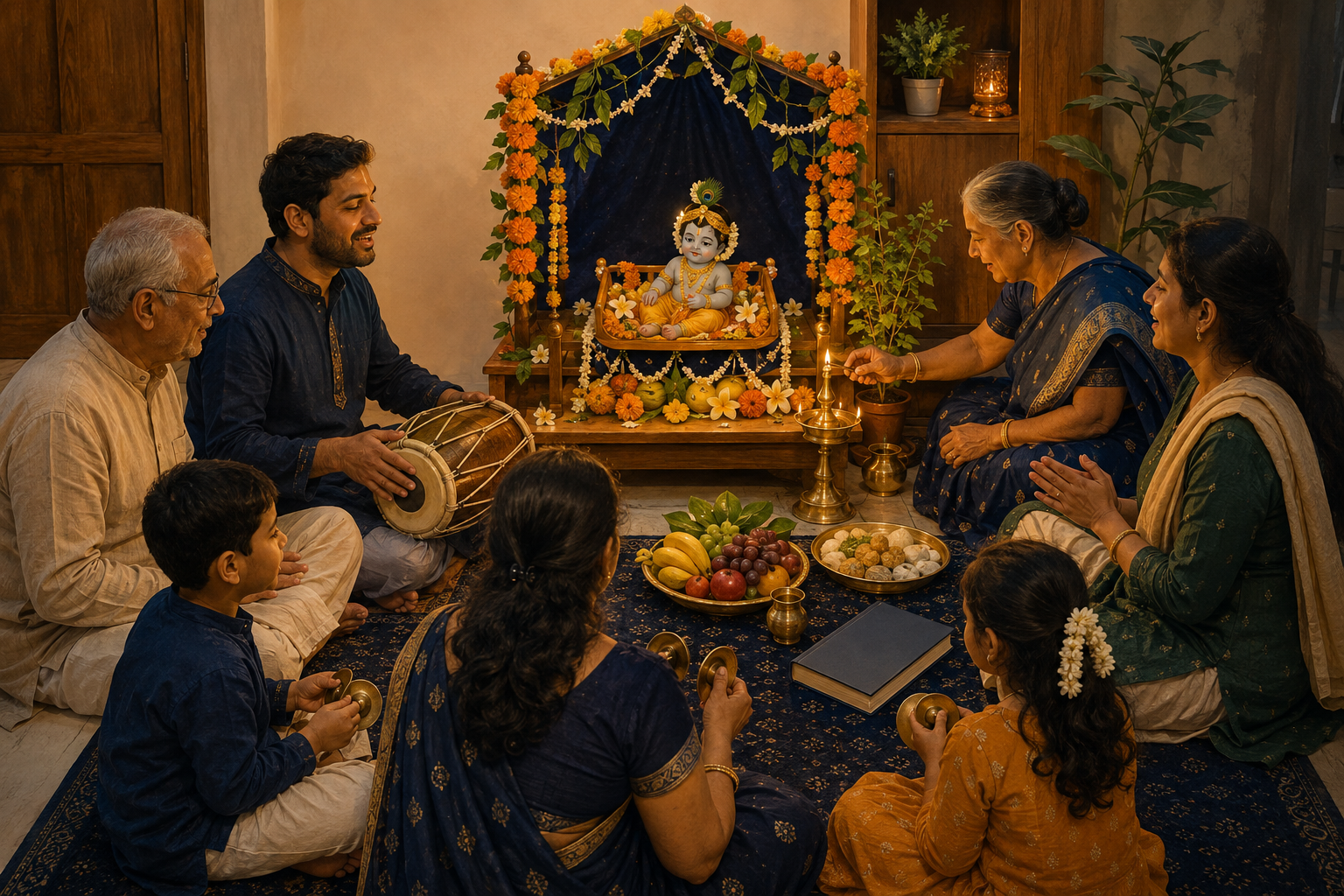
A home observance of Janmastami does not need to imitate the scale of a temple festival. It needs a clear centre. Keep the altar, food, reading, and music simple enough that preparation does not consume the attention meant for Krishna.
Prepare before the day begins
- Confirm the observance you are following. Check the date, expected fast, midnight practice, and fast-breaking custom with the temple, guru, or family tradition you actually follow. Do not combine demanding rules from several lineages and then treat the result as a universal standard.
- Choose a realistic form of fasting. During the first ISKCON Janmastami observance in America in 1966, A.C. Bhaktivedanta Swami Prabhupada encouraged the new devotees to fast but allowed fruit if hunger or weakness became too difficult. The concession protected the devotional purpose without turning the fast into an ordeal. Use the form permitted by your tradition and appropriate to your capacity.
- Place the essentials on the altar. Prepare a clean place for Krishna’s murti or image and arrange a flower, fruit, and water that can be offered. Bhagavad Gita 9.26 emphasizes these simple offerings when they are brought with bhakti. Expense and abundance cannot replace attention.
- Select the lila before you become busy. Mark the passages covering Bhumi’s appeal, the prison, Krishna’s appearance, the crossing of the Yamuna, and the welcome in Gokula. Choosing in advance prevents the central act of hearing from being displaced by last-minute preparation.
- Decide what you will chant. Follow the names, mantra, bhajan, or congregational response used in your tradition. If you are observing alone, reading Krishna’s names and lila aloud is still a meaningful form of glorification.
Fasting is a devotional discipline, not a test of spiritual worth. If food restriction could interfere with medication, blood-sugar management, pregnancy, recovery from an eating disorder, or another health need, do not undertake a strict fast without advice from a qualified clinician who knows your situation. Follow a gentler practice instead. Do not use an adult fasting rule as the measure of a child’s devotion.
Give the daytime fast something to serve
An empty stomach does not automatically produce remembrance. It can just as easily make the mind preoccupied with food. The early 1966 storefront observance showed this problem plainly: when the newcomers lacked engagement, the day felt slow and the mind wandered. Fasting works better when every period of restraint is attached to hearing, chanting, or service.
- Begin with a short sankalpa in your own words: you are setting aside ordinary indulgence so that you can hear and welcome Krishna with greater attention.
- Read the lila in episodes rather than rushing through it at midnight. After each episode, pause over one question: what does this reveal about Krishna, and what response does it ask from a devotee?
- Alternate reading with chanting. This keeps the observance from becoming either a lecture without devotion or singing without contemplation.
- Complete necessary household duties, but reduce avoidable distraction. A fast spent in continuous scrolling, shopping, or argument has preserved the rule while losing much of its purpose.
- Prepare the offering early enough that cooking and arrangement do not dominate the approach to midnight.
Kirtana is broader than musical performance. It includes spoken glorification and sacred recitation as well as singing. Reading Srimad Bhagavatam aloud can itself function as kirtana. That matters if you have no instruments, cannot sing confidently, or are observing by yourself. Your voice can still carry Krishna’s names and activities through the home.
Use the approach to midnight deliberately
At the 1968 Montreal observance, the final two hours, from ten o’clock until midnight, were devoted to kirtana understood as both chanting and speaking about Krishna. That is a useful structure, not a compulsory timetable. If your household cannot sustain two hours, preserve the sequence and shorten it rather than abandoning the observance.
- Settle the room and finish practical preparation.
- Begin with chanting or bhajan so that everyone arrives inwardly, not merely physically.
- Read the appearance and Yamuna-crossing portions of the lila.
- Allow each participant to name one quality, moment, or relationship that drew their attention.
- Return to kirtana as midnight approaches.
If children are present, give them a real devotional role rather than asking them only to remain quiet. A child can place a flower, repeat a name of Krishna, read a short line, or lead a familiar response. Participation turns a late night into a remembered family samskara.
Welcome Krishna at midnight
Midnight is the centre of the observance, but it does not require a complicated private ritual. Follow the worship authorized in your tradition. A simple sequence can remain fully focused:
- Receive the moment with Krishna’s names, kirtana, or a spoken prayer of welcome.
- Offer the prepared flower, fruit, and water with attention rather than haste.
- Recall Bhagavad Gita 4.9 and the distinction between an ordinary, karma-bound birth and Krishna’s divine appearance.
- Name the inner shackle you identified earlier and ask for the willingness to replace it with service.
- Bow, conclude the worship according to your tradition, and receive the offered food as prasada when it is time to break the fast.
If you have only a short window, keep these essentials: hear the appearance lila, chant Krishna’s name, make one simple offering, and welcome him consciously. A modest observance with attention is more coherent than an elaborate programme that leaves no time for remembrance.
Let midnight change the next morning
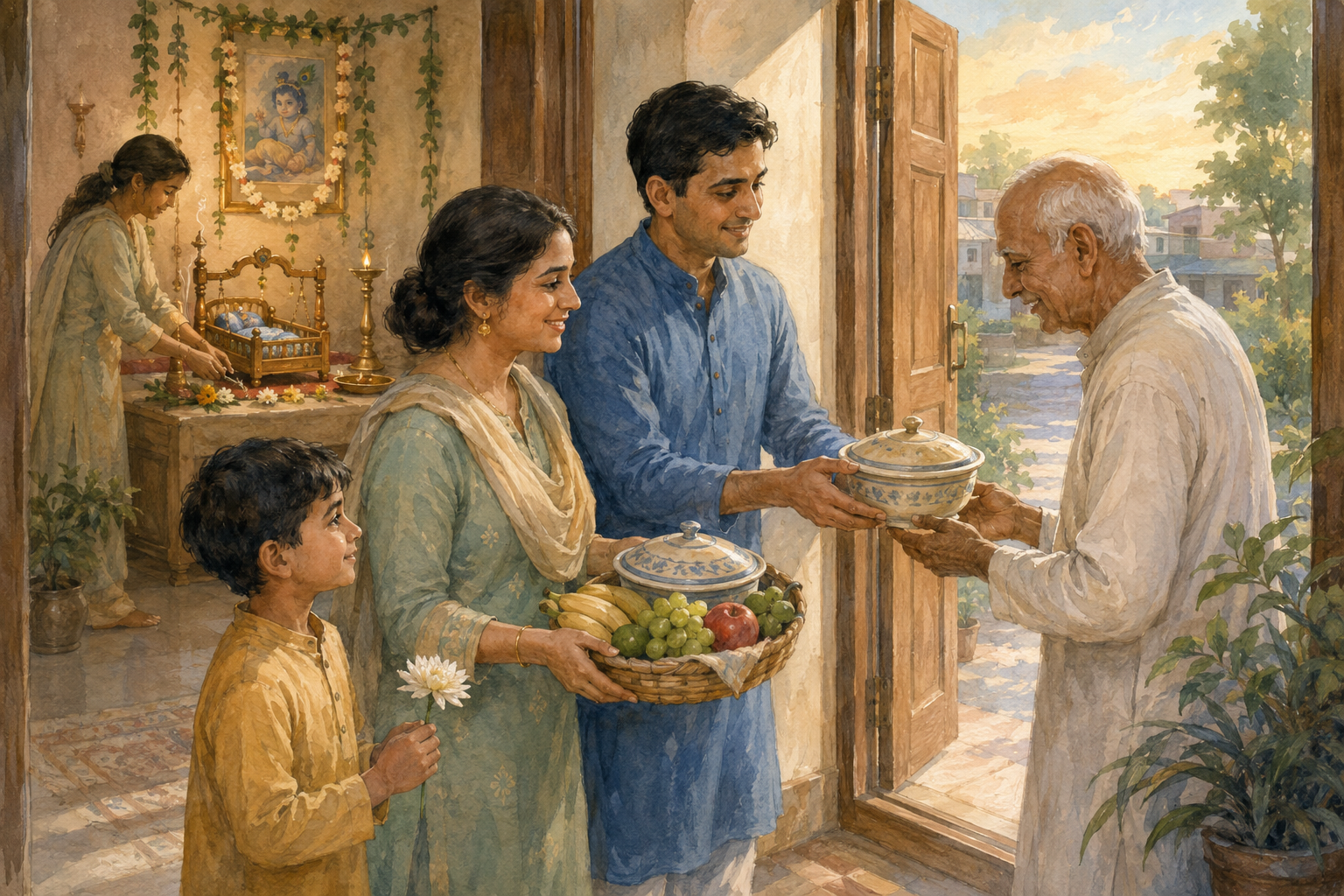
The lila does not say that devotion removes every difficult circumstance on demand. Vasudeva still walks through darkness, rain, and a swollen river. The change is that Krishna is present, the prison no longer has final authority, and a path opens through what had seemed impassable.
That gives you a practical way to carry Janmastami forward. Take the inner shackle you named and pair it with one repeatable act of bhakti. If greed is the shackle, practise offering before grasping. If revenge is the shackle, stop rehearsing the injury during your prayer and place the desire for retaliation before Krishna. If uncontrolled desire is the shackle, interrupt one habitual indulgence with chanting or sacred reading. The purpose is not to claim instant purity. It is to stop treating the prison as your permanent home.
Bhagavad Gita 2.40 teaches that sincere effort on this path is not lost and that even a beginning has protective value. The next step therefore does not need to be grand. It needs to be concrete enough to survive the return to ordinary duties. Choose one act you can continue: offer your food, read a passage of Krishna-lila, chant at a stable point in your routine, or serve someone without demanding recognition.
The morning after the festival, ask three questions: What opened during the observance? What remains locked? What form of service comes next? Then act on the final answer before Janmastami becomes only a pleasant memory.
Key takeaways
- Janmastami commemorates Krishna’s divine appearance, not an ordinary birth compelled by karma.
- The complete lila moves from Bhumi’s distress and Kamsa’s prison to Krishna’s loving reception in Vraja; hear the whole movement.
- Fasting serves remembrance. Adapt it within your tradition when health, age, or capacity makes a strict fast unsuitable.
- Kirtana includes singing, spoken glorification, and sacred recitation, so a meaningful home observance does not depend on musicians or a crowd.
- A flower, fruit, and water offered with bhakti can centre the midnight worship more effectively than elaborate preparation without attention.
- Carry the festival forward by matching one identified inner shackle with one specific, repeatable act of devotion.
References
- Dandavats – How to observe Janmastami at home
- Dandavats – Sweetest Description of Janmastami-lila
- Dandavats – Remembering Janmastami 1966
- Dandavats – Srila Prabhupada and some of his disciples talk about Janmastami, Montreal, August 16, 1968
- Dandavats – Krishna comes to conquer our hearts
