
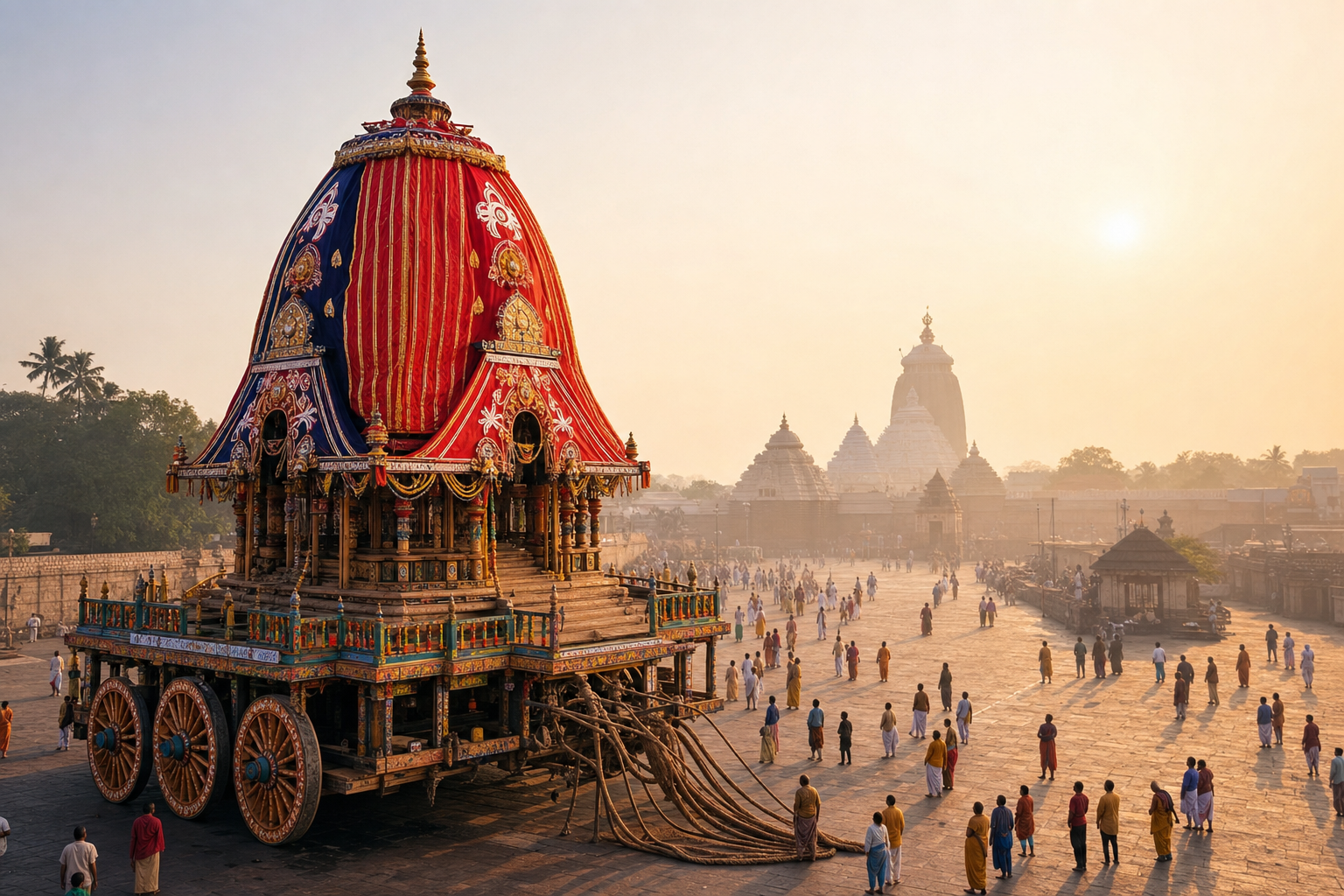
A Dandavats listing presents live coverage connected with the 2026 Jagannath Rath Yatra, Lord Jagannath and Puri. Because the source contains only a video thumbnail and no written report, it supports a viewing notice rather than a detailed account of the festival.
This guide separates what the listing actually confirms from general context that can help viewers approach the sacred procession with understanding and reverence.
What the Dandavats listing confirms
According to Dandavats, the featured subject is the Jagannath Rath Yatra of 2026, associated with Lord Shree Jagannath, Jagannath Dham and the festival in Puri. The page labels the presentation as live and displays a video thumbnail.
The supplied material does not name a broadcaster, give a timetable, describe the procession route or explain whether the stream remains live when a reader opens the page. Those details should not be inferred from the headline or thumbnail. A live broadcast can also become a recording after an event, so viewers should rely on the status shown by the video player.
Key takeaways
- The source identifies its subject as the 2026 Jagannath Rath Yatra in Puri.
- It offers a video presentation but no accompanying written account or practical viewing details.
- Any schedule, route, ceremony sequence or current broadcast status must be checked separately rather than assumed.
Why the chariot procession carries spiritual meaning
In established Hindu practice, a ratha yatra is a devotional procession in which a sacred form is carried on a chariot for public darshan. The movement from the temple into shared civic space gives the observance a distinctive character: worship becomes visible, collective and accessible beyond the inner precincts of a shrine.
Lord Jagannath is especially cherished within Vaishnava devotion, yet the procession also expresses themes recognized across the wider Dharmic family. Hindu, Buddhist, Jain and Sikh traditions retain their own teachings and forms of worship, but each gives meaningful place to disciplined practice, community, compassion and service. That comparison does not make their rites identical; it highlights an ethical vocabulary through which different Dharmic paths can meet with mutual respect.
Watching with attention rather than assumption
A festival broadcast is most useful when treated as a window into living devotion, not as a substitute for a complete explanation. Viewers can observe the role of darshan, collective participation, sacred movement and seva while remembering that the source provides no commentary with which to identify particular moments.
The 2026 listing therefore serves as an invitation to witness the Puri celebration, while careful readers should keep its limits in view. Future updates from organizers or the video publisher may supply the practical details needed for fuller participation.
Inspired by this post on Dandavats.
