
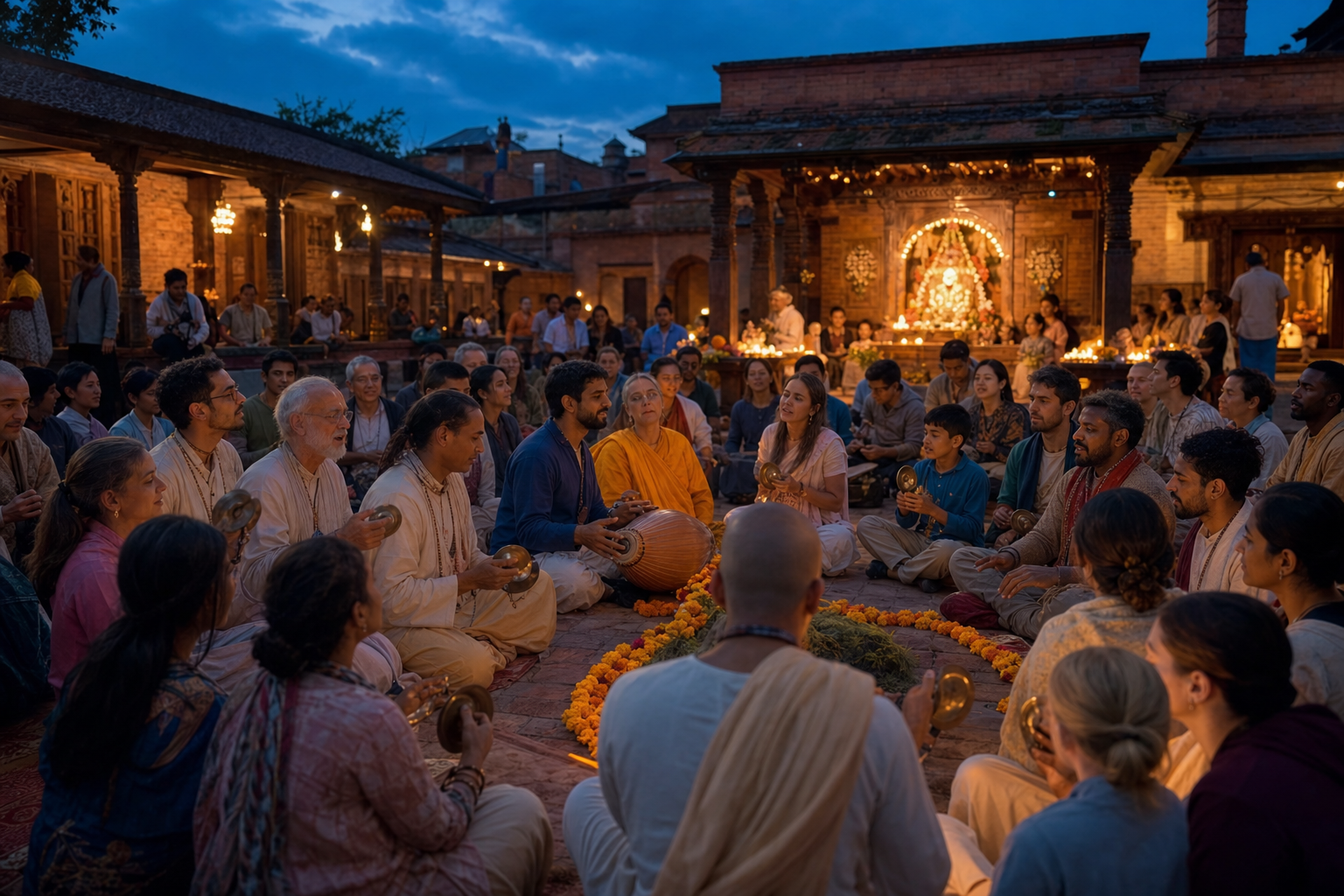
ISKCON’s sixtieth anniversary commemorates a legal beginning, but its larger significance lies in what survived that beginning: a devotional practice, an international community, a network of sacred places and a growing archive of remembered experience.
Accounts from the original New York storefront, the Radha-Krishna Temple in London and photographer Visakha Devi Dasi’s recollections illuminate different parts of that legacy. Read together, they show how an institution remains alive when founding purposes continue to take ritual, social and personal form.
What turned sixty was a framework for shared service
Both the London anniversary account and the Matchless Gifts report date ISKCON’s incorporation in New York to 13 July 1966. The latter presents incorporation as a sequence rather than a single ceremonial moment: the proposed name was settled on 6 July, a constitution was approved and taken to legal counsel on 7 July, and incorporation followed on 13 July. The London account adds a revealing detail: Srila Prabhupada had not yet initiated disciples when the society was incorporated.
That sequence changes the meaning of the anniversary. Incorporation did not certify the maturity of an already extensive movement. It gave durable form to an aspiration that was still materially fragile. A legal identity could hold property, support publishing, organise collective responsibilities and continue beyond the circumstances of one teacher or one circle of participants. The institution was therefore conceived in anticipation of a community that had yet to emerge.
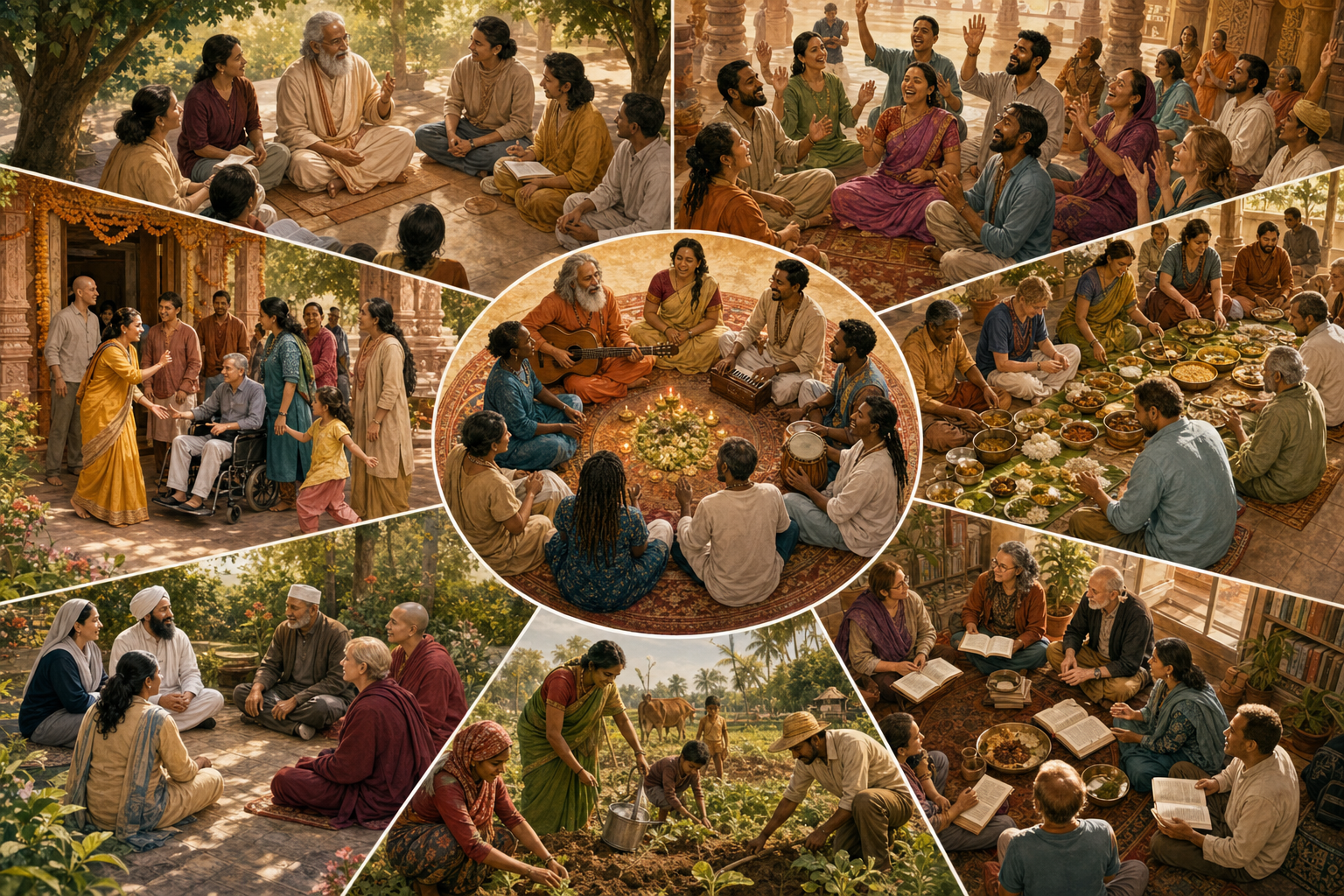
The two historical accounts also summarise the seven purposes in ISKCON’s founding document. They joined spiritual education and the study of the Bhagavad-gita and Srimad-Bhagavatam with fellowship centred on Krishna, congregational chanting, the creation of sacred places, simpler living, and the publication and distribution of literature. These were not unrelated departments added during later expansion. They formed an integrated vision in which learning, worship, community, communication and ways of living were meant to reinforce one another.
The 2026 observances translated much of that documentary language into activity. According to the Matchless Gifts account, the New York anniversary week ran from 6 to 13 July and included access to the historic storefront, classes, kirtan, prasadam, public harinama, remembered experiences and dramatic presentation. Its Day 7 programme on 12 July was scheduled around memories of Srila Prabhupada’s disciples and a Sunday feast. The London report describes a separate incorporation festival at the Soho temple on 13 July, scheduled from 07:00 to 21:00 and made available through a livestream. Teaching, chanting, place, hospitality and communication thus appeared as practices rather than commemorative slogans.
New York supplied the framework; London demonstrated its reach
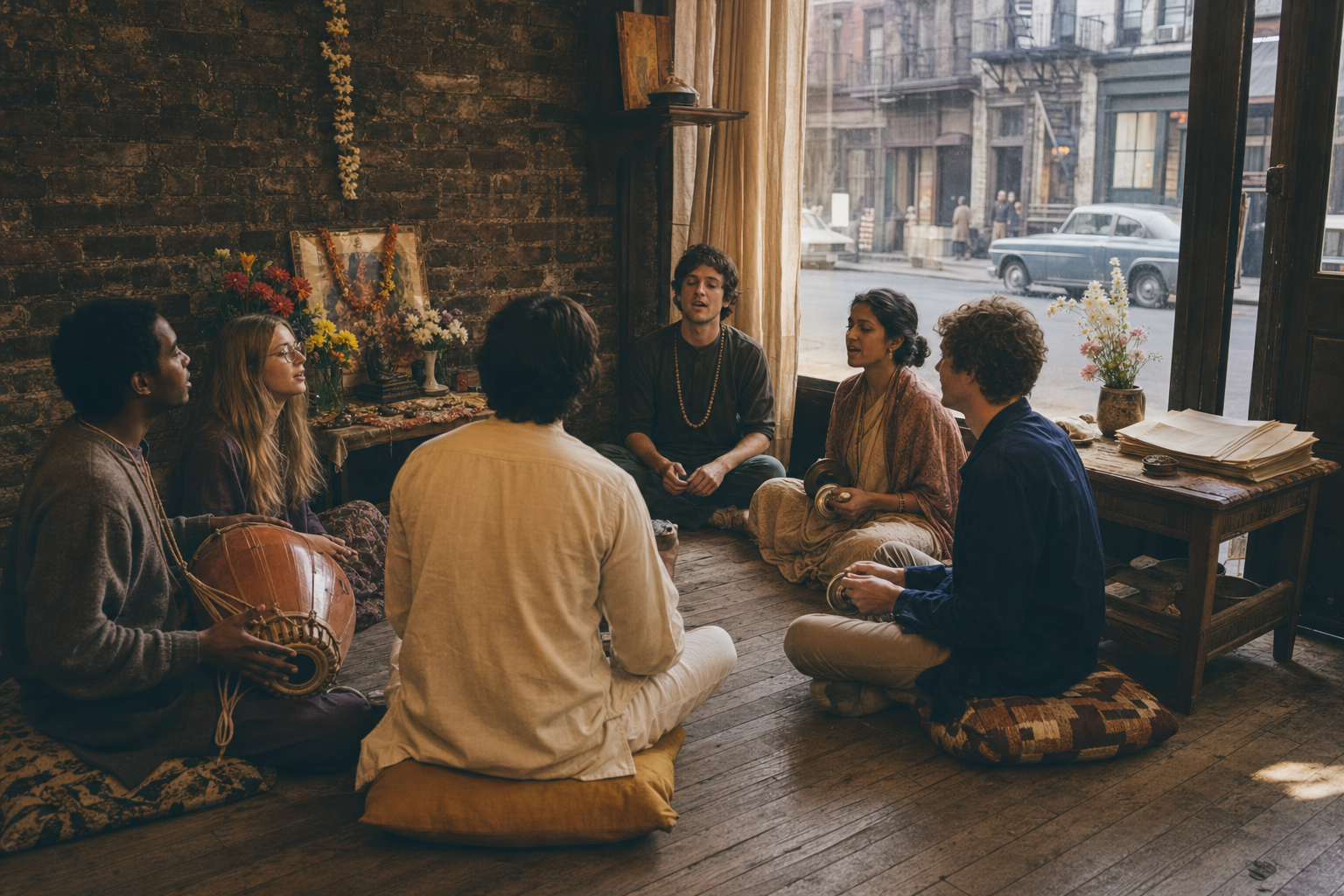
The original centre at 26 Second Avenue was a modest, street-level commercial space on New York’s Lower East Side. The Matchless Gifts report explains that its enduring name came from the curio shop that had previously occupied the premises. Repeated association with Srila Prabhupada’s teaching, early kirtans and the formation of the first community eventually gave that inherited shop name a devotional resonance. The site became significant through use, memory, restoration and continued gathering, not through monumental architecture.
This physical modesty was consequential. A storefront close to the sidewalk could accommodate lectures, chanting, conversation and food while remaining visible to passers-by. Its later treatment as a pilgrimage place shows how religious geography can develop within ordinary urban space. The anniversary’s return to 26 Second Avenue renewed the site’s meaning by placing living voices and practices inside the location associated with the movement’s institutional beginning.
London illustrates what happened when that framework crossed an ocean and entered another cultural setting. The London account reports that three married couples travelled from San Francisco in September 1968 to establish a mission at Srila Prabhupada’s request. Their work combined public chanting, conversation, music and the search for a permanent place of worship. The account distinguishes this mission from the international society’s 1966 founding, an important clarification because the 2026 Soho festival marked ISKCON’s sixtieth anniversary, not sixty years of the London temple.
The British mission’s encounter with popular music expanded the public circulation of sacred sound. According to the London source, the devotees met George Harrison in December 1968. He subsequently produced and performed on their recording of the Hare Krishna maha-mantra at Abbey Road Studios in July 1969. Released by Apple Records the following month, it reached number twelve on the United Kingdom singles chart, and the devotees performed it twice on the BBC programme Top of the Pops. The collaboration did not alter the mantra’s theological origin; it provided a new channel through which an existing devotional practice entered British public culture.
Physical institutions followed cultural visibility. The London account dates the opening of the Bury Place Radha-Krishna Temple to December 1969 and identifies Sri Sri Radha-Londonisvara as ISKCON’s first installed full-size Radha-Krishna deities. It reports that Harrison acquired the property that became Bhaktivedanta Manor in 1973, while the London congregation and deities moved to 10 Soho Street in 1978. New York and London consequently represent complementary dimensions of the same legacy: one preserved the founding framework, while the other demonstrated that bhakti could take root through music, worship, hospitality and public engagement in a different national environment.
Memory gives institutions a human scale
Buildings and incorporation documents explain where an organisation began, but they cannot fully convey how its founding teacher was experienced by those around him. The presentation by Visakha Devi Dasi, featured on 12 July 2026, contributes a different kind of historical evidence: photographs interpreted through the recollections of the person who helped make them.
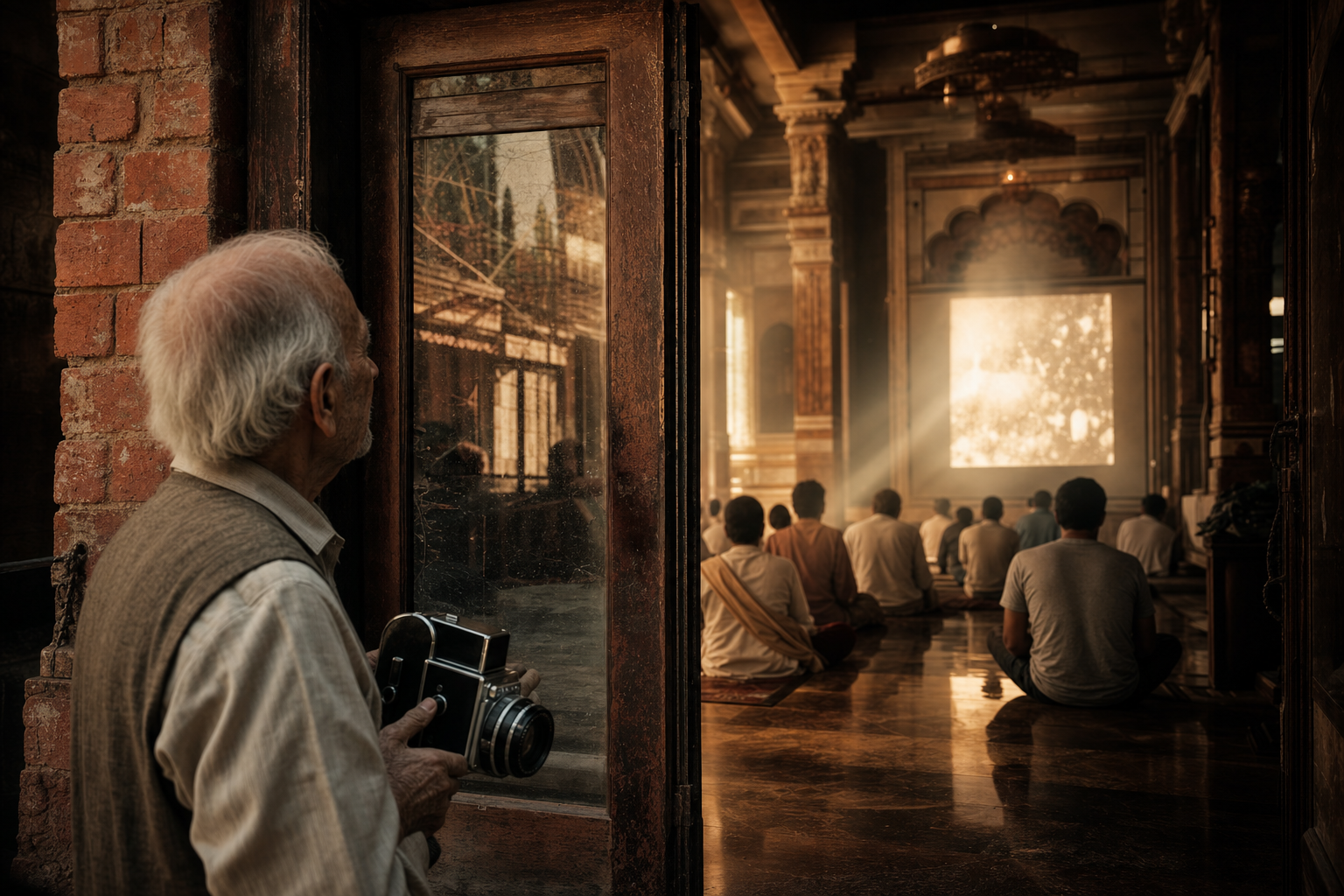
The presentation reports that Visakha Devi Dasi trained in photography at the Rochester Institute of Technology and travelled to Bombay in March 1971 after an invitation from photographer John Griesser, later known as Yadubara Dasa. She did not describe herself as arriving with unquestioned conviction. Her engagement developed through observation and sustained association. During her first meeting with Srila Prabhupada, he examined her photography book in the simple room where he was staying. What impressed her was the calm and courteous character of an otherwise ordinary encounter.
Photography then became more than the reason for her presence. After a period that included immersion in Vrindavan, she received initiation there on 29 November 1971 and was given the name Visakha. She later photographed Srila Prabhupada and his communities in India, Europe and the United States. Her archive therefore follows the movement across cultures while also retaining small moments that institutional chronologies usually omit.
The medium itself shaped what could be preserved. Working with film meant finite exposures, delayed review and the possibility of losing an unrepeatable moment. Religious settings added another demand: the photographer had to remain close enough to document events without converting worship or conversation into performances for the camera. Visakha Devi Dasi understood this technical labour as seva, allowing people outside the immediate setting to encounter what had occurred there.
Her commentary also demonstrates why images and oral testimony work best together. A photograph fixes a visible instant but does not explain everything outside its frame. The photographer can recall the setting, the difficulty of obtaining a view and the atmosphere surrounding an exposure. At the same time, the source appropriately treats memory as situated: devotional recollection supplies valuable perspective without becoming an exhaustive or detached record.
The qualities Visakha Devi Dasi recalls in Srila Prabhupada emerge through episodes of attention rather than through institutional statistics. Her memories emphasise concentration during worship, serious attention to questions, practical guidance and encouragement of service. This portrayal complements the anniversary histories. The incorporation documents reveal a leader planning for continuity; the photographs and recollections reveal leadership enacted through presence, correction and care.
There is also a clear line between the film archive and the 2026 livestreams from New York and London. The technologies differ, but both carry a local devotional event beyond the people physically present. The older photographs preserve selected instants for later interpretation, while livestreams transmit extended programmes in near real time. Together, they show that media are not peripheral to ISKCON’s history: they have repeatedly connected sacred sound, teaching and community memory with dispersed audiences.
A living legacy must remain recognisable in practice
The London account locates ISKCON within the Gaudiya Vaishnava tradition and describes bhakti-yoga as more than religious feeling. Study, mantra meditation, congregational singing, worship, ethical conduct, food offering and service discipline attention and action toward Krishna. This helps explain why the anniversary programmes could not be reduced to historical lectures. Kirtan, prasadam, worship and community participation were themselves expressions of the tradition being remembered.
The three sources consequently offer a practical standard for evaluating continuity. An institution can preserve property and documents while losing the practices that gave them meaning. A community can also remain active while allowing its history to flatten into a few familiar images. The anniversary accounts show a more demanding balance: founding purposes are interpreted through current service, historic places remain in use, and personal testimony complicates the polished outlines of institutional memory.
Key takeaways
- ISKCON’s sixtieth anniversary marks its incorporation on 13 July 1966, rather than the founding anniversary of every later temple.
- The seven founding purposes connected education, devotion, community, sacred places, simpler living and publishing from the outset.
- New York’s storefront and London’s urban temple show how ordinary spaces can become enduring centres through repeated worship, hospitality and transmitted memory.
- Photographs, oral recollections and livestreams extend the legacy by allowing different generations and distant audiences to encounter it.
- Institutional longevity becomes a living legacy only when inherited purposes continue to shape present practice and service.
Beyond the anniversary year, ISKCON’s continuity will depend less on repeating a settled story than on keeping its founding commitments intelligible and practicable for new communities. The legacy remains alive to the extent that memory continues to deepen service rather than substitute for it.
References
- DharmaRenaissance Blog — ISKCON London Celebrates ISKCON at 60: A Powerful Legacy of Bhakti and Service
- DharmaRenaissance Blog / YouTube — Rare Photographs Reveal Srila Prabhupada Through Visakha Devi Dasi’s Memories
- DharmaRenaissance Blog — Inside ISKCON’s Historic Day 7 at 26 Second Avenue: 60 Years of Living Bhakti