
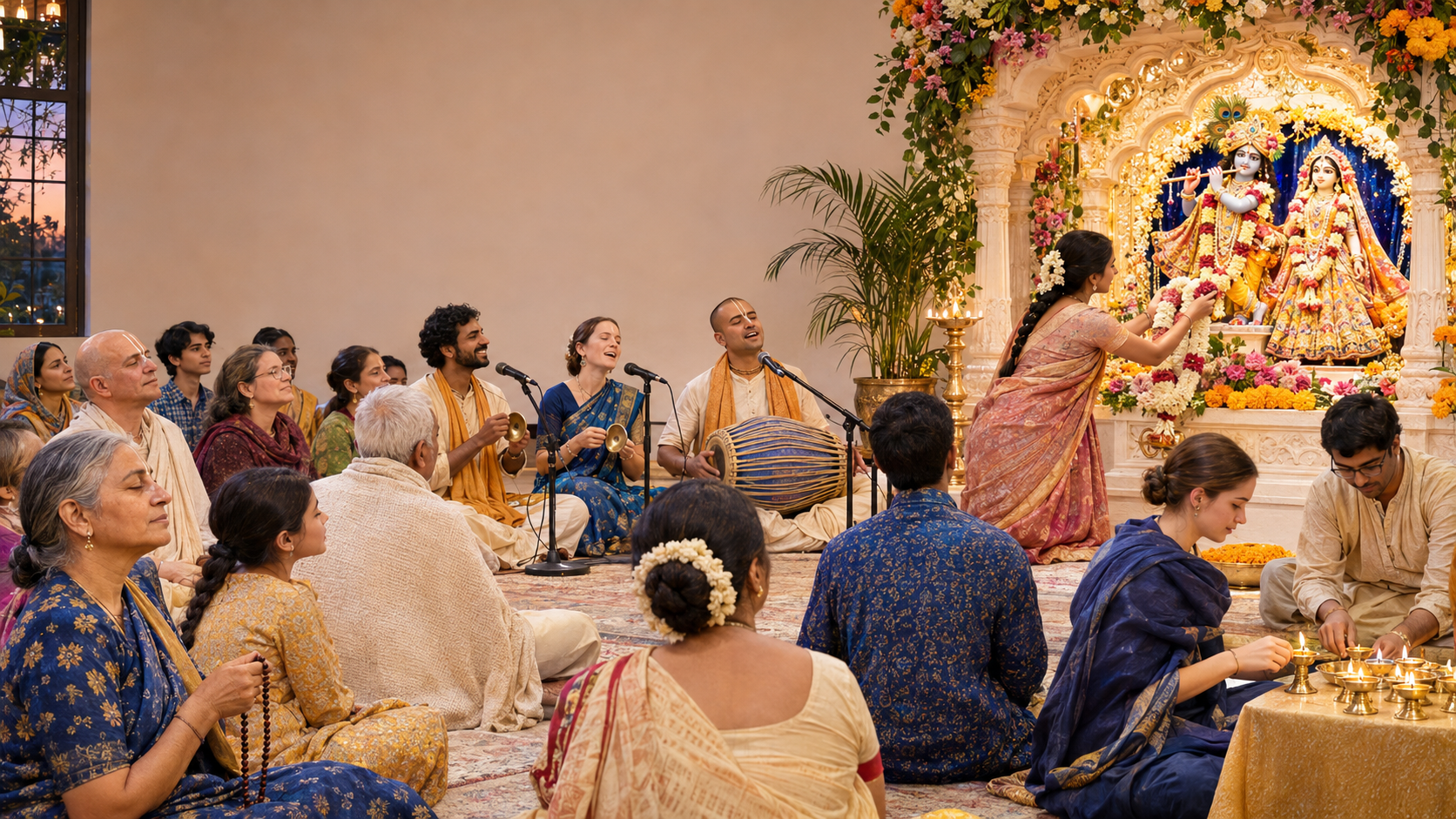
You may be looking at an ISKCON anniversary schedule and wondering whether to attend a class, watch a replay, volunteer, or simply offer your respects from home. The anniversary number may be prominent, but the real question is what the observance will change in the way you hear, remember, and serve.
Use the occasion as a doorway, not as a test of how much programming you can consume. You do not have to follow every session. You do need to understand what is being commemorated, participate with attention, and carry one meaningful action beyond the celebration.
First identify what the anniversary is actually marking
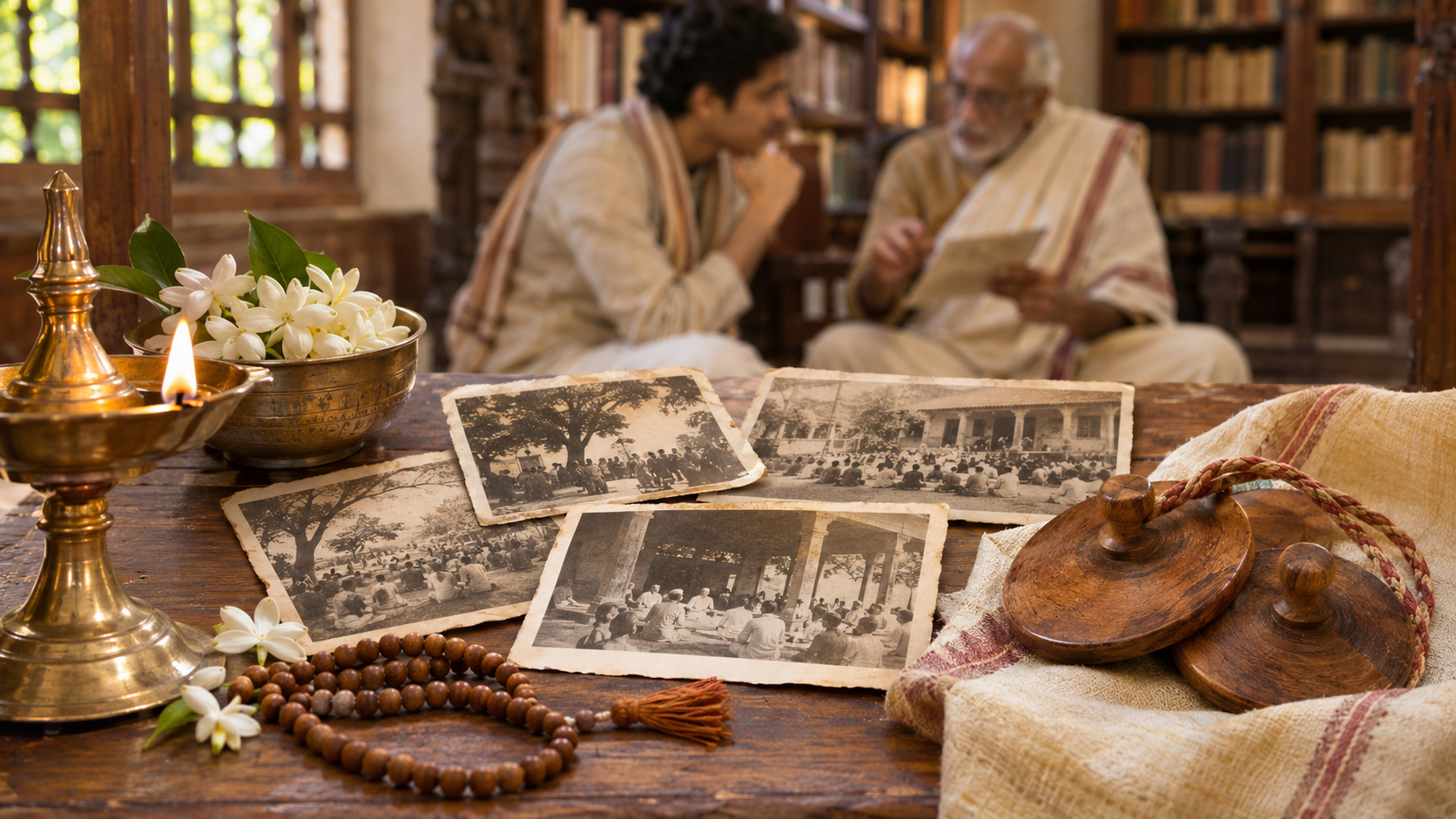
An anniversary is a container. It may mark a span of Deity worship, the founding of a community, the establishment of a temple, the growth of a mission, or the service of devotees across generations. Those are related forms of remembrance, but they are not interchangeable.
A 50th-anniversary observance centered on Sri Sri Radha Govinda should therefore be approached differently from an ordinary institutional birthday. The number does not imply that the Divine has grown older. It marks a span in the community’s relationship with the Deities: worship offered, festivals sustained, service inherited, and sacred memory passed forward.
A movement or community milestone asks a different set of questions. What began at an earlier moment? Which devotional practices carried it forward? Who performed the visible and invisible seva? What must the present generation protect, and what must it now build?
Before choosing a session, write down what you believe the anniversary marks. Then check that understanding against the event’s own title and schedule. If you cannot state the purpose in a sentence, the number is still doing too much of the work.
- For a Deity-centered observance, look for opportunities for darshana, kirtan, hearing, worship, and practical seva.
- For a community milestone, pay attention to historical memory, the work of earlier devotees, and the responsibilities now passing to younger participants.
- For a mission-centered commemoration, ask which part of A.C. Bhaktivedanta Swami Prabhupada’s service is being renewed rather than merely praised.
- For a special class, identify the teaching or occasion named in the program and listen for the action it asks of you.
This distinction keeps the observance devotional. Without it, an anniversary can become a sequence of speeches about endurance. With it, the same occasion becomes an examination of gratitude, continuity, and duty.
Choose a form of participation you can honor fully
On-site attendance, a live online session, and a replay are not lesser and greater versions of the same experience. Each asks for a different kind of discipline. Choose the form you can enter with attention rather than the most ambitious option on the schedule.
If you are attending in person
Arrive early enough to settle before the part you came to receive. Find out whether help is needed with welcoming visitors, footwear areas, prasada service, seating, cleaning, or other practical work. Anniversary crowds can make simple tasks more important, not less devotional.
Do not treat seva as a way to avoid hearing, or hearing as a reason to avoid seva. Decide beforehand which part of the program you will receive without interruption and which part you can support through service.
If you are joining online
Give the session a defined place in your day. Close unrelated screens, silence notifications, and remain with one complete portion rather than collecting disconnected fragments. If other members of your household are interested, agree on the session in advance so the observance becomes shared time rather than background audio.
If you are watching a replay
A replay is not merely leftover media. A clearly identified Day 1 morning replay for the Sri Sri Radha Govinda 50th anniversary gives devotees who were absent, distant, or unavailable a definite point of entry into the observance.
Protect replay time as you would protect attendance at a scheduled class. Start from the beginning of the selected session, resist skipping whenever the pace slows, and remain through its natural close. The ability to pause is useful for reflection, but constant jumping turns an observance into browsing.
Turn the special program into a personal observance
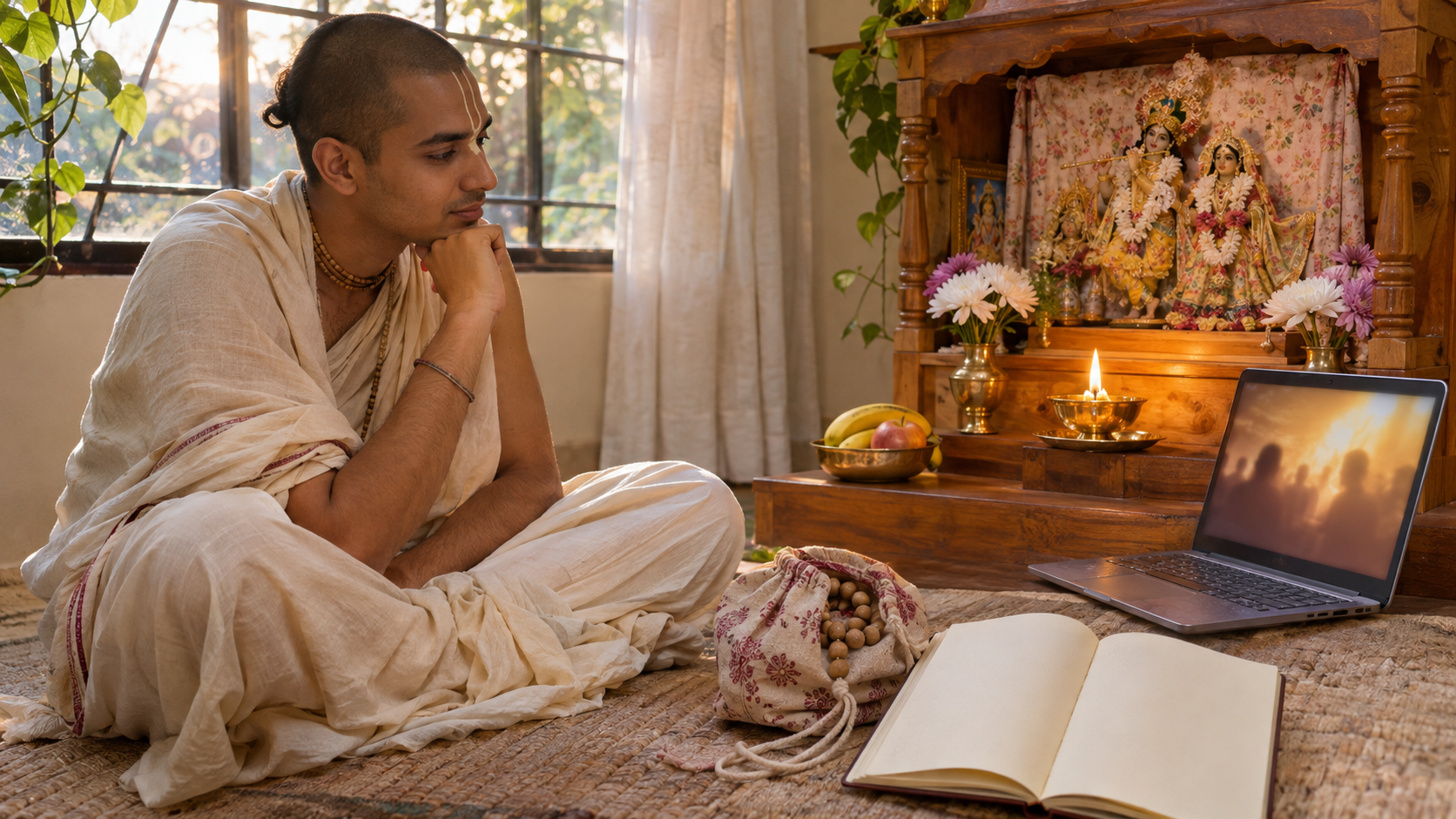
Watching or attending becomes an observance when you bring intention before it and accept responsibility after it. The process can be simple.
- State your intention in one sentence. You might be entering to express gratitude, understand the history of a service, reconnect with hearing, honor earlier devotees, or discern where you can help.
- Prepare the setting. Use a clean, quiet place and keep only what supports participation, such as your beads, a notebook, or the program schedule.
- Receive one complete unit of the observance. That may be a class, kirtan, ceremony, remembrance, or another clearly bounded part of the program.
- Write down one teaching and one service implication. The first records what you heard; the second prevents insight from remaining theoretical.
- Put the resulting action into your calendar or normal devotional routine before the emotional energy of the anniversary fades.
Your continuation does not need to be dramatic. You might volunteer at the next gathering, contact an older devotee whose service should be remembered, invite a newcomer to a future program, help preserve a recording, translate or transcribe useful material, support prasada distribution, or return to the teaching named in the class.
Choose an action that answers the milestone. If the anniversary honors continuity, strengthen continuity. If it honors worship, support worship. If it remembers outreach, help someone else enter. If it emphasizes hearing, create protected time to hear again.
Let a local occasion serve the dharmic center
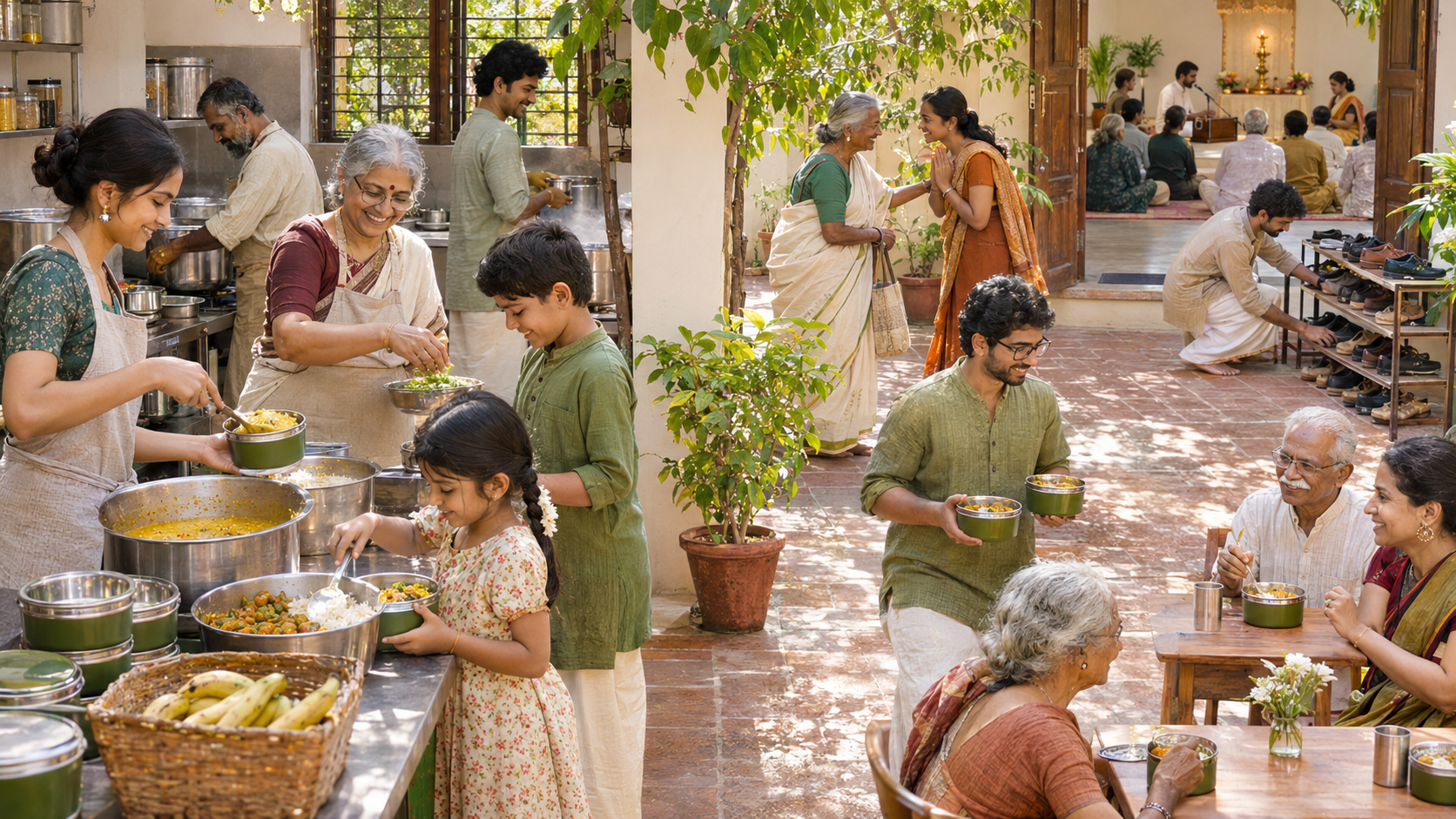
Special programs often meet people through the calendar they already inhabit. The NYC 60 marathon included a Thanksgiving special class by HG Arcita das, showing how a locally familiar occasion can be brought into a devotional sequence without becoming the center of it.
This is a useful model for organizers and participants. A civic holiday or public theme can open the door, but the devotional tradition must determine where the discussion goes. Gratitude, for example, becomes more than a pleasant mood when it leads to remembrance of grace, acknowledgment of those who serve, responsible use of what has been received, and service offered in return.
If you are helping plan an anniversary, test every topical program with three questions:
- Will a newcomer understand why this subject belongs within the anniversary?
- Will an established practitioner recognize the devotional principle guiding it?
- Will participants be shown what to do with the teaching after the session ends?
A marathon format creates an additional challenge: no participant will enter every part in the same way. Give each class or observance a clear title, name its speaker or focus, distinguish live sessions from replays, and make the sequence understandable to someone arriving in the middle. An archive is most useful when people can identify a meaningful doorway without already knowing the whole schedule.
Key takeaways
- Find out what the anniversary marks before deciding how to participate; a Deity-centered milestone and a community milestone call for different attention.
- Choose one form of participation you can honor fully: on-site attendance, a live online session when offered, or a deliberately scheduled replay.
- Enter with a stated intention and leave with one practical continuation of the service being commemorated.
- Treat special topical classes as doorways into dharmic understanding, not as substitutes for the devotional purpose of the anniversary.
- If you organize programs, label each entry point clearly and preserve enough context for distant devotees, newcomers, and later viewers.
If an anniversary program is open before you now, make the decision concrete. Choose the session, reserve uninterrupted time, write down what the milestone honors, and decide what kind of service you will consider when it ends. That is enough to move the anniversary from the screen or schedule into lived devotional practice.
References
- Dandavats – Day 1 Morning Replay | Sri Sri Radha Govinda 50th Anniversary
- Dandavats – NYC 60 Marathon Special Class: Thanksgiving | HG Arcita das

Leave a Reply
You must be logged in to post a comment.