
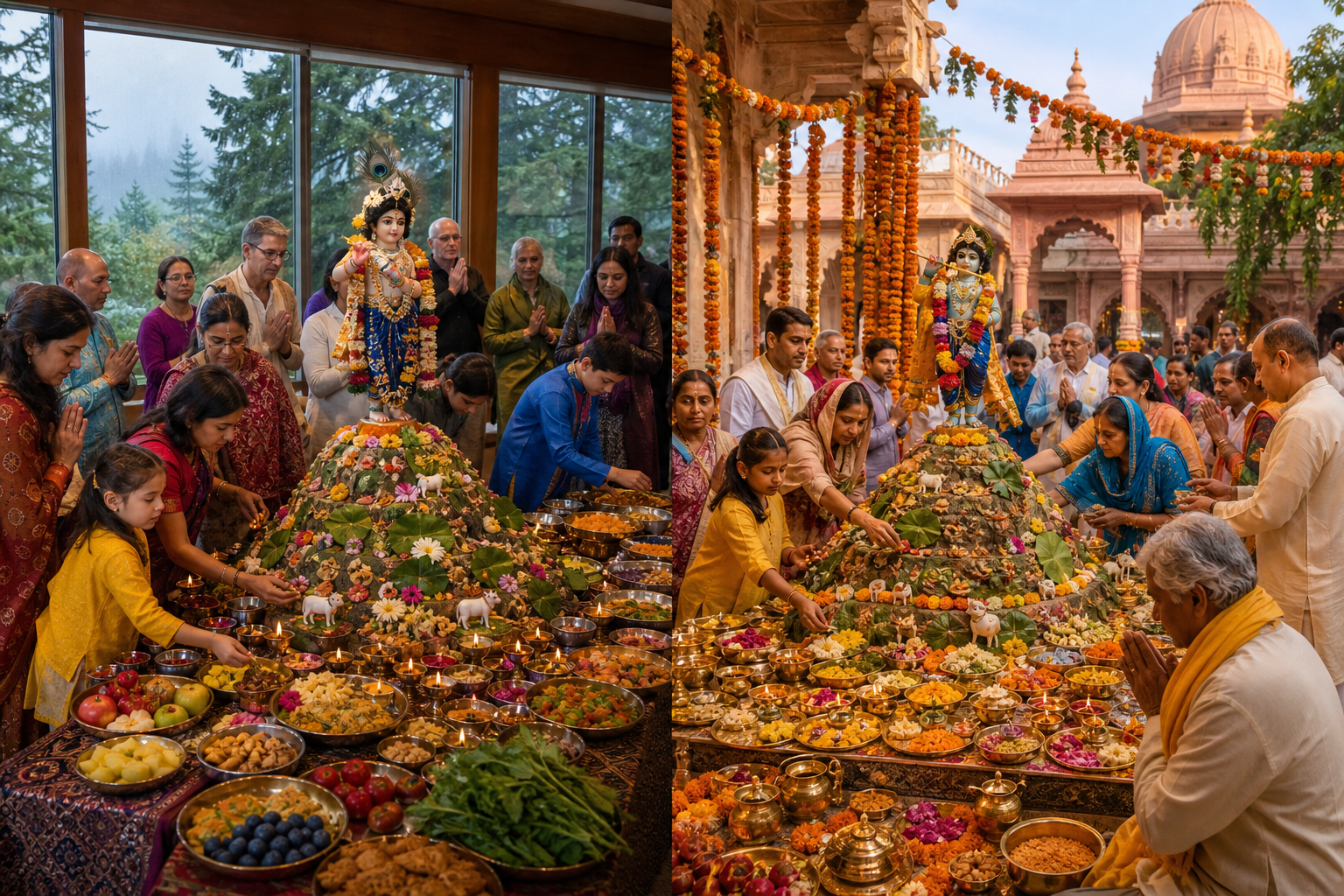
If you saw Govardhan Puja images from Seattle or Vrindavan and wondered what to notice beyond the elaborate decoration and abundant food, begin with the relationship at the heart of the festival: Sri Krishna protects his devotees by lifting Govardhan Hill, and the community responds through gratitude, offering, service, and care for life.
The two 2025 celebrations show how that relationship can remain recognizable across very different settings. They also give you a practical way to judge any Govardhan Puja, including one organized at home or in your local temple: look for devotion expressed as responsibility, not spectacle alone.
One lila, expressed through two devotional settings
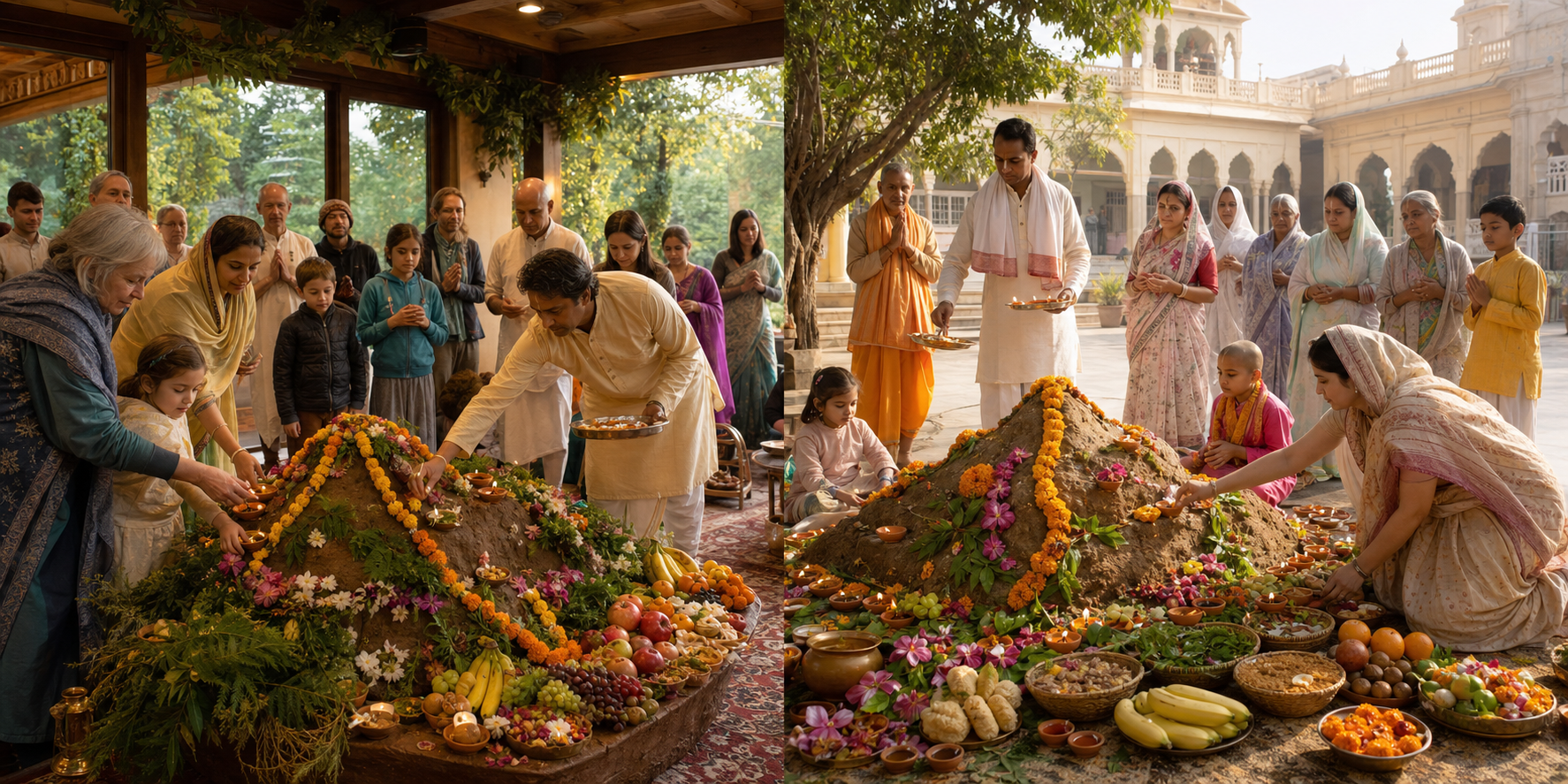
ISKCON Seattle observed Govardhan Puja on October 21, 2025, during the sacred Kartik period. Its crafted Govardhan display, rangoli patterns, lamps, flower garlands, Annakut offerings, and organized darshan placed Krishna’s lila inside the lived reality of a diaspora temple. Families, students, and experienced volunteers helped prepare offerings, distribute prasad, and maintain an orderly devotional environment.
In Seattle, continuity itself carries spiritual weight. A temple outside Bharat must do more than conduct a ceremony. It must teach children why the ceremony matters, give newcomers an intelligible way to participate, and turn a geographically dispersed community into a congregation capable of sustained seva. The festival therefore belongs as much to the volunteer preparing food or guiding visitors as it does to the finished altar.
ISKCON Vrindavan’s 2025 Sringar Darshan placed greater visual emphasis on the ornamentation of the deities. Textiles, flowers, and coordinated colors made beauty part of the devotional instruction. In Vrindavan, where Krishna’s presence shapes the sacred identity of the place, Sringar does not function as decorative excess. It directs attention toward loving service performed with concentration and care.
You do not need to decide which setting was more authentic. That question misses what each setting makes easier to see. Seattle reveals how a community carries a tradition across distance and generations. Vrindavan reveals how sacred place, temple artistry, and concentrated darshan can deepen the same tradition. The appropriate test is whether form serves remembrance of Krishna and produces responsible action afterward.
Key takeaways from the 2025 celebrations
- Govardhan Puja remembers protection: Krishna shelters his devotees, and devotees learn to protect the people, animals, land, and community entrusted to them.
- Annakut is not merely a large food display. Preparing vegetarian offerings, offering them with gratitude, distributing prasad, and avoiding waste are parts of one discipline.
- Sringar gives beauty a theological purpose. Flowers, textiles, colors, lamps, and spatial arrangement should steady attention and support darshan.
- A diaspora celebration remains alive when younger people receive real responsibilities rather than being treated only as spectators.
- Photography becomes cultural preservation when it records the meaning, place, date, ritual elements, and people behind the visible celebration.
- Compassion, gratitude, non-violence, service, and respect for life resonate across Dharmic traditions, but that shared ethical ground should not erase the distinctly Vaishnava meaning of Govardhan Puja.
Make Annakut a discipline of gratitude, not a display of excess
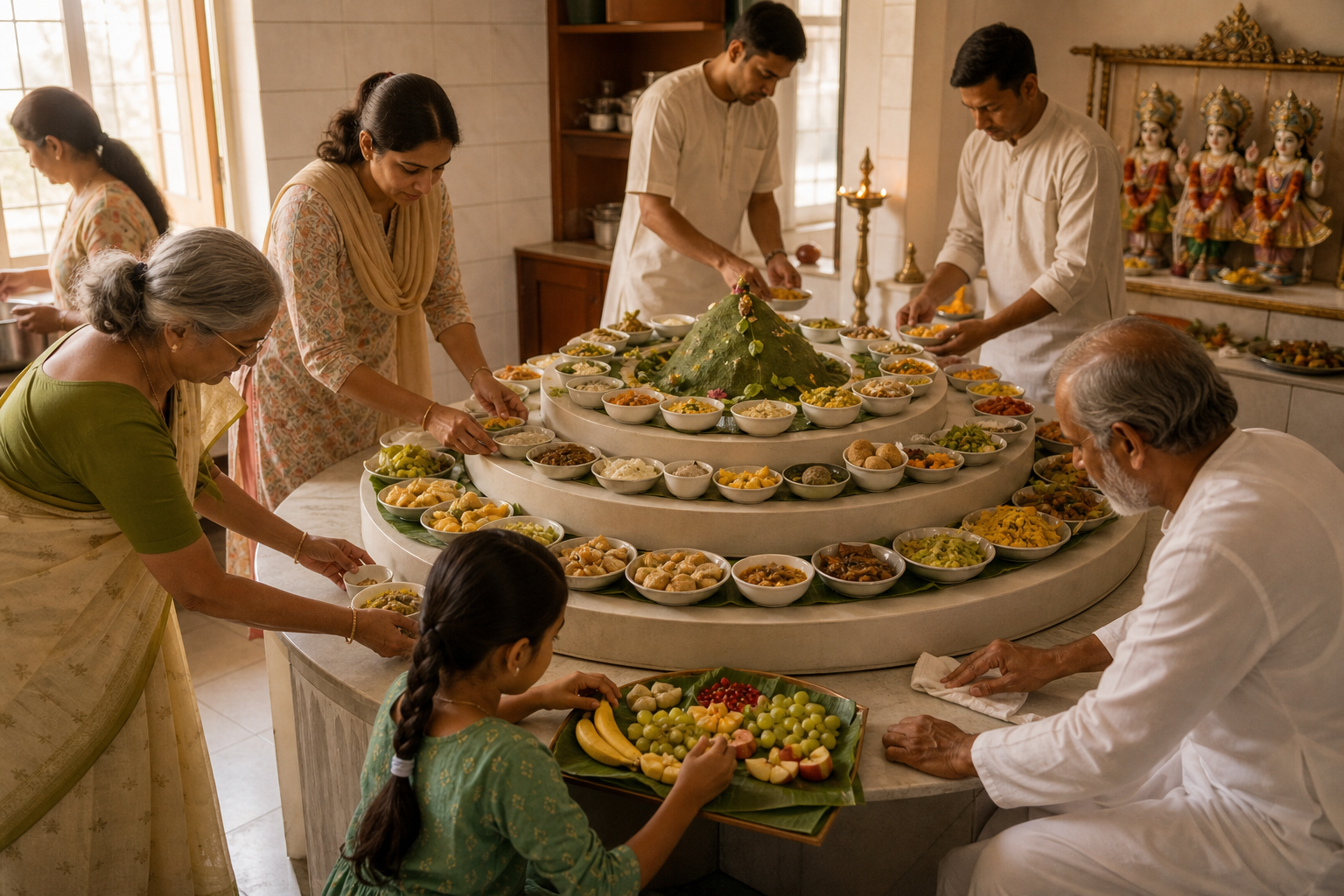
The abundance of Annakut can be misunderstood. A large assortment of preparations may express devotion, but quantity by itself proves little. The offering acquires meaning through intention, disciplined preparation, reverence, sharing, and responsible treatment of what has been prepared.
The connection with Govardhan Hill matters here. Food does not appear independently of soil, water, sunlight, animals, human labor, and community knowledge. Govardhan Puja trains you to receive those relationships with gratitude rather than treating nature as an inert warehouse of resources. The vegetarian preparations and communal distribution of prasad make that gratitude tangible.
If you are arranging a home or community observance, use this sequence as a practical framework. It is not a substitute for the ritual instructions of your temple or sampradaya; it is a way to keep the festival’s ethical purpose visible.
- Plan the offering and its distribution together. Decide who will receive the food before increasing the number of preparations.
- Prepare vegetarian dishes with cleanliness and attention. Treat cooking as seva rather than as a competition between households.
- Place the offering before Krishna and Govardhan with gratitude. Let the moment include reflection on the land, animals, labor, and divine protection that sustain the community.
- Distribute prasad patiently. Give volunteers a clear plan for serving families, elders, children, and visitors without turning the distribution into a rush.
- Account for what remains. Share usable food appropriately and organize cleanup so that an ecological message is not contradicted by avoidable waste.
This changes the question you ask during preparation. Instead of asking, “How can we make the offering look larger?” ask, “How can every preparation become an offering, every portion become prasad, and every volunteer become part of the seva?” A smaller Annakut handled reverently can teach more than an impressive display followed by disorder or waste.
Learn to read Sringar and darshan as devotional teaching
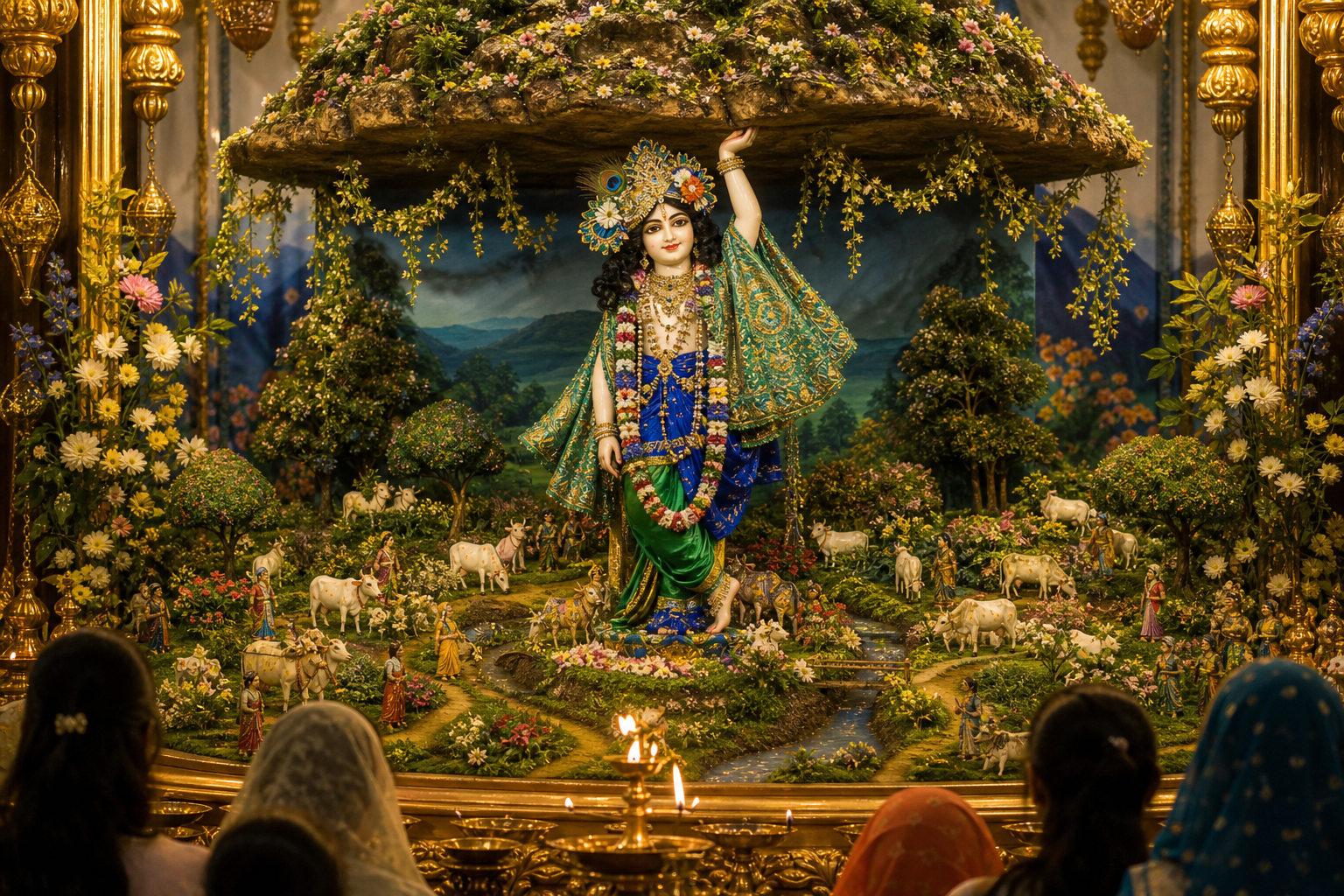
Sringar can appear inaccessible if you do not know what you are looking for. The solution is not to memorize every textile or ornament. Look first at how the elements direct your attention. In Seattle, lamps, rangoli, garlands, and the constructed Govardhan scene framed the festival narrative. In Vrindavan’s carefully coordinated Sringar, flowers, clothing, and color relationships presented divine beauty as an invitation to contemplation.
Give yourself enough time for the arrangement to work on you. A quick photograph preserves appearance, but darshan asks for attention. Notice where your eye goes first, how the flowers and textiles frame the deities, where Govardhan appears, and how the altar connects abundance with shelter. Then return to the central question: what kind of service does this beauty ask from you?
If you are accompanying a child or someone unfamiliar with the festival, avoid delivering a long lecture in front of the altar. Three questions are more useful:
- Who is protecting whom in the Govardhan lila?
- What has the community offered in gratitude?
- What person, animal, place, or shared resource can we care for after we leave?
These questions join story, ritual, and conduct without reducing darshan to an art lesson. They also give a younger visitor something concrete to remember after the colors and food displays are gone.
Kirtan and bhajan complete the movement from viewing to participation. You are no longer only looking at what others prepared; you add your voice and attention to the offering. Quiet darshan and collective singing are not opposites. One gathers the mind, while the other places that gathered attention within the community.
Carry the festival from the altar into community life
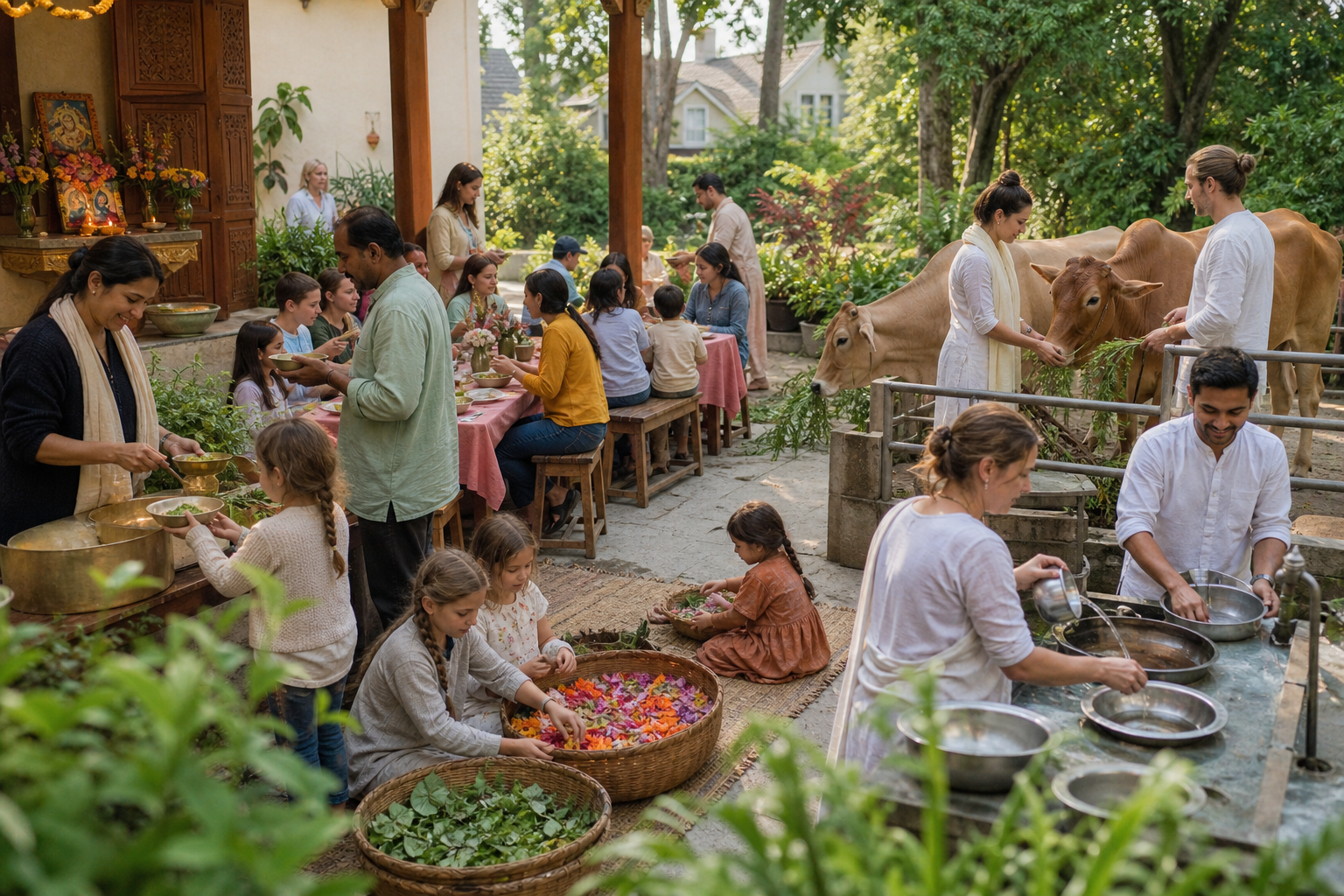
Seattle’s families, students, and long-serving volunteers demonstrate why Govardhan Puja cannot be sustained by altar work alone. Food preparation, welcoming visitors, managing darshan, leading kirtan, distributing prasad, documenting the event, and cleaning afterward are all parts of the celebration. When only the most visible roles receive recognition, a community unintentionally teaches that appearance matters more than service.
For a future observance, assign responsibilities across generations. Give a child one manageable task, such as helping arrange flowers or learning the meaning of one symbol. Give a teenager or student a role with real ownership, such as coordinating a small volunteer group or recording accurate captions for the photo archive. Let experienced devotees explain the ritual logic behind the work, not simply correct how it is performed.
A useful visual archive should preserve more than attractive images. Record the date, temple or location, principal ritual, identity of the display, and the form of seva being shown. Photograph preparation and prasad distribution as well as the completed Sringar. That creates material a family, teacher, temple, or future volunteer can actually use to understand how the celebration was built.
Govardhan Puja also offers a careful way to speak about Dharmic solidarity. Compassion, gratitude, non-violence, service, community responsibility, and respect for life are meaningful points of resonance among Hinduism, Buddhism, Jainism, and Sikhism. But resonance is not sameness. The worship of Krishna, remembrance of the lifting of Govardhan Hill, Annakut, and Vaishnava darshan should be named clearly rather than dissolved into generic spirituality. Unity becomes more credible when distinct traditions are respected on their own terms.
Before the next Govardhan Puja, choose one commitment you can carry all the way through: prepare and distribute an offering without avoidable waste, take responsibility for an unglamorous service, teach one child the meaning of Govardhan, or document one ritual accurately for the next generation. The celebration has done its work when gratitude changes what you protect after you leave the altar.
References
- Dandavats – Ultimate Govardhan Puja 2025: Complete ISKCON Seattle Darshan Highlights and Insights
- Dandavats – Complete Guide to ISKCON Vrindavan 2025 Govardhan Puja Sringar Darshan: Discover Devotion
