
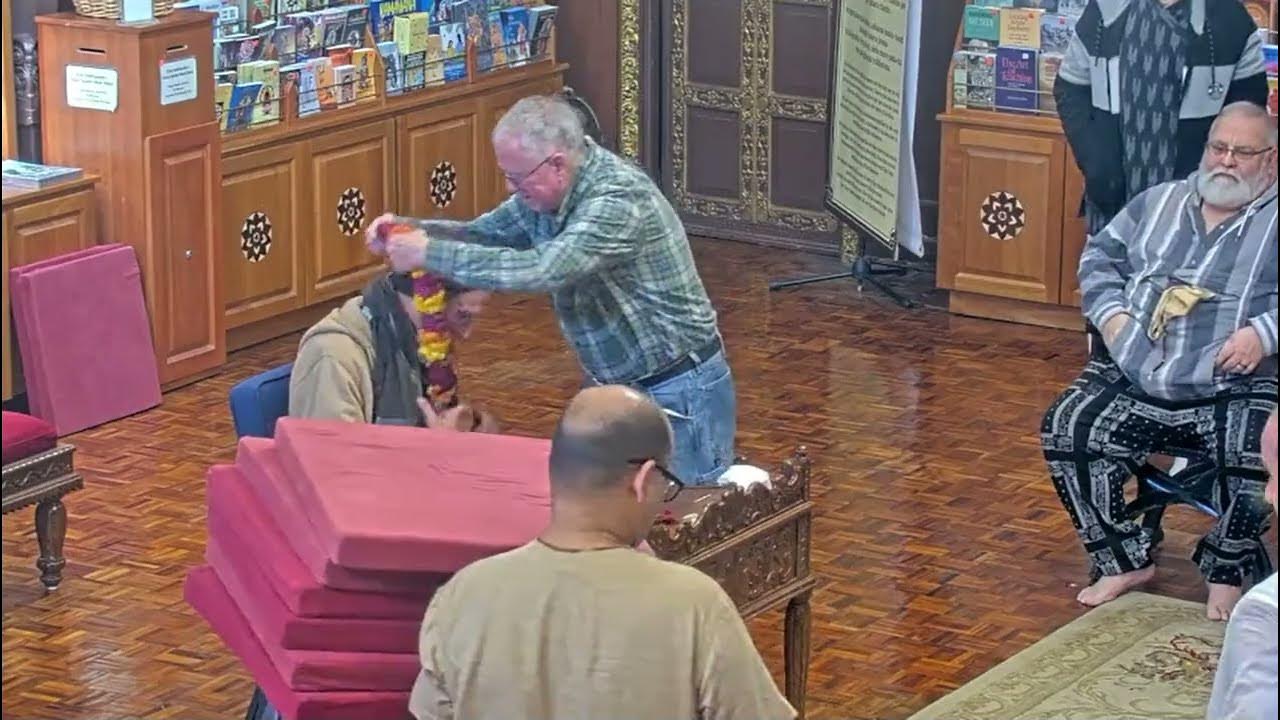
Marking the 540th anniversary of Śrī Caitanya Mahāprabhu’s appearance day, Gaura Pūrṇimā 2026 invited a reflective return to sources, practice, and living tradition. In a focused class, Varsana Swami (Varsana Maharaja) presented an integrated view of Mahāprabhu’s early pastimes, the theological reasons for His advent, and contemporary questions surrounding so-called “blood moon” prophecies. The presentation situated devotion (bhakti) within a rigorous textual framework while remaining sensitive to the lived emotions of observancegathering for kīrtana under the full moon, fasting until moonrise, and reading about Gaura-līlā with family and community.
Gaura Pūrṇimā, observed on the Pūrṇimā tithi of the lunar month Phālguṇa, commemorates the advent of Śrī Caitanya Mahāprabhu in Navadvīpa (1486 CE). The festival, central to Gaudiya Vaiṣṇavism and widely embraced across the bhakti landscape, aligns devotional aesthetics with calendrical precision drawn from the pañcāṅga (Vedic almanac). Its observance typically includes vrata (fasting) until moonrise, heightened nāma-japa, collective saṅkīrtana, and study of Śrī Caitanya’s life as preserved in the hagiographies Śrī Caitanya-caritāmṛta and Śrī Caitanya-bhāgavata.
Textual narratives describe Mahāprabhu’s childhood under the name “Nimāi” (Viśvambhara) as suffused with formative scenes that foreshadow the public kīrtana movement He would later inaugurate. In Navadvīpa’s courtyards, elders would chant “Kṛṣṇa” to pacify the crying child; the moment sacred sound arose, tears subsided and joy welled upan emblematic sign that nāma (the holy name) would be His universal gift. Episodes of playful instructionsuch as gently redirecting peers from ritual formalism toward hearts centered on compassion and remembranceare presented not as mere charm but as pedagogy through līlā.
Accounts further recall Nimāi’s precocious scholarship, where grammar (vyākaraṇa) became a portal for devotion. His analyses turned linguistic forms into vehicles of remembrance, anticipating the mature synthesis later offered through acintya-bhedābheda-tattva (the doctrine of inconceivable oneness and difference). In this frame, language, aesthetics, and metaphysics meet in one current: sacred speech, sung or spoken, aligns the intellect with the heart’s surrender.
Varsana Swami situated these narratives within a two-fold theological rationale for Mahāprabhu’s descent. Externally, as Śrī Caitanya-caritāmṛta (Ādi-līlā) states, He appeared to distribute a rarely-given treasureprema-bhaktithrough the yuga-dharma of saṅkīrtana: “anarpita-carīṁ cirāt karuṇayāvatīrṇaḥ kalau samarpayitum unnatojjvala-rasāṁ sva-bhakti-śriyam.” Internally, He descended to relish Śrī Rādhā’s love for Kṛṣṇa and display Her golden mood and effulgence“rādhā-bhāva-dyuti-suvalitaṁ naumi kṛṣṇa-svarūpam.” These complementary purposes explain why a golden-complexioned avatāra would arrive in Kali-yuga proclaiming the primacy of the holy name.
Scriptural pointers in the broader śāstric corpus reinforce this vision. Śrīmad-Bhāgavatam (11.5.32) describes the Lord in Kali-yuga“kṛṣṇa-varṇaṁ tviṣākṛṣṇaṁ”who inaugurates saṅkīrtana alongside associates, weapons, and limbs that are themselves forms of divine grace. The Kali-santaraṇa Upaniṣad gives the very mantra Mahāprabhu broadcast through public congregational singing: “Hare Kṛṣṇa Hare Kṛṣṇa Kṛṣṇa Kṛṣṇa Hare Hare / Hare Rāma Hare Rāma Rāma Rāma Hare Hare,” collapsing barriers of caste, education, and social standing before the egalitarian radiance of nāma.
Within this doctrinal arc, early pastimes take on paradigmatic meaning. The child who quieted only upon hearing “Kṛṣṇa” prefigures the social and spiritual therapy of sound that Caitanya would extend to all, from scholars to laborers. The “Nimāi Paṇḍita” who mastered grammar later unbound language itself, lifting it from morphology to melody, until the heart’s intent became the grammar of the soul and kīrtana became the shared syntax of community.
Varsana Swami emphasized that Mahāprabhu’s gift is historically rooted yet contemporarily actionable. Rūpa Gosvāmi’s famous address encapsulates this: “namo mahā-vadānyāya kṛṣṇa-prema-pradāya te”a recognition not only of divine identity but of distribution: prema as public welfare. The practice that flows from this insight remains practicalchanting, service (seva), study, and ethical alignmentforming a sustainable spiritual ecology in daily life.
Rather than isolating Gaudiya Vaiṣṇavism, the class invited a dharmic vantage that honors shared threads with related traditions. Kīrtana as sanctified sound finds kinship with Sikh gurbāṇī kīrtan and with the contemplative repetitions (japa/mañjuśrī-mantra recitation, sūtra chanting, stavana) that appear across Hindu, Buddhist, and Jain practices. The ethical coreahiṁsā, compassion, humility, and serviceoffers a common grammar of the heart that strengthens social cohesion without erasing distinct theological contours.
Turning to the “blood moon,” Varsana Swami addressed popular Western apocalyptic readings with clarity and calm. Total lunar eclipses appear red because sunlight refracts through Earth’s atmosphere, filtering shorter wavelengths and casting a copper hue upon the Moon. Astronomy thus explains the phenomenon without resorting to crisis narratives. From a dharmic perspective, eclipses are periodic, calculable events that can serve as prompts for introspection, restraint, and intensified remembrance rather than fear.
Jyotiṣa traditions advise simplicity during grahaṇaminimizing consumption during the period, engaging in mantra, and performing śauca (purificatory bathing) after the umbra passes. If an eclipse coincides with a festival day, many practitioners maintain the festival’s devotional essence while respectfully following customary eclipse practices according to local guidance. The constant across these approaches is ethical steadiness: devotion does not waver with transient shadows.
From calendrical details to personal observance, Gaura Pūrṇimā remains actionable. Common practices include fasting from grains and beans until moonrise, reading selections from Śrī Caitanya-caritāmṛta or Śrī Caitanya-bhāgavata, offering preparations to Gaura-Nityānanda with gratitude, joining nagara-saṅkīrtana, and sharing prasāda with neighbors. Families often describe the full-moon kīrtana as a yearly touchstonea time when community, music, and meaning naturally converge.
Theologically, acintya-bhedābheda-tattva clarifies how Gaura’s message bridges unity and plurality: the divine and the devotee are simultaneously one and different. Socially, this becomes an ethic for plural societies, where deep conviction coexists with respect for diverse pathways. Such an ethic aligns with the broader dharmic commitment to peaceful coexistence, dialogue, and mutual uplift across Hindu, Buddhist, Jain, and Sikh communities.
Varsana Swami’s framing thus joined textual fidelity with experiential resonance. Sources anchored the narrative; practice carried it into homes and streets; community wove it into shared memory. By disentangling eclipse myths from sensationalism and recentering festival observance on sādhana, the class modeled how classical insights meet contemporary questions with sobriety and warmth.
Ultimately, Gaura Pūrṇimā 2026 stands as an invitation to re-encounter Śrī Caitanya Mahāprabhu’s compassion through the accessible means of sacred sound. The child Nimāi’s tears turned to delight at the name of Kṛṣṇa; the adult Caitanya extended that delight to the world. In honoring His appearance, communities renew a living covenant: to cultivate remembrance, embody compassion, and welcome all seekers into a circle where song becomes knowledge and love becomes method.
Inspired by this post on Dandavats.
