

You encounter a fish in connection with Bengali Durga Puja and the question comes quickly: is it merely about food, a decorative Bengali motif, or a sacred sign? Begin with the landscape. In Bengal, fish belongs to a freshwater world that has shaped both ordinary life and religious imagination.
The short answer is that fish can signify prosperity and a safe journey. That answer becomes much more meaningful when you understand why Bengal could turn such a familiar creature into sacred vocabulary – and why you should not treat one regional symbol as a universal rule for every Durga Puja.
Start with Bengal’s freshwater world

The easiest mistake is to begin with diet. That reduces the fish to an ingredient before asking what it communicates. A better interpretation starts with Bengal’s waters.
The Ganga and the region’s many rivers, ponds, and wetlands give freshwater fish a deep place in Bengali Hindu culture. Fish is therefore not an arbitrary symbol imported into worship. It comes from the environment in which Bengali traditions took form.
This geographical setting changes how you should read the symbol. Fish testifies to living water: water that supports, replenishes, and carries life. Its religious meaning grows from familiarity rather than exoticism. The sacred and the everyday do not have to be opposites; an ordinary part of a people’s world can become a powerful sign precisely because everyone understands what it represents.
The freshwater emphasis also matters. Calling the symbol merely maritime or oceanic would detach it from its Bengali setting. If you are writing a caption, teaching a class, or explaining the custom to a child, connect the fish to Bengal’s inland waters before reaching for a broad theory about fish symbolism everywhere.
Prosperity and safe passage express one hope

Fish in Bengali Durga Puja is associated with prosperity and a safe journey. These meanings may sound separate, but both concern the continuity of life.
Read prosperity broadly. It need not mean sudden wealth or private luxury. In this symbolic setting, prosperity is better understood as flourishing: sustaining life, maintaining well-being, and having enough for life to continue fruitfully. Fish belongs to water capable of supporting life, so it becomes a natural sign of abundance rather than a detached promise of money.
Safe journey should also be read symbolically, not as a mechanical guarantee that nothing difficult will happen. It expresses a prayerful hope for protected passage through movement and uncertainty. A journey succeeds when life continues safely from one condition or place into another.
The two meanings therefore meet in a single idea: may life be sustained, and may it pass safely onward. That is more faithful to the symbol than translating prosperity as cash or treating safe passage as superstition.
Use three layers to interpret a particular custom
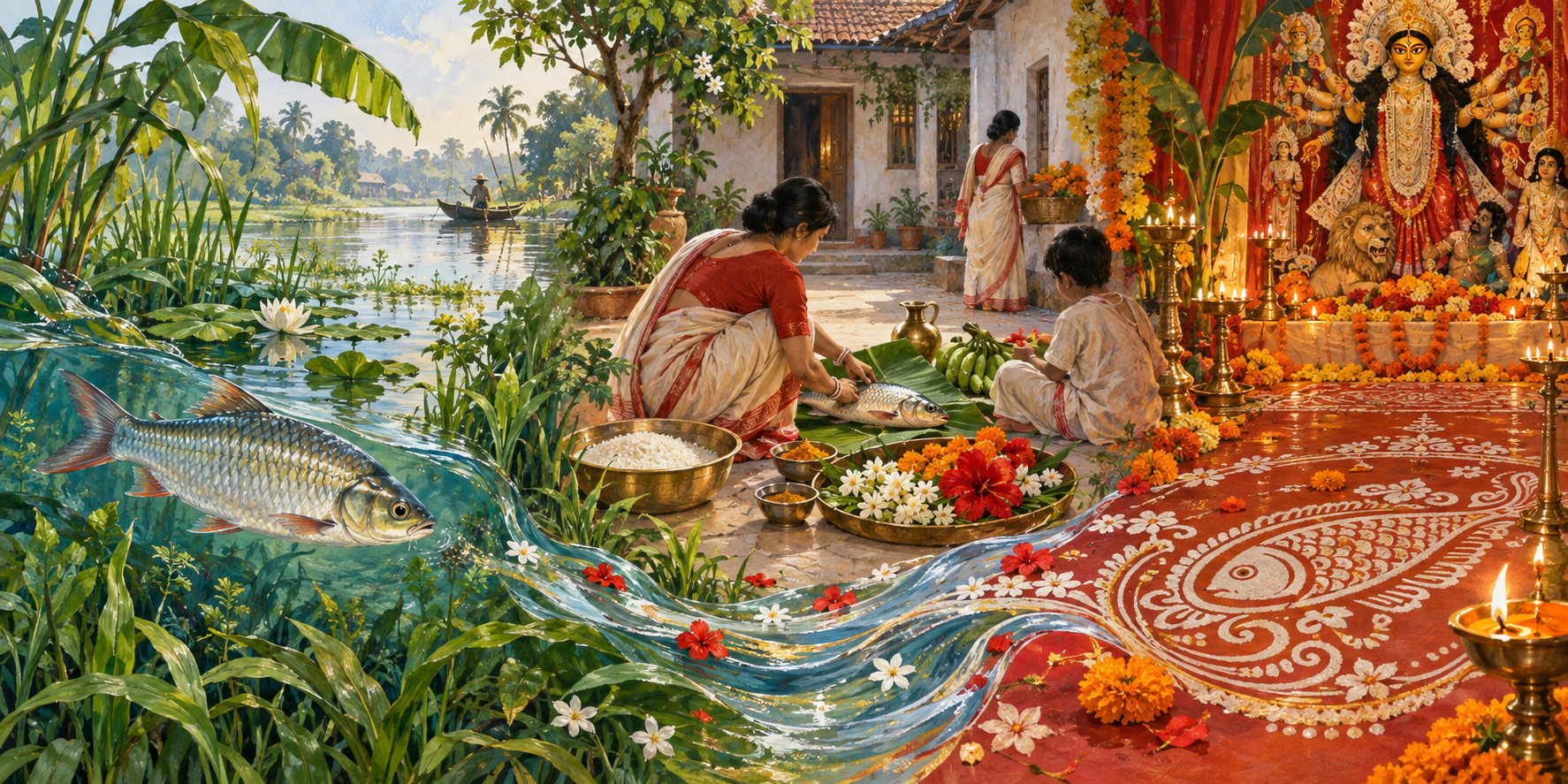
When you encounter fish symbolism in a household, community celebration, artwork, or explanation of Durga Puja, use three layers. This keeps you from making a sweeping claim based on one local expression.
- Place: Begin with Bengal’s riverine and wetland environment. Ask why freshwater fish would carry immediate meaning there.
- Symbol: Identify the broad associations supported by the tradition – prosperity, flourishing, continuity, and safe passage.
- Practice: Ask how the particular family or community understands what you are seeing. Record its explanation before trying to generalize it.
The third layer is essential. A regional symbol can be shared widely while its precise use varies locally. If someone gives you a Bengali term or family explanation, preserve the actual wording and context. Translating too quickly can replace a living custom with a generic label.
Guardrails against overclaiming
- Do not say that every Durga Puja requires fish. A Bengali association does not establish a universal ritual requirement.
- Do not reduce the symbol to cuisine. Its familiarity in everyday culture helps explain its sacred resonance; it does not cancel that resonance.
- Do not assume every fish symbol across Hindu traditions has the same meaning. This interpretation is rooted in a particular Bengali setting.
- Do not present safe journey as a promised result. It is a symbolic and prayerful aspiration.
- Do not describe a regional Hindu expression as less authentic merely because it differs from customs elsewhere. Local embodiment is part of how a tradition lives.
Language makes a practical difference. In a museum label, social-media caption, or classroom explanation, write that fish can symbolize prosperity and safe passage in Bengali Durga Puja. Avoid saying that it always means one thing or that all Hindus observe the same custom.
Key takeaways
- Read the fish as Bengali sacred vocabulary, not as an isolated ingredient or decoration.
- Its two central associations are prosperity and a safe journey.
- Prosperity is best understood as sustained flourishing, not simply monetary gain.
- Bengal’s Ganga, rivers, ponds, and wetlands explain why freshwater fish carries such cultural force.
- Distinguish the shared symbolism from the particular way a family or community expresses it.
Explain the symbol without flattening the tradition
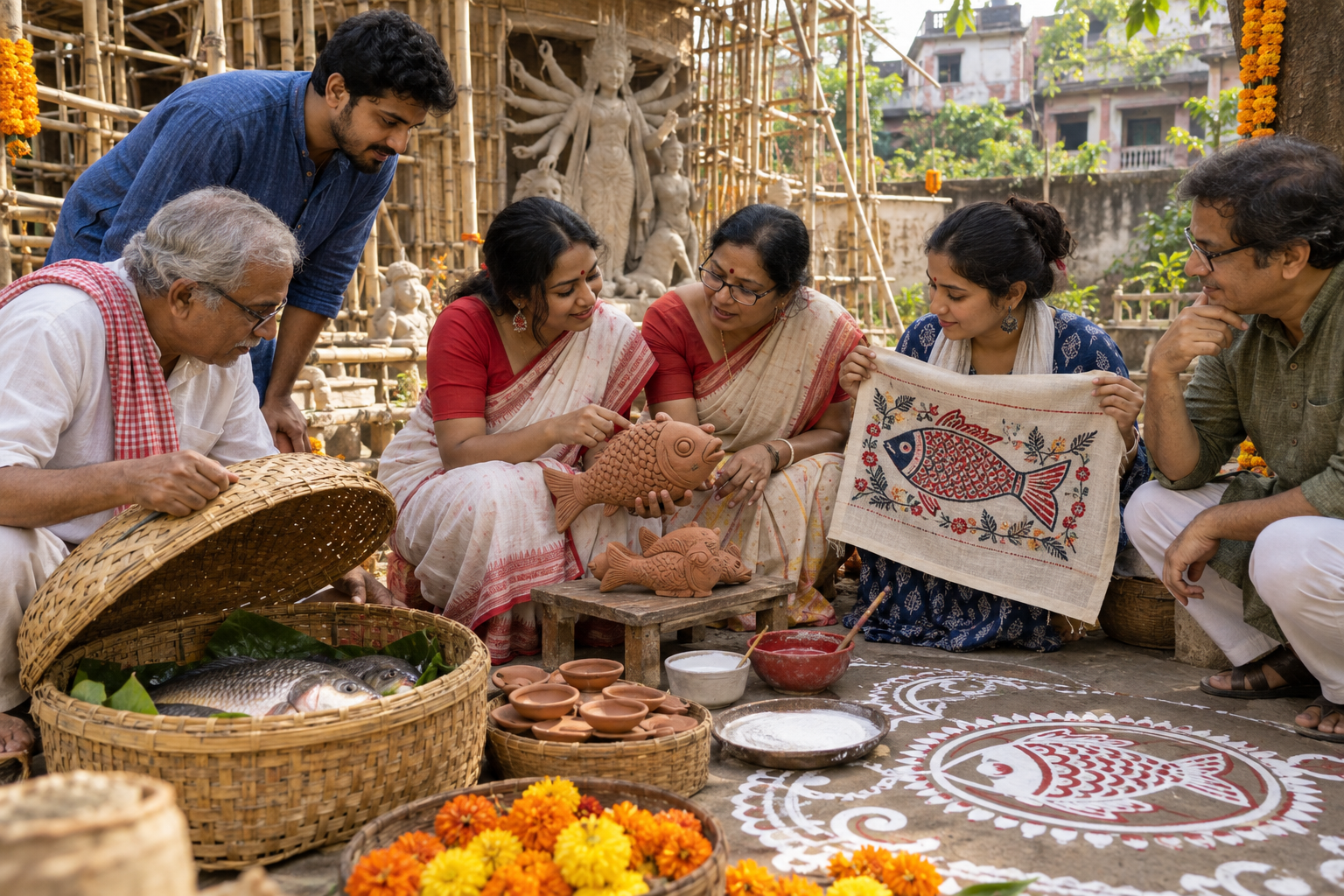
If someone asks you for a concise explanation, you can say: Fish in Bengali Durga Puja can symbolize prosperity and a safe journey. Its meaning grows from Bengal’s freshwater landscape, where fish belongs to both everyday culture and sacred imagination. The precise custom should be understood in its local context.
If you are visiting a Puja, ask what the fish means here rather than demanding a definition for all Hindus. If you are teaching, move in the order of landscape, meaning, and local practice. If your family is preserving a custom for the next generation, write down who taught it, what explanation was given, and which details belong specifically to your community.
There is a broader Dharmic insight here. A tradition need not abandon the material world in order to make spiritual meaning. In this Bengali setting, the waters that sustain life also furnish the language through which people imagine blessing, continuity, and protection. Regional expression is not a dilution of Dharma; it is one way Dharma becomes rooted in a lived world.
The next time you encounter the fish symbol, begin with the water around it. Then ask what hope the symbol carries: flourishing, continuity, safe passage, or a local meaning that deserves to be heard in the community’s own words.
References

Leave a Reply
You must be logged in to post a comment.