
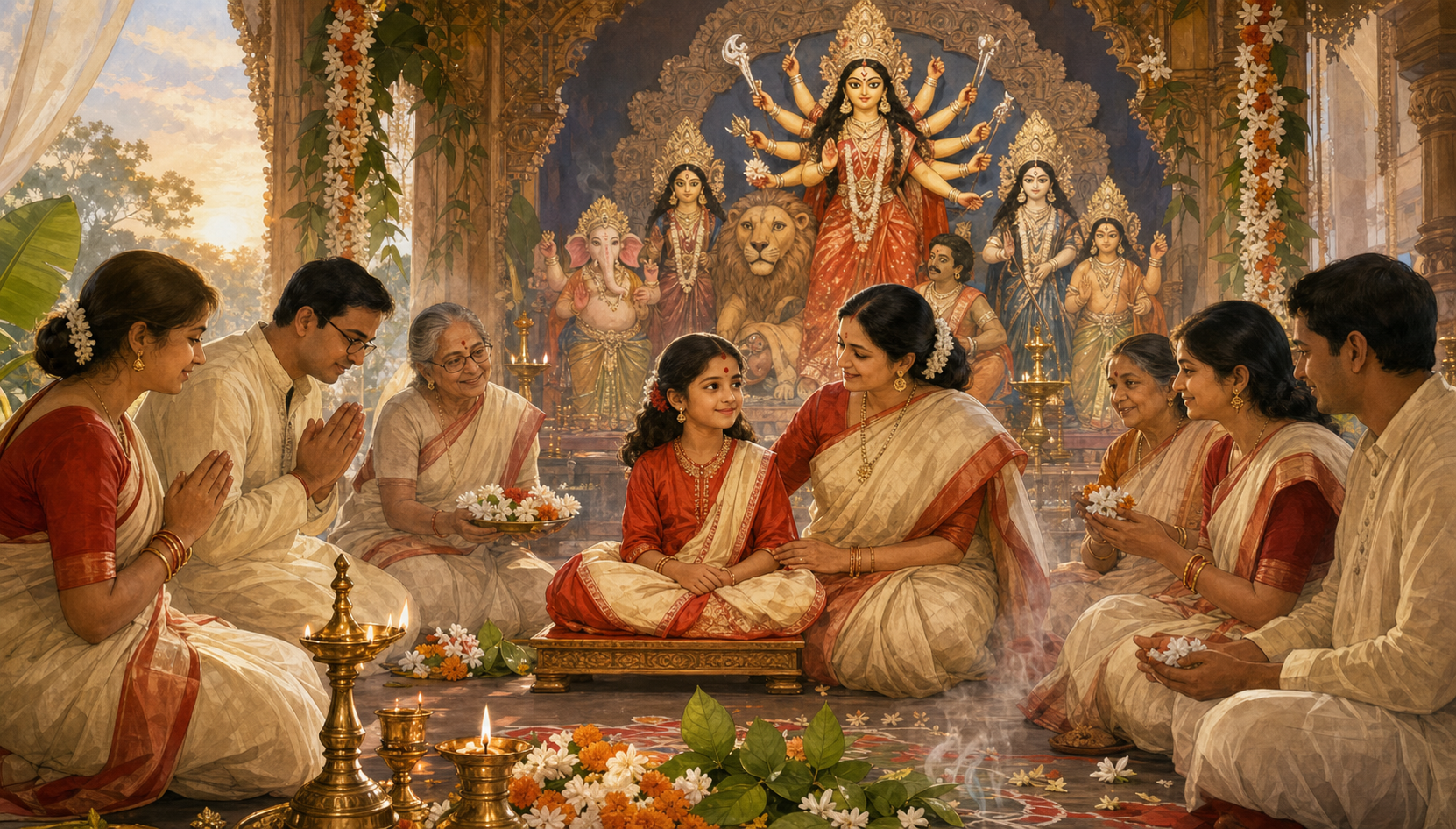
If you have heard that King Suratha began Durga Puja, that Sri Rama began it before the battle in Lanka, and that Bengal gave the festival its familiar form, you may wonder which account is correct. The apparent conflict comes from using the word origin for three different things: a sacred archetype, a seasonal transition, and the development of a living regional celebration.
Once you separate those layers, the tradition becomes easier to understand. Suratha explains the inner work of worship, Rama’s Akal Bodhan explains the special meaning of the autumn invocation, and Kumari Puja shows what belief in the all-pervading Devi demands from you in the presence of another human being.
The origin question has three different answers
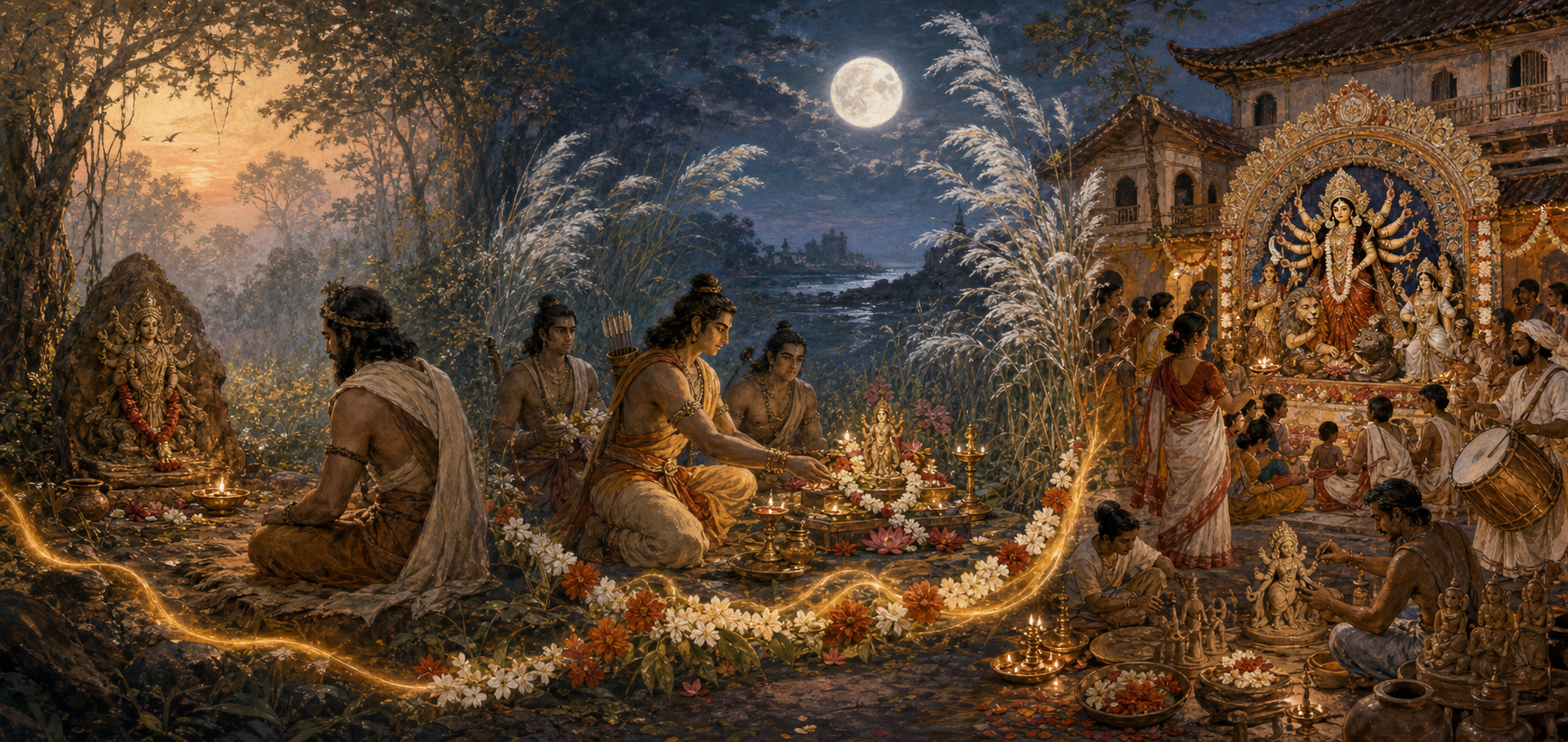
A responsible account of Durga Puja should not force its history into a single founding moment. Purāṇic narratives preserve sacred memory and theological patterns; they do not necessarily supply a modern, datable record of the first public festival. When someone asks who started Durga Puja, the first useful step is therefore to ask what kind of beginning they mean.
Suratha provides the Purāṇic archetype
The Devi Mahatmya within the Markandeya Purana frames the worship of the Goddess through King Suratha and a dispossessed merchant. Suratha has lost his kingdom and the loyalty of those around him. The merchant has been rejected by his own family. Yet both remain mentally attached to the people and possessions associated with their suffering.
They approach the sage Medhas with a psychological question that still feels immediate: why does the mind keep returning to what has harmed or abandoned it? Medhas explains their condition through Mahamaya, the power by which Devi both veils reality and makes recognition possible. Guided by him, the two undertake sustained worship, traditionally remembered as lasting three years.
This is the archetypal beginning of Durga worship in the narrative world of the text. It establishes the devotee’s problem, the discipline of sadhana, and the possibility of grace. It should not be turned into a precise claim about the first historical Durga Puja pavilion, dynasty, or calendar year.
Basanti Puja preserves the spring memory
Many traditions remember the spring observance in Chaitra as the earlier seasonal setting of Devi worship. Later Purāṇic and ritual traditions, including the Devi Bhagavata Purana and Kalika Purana, articulate Navaratri observances in both Chaitra and Ashwin. This gives Durga worship a two-season rhythm rather than two competing festivals.
Chaitra Navaratri falls in the spring and culminates around Rama Navami. Sharad Navaratri falls in the autumn and moves through Durga Ashtami and Mahanavami toward Vijaya Dashami. The corresponding Gregorian dates change from year to year and can differ by regional calendar reckoning, including amanta and purnimanta systems. If you are planning an observance, use the panchanga followed by your household, temple, or sampradaya rather than copying a date without checking its location and tradition.
Akal Bodhan explains the autumn invocation
In the widely cherished Rama narrative, Sri Rama invokes Maa Durga in Ashwin before confronting Ravana. The expression Akal Bodhan describes an awakening or invocation outside the Goddess’s customary spring season. Bengali devotional culture, including the Krittivasi Ramayan and regional Purāṇic retellings, helped make this account central to the meaning of Sharadiya Durga Puja.
Akal does not make the autumn worship spiritually inferior. It gives the season a particular moral force: when adharma must be confronted, the right response cannot always wait for an ordinary or convenient time. Rama’s invocation represents the gathering of clarity and Shakti before decisive action.
The cleanest answer is therefore threefold. Suratha gives the Purāṇic model of disciplined worship. Basanti Puja carries the memory of the spring cycle. Rama’s Akal Bodhan gives the autumn celebration its distinctive narrative of awakening before a struggle for dharma. These answers describe different layers and need not cancel one another.
Suratha’s two boons reveal what Durga Puja is for
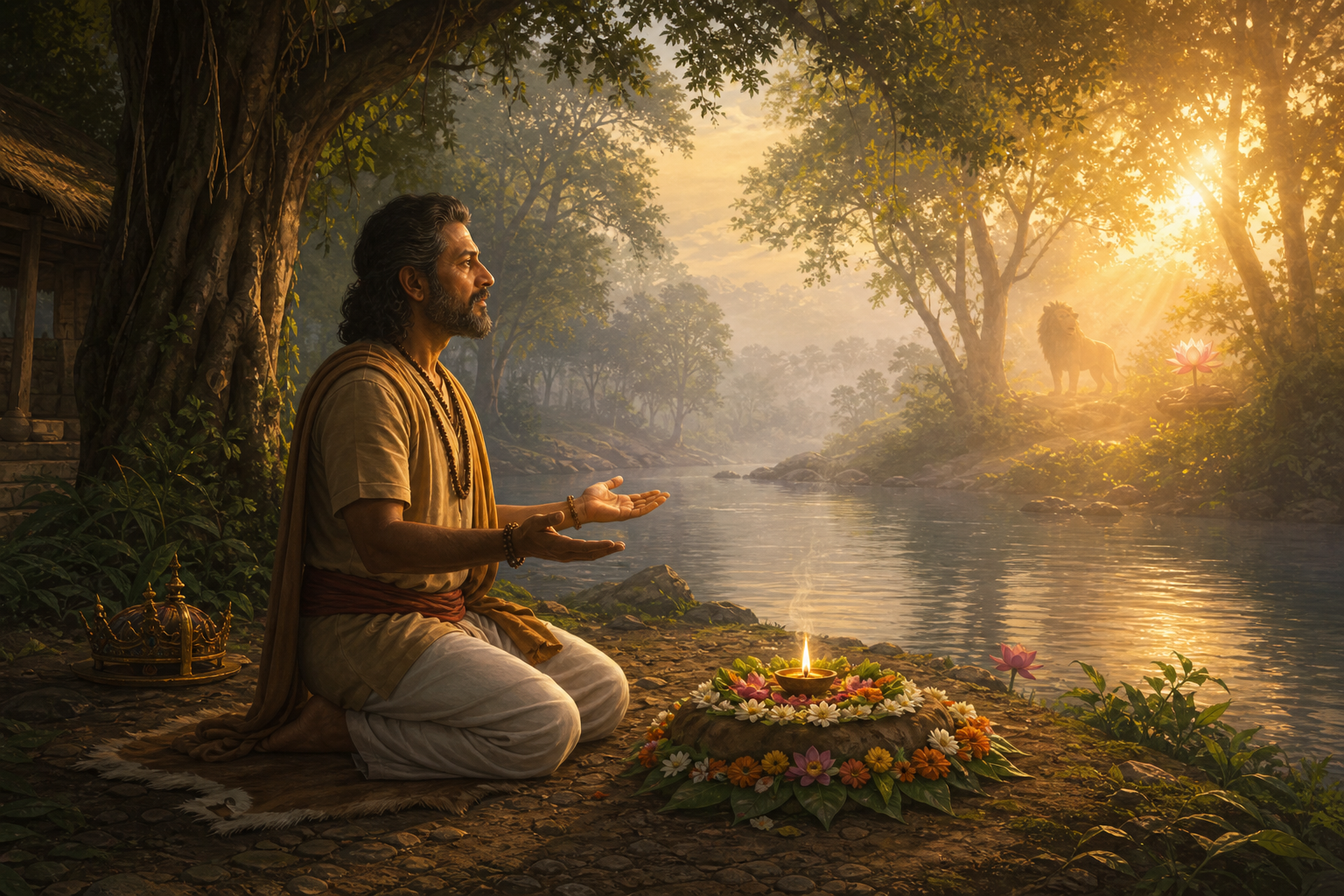
Suratha and the merchant do not request the same outcome when the Goddess appears. The king seeks the recovery and protection of rightful sovereignty. He receives kingship in his present life and the future destiny of Savarni Manu. The merchant asks for the knowledge that frees him from delusion and attachment. He receives wisdom and dispassion.
The contrast prevents Durga Puja from being reduced either to worldly success or to withdrawal from the world. Suratha’s boon affirms responsible action, order, and svadharma. The merchant’s boon affirms self-knowledge and freedom from compulsive attachment. One devotee must return to rule well; the other must learn to see clearly.
You can apply this distinction before making your sankalpa. It is not necessary to imitate either request literally. Instead, name one responsibility that needs strength and one attachment that needs understanding:
- What must be protected, repaired, or completed so that you can fulfil your duty?
- What person, possession, identity, or past injury keeps commanding your attention even when you know it cannot give you peace?
Ask for strength in the first case and clarity in the second. This keeps prayer from becoming a vague request for victory. It places power under dharma and turns detachment into discernment rather than indifference.
The same ritual reservoir serves both spring and autumn worship: kalash or ghata installation, recitation of the Durga Saptashati, offerings through Shodashopachara, homa in appropriate lineages, Sandhi Puja at the Ashtami-Navami transition, and Kumari Puja in communities that observe it. Kumari worship is therefore not an unrelated custom added to the festival. It brings the Devi Mahatmya’s theology of immanent Shakti into a direct human encounter.
Kumari Puja turns theology into hospitality
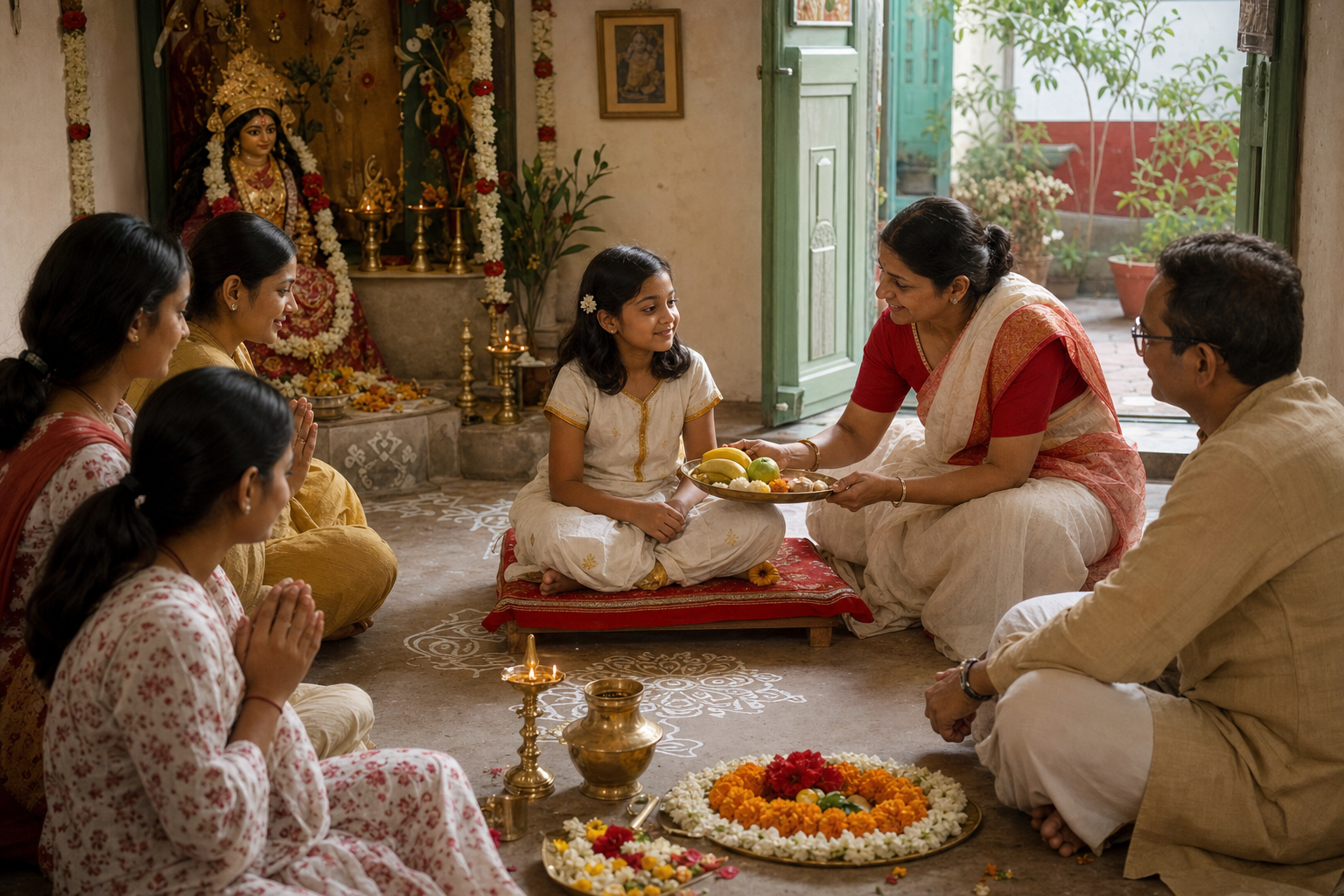
In Kumari Puja, a pre-pubescent girl is received and worshipped as a living manifestation of Devi. The practice is also known in several regions as Kanya Puja or Kanjak. Its central claim is not that divinity is locked inside one specially selected child. It is that the Goddess who operates through all beings can be approached in the kumari through innocence, unconditioned potential, and living presence.
This expands worship beyond the murti without displacing the murti. The image of Durga makes the cosmic form available to contemplation; the kumari makes reverence interpersonal. Flowers placed before an image do not have preferences or boundaries. A child does. Your conduct toward her therefore reveals whether the language of seeing Devi in all beings has entered your behaviour.
The invocation does not manufacture divinity, transfer ownership of sacred power, or make the child available for display. It asks the worshipper to recognize and serve the living presence of the Divine Mother. The child remains a child throughout the ceremony. Her willingness, comfort, hunger, fatigue, and personal boundaries take precedence over pageantry.
Regional forms should be distinguished rather than blended into one supposedly universal procedure. Eastern Durga Puja traditions often give special prominence to Kumari Puja on Ashtami, although some lineages choose another day. In northern household Kanya Puja, Ashtami or Navami commonly concludes the vrata with hospitality and a meal for invited girls. Nine kumaris may represent Shailaputri, Brahmacharini, Chandraghanta, Kushmanda, Skandamata, Katyayani, Kalaratri, Mahagauri, and Siddhidatri. Some customs also seat a Batuk, or young boy, in a protective role.
The Newar living-goddess institution of the Kathmandu Valley belongs to a distinctive Buddhist-Hindu cultural setting. It illuminates a wider civilizational reverence for feminine divinity, but it should not be treated as an interchangeable template for a household Kanjak ceremony. Shared symbolism does not erase differences of lineage, community, or ritual responsibility.
A careful Kumari Puja begins with consent, not decoration
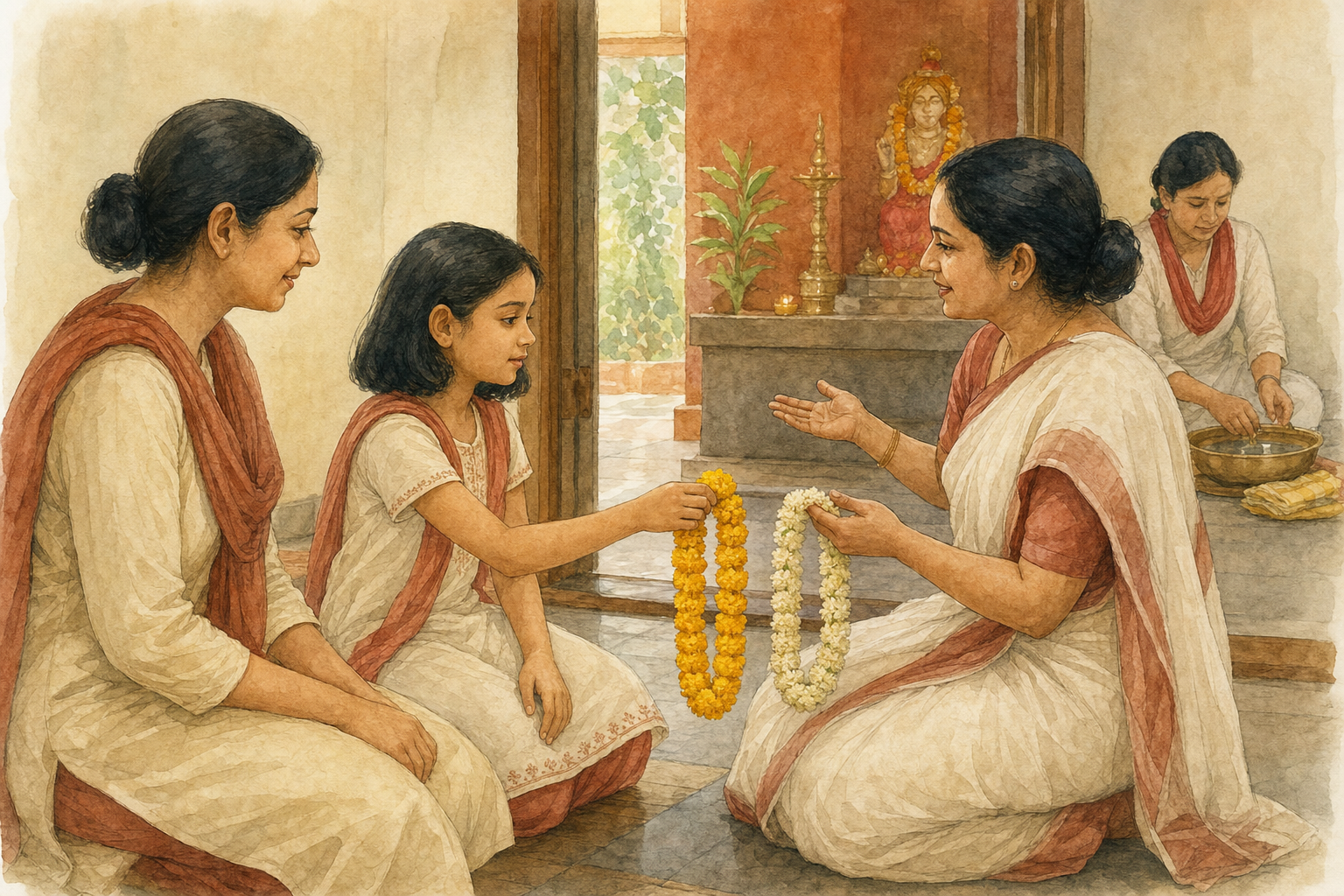
No single abbreviated procedure can replace the vidhi of your family, temple, or sampradaya. The sequence below identifies the stable practical core and the ethical checks that should accompany it. When a customary gesture conflicts with a child’s comfort, use a respectful symbolic offering and seek guidance from a trusted ritual authority afterward. Do not pressure the child for the sake of completing a photograph or performance.
- Choose the form and date first. Decide whether you are following a one-kumari observance, a nine-kanya household custom, or another established form. Kumari Puja is commonly held on Ashtami or Navami, while some lineages prefer Saptami. Confirm the tithi through the local panchanga used by your community.
- Invite the child through her guardian. Explain how long the ceremony will take, who will be present, what food will be served, whether any foot offering or tilak is customary, and whether photography is proposed. Participation must be willing, and a guardian should remain present.
- Ask about food and physical comfort. Check allergies, dietary restrictions, mobility needs, and anything the child does not want placed on her skin. Prepare a clean, comfortable seat, drinking water, a simple sattvic meal, seasonal fruit, flowers, akshata, sandal paste or kumkum where acceptable, and dakshina.
- Make a clear sankalpa. State that the worship is offered to Devi present in the kumari for purification, right understanding, and social harmony. If your tradition includes achamana, pranayama, or preliminary mantras, perform them without making the child sit through unnecessary delay.
- Welcome and invoke with restraint. Offer a respectful greeting and mentally perform avahana. Padya and arghya may be presented according to custom. Before washing or touching the feet, ask permission; a symbolic vessel offering is the better choice when the child or guardian is hesitant.
- Offer the customary honours. Apply tilak only with consent, then offer flowers, akshata, naivedya, and arati as your lineage directs. Keep gestures modest, chaperoned, and easy to understand. Sacredness does not require prolonged stillness, an elaborate costume, or physical contact.
- Complete the worship through hospitality. Serve the promised nourishing meal, present dakshina or a suitable gift respectfully, offer pranam without demanding a particular response, and let the child leave without delay. The guest should depart feeling comfortable and honoured, not examined or used.
Photography deserves a separate decision because it can quietly change worship into spectacle. Obtain agreement from both guardian and child before the event, explain where an image might appear, and accept a refusal without negotiation. No ritual value is lost when the camera remains absent.
Inclusion also requires more than assembling a symbolic number. Inviting across caste, class, and regional boundaries can embody equality before dharma, provided families are approached with ordinary respect and not treated as props for a claim about social harmony. The standard is simple: offer every kumari the care you would want for a child from your own household.
The real test comes after the kumari leaves
Kumari Puja becomes morally incoherent when a girl is honoured as Devi for an hour but girls and women are belittled in daily speech, denied attention, or expected to accept discomfort without complaint. Ritual cannot substitute for conduct. It trains conduct by making reverence visible, embodied, and difficult to keep at the level of abstraction.
After the ceremony, notice what happens in ordinary family life. Whose voice is interrupted? Whose work is assumed rather than acknowledged? Whose education, time, safety, or spiritual questions are treated as secondary? These observations turn puja into sadhana. They also give adults a way to explain the rite to children: Devi is not honoured because a guest performs sacredness perfectly, but because dignity is inherent and Shakti is not confined by social rank.
This ethical movement has resonances across the dharmic family. Jain ahimsa sharpens the obligation not to harm or coerce. Sikh teaching insists upon the dignity of women. Newar Buddhist-Hindu practice preserves its own encounter with a living goddess. These resonances do not make the religions or their rites identical. They show how reverence, non-harm, service, and dignity can meet without erasing distinct paths.
Key takeaways
- King Suratha supplies the Purāṇic archetype of Durga worship, not a securely datable claim about the first public festival.
- Basanti Puja preserves the remembered spring setting, while Rama’s Akal Bodhan explains the special meaning of invoking Durga in autumn.
- Suratha asks for restored sovereignty; the merchant asks for knowledge and dispassion. Together, their boons join rightful action to inner freedom.
- Kumari Puja expresses the presence of Shakti in a living person. It complements murti worship and makes hospitality part of theology.
- Ashtami and Navami are common observance days, but lineage and regional calendars vary. Confirm the tithi and vidhi locally.
- Guardian presence, the child’s willing participation, allergen-aware food, modest gestures, and explicit permission for photography are part of correct practice, not optional additions.
- The ceremony bears fruit when reverence continues in everyday treatment of girls and women.
Before your next Ashtami or Navami, do four things: confirm the local tithi, choose the form your tradition actually follows, speak plainly with the invited child’s guardian, and write down the duty and attachment you will place before Maa Durga. That preparation will do more for the integrity of the worship than adding another decorative element at the last minute.
References
- DharmaRenaissance Blog – Durga Puja’s Spring Origins: King Suratha, Akal Bodhan, and the Purāṇic Timeline Explained
- DharmaRenaissance Blog – Kumari Puja Unveiled: Encounter the Living Goddess of Navratri with Sacred Ritual Precision