
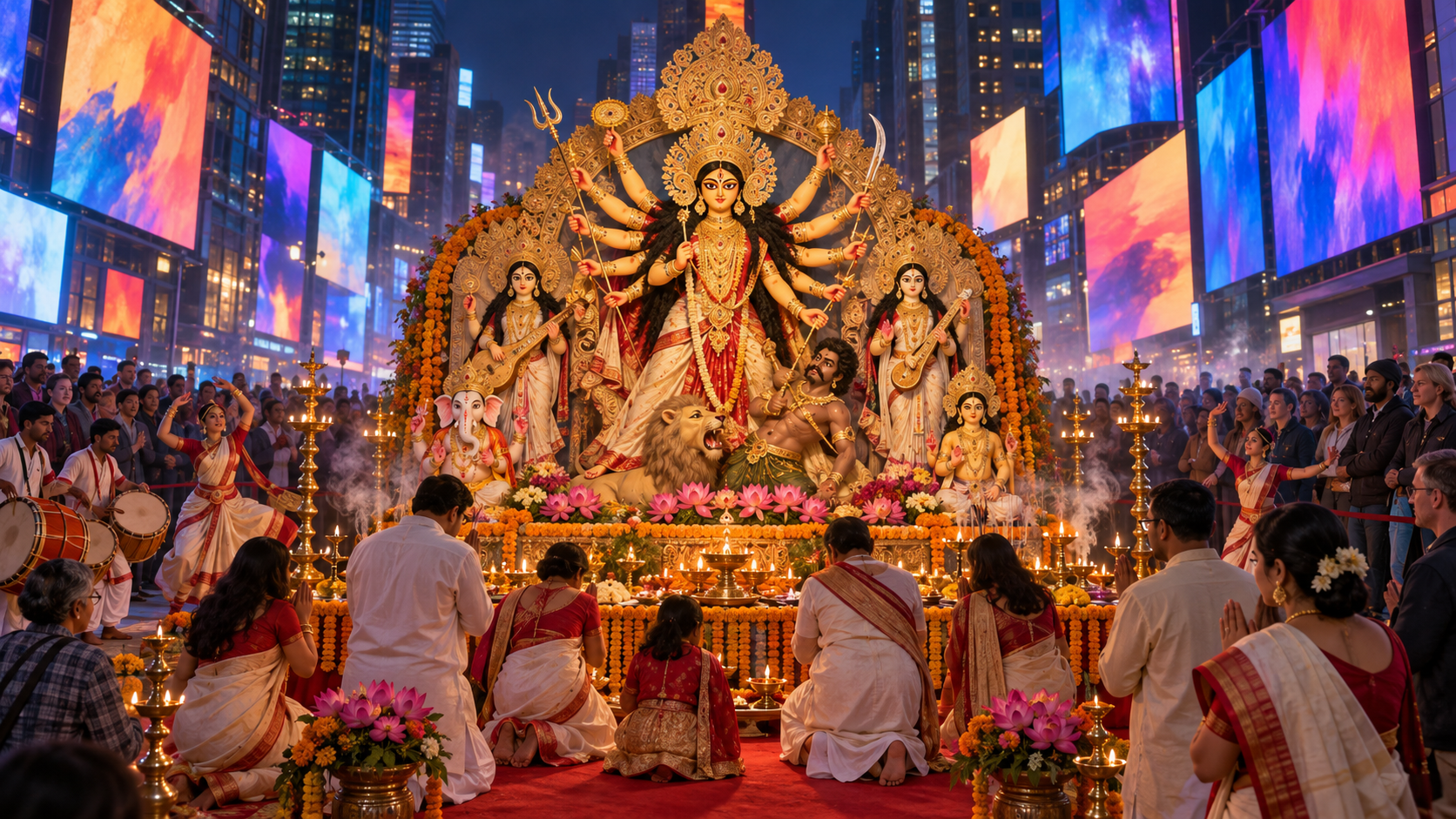
If a Durga celebration in Times Square left you proud but also unsure what the wider public actually saw, that tension is worth taking seriously. A sacred tradition can enter a famous civic setting without becoming a stage prop, but only when its name, purpose, and devotional centre remain clear.
On 10 October 2026, a Durga gathering brought devotion, music, dance, and cultural performances into the heart of New York City during Navaratri. The useful question now is not whether Hindu culture became visible. It did. The question is how you interpret and carry that visibility forward.
Begin with what actually happened
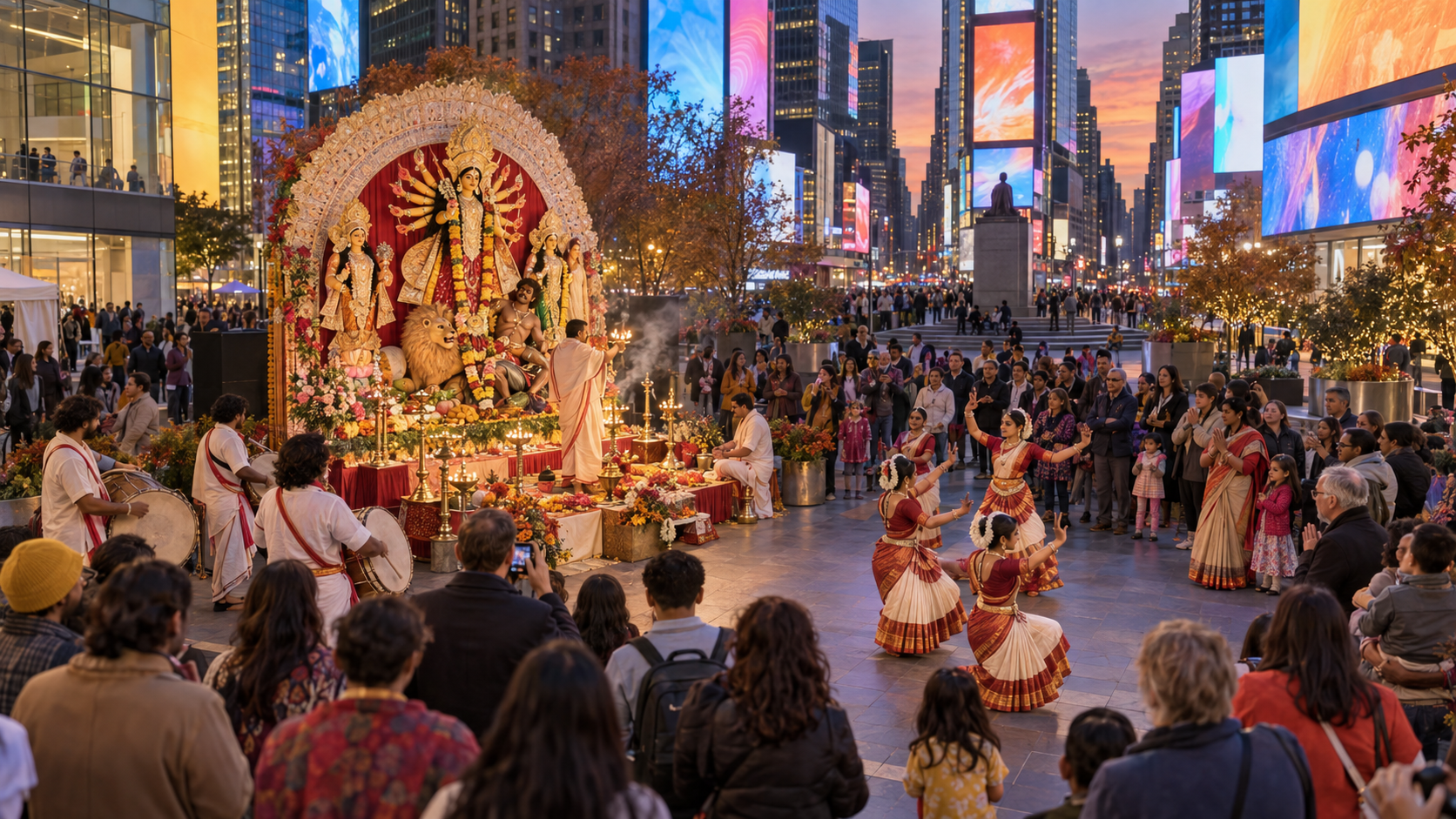
Durga Utsav 2026 took place at Times Square on 10 October 2026. It honoured Goddess Durga during Navaratri through devotion alongside music, dance, and cultural performances.
The event’s name matters. Puja refers specifically to worship. Utsav is broader: it names a festive observance that can hold worship, communal gathering, music, dance, and other cultural expressions together. Calling the occasion Durga Puja may be understandable in ordinary conversation, but a careful account should not invent particular rites that have not been identified.
You can safely name the date, location, Navaratri setting, Goddess Durga, and the combination of devotional and cultural activity. Verify anything more specific before repeating it. Crowd figures, claims that the event was the first of its kind, the identity of every organiser, or the performance of a particular ritual should not be inferred merely because a short clip looks persuasive.
A reliable caption would be simple: Durga Utsav 2026 at Times Square, held during Navaratri on 10 October, combined devotion to Goddess Durga with music, dance, and cultural performances. That sentence gives viewers enough context without turning enthusiasm into embellishment.
A famous venue changes the audience, not the sacred centre
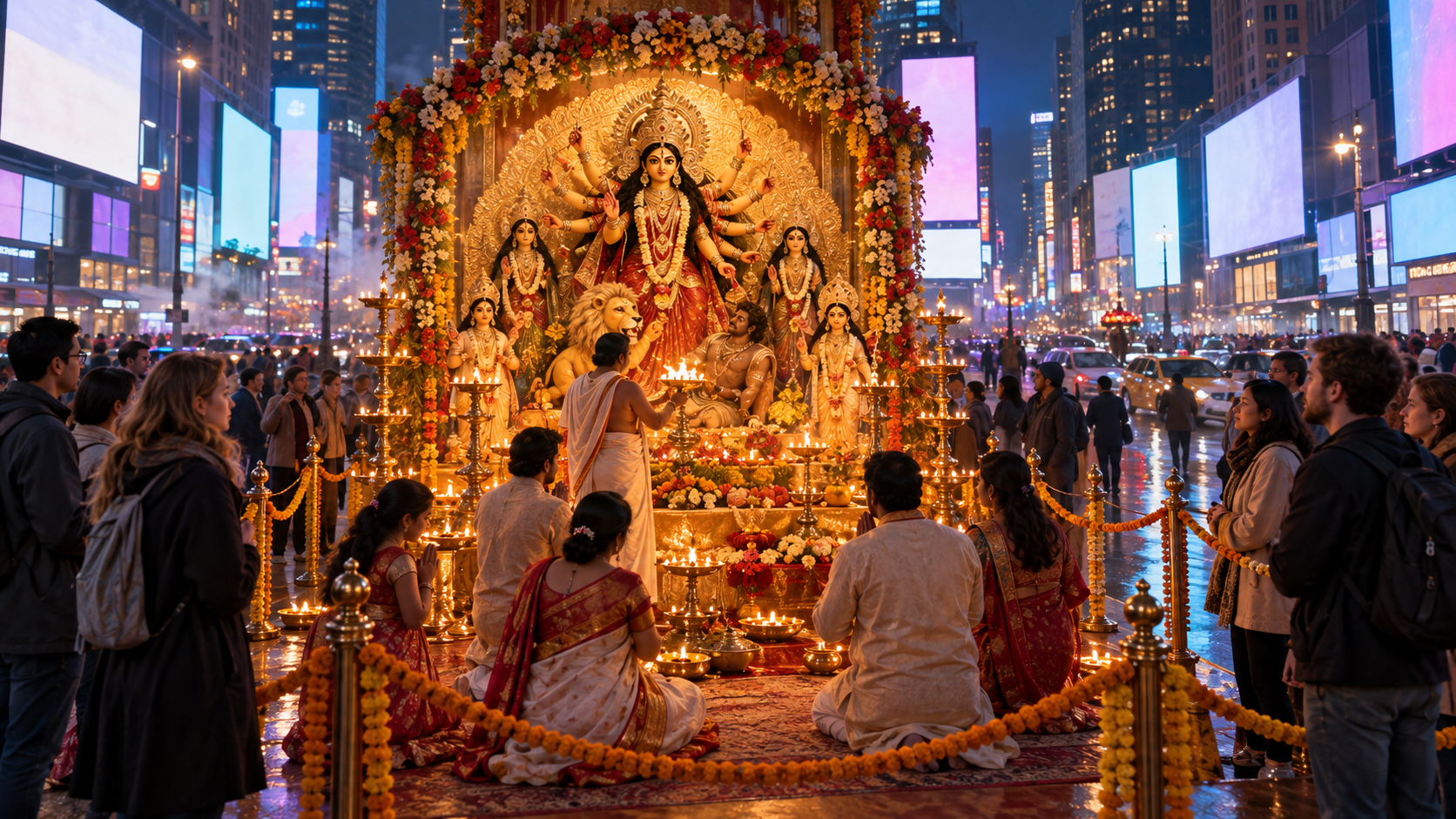
Times Square is significant precisely because it is not a temple. In a mandir, the setting already tells you that conduct, image, sound, and movement belong to a sacred framework. In a public square, that framework must travel with the event. Names, explanations, sequencing, and participant conduct have to make the devotional purpose intelligible.
Different people can encounter the same gathering in very different ways. A devotee may ask whether Durga is being approached reverently. A Hindu child growing up outside Bharat may be deciding whether this is a living inheritance or merely an ethnic performance. A passerby may see colour and dance without knowing who is being honoured. A strong public celebration makes the answer available to all three without rewriting Dharma for outside approval.
Yet Times Square does not confer legitimacy on Durga worship. Hindu traditions do not become more authentic because they appear at a globally recognisable location. The venue’s value lies elsewhere: it lets a living Hindu observance meet people beyond the spaces where it is already understood.
This distinction protects you from two opposite mistakes. One is dismissing every public celebration as spectacle. The other is treating visibility itself as victory. The better measure is whether a viewer can leave knowing that the occasion concerned Goddess Durga, took place during Navaratri, and carried a devotional purpose rather than merely an Indian aesthetic.
The test is whether culture carries devotion
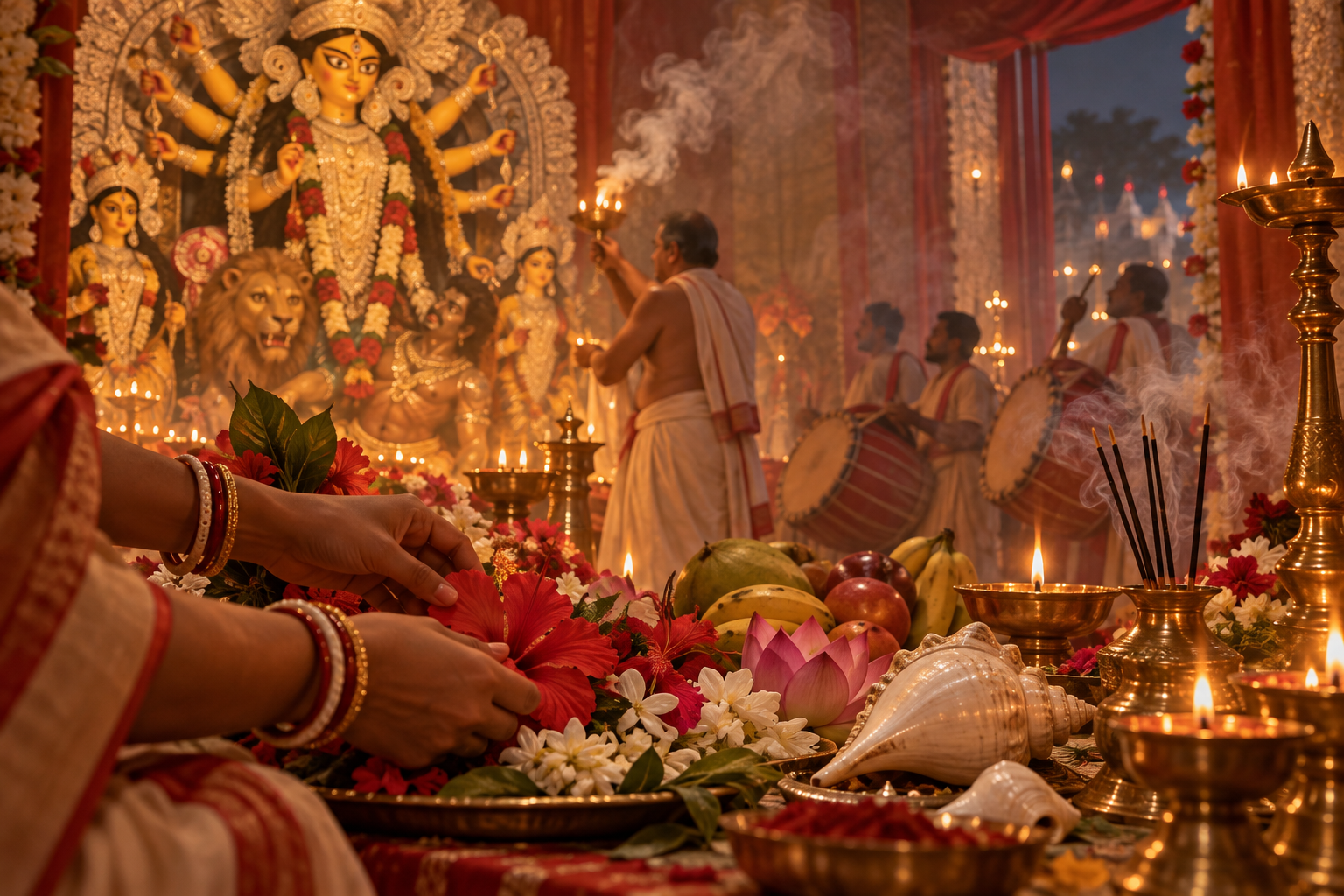
Music, dance, performance, and worship do not have to compete. Dharmic celebration has never required devotion to be joyless. The problem arises when presentation preserves the entertaining elements but removes the sacred relationship that gives them meaning.
If you are assessing a public Hindu programme, sharing it online, or planning a future one, use these checks:
- Name the sacred centre. Say Goddess Durga rather than reducing the occasion to a generic Indian or South Asian festival.
- Distinguish worship from performance. A dance offered in a devotional setting may carry religious meaning, but it is not automatically a puja. Label each part accurately.
- Explain the Navaratri setting. A newcomer needs to know that the gathering belongs to a sacred observance, not just a programme placed on an outdoor stage.
- Protect devotional transitions. When worship and cultural performances share a programme, the schedule and announcements should tell participants when the mode of attention changes.
- Preserve context in the recording. A short edit that shows only dancing may travel farther online, but it can leave viewers unable to identify Durga or the devotional purpose.
- Avoid triumphalist language. Describing a Hindu event as a takeover substitutes confrontation for confidence. Accurate naming makes a stronger cultural statement.
These checks also clarify a common misunderstanding: public presentation does not necessarily dilute worship. Dilution occurs when the religious meaning is hidden, mislabelled, or treated as an obstacle to mass appeal. A celebration can welcome curious onlookers while remaining recognisably Hindu.
How to take part without flattening the event
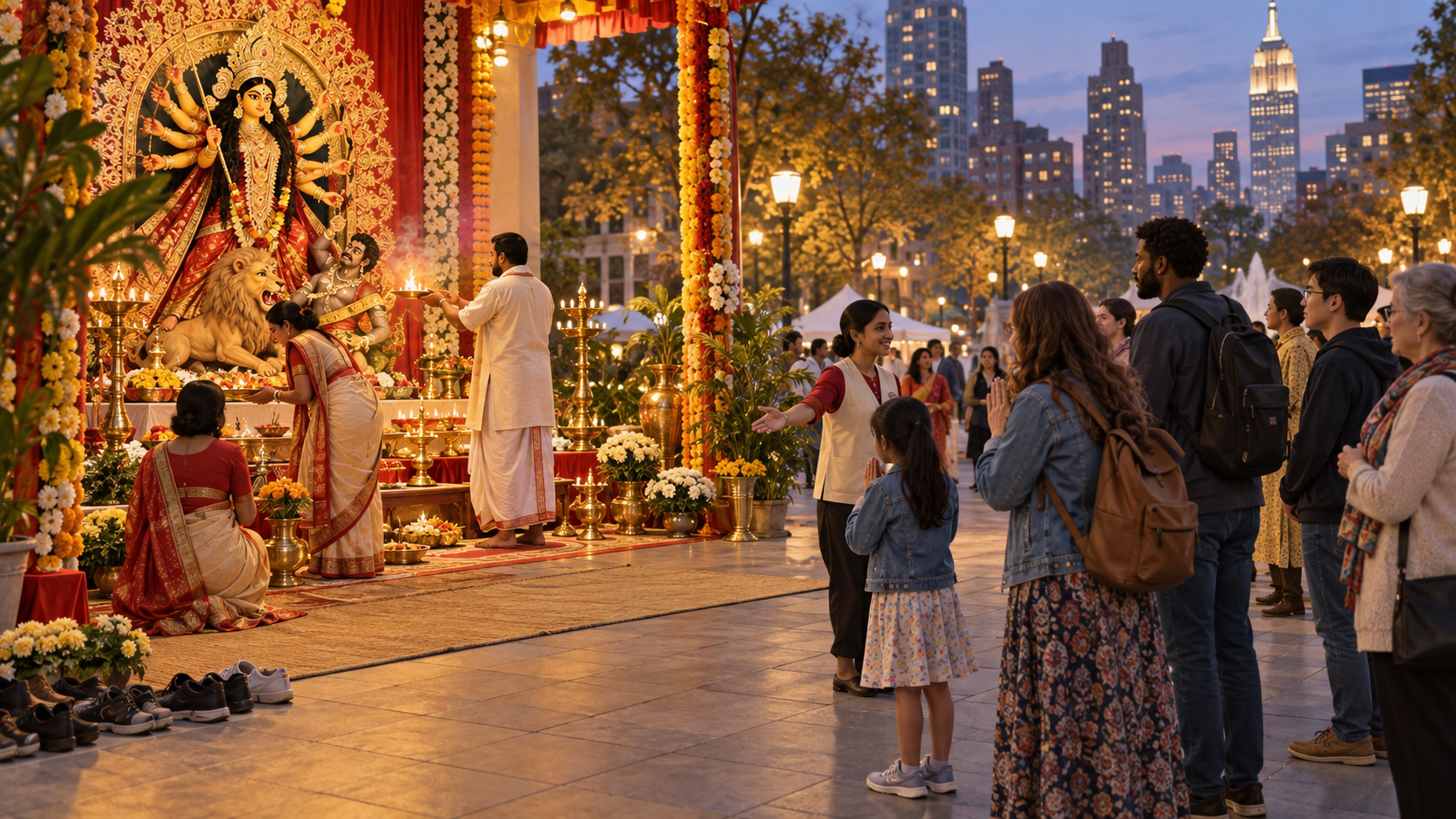
Your responsibility depends on how you encounter the celebration. The same basic discipline applies in every case: receive the event on its own terms before turning it into content.
- If you attend: Watch for cues before moving, speaking, or filming during a devotional portion. Keep sightlines and walking paths open, and ask a volunteer when you are uncertain about expected conduct.
- If you bring children: Ask them to notice what expresses devotion and what serves as cultural presentation. The distinction helps them understand that joy, art, and worship can belong together without becoming interchangeable.
- If you share a clip: Include the event name, Times Square, the date, Navaratri, and Goddess Durga. Do not label an exact rite unless you can identify it reliably. Link to fuller context when an isolated clip could mislead.
- If you explain it to a non-Hindu friend: Begin with who is being honoured and why the gathering is devotional. Clothing, choreography, and scenery are secondary explanations, not the meaning of the event.
- If you organise a similar programme: Publish a schedule that distinguishes devotional observance from cultural performance. Give the emcee a short, accurate explanation of each transition and provide clear guidance about photography and movement during sacred portions.
- If you represent a community organisation: Give interested visitors a next step, such as a future observance, a local community contact, or a place where they can learn the meaning of Durga worship. Public attention is most valuable when it opens a path to understanding.
There is also a simple editorial test for every photograph, caption, and video: if Durga can be removed from it without changing its apparent meaning, the sacred context has probably become too thin. Add the missing name and setting rather than assuming viewers already understand them.
Key takeaways
- Durga Utsav 2026 was held at Times Square on 10 October during Navaratri, with devotion, music, dance, and cultural performances.
- Puja and utsav are related but not identical terms; do not invent a detailed ritual programme from a general festival description.
- Times Square expands the audience for a Hindu observance, but it does not supply the observance with legitimacy or sacredness.
- Judge public representation by whether it clearly identifies Durga, Navaratri, and the devotional purpose.
- When attending or sharing the event, preserve context and use precise language instead of spectacle-driven or triumphalist captions.
The next time you share the Times Square gathering, let the attention lead somewhere deeper. Name it accurately, keep Durga at the centre, and point the interested viewer toward Navaratri observance or a Hindu community where questions can continue. That is how a public moment becomes more than an image passing across a screen.
References

Leave a Reply
You must be logged in to post a comment.