
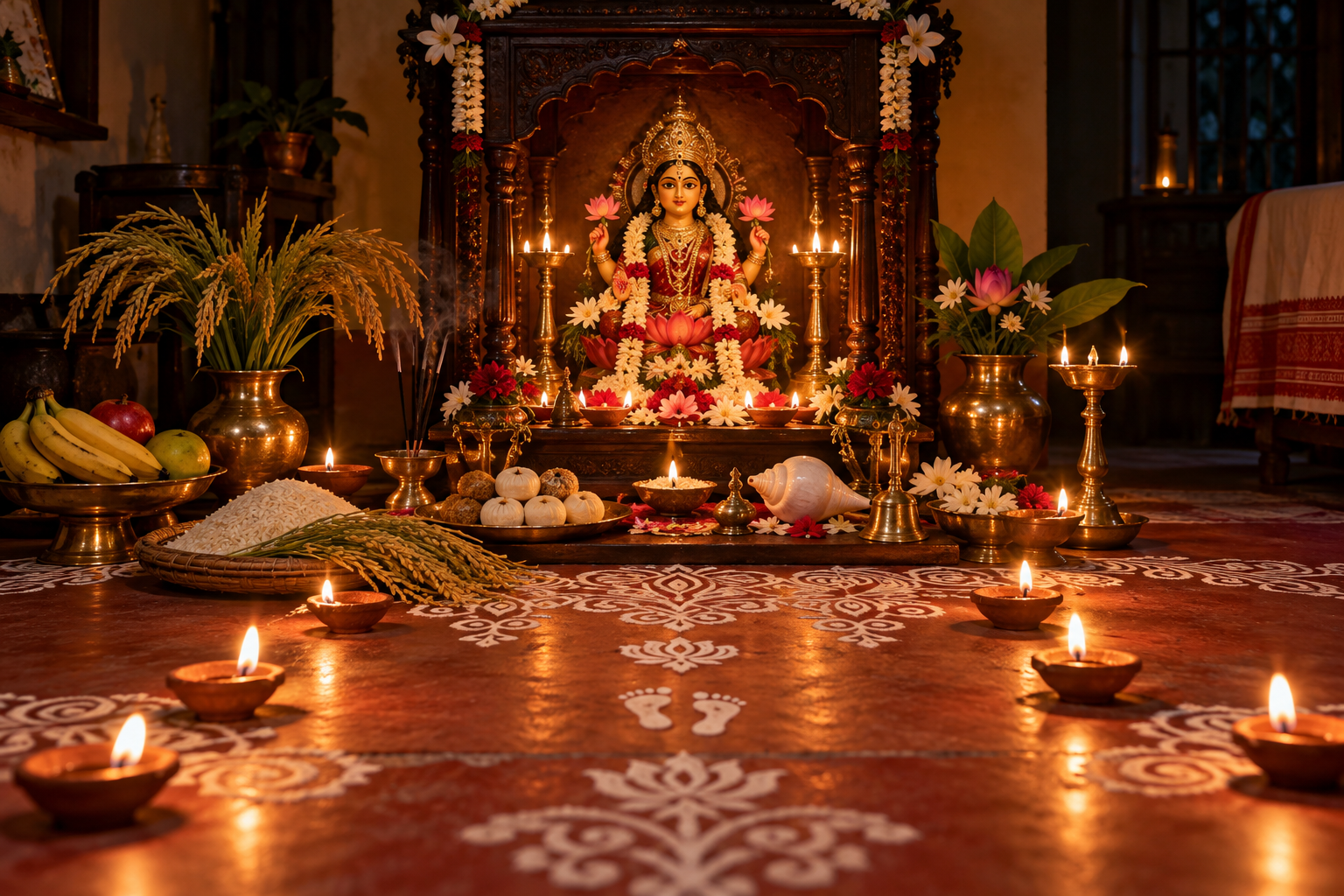
If you are arranging Lakshmi Puja for a Bengali family, the first question is not which flowers or sweets to obtain. It is which Lakshmi Puja you mean. Kojagari and Dipanwita occur close together, but they belong to opposite lunar phases and should not be folded into one generic observance.
The distinction gives you a reliable starting point. Identify the tithi, confirm the correct evening in a current local panjika, and then follow the ritual form preserved by your family, guru, purohit, or community.
First identify which Bengali Lakshmi Puja you are keeping
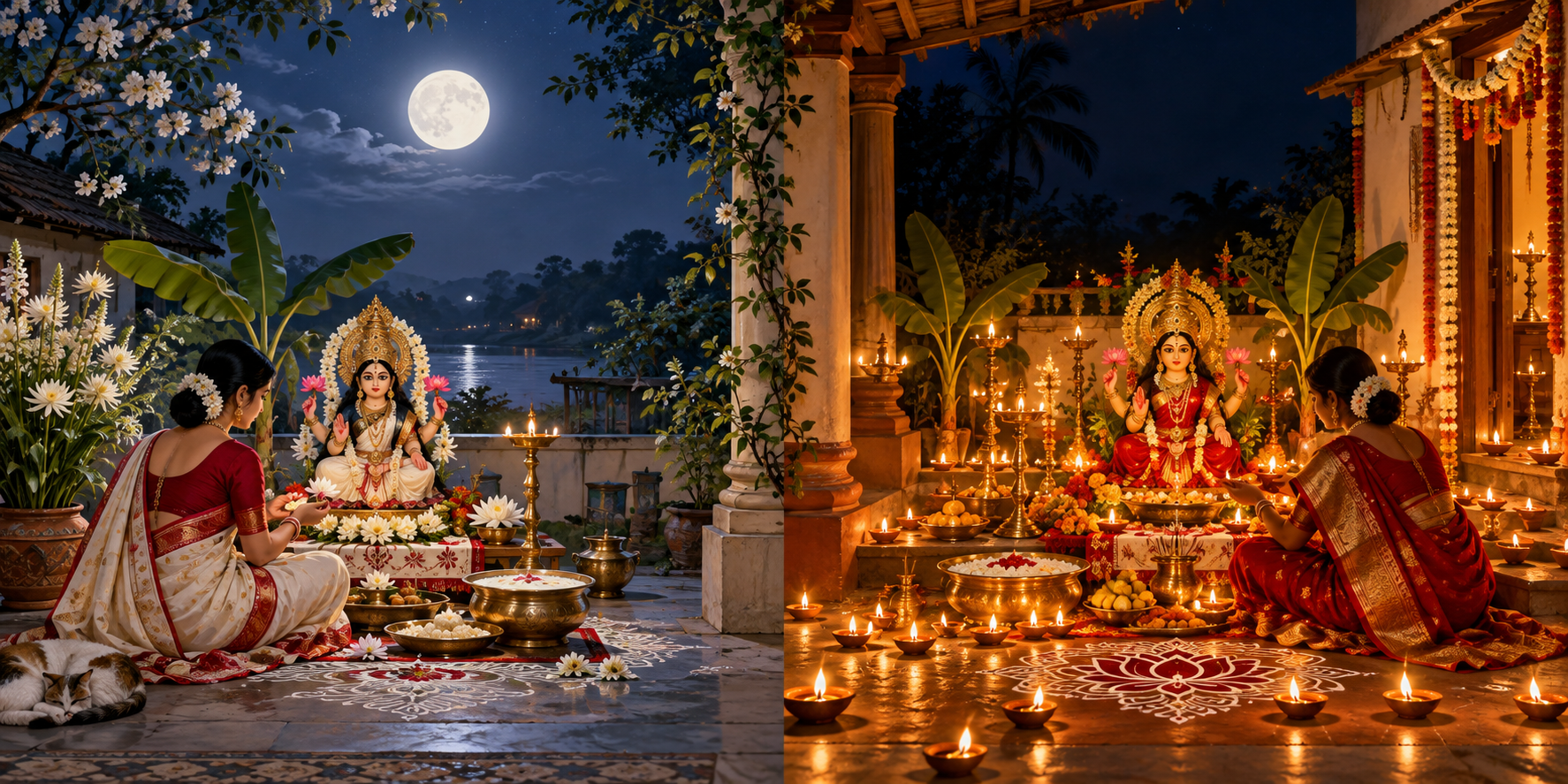
Bengal observes two distinct nocturnal Lakshmi Pujas within a fortnight. Kojagari Lakshmi Puja falls on the full moon of Ashwin. Dipanwita Lakshmi Puja falls on the new moon of Kartik and belongs to Diwali night.
| Point to check | Kojagari Lakshmi Puja | Dipanwita Lakshmi Puja |
|---|---|---|
| Lunar month | Ashwin | Kartik |
| Lunar phase | Purnima, the full moon | Amavasya, the new moon |
| Time of observance | Night | Night |
| Festival setting | The earlier Lakshmi observance | Diwali night |
| Quick calendar test | Look for Ashwin Purnima | Look for Kartik Amavasya and Diwali |
This table is a calendar test, not a complete ritual manual. If an invitation, family note, or shopping list says only “Lakshmi Puja,” ask whether it refers to Ashwin Purnima or Kartik Amavasya. That one question prevents the most basic mix-up.
The contrast can also help you remember the order. Kojagari comes beneath the full moon; Dipanwita comes on the moonless Diwali night. Both honour Lakshmi at night, but their calendrical identities remain distinct.
Why the Kartik new moon is the defining detail
Dipanwita occupies an exceptional place in the Bengali calendar. Outside the month of Kartik, Lakshmi Puja is not performed on a new moon in Bengal. The observance therefore should not be treated as a monthly Amavasya practice that happens to receive extra decoration at Diwali.
The useful rule is precise: Kartik plus Amavasya plus night plus Diwali identifies Dipanwita Lakshmi Puja. Remove the Kartik setting, and the rule no longer describes this Bengali observance.
Do not determine the festival from a fixed Gregorian date or reuse last year’s date. Lunar observances move through the civil calendar. Consult a current Bengali panjika or a calendar followed by your local temple, then verify which evening is assigned to Kartik Amavasya and Diwali. If you live outside Bharat, use guidance intended for your location rather than assuming that an Indian civil date automatically settles the local observance.
The moon phase provides a valuable error check even after you consult a calendar. A full-moon listing points you toward Kojagari; a Kartik new-moon listing points you toward Dipanwita. The check does not replace the panjika’s tithi calculation, but it can expose a mistaken label before invitations are sent or preparations begin.
Prepare without flattening your family’s tradition
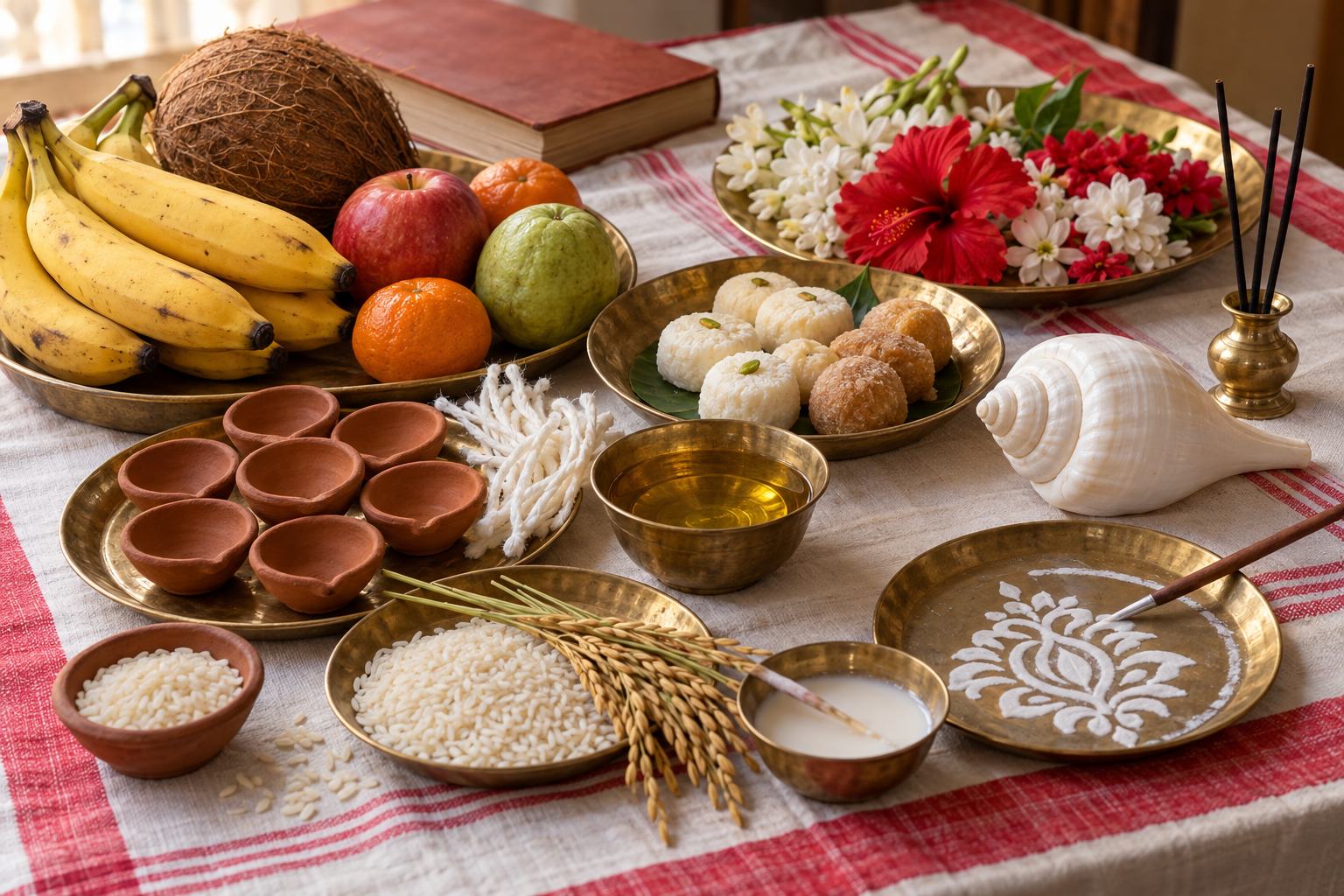
The common frame is firm, but it does not require every Bengali household to use an identical sequence, narrative, offering list, or ritual arrangement. A useful preparation method separates the shared calendar identity from the details entrusted to a particular family or community.
- Write down the observance clearly. Record “Dipanwita Lakshmi Puja,” Kartik Amavasya, the local civil date, and the planned night. Do not leave the family calendar with the ambiguous label “Lakshmi Puja.”
- Ask for the household procedure before shopping. Confirm which murti, image, or ritual vessel your family uses; which katha is recited; which mantras or names are customary; which offerings are prepared; and whether the household keeps any particular vrata rule. Treat these as questions for the tradition-bearer, not details to guess from a generic list.
- Identify who will guide the puja. If a purohit, elder, or experienced family member will lead, obtain the required materials from that person. This prevents a long shopping list assembled for a different regional or household practice from displacing the procedure you actually intend to follow.
- Keep Dipanwita materials separate from Kojagari notes. Families that observe both can easily accumulate instructions under one broad “Lakshmi Puja” heading. Label photographs, recipes, mantras, and stored utensils with the specific observance to which they belong.
- Handle lamps as both sacred objects and open flames. If your Diwali observance includes oil lamps, place them on stable, non-flammable surfaces, keep loose cloth and decorations away, and do not leave them unattended. Use a safer alternative wherever children, animals, wind, or building rules make an open flame unsuitable.
- Preserve the sequence after the puja. Ask the person who led it to review your notes while the details are still fresh. Record unfamiliar Bengali or Sanskrit names accurately and explain what each item is used for. A short, verified family record is more valuable next year than an expansive checklist copied from another tradition.
This method does not make household practice secondary. It gives that practice a secure frame. The calendar tells you which observance you are keeping; the inherited procedure tells you how your household keeps it.
Let the stories illuminate the night without forcing uniformity
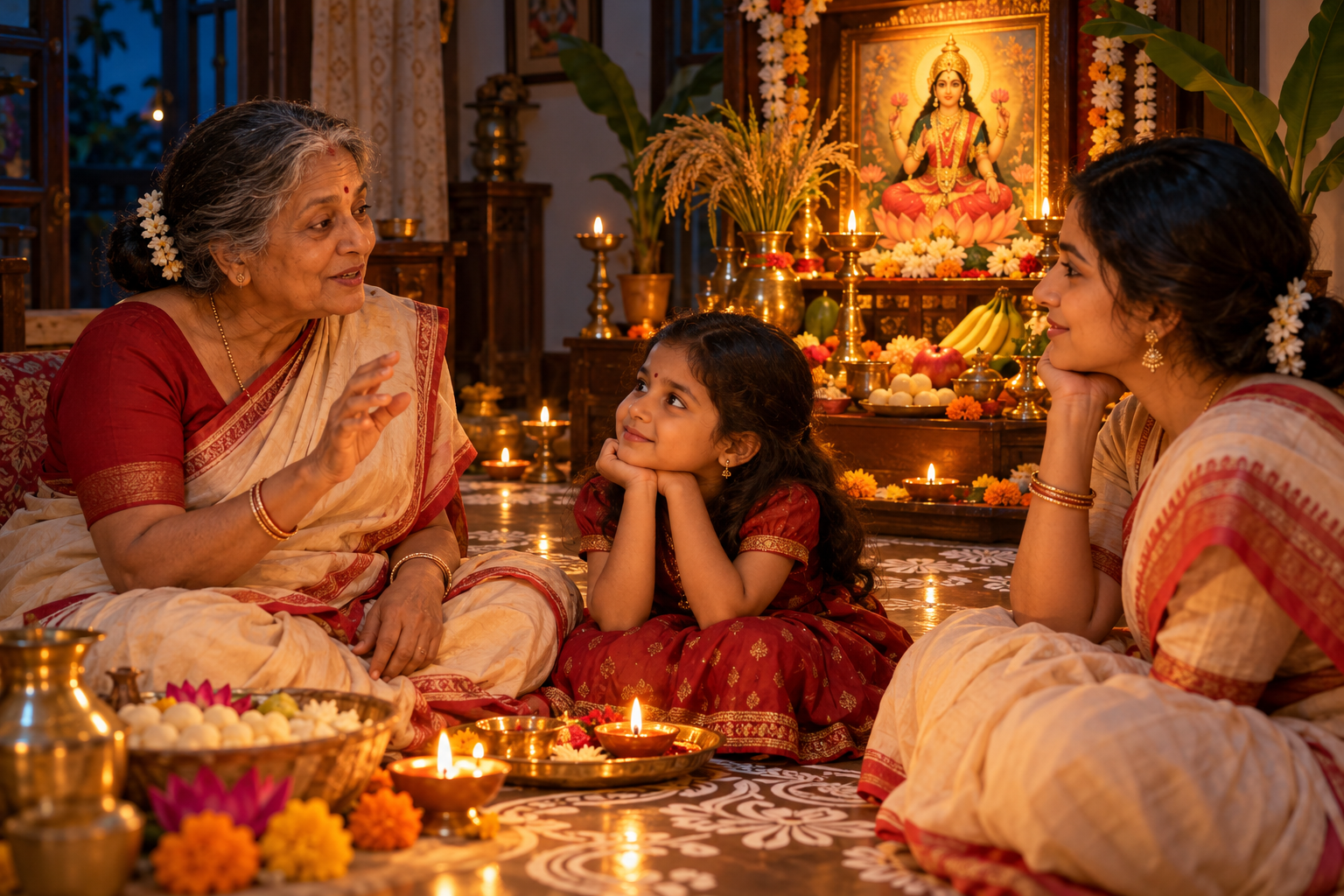
Several legends are associated with Dipanwita Lakshmi Puja. That plurality matters. If your family recites one particular account while another Bengali family knows a different one, the difference does not by itself prove that one household has abandoned the festival.
When you teach the observance to children or present it at a community gathering, name the version you are actually transmitting: “This is the katha followed in our family” is clearer than declaring it the only possible origin of Dipanwita Lakshmi Puja. If you do not know where your version came from, ask an elder before adding details from memory.
The lunar contrast also offers a simple way to explain why the two Lakshmi Pujas are not duplicates. Kojagari stands at the brightness of Ashwin Purnima; Dipanwita stands at Kartik Amavasya within Diwali’s world of light. You may use that contrast as a devotional reflection or teaching aid, but it should not be turned into a supposedly universal doctrine unless your own sampradaya or family teaching presents it that way.
This is one of the strengths of Bengali Hindu tradition: participation in the wider sacred season of Diwali does not erase a recognisably Bengali calendrical form. Preserving the name, tithi, night observance, and family katha keeps that form visible.
Key takeaways
- Bengal keeps two night-time Lakshmi Pujas within a fortnight: Kojagari on Ashwin Purnima and Dipanwita on Kartik Amavasya.
- Dipanwita is the Lakshmi Puja associated with Diwali night; it should not be confused with the earlier full-moon observance.
- Lakshmi worship on Amavasya is exceptional in this Bengali pattern: outside Kartik, it is not performed on another new moon.
- Use a current local panjika or trusted temple calendar rather than copying a previous Gregorian date.
- Confirm the ritual sequence, katha, offerings, and vrata rules with the person who carries your household tradition.
- When different legends or customs appear, describe your version accurately instead of presenting every household practice as universal.
Before buying puja materials, make two enquiries: ask a family elder which Dipanwita procedure your household follows, and ask a trusted local calendar authority which evening carries Kartik Amavasya. Once those two answers agree, you can prepare with confidence and leave the next generation a clearer tradition than an unlabeled list.
References

Leave a Reply
You must be logged in to post a comment.