
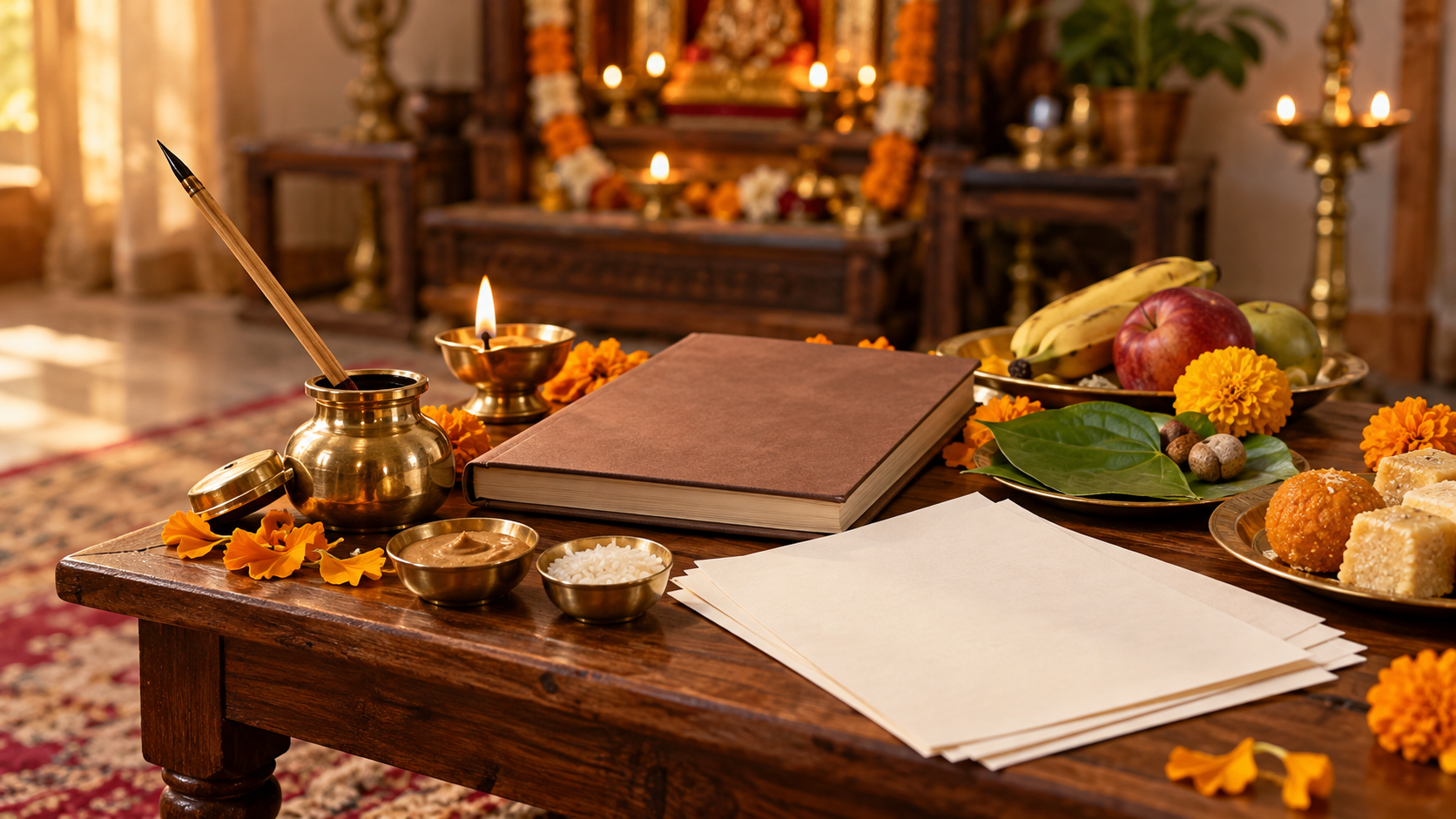
If your calendar says Chitragupta Puja while your family calls it Dawat Puja, you are not looking at two festivals. They are two names for the same observance, and the date in 2026 is November 11.
That distinction makes planning much easier. You need one date, but you still need to learn which name, sequence, and household customs your family follows. Here is how to do that without turning a living tradition into a generic festival checklist.
Chitragupta Puja and Dawat Puja are the same observance
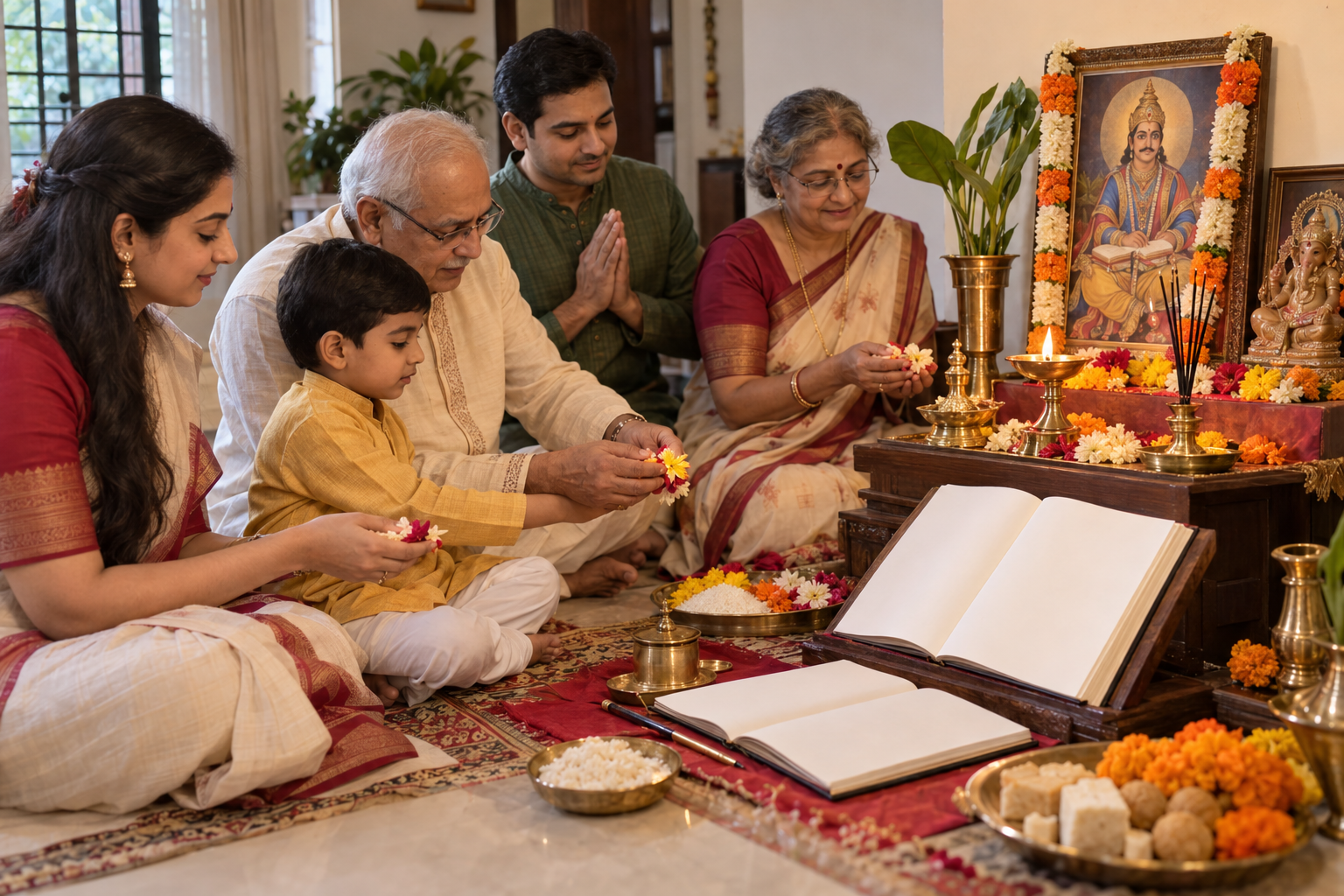
Chitragupta Puja, also known as Dawat Puja, marks Chitragupta Jayanti. It is mainly observed among Kayastha Hindus. The different names therefore do not indicate separate festivals, separate dates, or a choice between two competing observances.
The word “mainly” matters. It identifies the community most closely associated with the observance without requiring you to describe it as exclusive. If you are attending through a Kayastha family, let that family’s practice set the form. If you are hosting people who may know only one name, put both names on the invitation or calendar entry: “Chitragupta Puja (Dawat Puja).”
- Use your family’s customary name inside the home.
- Use both names when informing guests or younger relatives who may not recognize the alternative.
- Do not prepare two separate ceremonies merely because two labels appear on different calendars.
- Ask the host or senior family member before importing a ritual sequence from another household.
Place it correctly within the Diwali calendar
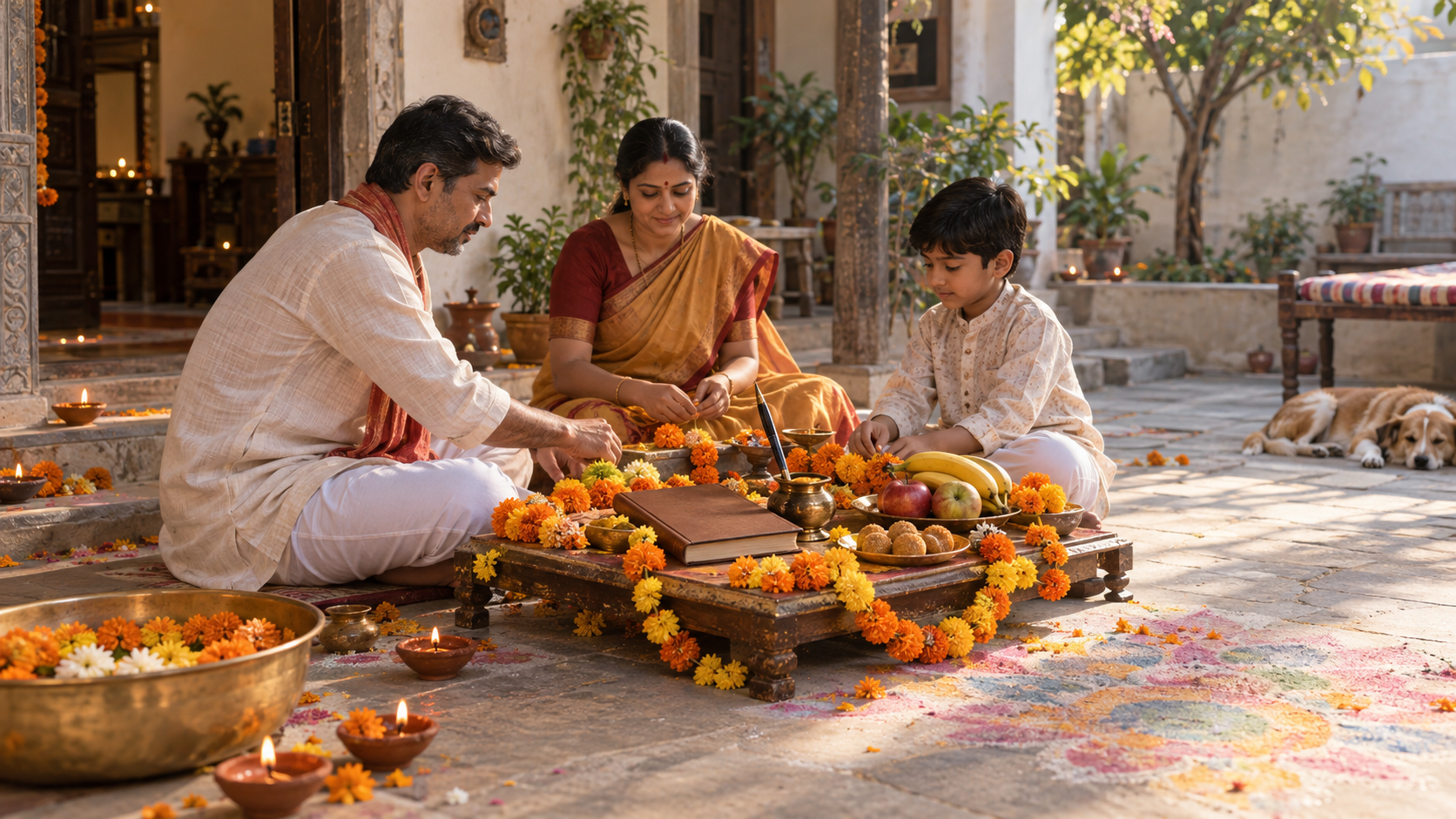
In North India, Chitragupta Puja is observed on Bhai Dooj, the second day after Diwali. In 2026, that places it on November 11. The day is also associated in different parts of India with names such as Yama Dwitiya, Bhai Phonta, Bhatru Dwitiya, and Bhai Tika.
This regional vocabulary can create unnecessary calendar confusion. A relative may speak about Bhai Tika while another says Bhai Dooj and a third is arranging Dawat Puja. Before assuming that the family has chosen different days, check whether everyone is referring to the same post-Diwali date from a different regional or community perspective.
The festival date and the household schedule are still separate questions. Knowing November 11 tells you the day, but it does not establish the hour, venue, or order in which your family will observe Chitragupta Jayanti and the sibling-centered customs of Bhai Dooj. Settle those details before sending invitations.
- Enter “Chitragupta Puja / Dawat Puja – Bhai Dooj” on November 11, 2026.
- Ask whether your household performs the observances together, consecutively, or at different locations.
- Check whether relatives use another regional name for Bhai Dooj before creating duplicate plans.
- If you will attend a temple or community gathering, confirm its announced time separately; the shared date does not determine every local schedule.
Prepare according to your family’s actual practice
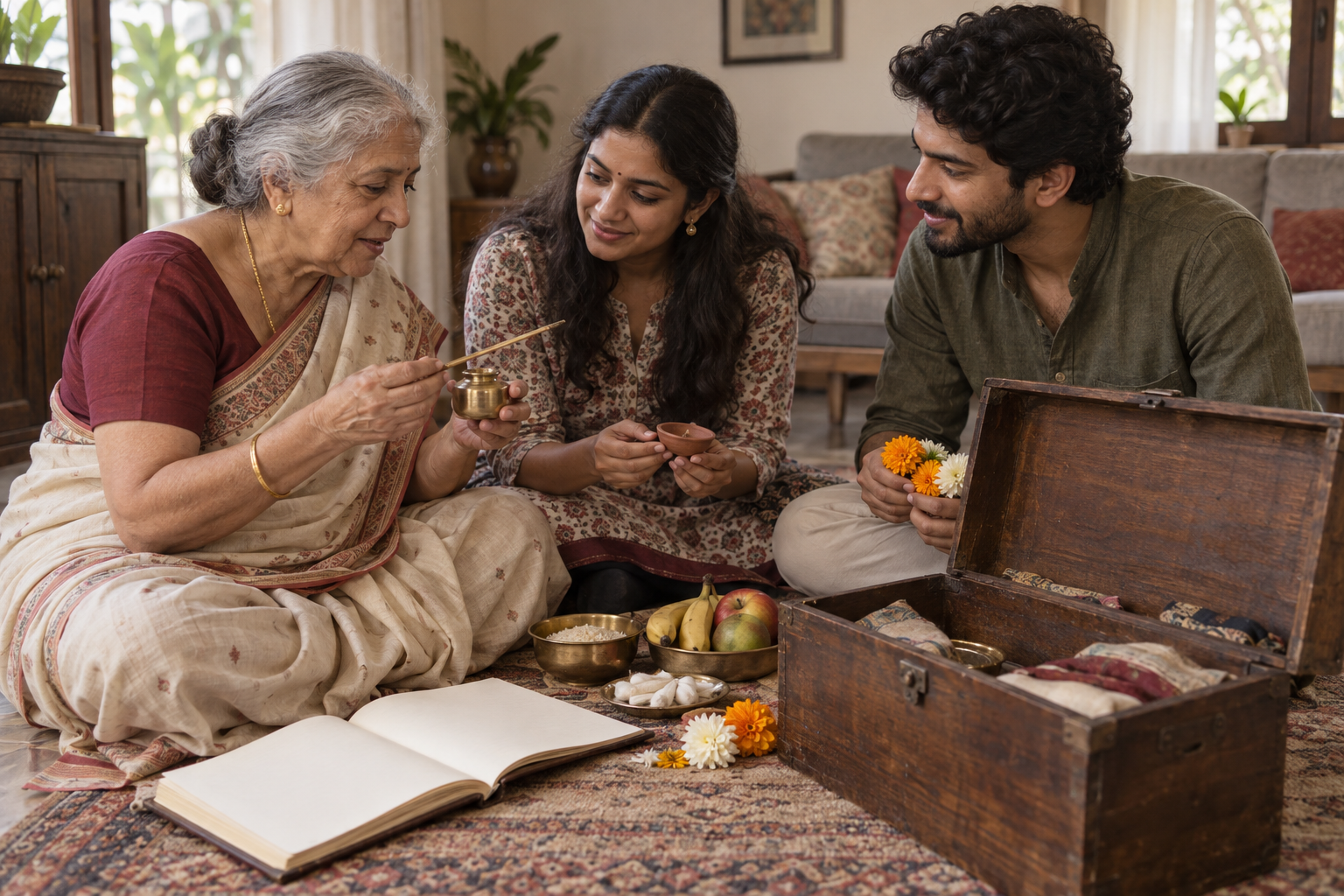
A date listing cannot tell you every item, mantra, or sequence used in your home. Those details may be carried through family and community practice. The reliable approach is to identify that practice first and assemble materials second.
Ask one knowledgeable relative or the person who normally leads the puja three precise questions: What do we call the observance? What must be ready before it begins? Which parts are performed together with, before, or after Bhai Dooj? These questions produce a usable plan; asking only “What should I buy?” does not.
- Choose the family reference point. Decide whose established practice you are following rather than combining several online lists.
- Write down the required materials. Use the list given for that practice. If an item is unfamiliar, ask what role it has before substituting something else.
- Record the sequence. A short numbered note is more useful during the puja than scattered messages from several relatives.
- Coordinate the shared date. Allow for both the Chitragupta observance and your household’s Bhai Dooj customs instead of treating one as an unexpected addition.
- Preserve what you learn. After the observance, correct the list while the details are fresh and save it with the family’s festival records for the following year.
If you are hosting
Tell guests which name your household uses and whether the gathering also includes Bhai Dooj customs. A clear invitation can be as simple as: “We will observe Chitragupta Puja, also called Dawat Puja, on November 11, together with our family’s Bhai Dooj observance.” Add the actual time only after it has been confirmed by the person leading the ceremony.
If you are attending
Use the host family’s preferred name and ask whether you should arrive for the entire gathering or a particular part. You do not need to demonstrate familiarity by guessing at regional customs. Respectful participation begins with letting the household explain how it keeps the day.
Key takeaways
- Chitragupta Puja and Dawat Puja are two names for the same observance.
- The occasion marks Chitragupta Jayanti and is mainly associated with Kayastha Hindu communities.
- In 2026, the observance falls on November 11.
- It is kept on Bhai Dooj, two days after Diwali, in the North Indian festival calendar.
- Yama Dwitiya, Bhai Phonta, Bhatru Dwitiya, and Bhai Tika are other names connected with the same day in different parts of India.
- The date is common, but the precise household schedule and ritual sequence should be confirmed within your family or community.
Your next step is straightforward: mark November 11, call the relative who knows your family’s practice, and write down the materials and sequence before the Diwali rush begins. One accurate family record will serve you better than several disconnected checklists.
References
- Hindu Pad – Diwali Chitragupta Puja | Chitragupta Jayanthi Pooja
- Hindu Pad – Chitragupta Puja 2026 | Dawat Puja

Leave a Reply
You must be logged in to post a comment.