
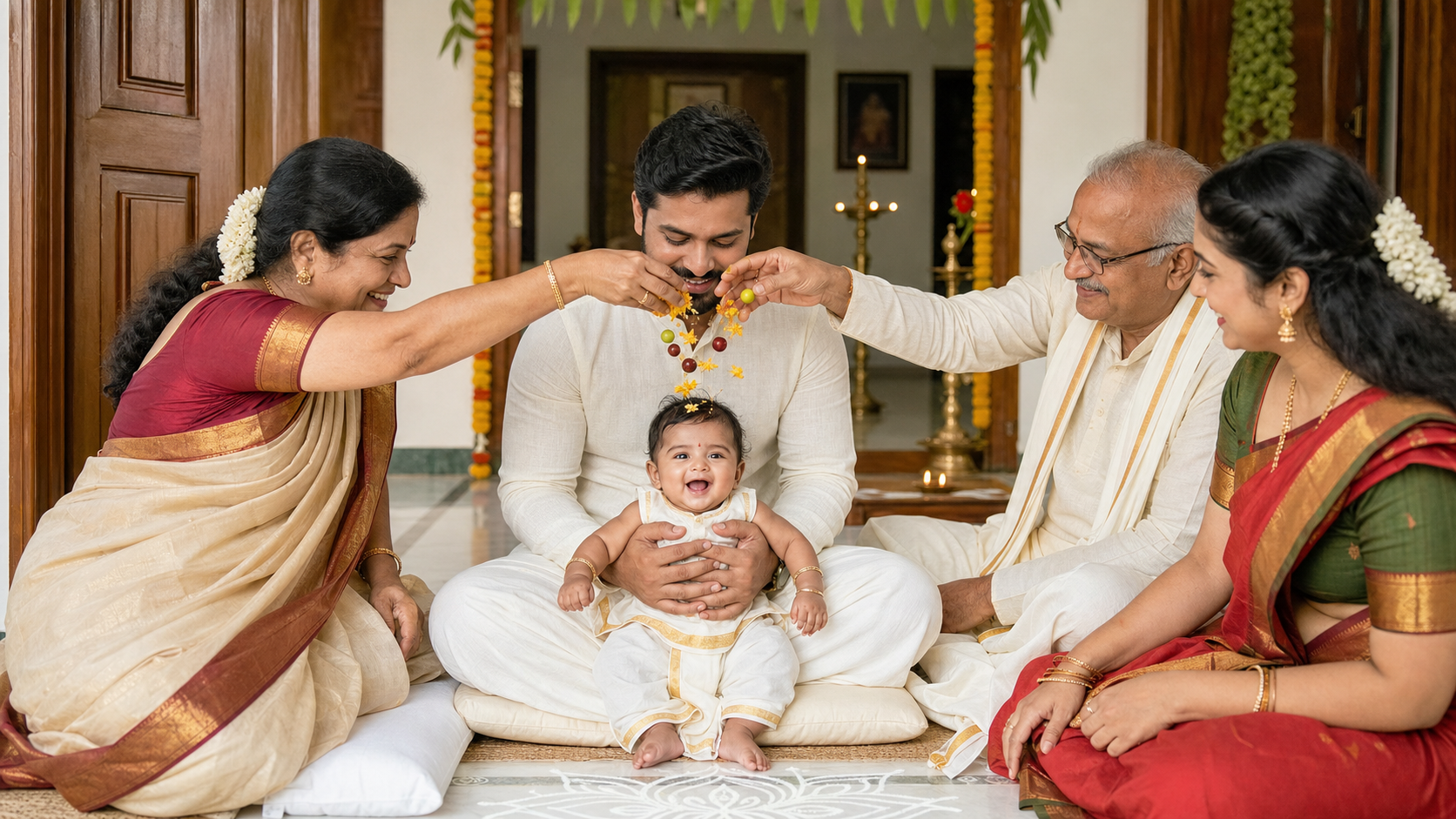
If you are arranging Bhogi Pandlu for a baby or young child in 2026, you need to settle two things separately: the festival date and the local muhurtham. Put 13 January on the family calendar, but do not circulate an exact hour copied from a Panchangam prepared for another city.
The observance can remain simple. A safe place for the child, the traditional fruit-and-flower mixture, and elders ready to offer sincere blessings matter more than an elaborate display.
Confirm the date first, then find your local muhurtham
In most regional almanacs, Bhogi falls on 13 January 2026 and Makara Sankranti follows on 14 January. Bhogi Pandlu is normally arranged during the morning of Bhogi, so 13 January is the date to reserve for the children’s blessing.
That does not create one universal clock time. A muhurtham depends on local sunrise, tithi and the coordinates used by the Panchang or Panchangam. A time calculated for Hyderabad should not automatically be transplanted to Visakhapatnam, Bengaluru, Toronto or another place. If your family is gathering away from its ancestral home, use the location where the ceremony will actually take place.
Before sending invitations, confirm the window through one trusted city-specific Panchangam, a local temple or the purohit who normally guides your family. If two calendars differ, do not combine the opening time from one with the closing time from another. Ask which almanac your temple or family follows and use that calculation consistently.
A clear message to relatives can simply say that Bhogi Pandlu will be held on the morning of 13 January and that the exact local muhurtham will follow. This prevents an uncertain internet timing from becoming a family commitment.
Bhogi Pandlu, also called Bhogi Pallu, is especially associated with Andhra Pradesh and Telangana. Related child-blessing customs may be observed in parts of Karnataka and Maharashtra around Ratha Saptami or even the Holi season. If branches of your family remember different dates, first identify which regional custom each branch is following. A related practice is not necessarily the same observance with a mistaken calendar.
Prepare a ritual thali that is meaningful and child-safe
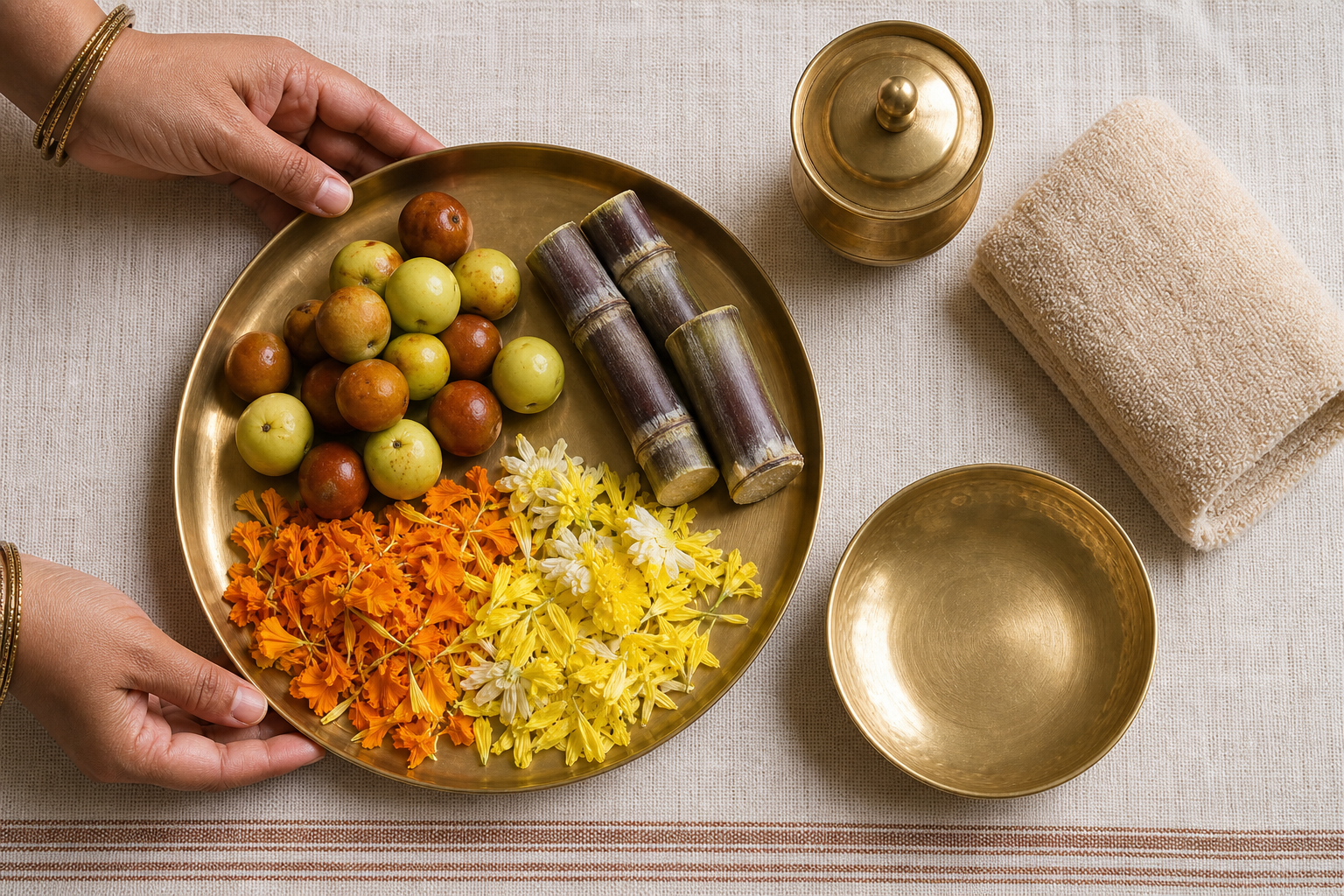
Choose a clean space where elders can approach without crowding the child. An east-facing arrangement is customary in many homes. Place a small lamp, turmeric, kumkum and the Bhogi Pandlu mixture on a thali. If your household has an inherited arrangement, preserve it instead of replacing it with a decorative version seen elsewhere.
The customary mixture brings the harvest and the family’s hopes into one visible blessing:
- Regi pallu: Ber, or Indian jujube, represents seasonal abundance and gives the observance its familiar Telugu name.
- Pieces of sugarcane: These carry the sweetness and plenty of the harvest season.
- Akshata: Turmeric-blessed rice signifies sanctity, continuity and an auspicious family life.
- Flower petals: Flowers express purity, freshness and joy without making the shower heavy for a small child.
- Small coins: Coins embody the elders’ wish for the child’s future stability and prosperity.
These ingredients should be handled as ritual objects, not as loose toys. Coins, firm fruits and sugarcane pieces can enter a baby’s mouth. Keep an adult within reach throughout the shower and clear the mixture as soon as the blessing ends. If the child has a known sensitivity to a fruit, flower, turmeric or another ingredient, omit the irritant and ask a family elder or priest about an appropriate symbolic alternative.
Make the mixture light enough to fall gently. A large heap is unnecessary and can frighten an infant. The regi pallu, sugarcane, akshata, flowers and coins each carry a distinct blessing; their meaning is not increased by quantity.
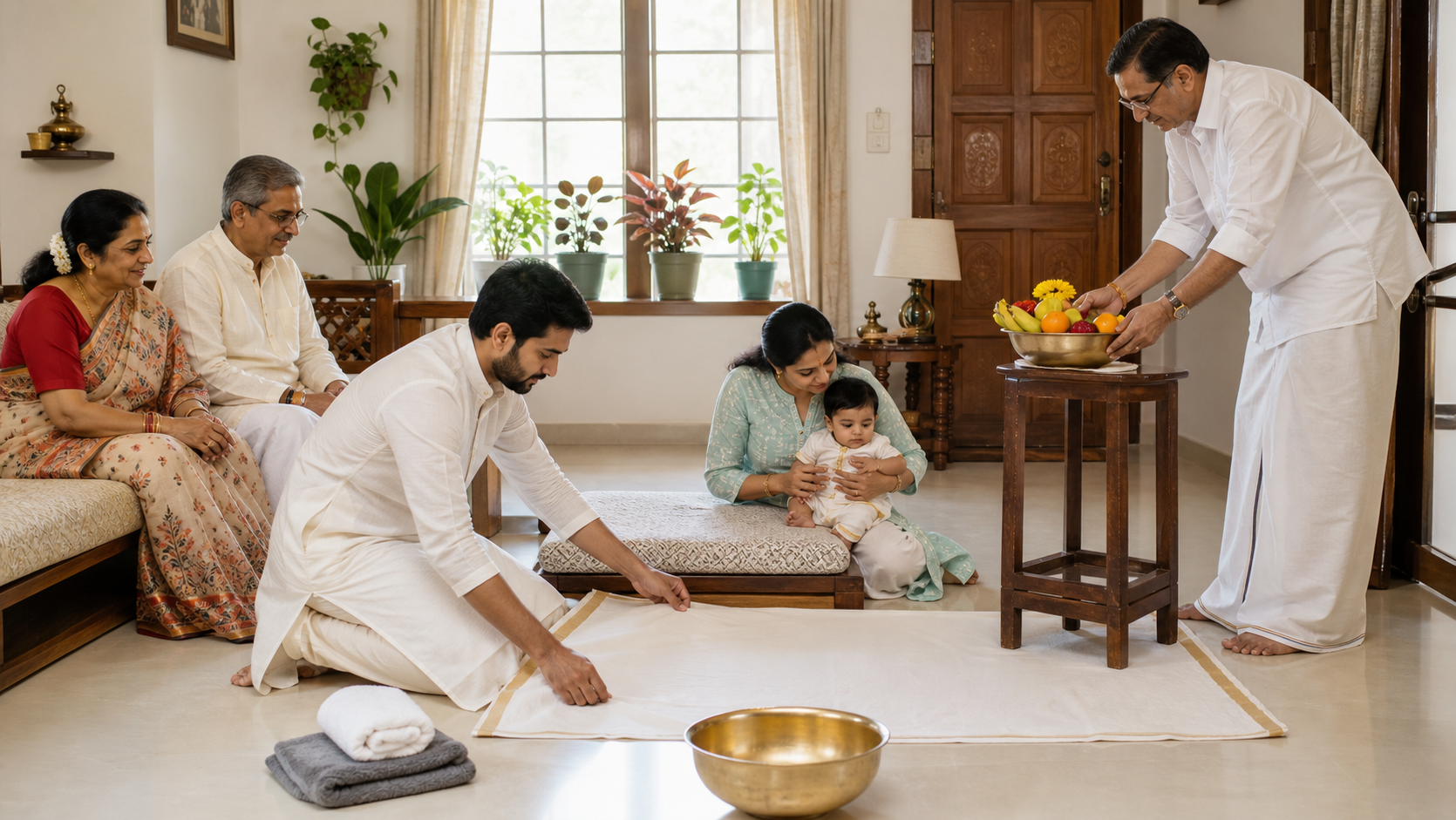
Assign the practical roles before the muhurtham begins:
- One parent or familiar caregiver holds or sits beside the child.
- An elder leads the blessing and showers the mixture.
- Another adult manages the lamp and arati plate.
- A fourth person, if available, collects coins and hard pieces immediately afterward.
This small division of responsibility prevents the familiar moment when every adult reaches for a photograph while no one is watching what the child has picked up.
Perform Bhogi Pandlu as a blessing, not a performance
The household sequence can follow your sampradaya without becoming complicated. Where the family has inherited prayers, songs or a particular form of drishti nivarana, retain them. Where it has not, elders can offer short, intelligible blessings for āyu, ārogya and aiśvarya: longevity, health and prosperity.
- Prepare the threshold and ritual place. Complete the muggulu, arrange the thali and remove unnecessary clutter before bringing in the child.
- Keep the child comfortable. Dress the child warmly for the winter morning and seat an infant securely with a parent or trusted caregiver.
- Light the lamp safely. Place it beyond the child’s reach. Let one adult remain responsible for the flame rather than passing that duty around.
- Begin with the family’s prayer. Elders may invoke the household’s chosen deity, sing a traditional song or state the blessing in their own words according to family practice.
- Shower the mixture gently. Let the fruit, petals, akshata and coins fall lightly over and around the child. Pause if the child becomes distressed; completing a display is never more important than the child’s well-being.
- Offer arati and remove drishti. Follow the family’s customary form while maintaining a safe distance between the flame and the child.
- Speak the blessings clearly. Let elders pray specifically for a long life, sound health, good character, stability and flourishing.
- Clear and distribute. Remove coins and hard pieces promptly. Share suitable seasonal fruit and sweets with relatives, neighbours or others in the community rather than allowing the materials to become waste.
The ritual’s symbolism becomes clearest when the child can hear the elders and the family can attend to what is being offered. Regi pallu and sugarcane place the household within the agricultural season. Akshata carries continuity. Flowers bring purity and delight. Coins turn prosperity into a blessing for the child’s future rather than a display of present wealth.
Bhogi Mantalu and muggulu belong to the wider atmosphere of Bhogi. The bonfire represents leaving behind what is worn out and opening the household to renewal, while the decorated threshold welcomes auspiciousness. Keep the bonfire physically separate from the children’s ceremony. Open flames require a designated adult, clear space and close supervision; they should not become a background prop beside an infant.
Choose natural, reusable or compostable materials where possible. Flower petals and seasonal produce serve the ritual without plastic confetti or disposable ornament. Extending the celebration through dana can be equally concrete: share usable fruit and sweets with neighbours, visiting relatives or a community kitchen.
At its best, Bhogi Pandlu transmits dharma without a lecture. A child receives the tenderness of elders. The family acknowledges the harvest and the natural cycle. Younger relatives see that prosperity is something to bless, share and handle responsibly. That intergenerational encounter is the heart of the observance.
Four practical questions to settle before Bhogi morning
Is Bhogi Pandlu on 13 or 14 January in 2026?
Plan the children’s Bhogi Pandlu ceremony for Bhogi on 13 January 2026. Makara Sankranti follows on 14 January in most regional almanacs. The two dates belong to the same festive period, but they are not interchangeable for planning this ritual.
What is the exact Bhogi Pandlu muhurtham?
The supported guidance is a morning observance on 13 January, not one clock time for every location. Confirm the exact window for the city where the ritual will occur through a trusted local Panchangam, temple or purohit. If you cannot verify a city-specific calculation, do not present an online time as universally authoritative.
Are Bhogi Pandlu and Bhogi Pallu different rituals?
No distinction is needed for ordinary family planning: the two names refer to the same Telugu children’s blessing observance. Family vocabulary, pronunciation and the precise composition of the mixture can vary.
Which children should receive the blessing?
The custom is centred on infants and young children. Families may differ about when a child has outgrown the observance, so follow your inherited practice rather than inventing a universal age cutoff. Safety should be adjusted to the child’s stage: an infant needs secure holding and immediate removal of coins and hard fruit, while an older child can participate more actively under supervision.
Before the invitations go out, lock in the local Panchangam, identify the adult responsible for the lamp, and prepare a mixture suited to the child in front of you. Once those decisions are made, stop chasing conflicting timings and let the ceremony do its proper work: gathering the family around a clear, affectionate and dharmic blessing.
References
