
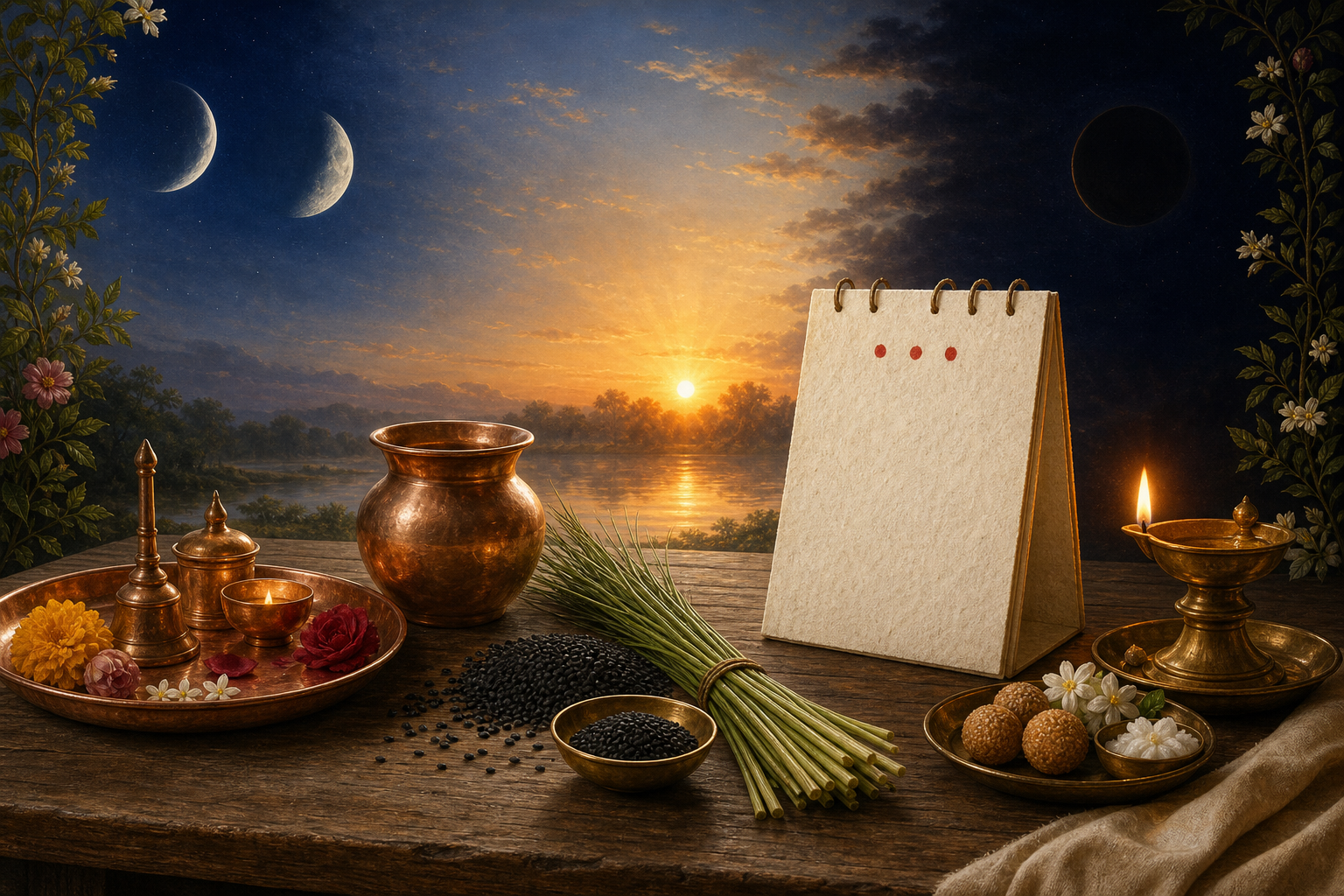
You have three different kinds of observance to plan in January 2026: a tithi change during the day, a solar transition with its own sacred window, and an Amavasya whose practice changes by region and family tradition. Putting all three into an ordinary date-only calendar is where confusion begins.
The workable approach is to mark the civil date now, verify the local Panchang time shortly before the observance, and keep the ritual method separate from both. Your regional calendar may contain additional vratas and festivals; retain those while using the three dates below as firm planning anchors.
Start with three dates, but do not stop at the dates
A Panchang does not divide time at midnight in the way a civil calendar does. A tithi can change at midday, while a Sankramana is tied to the Sun’s entry into a rashi. The date tells you when to pay attention; the local calculation tells you when to act.
| Date | Panchang marker | What you should plan |
|---|---|---|
| Sunday, January 11 | Krishna Paksha Ashtami until 12:15 PM, followed by Navami | Complete any Ashtami-specific practice before the locally verified boundary. Use Navami in a sankalpa made after the transition. |
| January 14 | Makara Ravi Sankramanam and Uttarayana Punyakalam | Obtain the Sankramana and punya-kala timings for your city before arranging Tharpana. |
| Sunday, January 18 | Amavasya, observed as Magh Amavasya in North Indian reckoning | Confirm the local Amavasya-tithi window, then plan snan, daan, prayer, and any customary ancestral offering. |
Treat every displayed clock time as location-dependent. Longitude, latitude, local sunrise, and time zone matter. If you are travelling, calculate for the place where you will perform the observance rather than for your home city. A screenshot saved months earlier is not enough unless its city and time zone match your actual location.
January 11: handle the Ashtami-to-Navami boundary deliberately
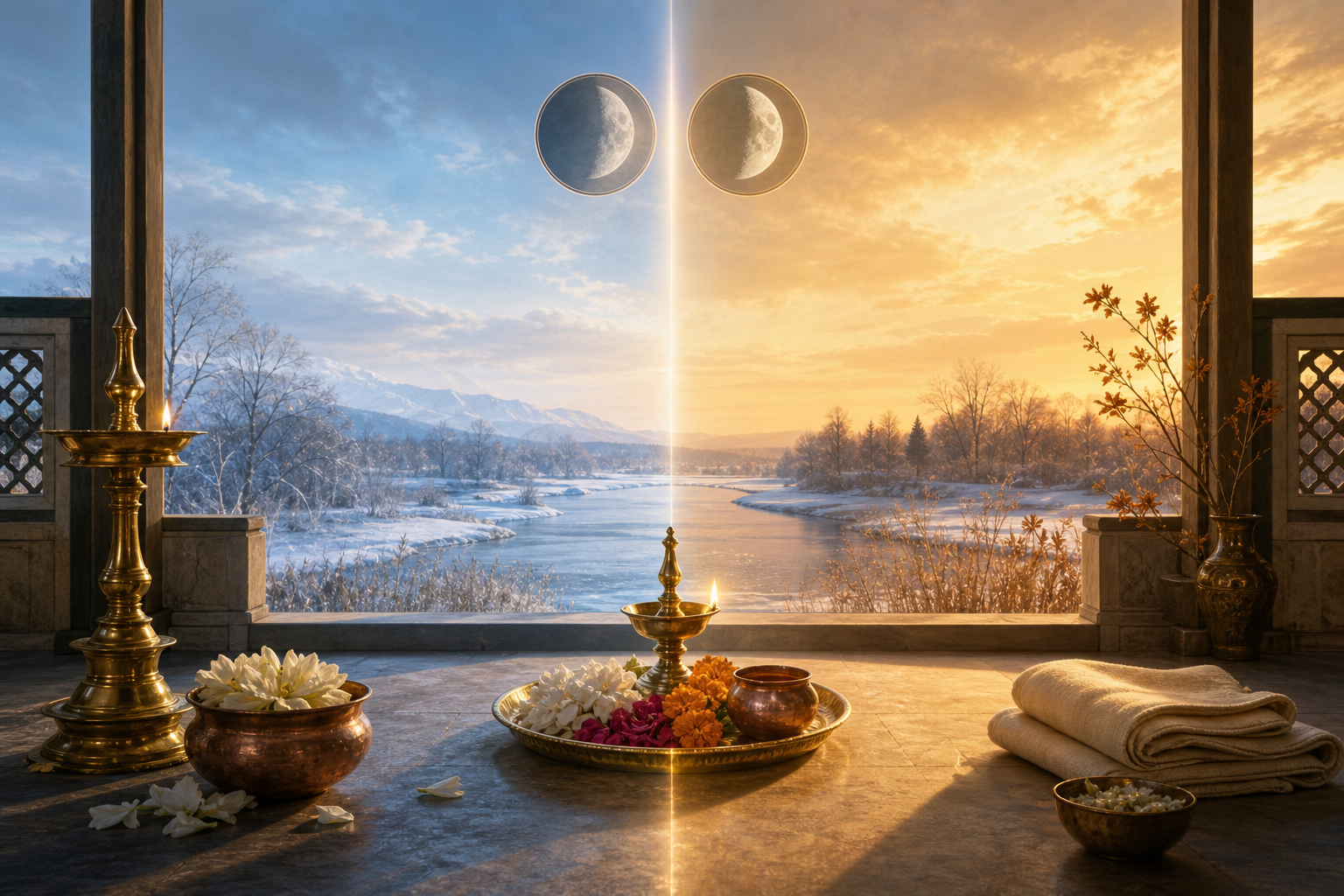
The important feature of January 11 is not simply that both tithis touch the same civil day. It is the sequence: Krishna Paksha Ashtami prevails until 12:15 PM, and Navami follows. Because Panchang times can shift with location, use 12:15 PM as the stated reference rather than an automatic worldwide deadline.
If your vrata, puja, or sankalpa specifically requires Ashtami, the safe planning choice is to finish it before the locally listed Ashtami end time. Do not begin at the boundary itself. Leave enough room for the whole practice, including sankalpa and concluding prayer, instead of assuming that starting before the transition is always sufficient.
- On the evening of January 10, open a trusted Panchang set to the city where you will be on January 11.
- Check the local sunrise, the prevailing tithi at the time of worship, and the precise Ashtami end time.
- If the practice is Ashtami-specific, place it comfortably before that boundary. The forenoon is the practical window indicated by the stated schedule, subject to local verification.
- If you begin after the transition, treat Navami as the prevailing tithi rather than repeating the morning’s Panchang entry.
- Check Nakshatra and Rashi separately if your intended activity depends on them; neither should be inferred from the tithi alone.
A tithi boundary is also not a universal shubh muhurta. It tells you which lunar day prevails, not whether every undertaking is auspicious at that moment. For a wedding decision, major purchase, journey, or other muhurta-sensitive undertaking, use the city-specific combination prescribed by your tradition rather than turning the 12:15 PM transition into a general rule.
If you have no Ashtami-specific vrata, you do not need to manufacture one merely because the boundary is notable. A steady daily puja, japa, or period of quiet dhyana can acknowledge the waning fortnight without adding a ritual your household does not follow.
January 14: plan Uttarayana Tharpana around Sankramana
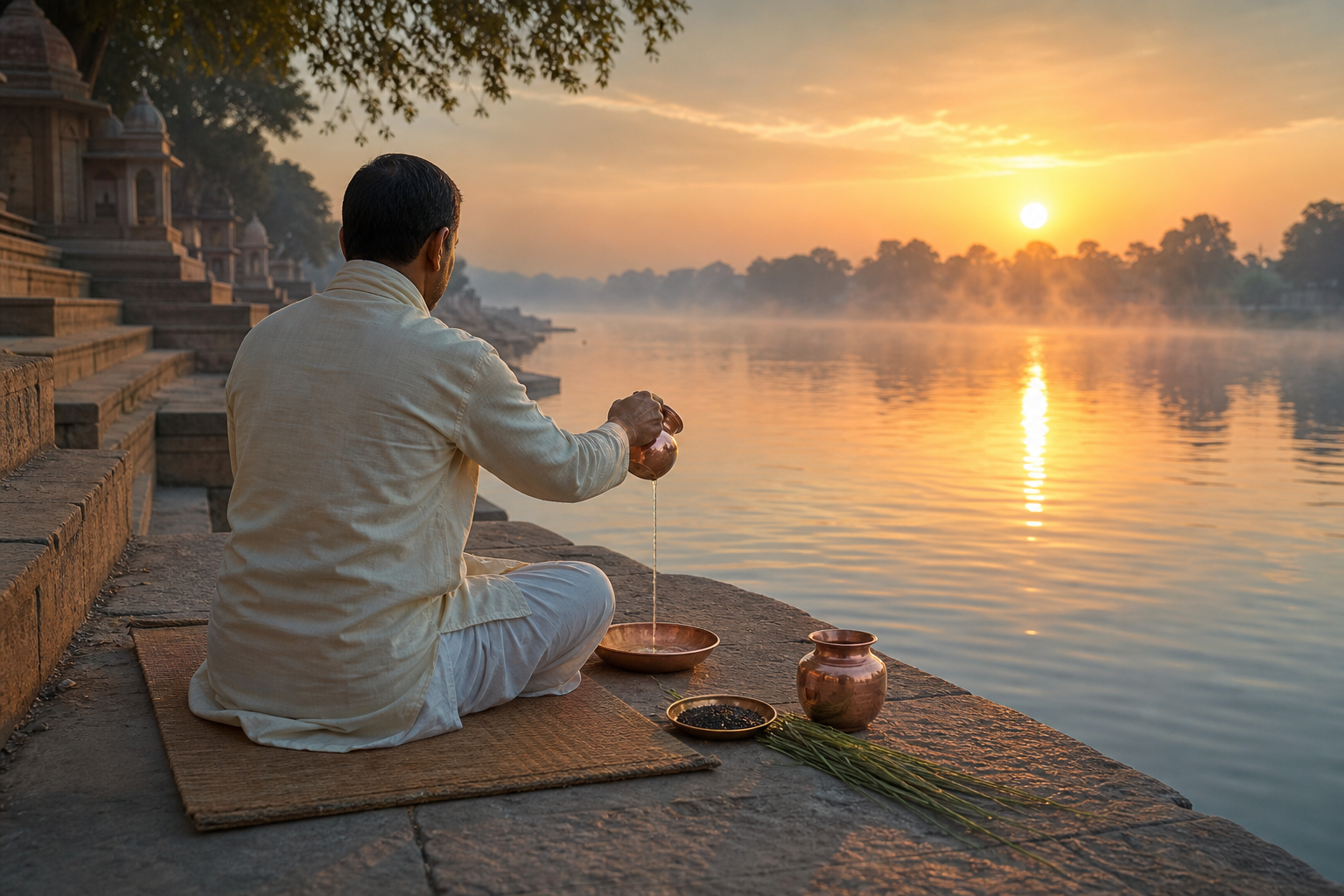
January 14 requires a different calculation. Makara Ravi Sankramanam is the Sun’s transition into Makara, traditionally associated with the commencement of Uttarayana. The sacred window is therefore linked to the local Sankramana calculation. Do not assume that any convenient hour from sunrise to sunset carries the same ritual weight.
For households that perform Uttarayana Punyakalam Tharpana, the preparation has two distinct parts. First comes the local timing. Second comes the inherited procedure: materials, posture, sequence, mantras, and the form of ancestral remembrance used by your family or sampradaya. Accuracy in one does not repair improvisation in the other.
The commonly cited calendrical opening for the day is Viswavasu nama samvathsare, Utharayane, hemantha rithou, Makara mase, Krishna pakshe, adhya […]. It identifies the named year, Uttarayana, Hemanta season, Makara month, and Krishna Paksha. The bracketed ending shows that this is a scaffold, not a complete universal sankalpa. Do not read the brackets aloud or guess the missing calendrical and personal elements.
- By January 13, obtain the Makara Sankramana time and recommended punya-kala window for your city.
- Confirm whether your household performs Tharpana on this occasion and which family or sampradaya procedure applies.
- Write or print the complete sankalpa exactly as it is to be recited. Preserve the inherited non-English wording rather than silently modernising or mixing transliterations.
- Arrange the required place, water, and customary materials before the sacred window begins.
- Keep the observance calm and uninterrupted. Complete it within the recommended local window rather than spending that period searching for missing instructions.
If you do not know your family’s Tharpana method, ask a knowledgeable elder, purohit, or temple connected with your tradition before January 14. Until the procedure is clear, prayer, gratitude toward one’s lineage, disciplined conduct, and an act of service are more responsible than assembling an ancestral rite from disconnected online fragments.
The practical meaning of Uttarayana is also larger than one recitation. Use the transition for a restrained sankalpa you can actually keep: a regular period of japa, a duty toward parents or elders, support for someone in need, or a neglected obligation brought back into order. Sacred resolve becomes meaningful through repetition after the punya-kala has passed.
January 18: let regional practice shape Amavasya

Amavasya falls on Sunday, January 18, 2026. The same new-moon tithi carries different calendar and ritual emphasis across Bharat, so the name used in one region should not be treated as the only correct name everywhere.
- In North Indian reckoning, the observance is Magh Amavasya, with emphasis on sacred snan, daan, restraint, and inward reflection.
- In Maharashtra, Gujarat, Telangana, Andhra Pradesh, and Karnataka, Amavasyant reckoning makes this the close of the lunar month.
- In Tamil usage, Amavasai commonly places particular emphasis on pitru tarpan and quiet family worship.
These are not rival descriptions of the day. They show how a common lunar marker enters different regional calendars and inherited practices. Follow the custom of your family and place. If you live away from your ancestral region, tell the temple or priest which tradition you follow rather than assuming the local public programme automatically matches it.
A simple household observance can be planned without turning the day into a complicated production:
- On the evening of January 17, verify the Amavasya start and end times for your city.
- Bathe early where feasible and begin with a clear sankalpa or simple prayer. A home bath is the sensible choice when travel to sacred water is impractical or unsafe.
- Offer worship according to your household tradition. Shiva worship, remembrance of the ishta-devata, mantra-japa, silence, and meditation are suitable forms where customary.
- Perform pitru tarpan only according to the method your family follows. The emotional importance of ancestral remembrance is not a reason to invent procedural details.
- Choose a concrete act of daan or seva: offer food, support a community kitchen, or assist a person whose need you can identify.
- Keep food and conduct sattvic and restrained. If a formal fast is not part of your practice or circumstances, do not present an improvised fast as a universal requirement.
- Light a deepa in the evening and close the day quietly, with gratitude rather than a new list of wishes.
Pre-dawn snan, ancestral rites, Shiva worship, and the Amavasyant month ending are specifically Hindu observances. Their broader Dharmic resonance lies in self-discipline, compassion, gratitude, and seva. That kinship does not mean Buddhism, Jainism, Sikhism, and every Hindu sampradaya perform the same rite or use the Panchang in an identical way. Unity is better served by respecting real distinctions than by flattening them.
Key takeaways for your January Panchang
- Mark January 11, 14, and 18 now, but attach local timings only after checking a city-specific Panchang.
- On January 11, a tithi boundary separates Ashtami practice from Navami practice; it is not automatically a general auspicious muhurta.
- On January 14, use the local Makara Sankramana and punya-kala window for Uttarayana Tharpana.
- Treat the stated Uttarayana sankalpa line as incomplete until the missing elements have been supplied according to your tradition.
- On January 18, let regional and family custom determine whether the emphasis falls on Magh snan and daan, an Amavasyant month ending, Amavasai tarpan, or a simpler household observance.
- When exact ritual knowledge is unavailable, choose sincere prayer, japa, restraint, daan, and seva instead of improvised complexity.
Set three reminders now: the evenings of January 10, January 13, and January 17. At each reminder, write down the city, time zone, relevant tithi or Sankramana window, and the practice you intend to complete. If you need help from an elder, temple, or purohit, arrange it before the sacred window begins. That small discipline will make January’s observances quieter, clearer, and more faithful to the living tradition you actually follow.
References
- DharmaRenaissance Blog – Amavasya January 2026: Exact Date, Sacred Timings Guidance, and Regional Traditions
- DharmaRenaissance Blog – Uttarayana Punyakalam Tharpana, 14 Jan 2026: Exact Sankalpa, Auspicious Timings, and Significance
- DharmaRenaissance Blog – Jan 11, 2026 Panchang: Ashtami to Navami Timings, Auspicious Moments, Nakshatra and Rashi Guide
