
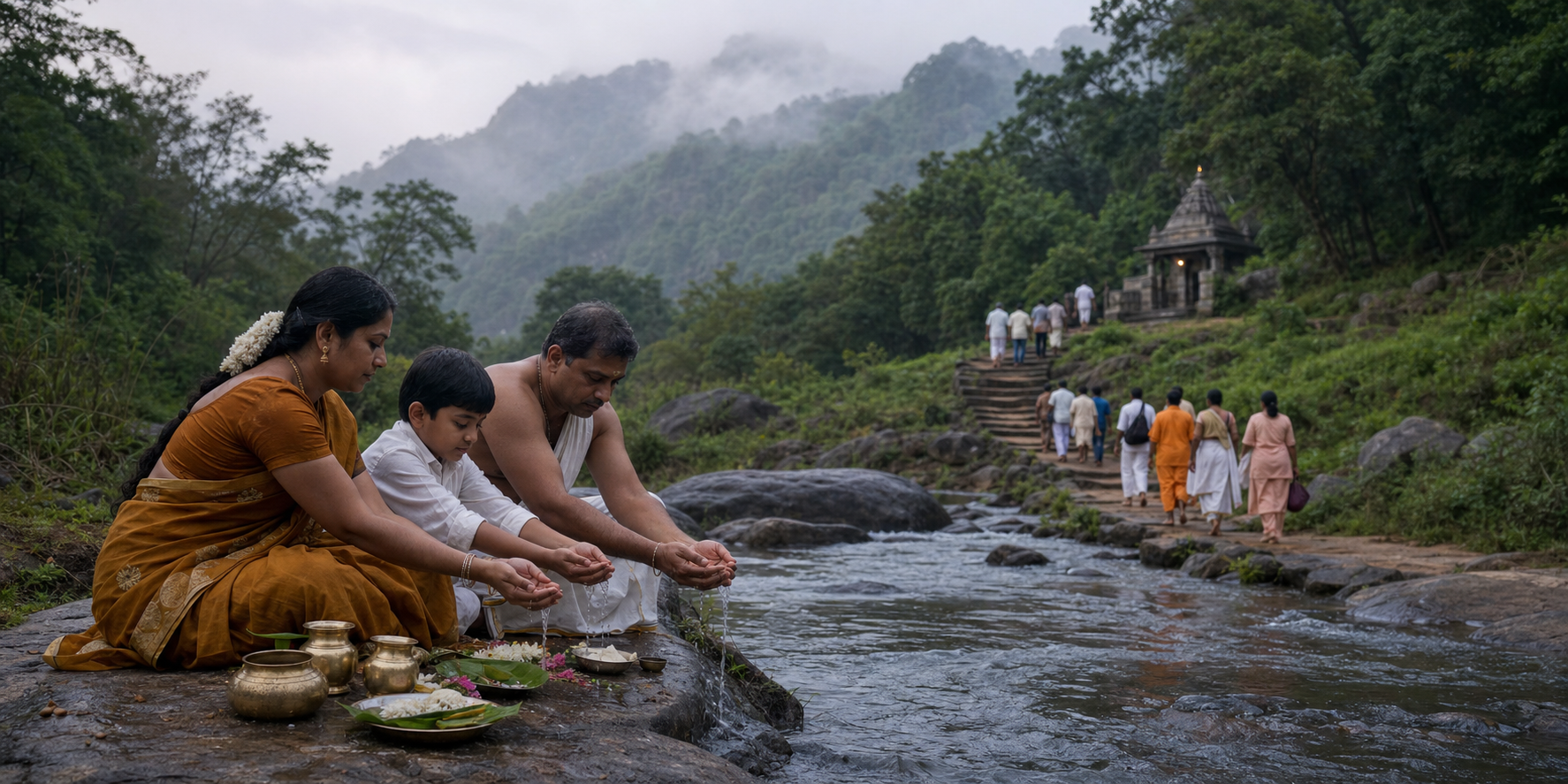
Aadi Amavasai on Wednesday, 12 August 2026 brings together two related but distinct practices: remembrance of departed ancestors and pilgrimage to the Shiva shrines of Sathuragiri. The supplied reports agree on the principal date, while their differences over panchanga details and forest access show why ritual timing, family procedure and travel authorization must be checked separately.
This synthesis explains what can be established from the reports, where their details vary, and how a devotee can prepare without treating a generic mantra, an Indian clock time or an older festival schedule as universal guidance.
Key takeaways
- All four reports identify Wednesday, 12 August 2026 as Aadi Amavasai; the two pilgrimage guides also identify it as Aadi 27.
- The reports place the start of Amavasya at approximately 1:52 a.m. IST. Several calculations end it near 11:06 p.m., while one pilgrimage report records an alternative published ending of 11:16 p.m.
- For the cited Chennai calculation, Pushya Nakshatra lasts until approximately 7:59 or 8:00 a.m., after which Ashlesha applies. The sankalpa should name the nakshatra prevailing when it is actually made.
- Tharpana, shraddha and sankalpa procedures vary by lineage, Vedic affiliation and family tradition. An online formula should not displace inherited guidance.
- The reports do not establish a final August 2026 forest-entry schedule for Sathuragiri. Festival dates and trekking authorization are separate matters.
One observance, three clocks to keep separate
Aadi Amavasai is not a different lunar event from Karkidaka Vavu, Shravana Amavasya or Ashadha Amavasya. The two ritual reports explain that these names arise from different calendrical systems. A purnimanta calendar places the waning fortnight within Shravana, whereas an amanta calendar treats the same new moon as the conclusion of Ashadha. Tamil and Malayalam usage instead emphasizes the solar months of Aadi and Karkidakam.
The distinction matters because a civil date, a lunar tithi and an administrative entry period answer different questions. A tithi is determined by the changing angular separation of the Sun and Moon, so it does not necessarily begin at midnight. Ritual practice may also be organized around local sunrise, while the forest authorities can impose an entirely separate checkpoint timetable.
| Question | Source-reported answer | Practical meaning |
|---|---|---|
| What is the principal date? | All four reports identify Wednesday, 12 August 2026. | This is the common festival date reported for India. |
| What is the Tamil calendar date? | The pilgrimage reports identify Aadi 27 and place Aadi in 2026 between 17 July and 17 August. | The solar month explains the name Aadi Amavasai. |
| When does Amavasya prevail? | The cited Indian calculations begin near 1:52 a.m. IST. The ritual guides and a Vellore calculation end near 11:06 p.m.; one pilgrimage guide also records a published 11:16 p.m. ending. | A local customary panchangam should govern precision-sensitive rites. |
| Which nakshatra applies? | The Chennai references place Pushya until approximately 7:59 or 8:00 a.m., followed by Ashlesha. | The actual time of sankalpa determines the wording. |
The first ritual guide also discusses a displayed ending of 1:07 p.m. and treats it as a likely missing-digit error because the Indian calculations it compared placed the transition near 11:06 p.m. That assessment is reported by the guide rather than independently established here. More broadly, small differences between almanacs can reflect location, astronomical method and rounding; a diaspora household should therefore calculate the observance for the place where the rite is performed instead of mechanically converting an Indian time.
A reliable rite starts with inherited procedure
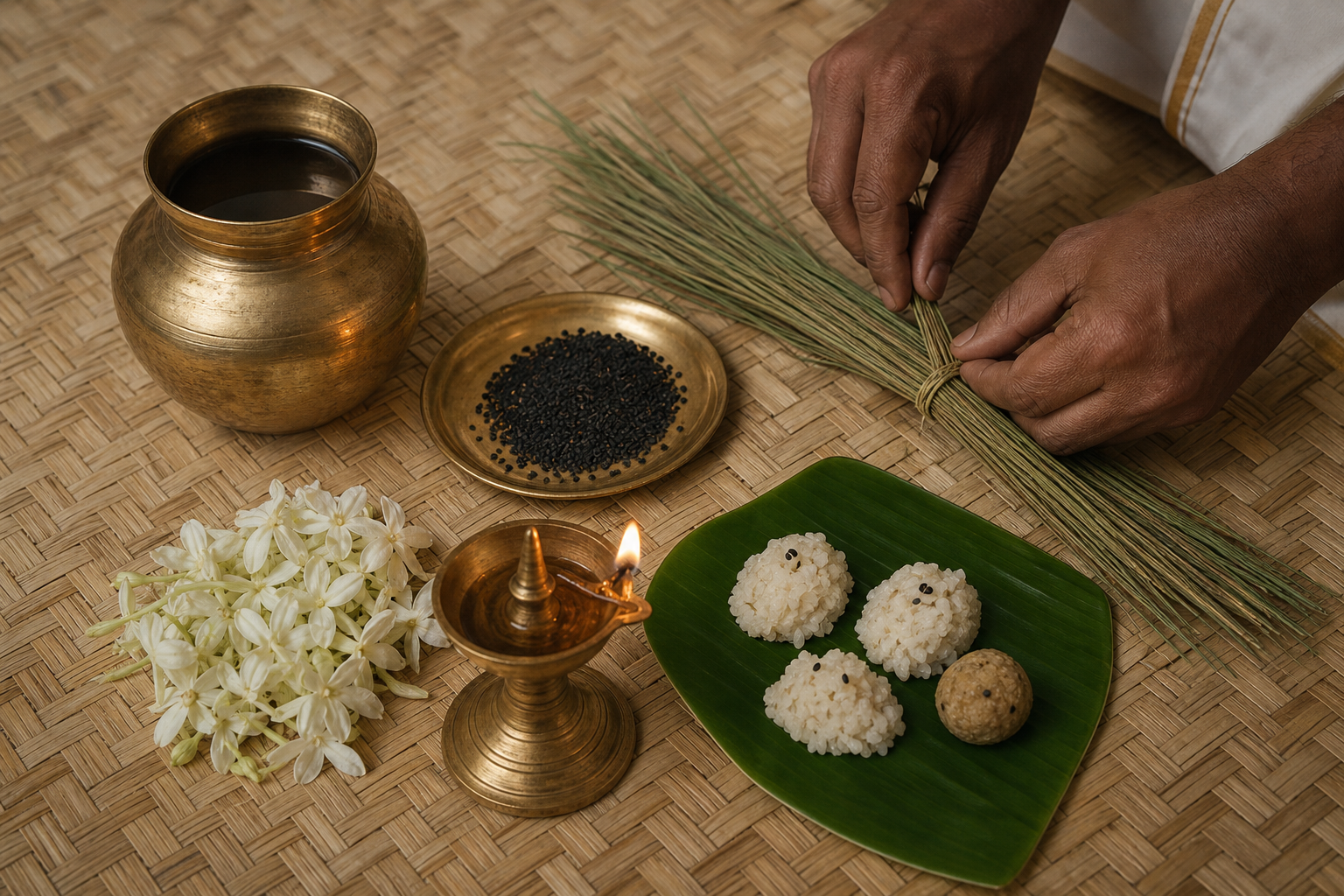
Across the sources, the stable principle is gratitude toward previous generations, often expressed through the concept of Pitru Rina. Water, black sesame and darbha or kusha grass appear in many forms of ancestral offering, but the reports repeatedly caution that recipients, mantras, hand positions, sacred-thread placement, eligibility and sequence can differ by family and sampradaya. Tila tharpana, Darsha Shraddha and more elaborate shraddha observances should not be treated as interchangeable merely because they occur on the same tithi.
A sankalpa formally locates the intended act in time, place, lineage and purpose. The supplied guides associate the 2026 observance with the year name Parabhava, Dakshinayana, the source-aligned season Greeshma, Kadaka month, Krishna Paksha and Amavasya. Parabhava is an important correction: both ritual discussions warn against copying the preceding year name, Viswavasu, from a 2025 text.
The reports also demonstrate why complete phrases should not be assembled from fragments. One preserves Saumya vasara in its source passage, while the other uses Budha vasara in a working framework; both relate the observance to Wednesday. One uses generic expressions for yoga and karana, while the other reports explicit Chennai transitions involving Vyatipata and Variyana Yoga and Chatushpada and Nagava Karana. These variations are a reason to follow a complete inherited form, not an invitation to combine whichever terms appear online.
The same discipline applies to Pushya and Ashlesha. A slash between their names is an editorial choice, not normally an instruction to pronounce both. Under the reported Chennai calculation, a sankalpa made before the transition uses Pushya, while one made afterward uses Ashlesha. Near the boundary, a precise local panchanga or qualified priest is more reliable than a rounded web display.
Most importantly, the resolve should name the rite actually being undertaken. A person following an abbreviated household observance should not declare a different or more elaborate ceremony. The pilgrimage guides add that those unable to travel may still observe the day through practices recognized in their tradition, including prayer, remembrance, food offered reverently or charity. The reports present sincerity and continuity of practice as more meaningful than borrowing an unfamiliar sequence.
What Sathuragiri adds to ancestral remembrance
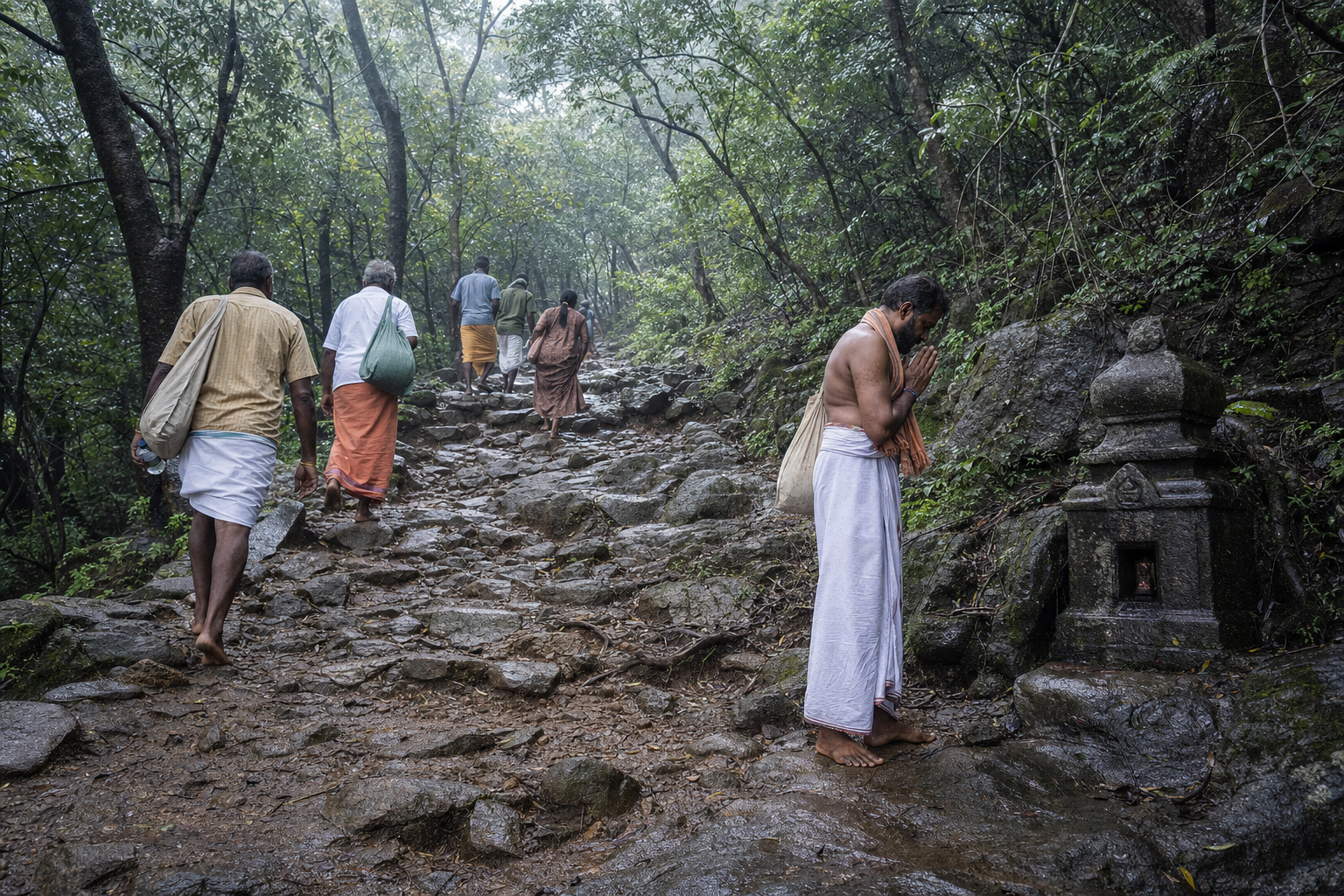
At Sathuragiri, the domestic and ancestral emphasis of Aadi Amavasai meets Shaiva temple worship and a demanding hill ascent. The reports describe the pilgrimage as an embodied discipline in which memory, darshan and mutual assistance converge. That connection does not make the trek a universal substitute for a family’s ancestral rite; it gives the observance a distinctive sacred setting for those who undertake it.
The hill complex is centred on Sri Sundara Mahalingam Swamy Temple and Sri Sandhana Mahalingam Swamy Temple, with the latter also transliterated as Santhana Mahalingam. The reports also place an Anandavalli Amman shrine behind the Sundara Mahalingam temple. Local tradition regards the principal lingams as self-manifested, while Sathuragiri is popularly honoured as Siddargal boomi, the land of Siddhas. Belief in the spiritual presence of eighteen Siddhas belongs to the devotional understanding of the landscape and is presented by the sources as tradition, not scientific or archaeological proof.
Two explanations of the name Sathuragiri appear across the pilgrimage reports. One associates it with four surrounding hills or a square-like arrangement; another connects the place with the meeting of the four Vedas. These accounts can be read as complementary expressions of sacred geography without turning either into a demonstrated historical etymology.
The usual public approach begins at Thaniparai, near Vathirairuppu or Watrap. The reports explain apparently inconsistent district references by noting that the foothill approach is on the Virudhunagar side, while the temple enclosure and parts of the Saptur forest are associated with Madurai district. The Complete Sundara Mahalingam guide cites a 2024 Madras High Court judgment as requiring coordination between the two administrations. For pilgrims, the practical implication is that relevant notices may come from either district as well as from the Forest Department and temple administration.
Forest access is separate from the festival calendar
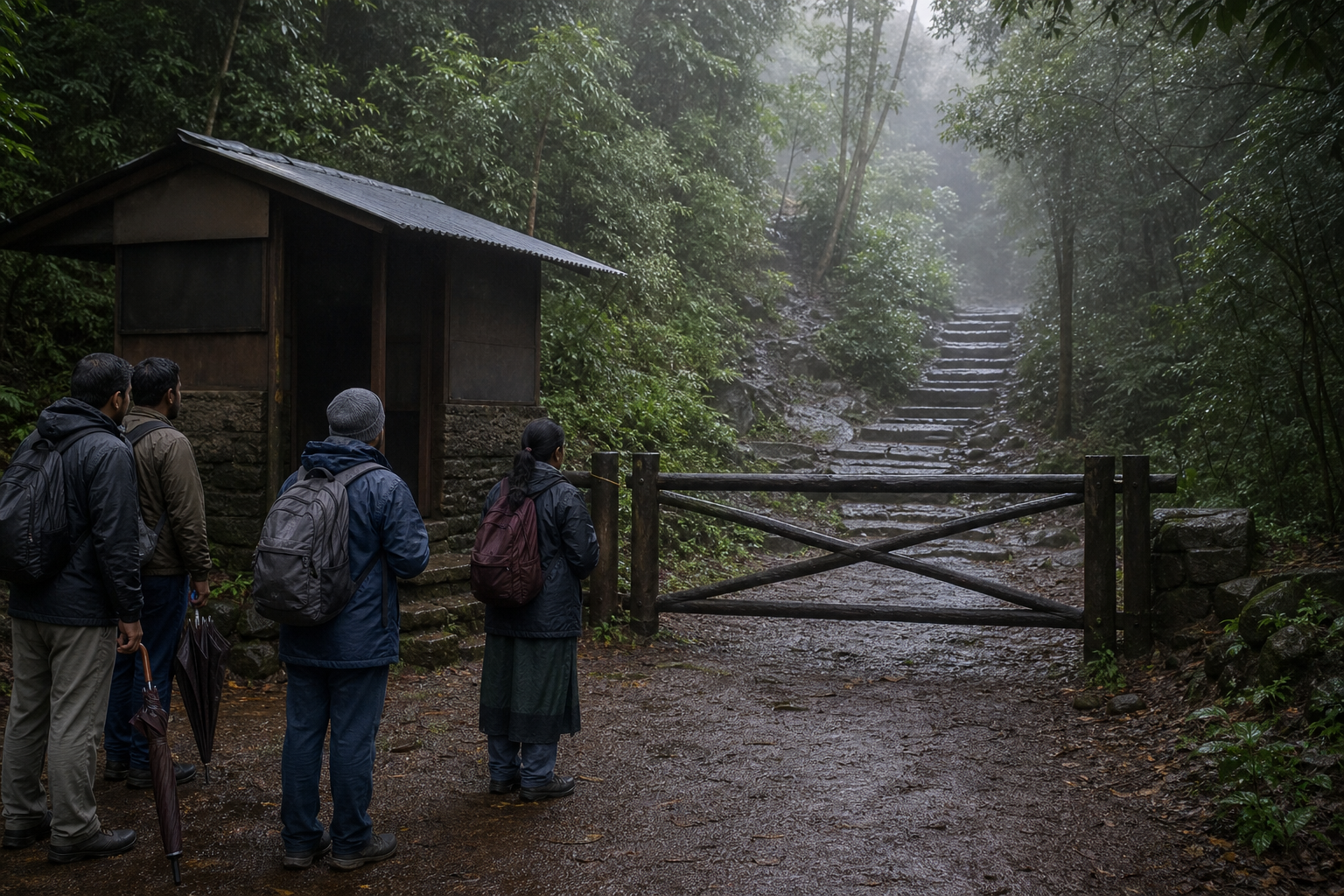
The strongest point of agreement in the pilgrimage reporting is that an extended religious festival does not authorize unrestricted trekking. Older descriptions of a roughly ten-day Aadi celebration cannot be used as current entry permission. The temple programme, the principal Amavasai date and the days on which the public may enter protected forest are controlled through different processes.
The Complete Sundara Mahalingam guide cites public reporting dated 22 June 2026 that daily climbing had been discontinued and a limited monthly system restored. Under that reported framework, admission ordinarily covered eight days per month: four associated with the new-moon period and four with the full-moon period. The Essential Sacred Trek guide, however, states that as of 15 July 2026 it did not regard any secondary website’s proposed August window as final government authorization. Read together, the reports support a limited-access expectation but not a confirmed Aadi Amavasai timetable.
The preceding Aani Amavasai period illustrates how specific a notice can be without predicting August. According to the Complete Sundara Mahalingam guide, climbing was permitted from 12 to 15 July, generally between 6:00 a.m. and noon, with a shorter 6:00 a.m. to 10:00 a.m. window on the final day. The same report says rain could cancel entry and notes prohibitions on plastic, easily combustible materials and overnight stays, together with reported age restrictions. Those July conditions demonstrate the administrative approach; they should not be copied as the August schedule.
A sound preparation process is therefore source-specific and date-specific. Pilgrims should wait for the official August notice and verify the admitted dates, checkpoint hours, weather status, age eligibility, prohibited materials, overnight-stay rule and any temple programme directly with the responsible authorities. Because the sources characterize the ascent as physically demanding, the limited entry hours and reported ban on overnight stays also make the ability to complete both ascent and descent an essential planning consideration.
As 12 August approaches, careful observance will depend on two confirmations made independently: the family’s ritual guidance for the place and time of worship, and the authorities’ final permission for the Sathuragiri route. Keeping those responsibilities distinct allows devotion, ancestral memory and protection of the hill landscape to reinforce one another.
References
- DharmaRenaissance Blog – Aadi Amavasai 2026: Complete Pitru Tharpana Sankalpa Guide for 12 August
- DharmaRenaissance Blog – Sathuragiri Aadi Amavasai 2026: Complete Sundara Mahalingam Pilgrimage Guide
- HinduPad – Honour Ancestors Correctly: Aadi Amavasai Pitru Tharpana Sankalpa for 12 August 2026
- HinduPad – Sathuragiri Aadi Amavasai 2026: Essential Sacred Trek and Darshan Guide