
You are considering Dhara because you want relief from mental strain, restlessness, or the weariness that comes with poor sleep. The practical questions are simple: What will actually happen, what can the therapy reasonably do, and how can you tell whether a practitioner will handle it responsibly?
Dhara can be a deeply settling Kerala Ayurvedic treatment when its defining elements are preserved: a carefully selected oil, comfortable warmth, an uninterrupted flow, and attentive supervision. It should be approached as supportive care for relaxation and balance, however, not as a diagnosis or a promised cure.
What makes Dhara more than warm oil on the forehead
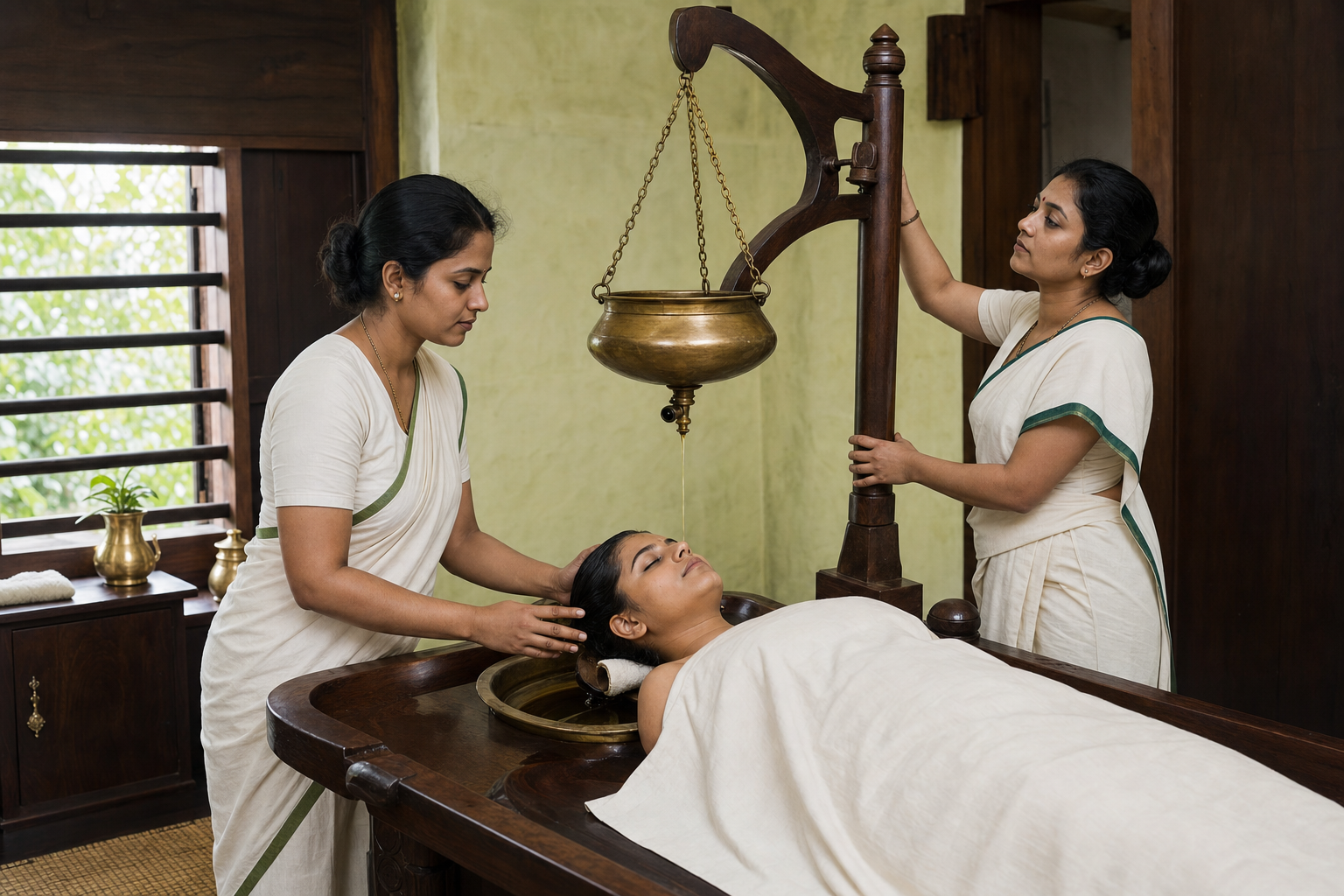
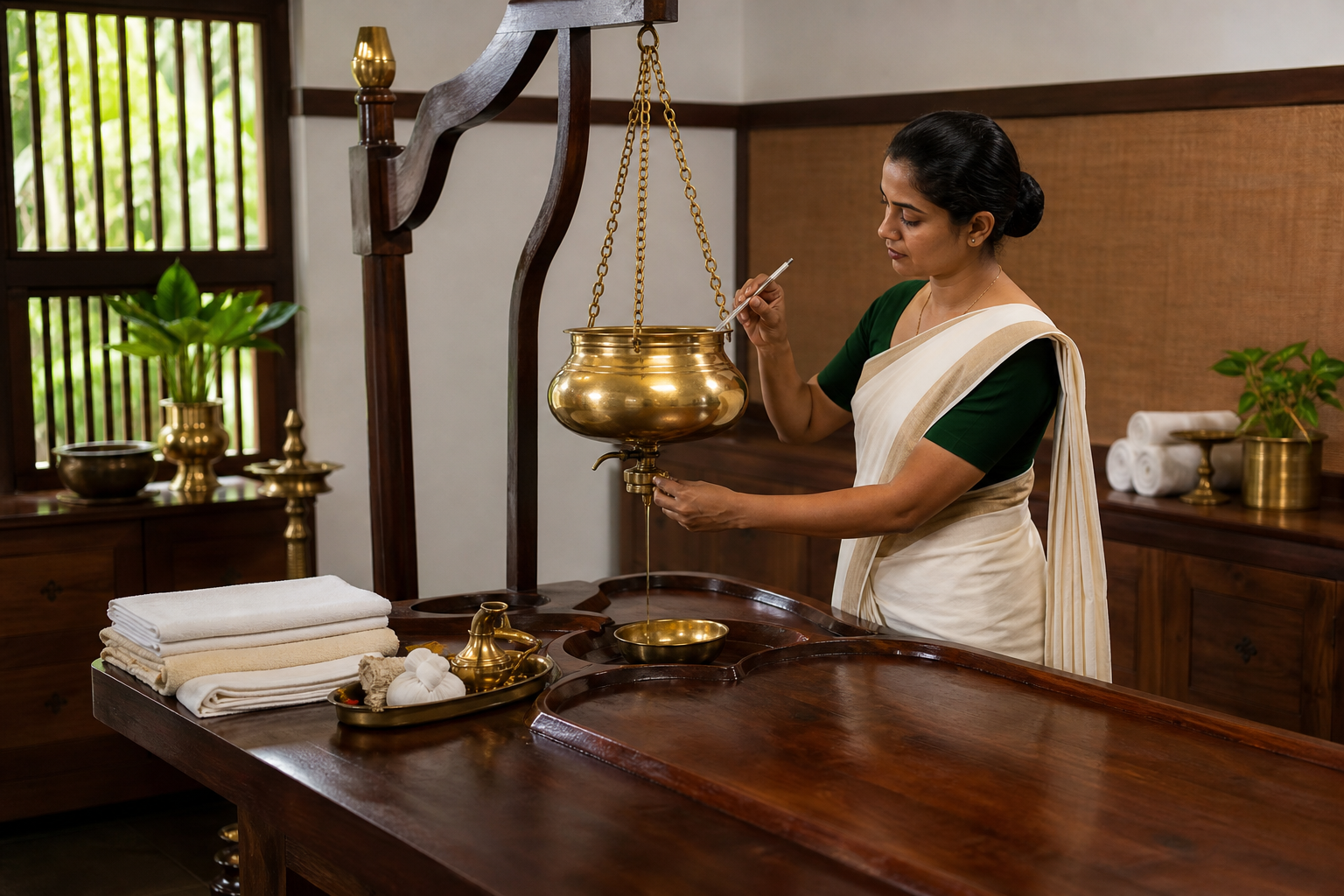
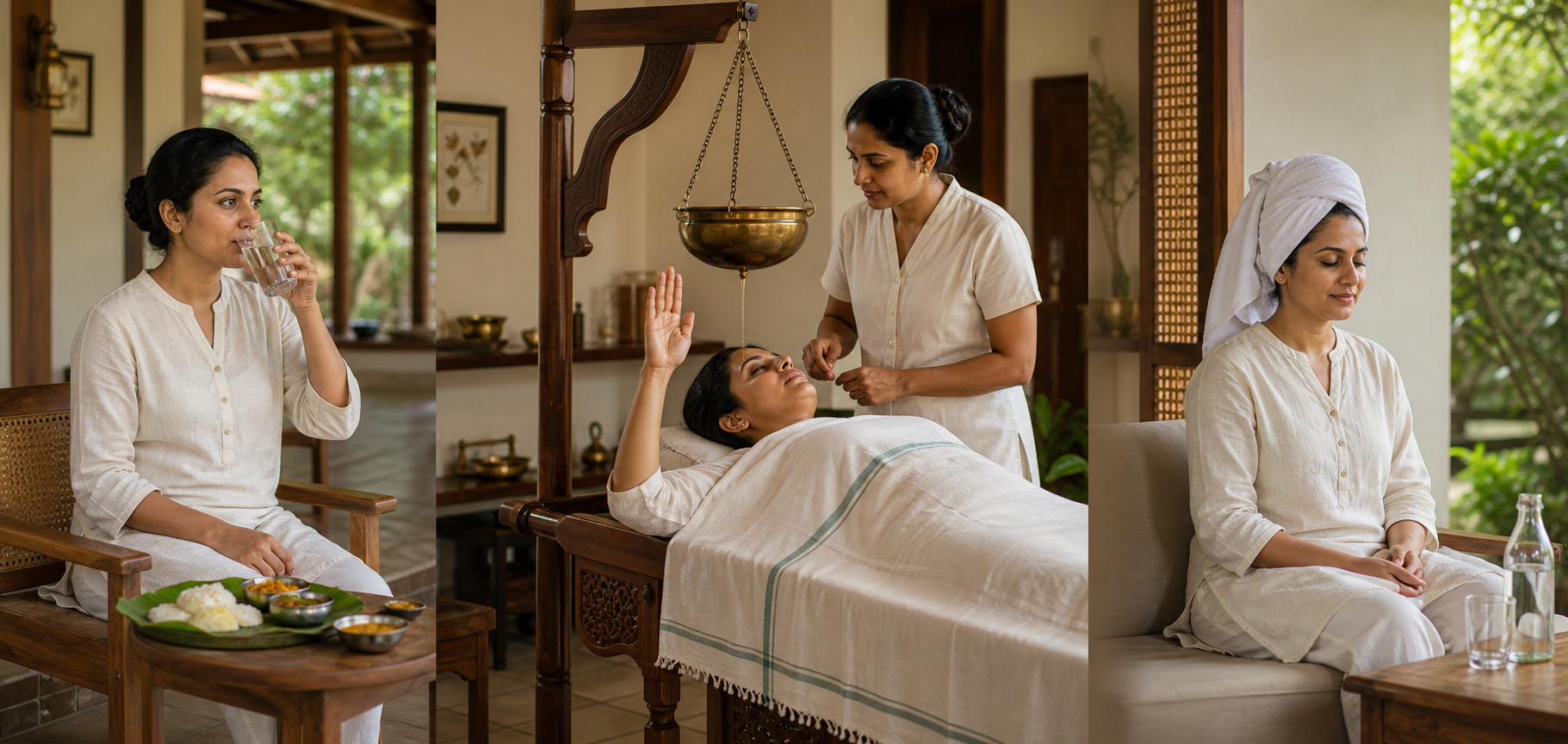
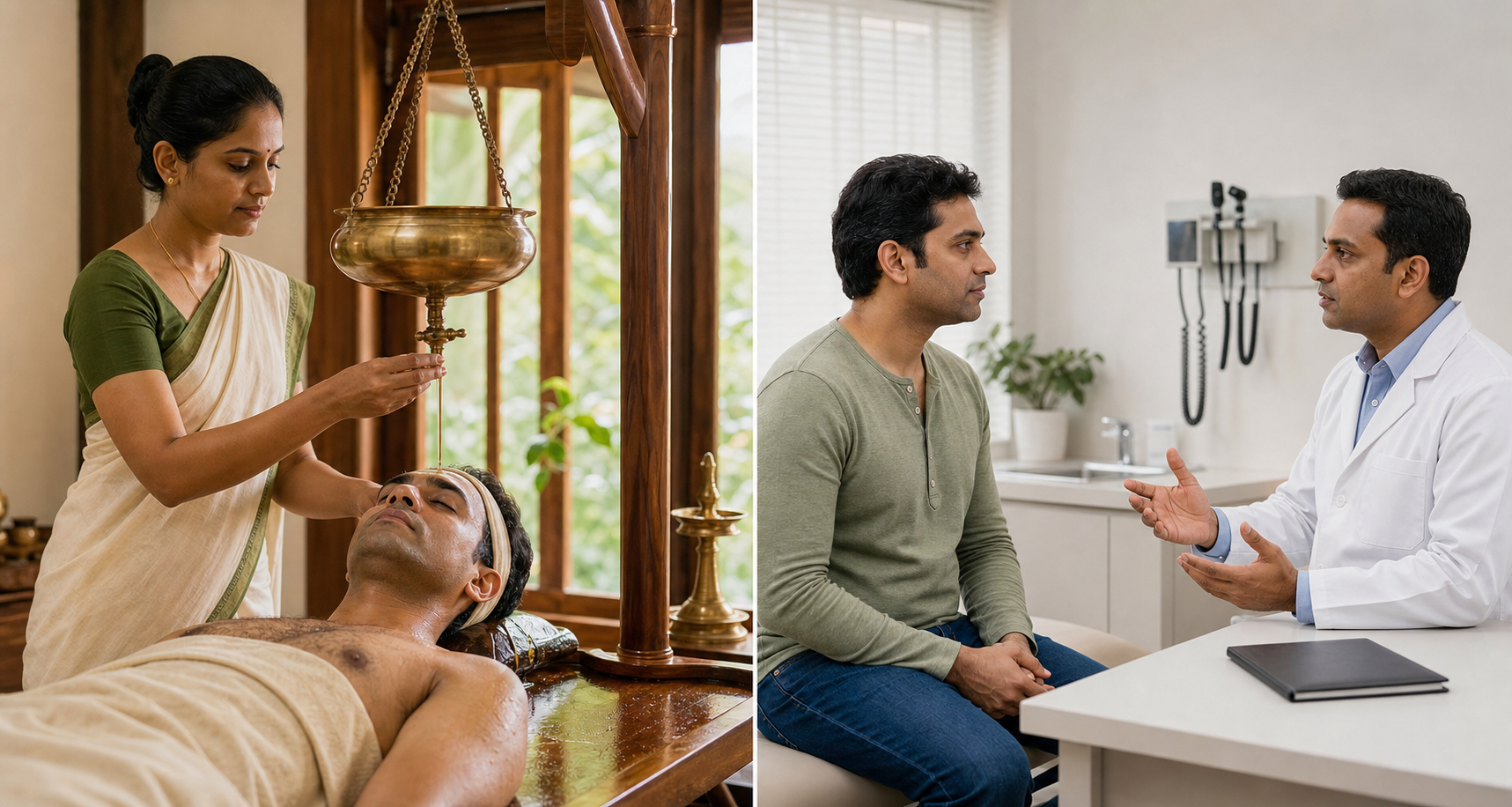
In Dhara, a thin stream of warm, medicated herbal oil is directed continuously over the central forehead and brow. A purpose-built apparatus helps the therapist maintain the flow at a controlled pace. The treatment is defined as much by rhythm and continuity as by the oil itself; irregular pouring or repeated interruptions change the experience.
The flow is kept steady so that the sensory experience can deepen gradually. You may notice that mental activity becomes less insistent, your breathing settles, or bodily tension becomes easier to recognize. Some people describe the resulting state as meditative. None of these responses needs to occur on command, and the absence of an unusual sensation does not mean that you have undergone the treatment incorrectly.
In traditional settings, a Dhara session may continue for approximately 60 to 120 minutes. Treat that range as a description of established practice, not as a prescription to request the longest possible appointment. Your constitution, purpose, comfort, skin sensitivity, and general health should influence the plan.
The brow region is often associated in classical descriptions with the ajna marma. That gives Dhara an important place within Ayurveda’s traditional understanding of the person, but it should not be converted into an unsupported anatomical or neurological claim. A classical association and a modern medical mechanism are different kinds of statements.
Decide what you expect the treatment to do
Your aim determines whether Dhara is a sensible choice. If you want a structured period of quiet, warmth, reduced sensory demand, and attentive care, its traditional purpose aligns well with that goal. Ayurveda has also long associated Dhara with mental agitation, chronic headaches, restlessness, disturbed sleep, and accumulated strain.
Those associations do not establish that Dhara cures the conditions behind such symptoms. A headache may be tension-related, but it may also have a cause that needs medical assessment. Sleep disruption can likewise arise from many different physical, psychological, environmental, or behavioral factors. Dhara may support relaxation while the cause is being addressed; it should not be used to avoid finding out what that cause is.
- A reasonable expectation: a carefully supervised relaxation treatment that may help you feel calmer, less strained, and more mentally settled.
- A question for an Ayurvedic Vaidya: whether Dhara fits your constitution, present condition, and intended role within a broader care plan.
- A claim to question: guaranteed relief, a universal result, or the promise that one session will cure a persistent medical problem.
- A boundary to keep: do not stop prescribed treatment or postpone professional assessment because Dhara has been presented as a natural alternative.
This distinction does not diminish the therapy. It protects its proper role. A traditional practice can be meaningful, skilful, and beneficial as supportive care without being made responsible for claims it cannot safely carry.
How to assess the practitioner before you book
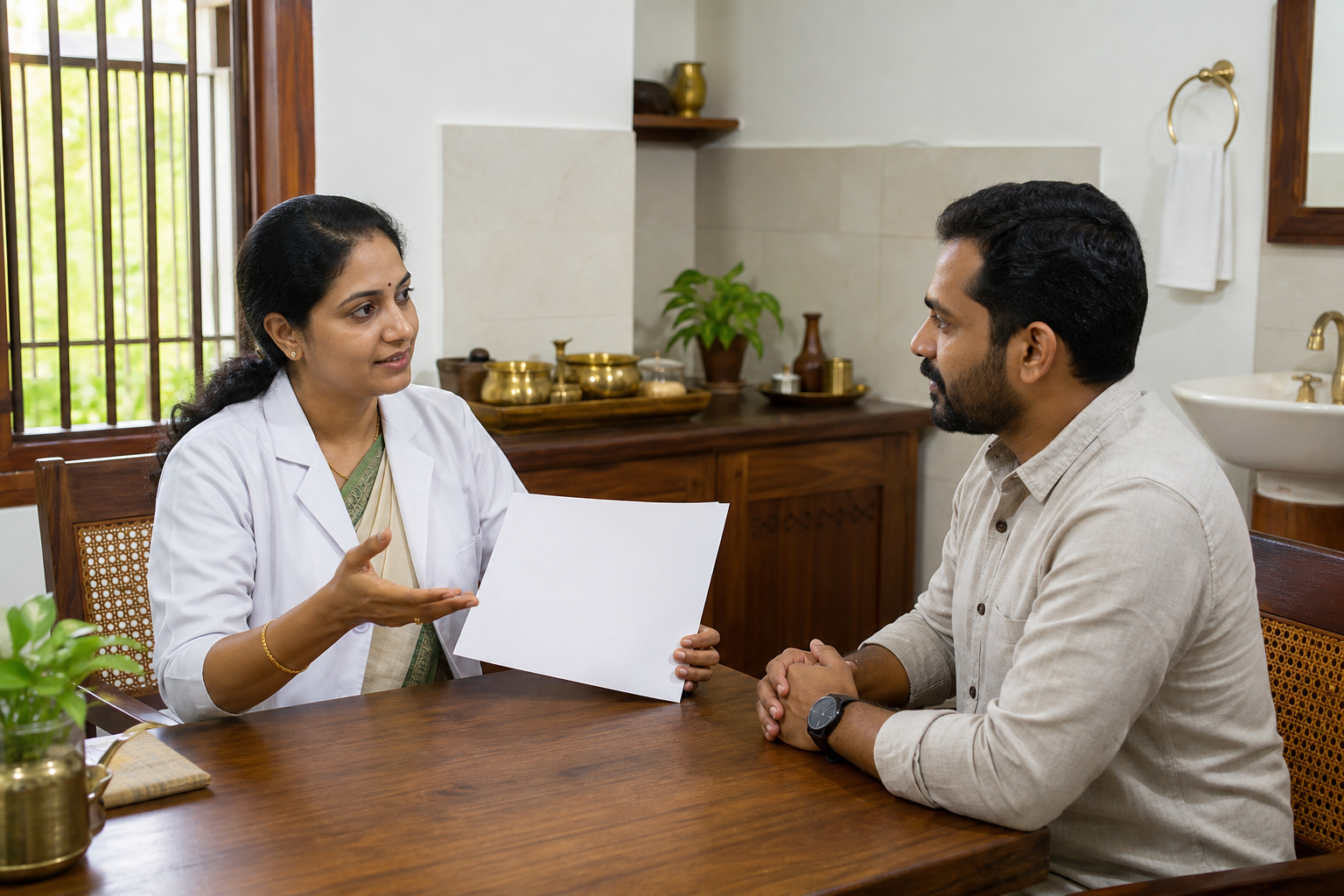
The treatment should not begin with the assumption that every person needs the same oil, temperature, or duration. Kerala Ayurveda places importance on constitution-based care, and the medicated oil is traditionally selected by a Vaidya according to the recipient’s needs. A menu that offers one standardized Dhara package may still be competently operated, but you should ask how personalization occurs before treatment starts.
Use these questions when speaking with a clinic or Ayurvedic center:
- Who assesses me before the session? Ask whether a trained Ayurvedic Vaidya or qualified therapist will review your purpose, health conditions, and skin sensitivity.
- How is the oil selected? The answer should connect the choice to your constitution and present need, rather than treating every medicated oil as interchangeable.
- How do you control the temperature? Warmth is part of the treatment, but excessive heat is not. The practitioner should be able to explain how comfort is checked and maintained.
- How is the stream kept continuous? Ask about the apparatus and how the therapist manages the pace and position of the flow throughout the session.
- How much of the appointment is actual Dhara? This prevents confusion between the advertised appointment length and the time during which the continuous flow is maintained.
- What would make you shorten, alter, or decline the treatment? A responsible provider should recognize that suitability is individual rather than automatic.
- What should I do if I become uncomfortable? You should be able to speak up and stop the procedure without pressure to endure it for therapeutic or spiritual reasons.
A careful answer does not need to be ornate or mystical. It should show that the practitioner understands oil selection, temperature, continuity, skin sensitivity, room conditions, and your comfort. Duration alone is not a mark of quality. A long session with poor temperature control or no individual assessment is not made better by its length.
Make the safety decision before the oil begins to flow
Tell the practitioner about underlying health conditions and any known skin sensitivity before treatment. If you are receiving medical or psychological care, or if you are unsure whether the treatment is appropriate for your condition, consult the relevant healthcare professional as well as the Ayurvedic Vaidya. Integrated care is safer than asking either tradition to operate without knowledge of the other.
Do not book Dhara as your first response to a new, severe, worsening, or otherwise concerning headache or sleep disturbance. Seek timely medical assessment. The fact that a symptom appears among the traditional uses of Dhara does not make that symptom safe to self-manage.
During the session, report excessive heat, burning, irritation, pain, or distress immediately. Dhara is not an endurance exercise, and discomfort is not evidence that a medicine is working. The therapist should adjust or stop the flow when safety or comfort requires it. If a reaction is severe or persists after the treatment, obtain appropriate healthcare rather than relying on another session to correct it.
Be especially cautious if anyone promises a cure, discourages medical assessment, or tells you to discontinue prescribed care. Those statements move beyond the responsible use of a relaxation and rejuvenation practice.
Keep the Dharmic meaning clear without turning it into a sales claim
Dhara belongs to the living Ayurvedic heritage of Kerala and the wider civilizational inheritance of Bharat. Its disciplined use of warmth, rhythm, awareness, and gentle attention reflects a recognizably Dharmic approach: balance is cultivated through repeated, embodied practice rather than demanded through force.
Values such as awareness, compassion, restraint, and self-regulation resonate across Hindu, Buddhist, Jain, and Sikh traditions. That shared resonance can help you understand why a quiet bodily treatment carries meaning beyond an ordinary spa service. It does not make Dhara a compulsory rite of any religion, nor does it turn relaxation into proof of spiritual attainment.
You do not need to report visions, altered consciousness, or an activated “third eye” for the treatment to be worthwhile. Judge it by more grounded standards: Was the procedure competently administered? Was your comfort respected? Did the practitioner make claims proportionate to the therapy? Did the experience safely support the calm or clarity you sought?
Key takeaways
- Dhara uses a thin, continuous stream of warm, medicated herbal oil over the central forehead; continuity is a defining part of the method.
- Traditional sessions may last approximately 60 to 120 minutes, but the appropriate duration should be individualized.
- The oil should be selected according to constitution and need rather than offered as a universal formula.
- Relaxation, reduced strain, and a settled mental state are reasonable aims; a guaranteed cure for headaches, sleep problems, or another condition is not.
- Temperature control, therapist training, skin sensitivity, room conditions, and your ability to stop the session all matter.
- Persistent, severe, new, worsening, or concerning symptoms require professional assessment; Dhara is not a replacement for medical or psychological care.
If you decide to try Dhara, begin with a consultation rather than a treatment package. Ask who will assess you, why a particular oil and duration are being chosen, and how the therapist will protect your comfort. Those answers will tell you more about the quality of the care than any promise of instant calm.
References
