

Your day may already be full before you have made a conscious choice: the phone sets the mood, work fragments your attention, meals happen when they can, and fatigue turns small wants into urgent needs. Adding an elaborate spiritual routine to that strain is unlikely to restore balance.
A more workable approach is to place a few Dharmic disciplines at the transitions that already exist in your day. Food, breath, work, consumption, service, and sleep then become parts of one practice. The aim is not a perfectly controlled schedule. It is a rhythm that helps you notice excess sooner, choose with greater clarity, and return to steadiness when the day goes off course.
Build your day around reliable anchors, not a rigid timetable

Dinacharya, or daily routine, works best as an ordered rhythm rather than a minute-by-minute performance. The exact clock time may change with your work, family duties, health, and season. The sequence can remain recognizable: wake deliberately, prepare the mind, nourish the body, perform your duties, reduce stimulation, and rest.
Begin with the smallest version you could keep on an ordinary day:
- Meet the morning before meeting the world. Seek natural morning light soon after waking. Before opening messages or news, sit or stand quietly and practise five minutes of breath awareness. You are establishing the quality of attention with which you will receive everything that follows.
- Give food a dependable place in the day. Anchor two meals at reasonably consistent times. Consistency matters more than designing an impressive menu that you cannot sustain.
- Create pauses at major transitions. When moving from home to work, task to task, or work to family time, take several unforced breaths. Use the pause to release the previous activity and name the duty now in front of you.
- Let the evening become quieter by degrees. Avoid making a heavy late meal the day’s reward. Reduce electronic stimulation before bed and protect a regular sleep window as far as your responsibilities allow.
This rhythm reflects the wider Ayurvedic understanding of ahara and vihara as connected dimensions of health. Food, sleep, movement, breath, mental composure, conduct, and relationships do not operate as isolated projects. Disorder in one tends to spill into the others.
If your schedule changes because of shift work, caregiving, travel, or illness, preserve the sequence rather than forcing conventional clock times. Adaptability is not a failure of discipline. It is disciplined attention to present conditions. A routine should support dharma in your actual life, not make you neglect a real duty for the sake of appearing spiritually consistent.
Use ahara to steady energy and attention
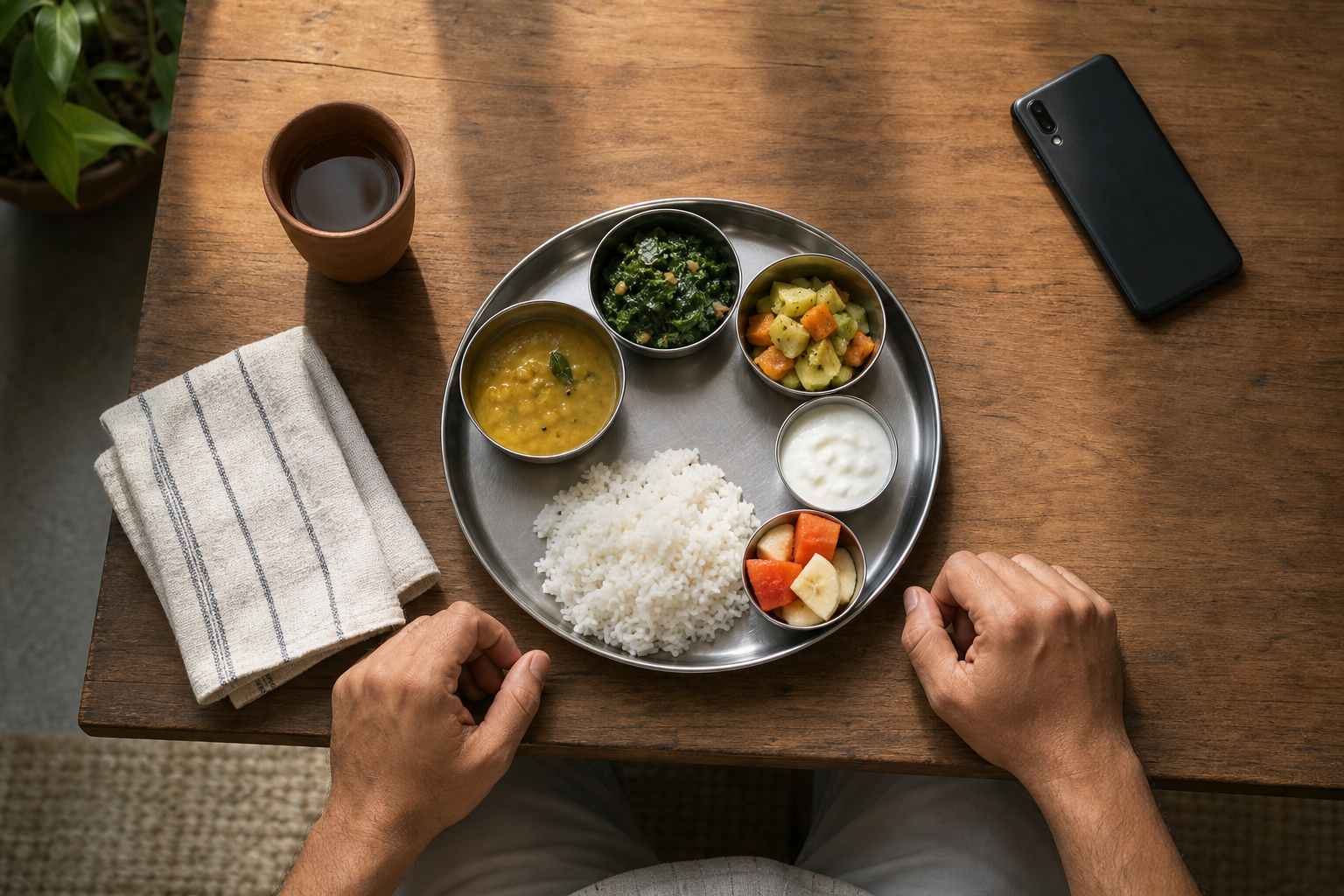
Ahara asks more than, “What nutrients are in this food?” It also asks how fresh the food is, how it was prepared, when and how much you eat, and what state of mind accompanies the meal. That makes eating a daily training ground for balance.
Before eating, run through a practical set of checks:
- Quality: Is this meal fresh, nourishing, and reasonably simple? Favour largely plant-forward food and seasonal ingredients where they are suitable and available.
- Preparation: Would a warm, freshly cooked meal leave you better supported than heavily processed convenience food? Ginger, cumin, and turmeric can be used as culinary spices rather than treated as miracle remedies.
- Quantity: Are you serving a moderate portion, or using food to answer fatigue, agitation, or disappointment? Begin with enough to nourish yourself without planning for discomfort.
- Attention: Can you sit down, put the screen aside, chew mindfully, and notice the meal? Eating while consuming upsetting or stimulating content brings the restlessness of the screen to the plate.
- Timing: Is this close to the meal rhythm you intended, or has an unplanned day pushed a heavy meal late into the evening? When plans fail, choose the lighter correction instead of turning one disruption into a night of excess.
Seasonal adaptation should remain practical. Warmer conditions may call for lighter meals, while cooler periods may make nourishing soups and appropriate use of ghee more welcome. Treat these as observations to test against your needs, local climate, and constitution, not universal commands detached from context.
The inner state matters as much as the menu. Pause before the first bite. Notice whether you are hurried, angry, distracted, or grateful. You do not have to manufacture serenity. Simply recognizing your condition can stop it from unconsciously deciding the speed and quantity of the meal.
After eating, use clarity as feedback. If a recurring meal or timing pattern leaves you dull, uncomfortable, or unable to work steadily, adjust one element rather than condemning the entire routine. Change the portion, preparation, timing, or surrounding distraction, then observe again. This is abhyasa: patient repetition guided by attention.
Food practices are not substitutes for medical care or an individualized treatment plan. If your health requires particular ingredients, portions, or meal times, do not override those requirements to imitate a generalized routine. A qualified clinician or Ayurvedic Vaidya can help you adapt these principles to your circumstances.
Practise pratyahara at the moment an impulse appears

Many people associate restraint with a dramatic renunciation of possessions. Everyday pratyahara is quieter. It begins when an advertisement, notification, comparison, craving, or passing mood tries to seize the next decision.
Aparigraha, or non-hoarding, does not require you to reject useful possessions. Asteya, or non-stealing, asks you not to take what is not rightly yours, including more than your fair share of limited resources. Santosha, or contentment, asks whether sufficiency is already present. Together, these disciplines help you distinguish a tool that serves life from an acquisition that merely extends desire.
When you feel the urge to buy, upgrade, order, or accumulate, stop before payment and ask:
- What precise need will this meet?
- Do I already own something that performs the same function?
- Is the item durable, repairable, and likely to remain useful?
- Am I choosing function, or trying to purchase status, relief, or belonging?
- What will this cost in storage, maintenance, attention, and future disposal as well as money?
- Would leaving it behind obstruct a real duty, or merely disappoint an impulse?
If the answers are vague, leave the cart and revisit the decision after the urgency has passed. The pause is not punishment. It gives discernment time to catch up with desire. When the purchase clearly supports health, work, family responsibility, learning, worship, or service, restraint does not require an automatic refusal. It requires an honest reason.
The same test belongs in digital life. Attention can be hoarded, traded, and depleted even when no physical object changes hands. Protect no-input spaces around morning practice, meals, prayer, and the approach to sleep. When you reach for a device without a purpose, name what you expected to find. That small act separates a chosen use from a conditioned response.
Excess tends to feed rajas: agitation, comparison, restless activity, and the feeling that satisfaction lies just beyond the next acquisition. Mindful consumption restores the relationship between artha and dharma. Material prosperity can then serve responsibility, generosity, and purposeful living instead of becoming a measure of personal worth.
This also changes how you understand contentment. Santosha is not an excuse for passivity, low standards, or neglecting legitimate needs. You can pursue education, income, skill, and material security without allowing every improvement to generate a new dissatisfaction. The question is whether you direct prosperity or compulsion directs you.
Carry dharma into work, relationships, and the evening review

A balanced routine cannot end at the edge of the meditation seat. Its real test is whether it changes how you earn, respond, share, and repair mistakes.
Dharmic traditions offer complementary ways to test that conduct. The Buddhist Middle Way avoids both indulgence and harsh denial. Jain emphasis on ahimsa and aparigraha asks you to reduce harm and possessiveness. Sikh teaching joins honest work, remembrance, and sharing through kirat karo, naam japo, and vand chhako. These are not interchangeable doctrines, but they converge on a useful everyday principle: inner discipline should become ethical participation in the world.
Put that principle into the ordinary parts of your day:
- At the start of work, name the duty. Decide what honest completion looks like before messages and competing demands scatter your attention. Return to that duty when busyness begins to masquerade as usefulness.
- Before reacting, create room for ahimsa. When irritation rises, pause long enough to choose a response that is firm without being needlessly harmful. Restraint does not forbid boundaries; it changes the spirit and precision with which you set them.
- Build remembrance into transitions. A brief mantra, prayer, breath practice, or period of silence between activities can return the mind to its governing values. Remembrance is most useful before a difficult choice, not only when the atmosphere is already peaceful.
- Make sharing deliberate. Set aside food, time, skill, attention, or material resources for another person or the community. Seva turns sufficiency into circulation and prevents simplicity from becoming a private exercise in self-improvement.
- Repair quickly. If you spoke carelessly, consumed excessively, missed practice, or neglected a duty, identify the next corrective action. Guilt without repair consumes attention while leaving the harm in place.
Close the day with a short review rather than a verdict on your character. Ask yourself:
- Where did I act from clarity, and where did restlessness decide for me?
- Did my food, media, and purchases support the duties I value?
- Where did I reduce harm or share what I had?
- What is the smallest adjustment that would make tomorrow more balanced?
Choose one adjustment. Preparing breakfast ingredients, placing the phone away from the bed, setting aside something to share, or defining tomorrow’s first duty is more useful than designing a complete new life at night. The evening review should reduce tomorrow’s friction, not become another arena for self-criticism.
Key takeaways
- Build a recognizable sequence around waking, breath, meals, duties, reduced stimulation, and sleep; adapt the clock to your real responsibilities.
- Use ahara as a practice of quality, moderation, timing, attention, and seasonal awareness, not merely as a list of approved foods.
- Apply aparigraha, asteya, and santosha before buying or accumulating by testing need, durability, hidden burden, and motive.
- Protect attention through small acts of pratyahara, especially around morning practice, meals, transitions, and bedtime.
- Measure discipline by its effect on honest work, non-harm, remembrance, sharing, and repair.
- Review the day without condemning yourself, then prepare one concrete correction for the next day.
Begin with the next transition in front of you. Protect five minutes of breath awareness, anchor two meals, and make the evening quieter. Let those practices become stable before adding more. A modest rhythm that survives an ordinary day can mature into abhyasa; an ideal routine that collapses under ordinary duties cannot.
References
- DharmaRenaissance Blog – From Need to Excess: Dharmic Wisdom on Consumption, Contentment, and Inner Freedom
- DharmaRenaissance Blog – Ahara and Vihara Made Practical: Transform Health with Ayurveda’s Time-Tested Vedic Wisdom
