
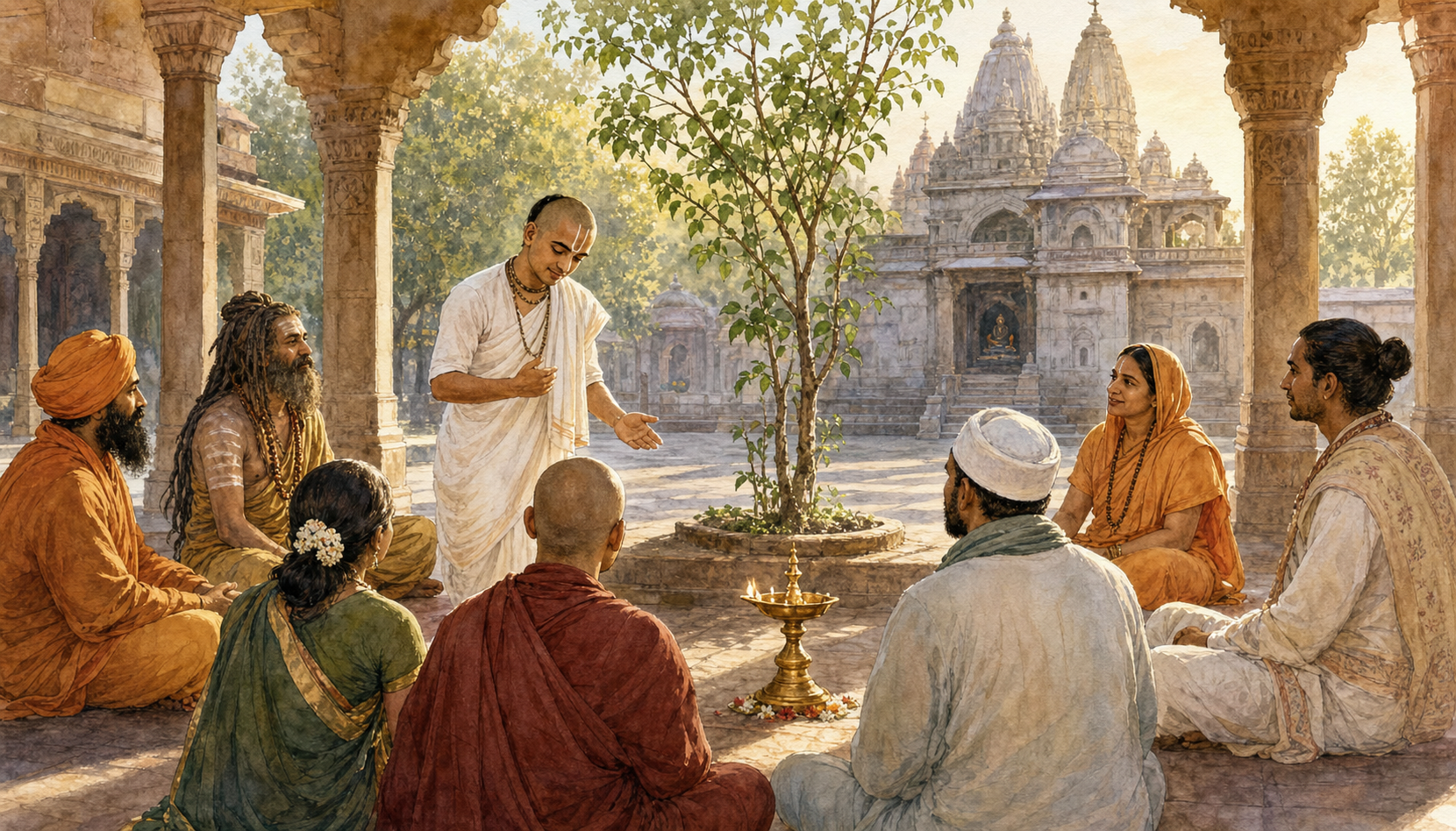
You may know the moment: a discussion among dharmic people begins with reverence and ends as a contest over whose lineage, vocabulary, or history deserves the highest place. You want to defend what you believe, but you don’t want devotion to harden into sectarian pride.
The Vaishnava answer is not weaker conviction. It is conviction disciplined by humility, sadachara, and seva. You learn to speak clearly from within your tradition, listen without appropriating another tradition, and make unity visible through conduct.
Humility makes you teachable, not useless

Sanatana Gosvami was entrusted with the difficult responsibility of preparing directions for Vaishnava conduct. He did not advertise his qualifications or treat the assignment as proof of his spiritual rank. He acknowledged his limitations, requested instruction, and prayed for the Lord to guide him from within.
“Please manifest Yourself within my heart.”
Sanatana Gosvami
Notice what his humility did not produce. It did not make him abandon the responsibility. It did not become an excuse to remain uninformed. It did not reduce obedience to passivity. His sense of inadequacy moved him toward guidance so that he could complete the work responsibly.
This gives you a practical distinction. Self-belittlement says, “I am incapable,” and withdraws. Performative humility uses modest words while protecting status and control. Vaishnava humility says, “This duty is larger than my unaided judgment, so I will seek guidance, learn carefully, and remain answerable for what I do.”
You can test your humility by watching what happens when your position is challenged:
- Do you become curious about what you may have missed, or do you immediately defend your image?
- Can you distinguish an attack on truth from an injury to your pride?
- Does valid correction change your words and conduct, or merely produce a more sophisticated defense?
- Can you complete an uncelebrated service with the same care you bring to a visible religious role?
- Can you say, “I do not know,” and then consult someone who does?
Humility is therefore not a claim that every opinion is equally sound. A teacher may still teach, a community leader may still set a boundary, and a practitioner may still reject an interpretation. The difference lies in the location of the self. Bhagavan, dharma, guru, and responsible conduct remain central; personal prestige does not.
Before accepting a religious responsibility, name four things plainly: the duty you have been given, the authority under which you are acting, the limit of your present knowledge, and the guidance you need. This simple inventory prevents both arrogant improvisation and timid avoidance.
Make humility visible as sadachara
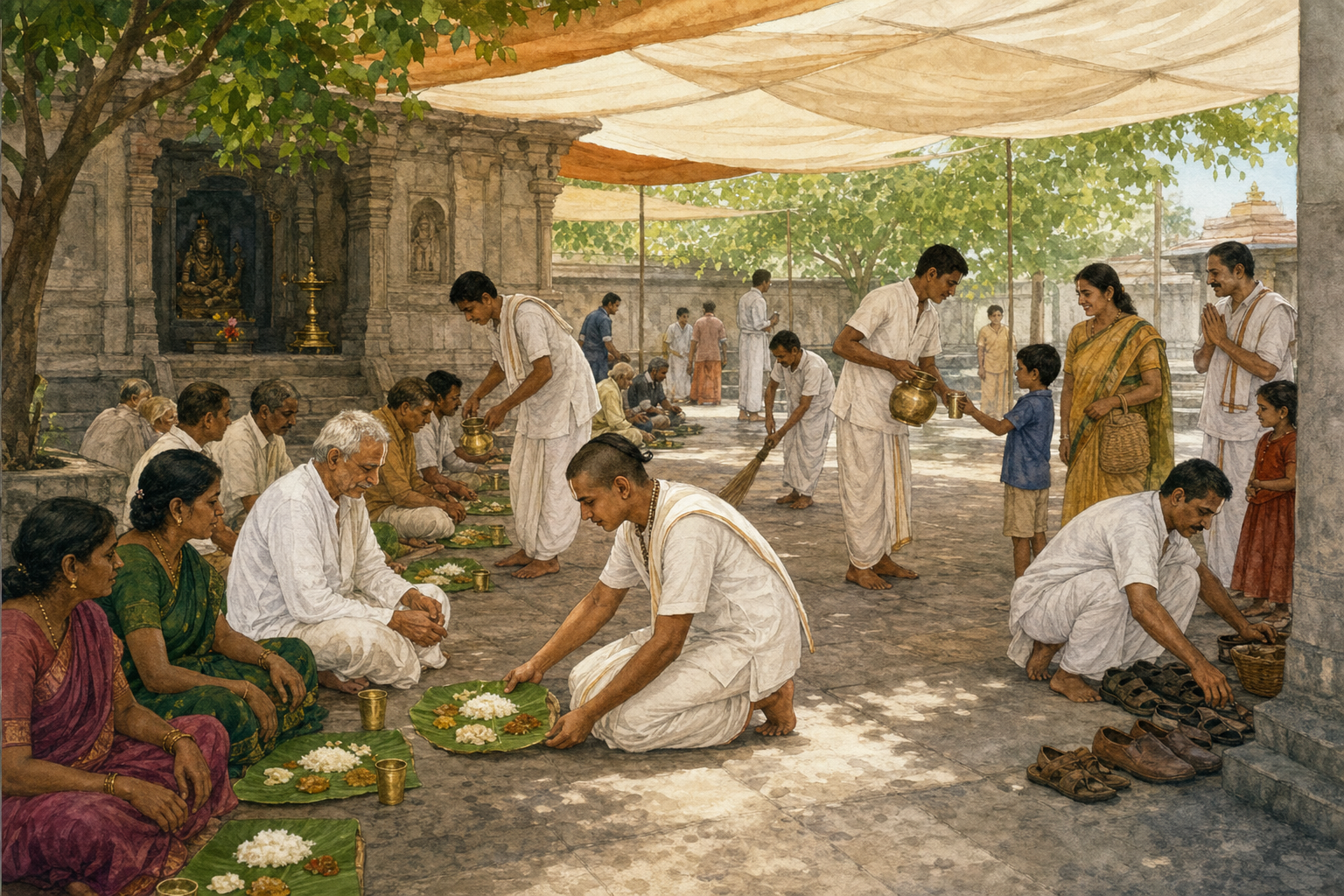
Humility that never affects behavior is only an attractive idea. Sadachara makes it observable. It joins devotion to disciplined speech, reliable service, reverence for learning, and accountability within the guru-shishya tradition. Your conduct becomes the place where your theology can be trusted.
Use this sequence before and during a difficult dharmic conversation:
- Purify the intention. Ask whether you are trying to clarify dharma, protect another person, solve a real problem, or merely win recognition. If you cannot identify a constructive purpose, delay the response.
- Locate the claim. Say whether you are presenting the teaching of your lineage, your own interpretation, a historical claim, or a practical preference. Confusion between these levels causes avoidable conflict.
- Represent before replying. Restate the other person’s position in language they would recognize. Do not translate it immediately into your own theology.
- Name the limit. If you do not know how another school understands a doctrine, say so. Ask a sincere question or consult a qualified practitioner instead of filling the gap with assumption.
- Accept correction cleanly. Identify the inaccurate statement, replace it, and stop defending the version you no longer believe.
- Return to service. After disagreement, do something that benefits the community without requiring the other person to concede your theological position.
Sanatana Gosvami’s prayer for direction from within also needs a guardrail. An intense preference, fear, or impulse is not automatically divine guidance. In his example, inward prayer accompanies duty, instruction, established practice, and responsibility. Inner clarity does not grant private permission to ignore shastra, guru, or the consequences of your conduct.
A short interval of japa, dhyana, or mindfulness before you answer can help create space between wounded pride and deliberate speech. These contemplative disciplines are associated in their respective settings with qualities such as clarity, empathy, and steadiness. Similar practical fruit does not make their philosophies identical, but it can make a difficult encounter more humane.
Careful language helps as well. Replace universal declarations with accurately located statements:
- “In our Vaishnava lineage, this is understood as…”
- “The distinction I am trying to preserve is…”
- “I can explain our position, but I cannot define your tradition for you.”
- “I may be missing part of your view; how would you state it?”
- “We disagree about the explanation, but we may still cooperate in this act of seva.”
These are not evasive formulas. They make your claims more exact. They also deny ahankara the pleasure of presenting one person’s partial understanding as the final measure of every dharmic path.
Keep conviction without annexing another path
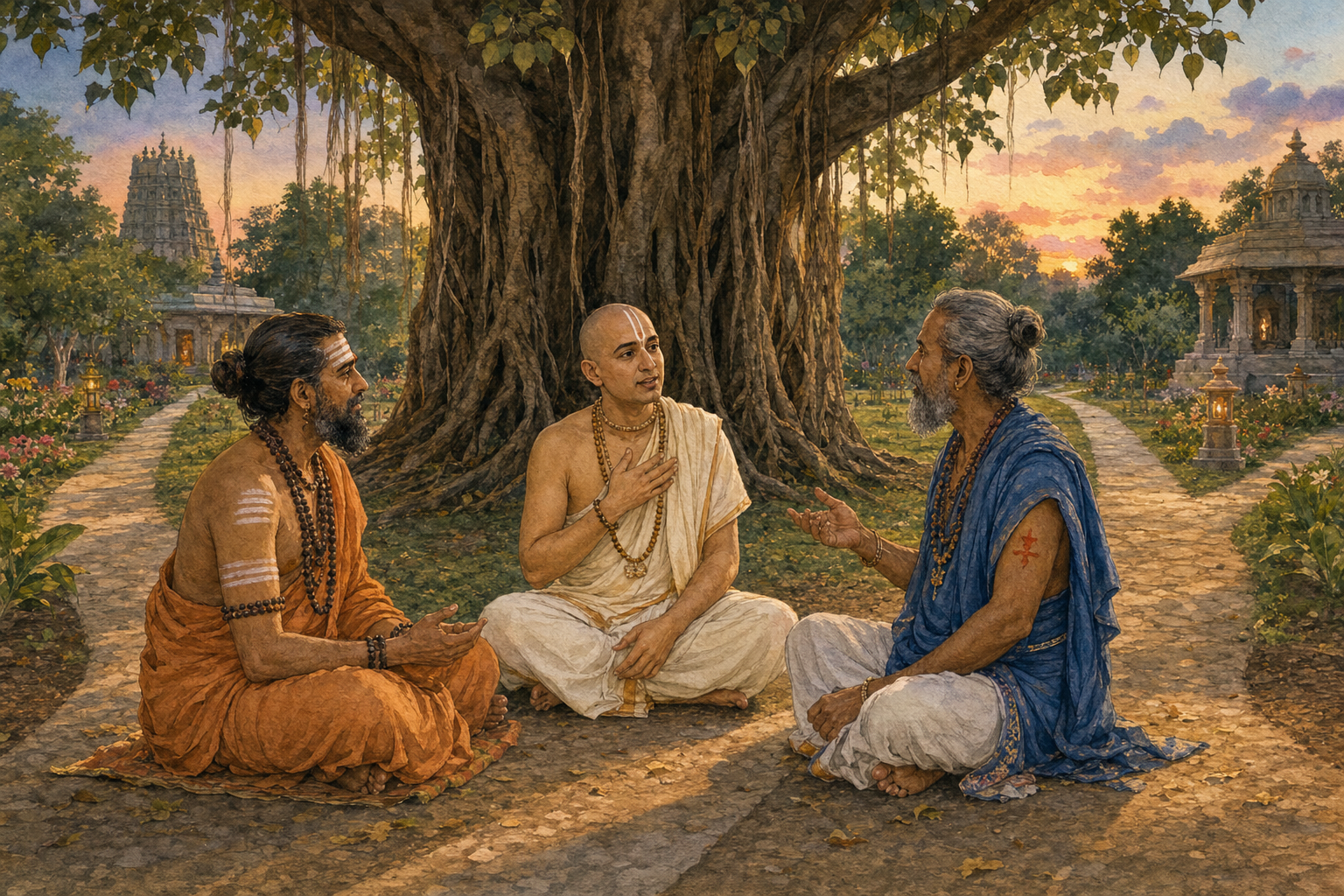
Lord Buddha presents a useful test of mature Vaishnava speech. Within Vaishnava theology, Buddha is revered as an avatar of Vishnu. A Vaishnava does not need to hide that belief in order to be respectful. A Buddhist, however, need not adopt the Vaishnava category as the authoritative explanation of Buddhism.
The problem begins when a first-person confession becomes a second-person verdict. “We understand Lord Buddha as an avatar of Vishnu” states a Vaishnava conviction. “Buddhists are really Vaishnavas, whether they know it or not” overrides another community’s self-understanding. The first opens a theological conversation; the second closes one.
A Vaishnava interpretation may understand Buddha’s emphasis on compassion and ahimsa, together with his de-emphasis of ritualism, as a restoration of dharma’s ethical center when ritual practice had obscured it. That is a coherent claim from within the Vaishnava frame supplied by Vishnu’s protective and guiding role. Buddhist traditions may explain the same religious transformation differently. Humility does not require you to abandon your frame; it requires you to stop presenting it as though no other frame exists.
Use three boundaries whenever you discuss another dharmic tradition:
- State your location. Identify the lineage or theological perspective from which you are speaking.
- Preserve the other’s voice. Let adherents describe what their own practices, teachers, and goals mean to them.
- Separate reverence from absorption. You can revere a figure through Vaishnava theology without claiming ownership of every tradition associated with that figure.
This discipline protects unity from two opposite mistakes. Sectarian arrogance treats difference as inferiority. Shallow pluralism treats every difference as verbal decoration around the same doctrine. Dharmic friendship needs neither mistake. It can hold genuine theological difference alongside reverence, non-hostility, and cooperation.
The same rule applies to the phrase “Sanatana Dharma.” Many Hindu and Vaishnava practitioners use it to name a wide civilizational and spiritual family. Buddhists, Jains, and Sikhs may articulate their identities and boundaries in their own ways. If you want durable unity, offer the family relationship as an invitation to mutual recognition, not as a compulsory label.
Turn shared virtues into working dharmic unity

Unity becomes credible when people can see what it changes. Vaishnava humility has meaningful points of contact with Jain ahimsa and aparigraha, Buddhist karuna and mindfulness, and Sikh nimrata and seva. These are bridges for conversation and action, not proof that the traditions hold identical doctrines.
A shared virtue has at least three dimensions: the name a tradition gives it, the discipline through which it is cultivated, and the ultimate account of why it matters. Communities may cooperate at the level of conduct while retaining different metaphysical explanations. You do not need agreement about ultimate reality before you can practice truthful speech, reduce needless hostility, serve people in distress, or protect the dignity of another community.
For a temple forum, campus gathering, family dialogue, or inter-dharmic service effort, build the encounter in this order:
- Let each tradition name itself. Ask a practitioner to explain one virtue in the vocabulary of that tradition. Do not assign identities or definitions from outside.
- Ask for a lived discipline. Move from general claims about compassion or humility to the conduct expected in speech, worship, study, restraint, or service.
- Name a boundary without embarrassment. Participants should be free to say where doctrines diverge. A boundary stated without contempt is more trustworthy than artificial agreement.
- Choose a concrete act of service. Select work that can be completed together without requiring theological compromise. Define the responsibility, the beneficiary, and who remains accountable for follow-through.
- Review representation. Before publishing a joint statement, ask each community to verify the sentences that describe it. Correcting a label before publication is easier than repairing mistrust afterward.
When disagreement does occur, first identify its kind. A disputed historical fact needs evidence. A theological difference needs accurate attribution. A breach of conduct needs correction or accountability. An insult needs withdrawal and repair. Treating every disagreement as a battle over ultimate truth allows ordinary errors and wounded pride to become sectarian crises.
Humility also does not require silence about adharma. If someone misrepresents a tradition, demeans a community, or uses the language of unity to avoid accountability, name the specific conduct and set a clear boundary. Correct the act without claiming that the offender’s entire tradition is defective. Firmness and humility can coexist when the aim is protection and correction rather than humiliation.
Key takeaways
- Vaishnava humility accepts responsibility, seeks guidance, and remains open to correction; it is not helplessness or self-contempt.
- Sadachara turns humility into observable conduct through disciplined speech, reliable service, study, and accountability.
- State Vaishnava beliefs as Vaishnava beliefs, especially when describing Lord Buddha or another tradition’s sacred figures.
- Shared virtues can support cooperation without erasing distinct doctrines, identities, or spiritual goals.
- When conflict arises, determine whether it concerns fact, theology, conduct, or insult before deciding how to respond.
- Measure dharmic unity by the quality of representation, restraint, repair, and seva it produces.
At your next difficult encounter, begin with one disciplined move: restate the other person’s position until they recognize it, then state your Vaishnava conviction with its lineage and limits clearly marked. After the discussion, choose one act of seva that does not depend on winning. That is how humility stops being a devotional slogan and becomes a path toward dharmic unity.
References
- Dandavats – Sanatana Gosvami’s Humble Plea: Timeless Vaishnava Etiquette, Devotion, and Dharmic Unity
- Dandavats – Lord Buddha as Vishnu’s Avatar: Bridging Hinduism and Buddhism with Compassionate Dharma
