

Someone tells you that the word Aryan proves Indians are two races, or that an ancient movement makes one community less native, more oppressive, or more entitled to rule. You can sense the trap: a historical question has quietly become a verdict on living people. If you answer only yes or no, you accept the categories built into the accusation.
You do not have to choose between defending Bharat’s civilizational continuity and taking evidence seriously. You can challenge a colonial identity myth, refuse racial hierarchy, and preserve interfaith trust at the same time. The key is to separate the claims before deciding which of them the evidence can actually support.
Separate the five claims hidden inside the word Aryan

Before debating a conclusion, ask what Aryan means in the sentence in front of you. A speaker may be moving between five different kinds of claim without acknowledging the transitions:
- A lexical claim: what the Sanskrit word means in its textual setting.
- A linguistic claim: how particular languages are related.
- A historical claim: whether people, practices, or languages moved between regions.
- A biological claim: what ancestry can be reconstructed from genetic evidence.
- A moral or political claim: who belongs, who has status, or who may speak for Bharat.
These are not interchangeable. In Sanskrit usage, arya denotes someone noble or honorable rather than a biological race. That fact does not settle every question about ancient population history. It does settle an important semantic point: the term itself is not an ancient doctrine of racial purity.
A language classification describes relationships among languages. It does not, by itself, establish the existence of a biologically uniform people. Ancestry can describe patterns of inheritance, but it cannot assign moral worth. A Vedic passage must be read through its wording, context, and genre; a flood story or mythic motif cannot become a demographic map merely because it resembles a modern theory.
The colonial distortion was produced by collapsing these categories. Linguistic labels were racialized and mapped onto caste, complexion, region, and cultural value. The resulting Aryan-Dravidian binary made a complicated civilizational history look like a permanent contest between supposedly separate races. Once description becomes rank, pseudoscience can be used to justify exclusion; eugenic and white-supremacist movements demonstrated how destructive that escalation can become.
When you encounter the claim, rewrite it without identity adjectives. Replace an assertion such as Aryans were superior with the exact proposition being offered: a word had a particular meaning, a language entered a region, a population moved, or a text records an event. If the speaker cannot choose one proposition, there is no coherent historical claim to assess.
Keep the historical question open and the racial hierarchy closed
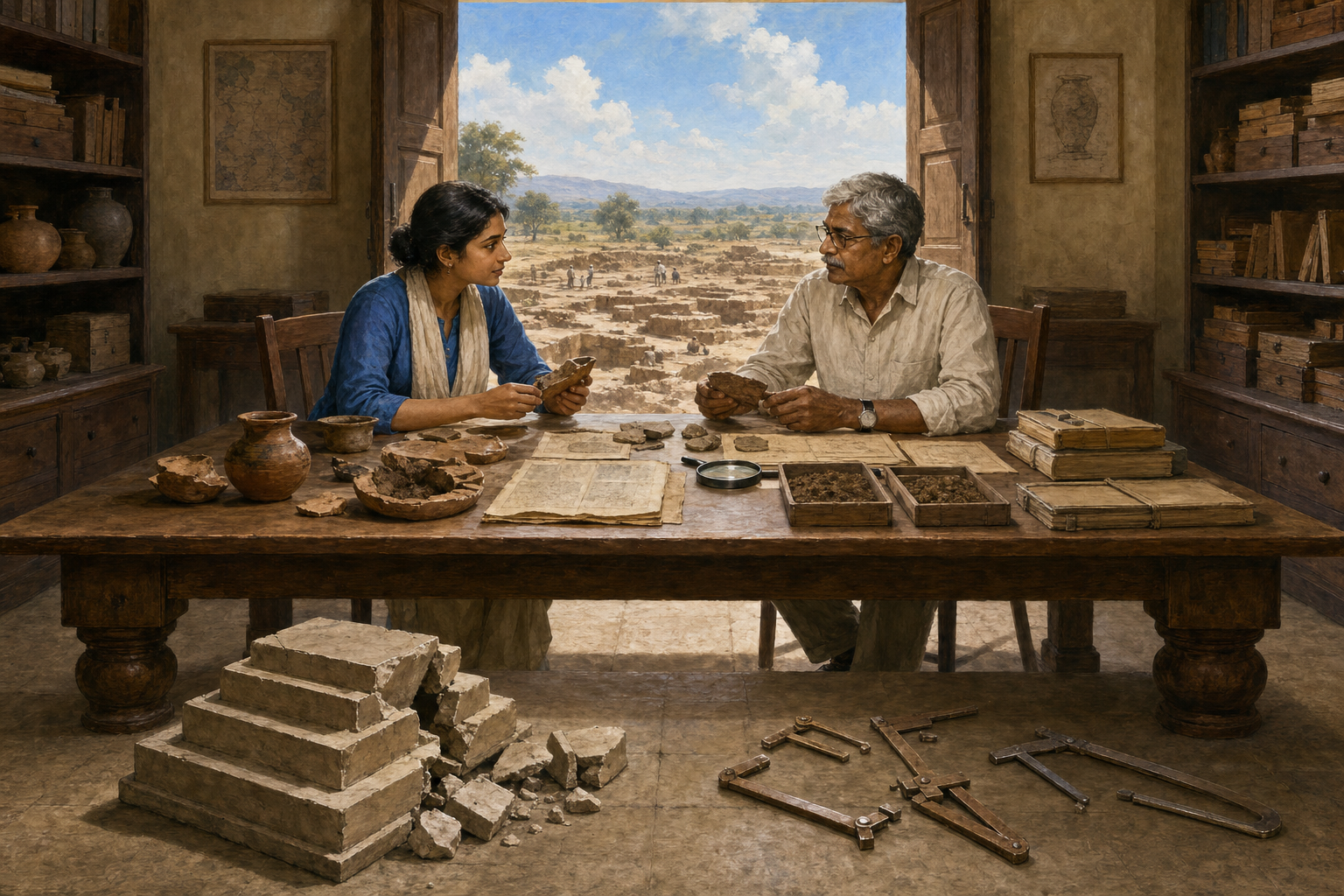
The debate over Indo-Aryan migration and Out of India interpretations should not be resolved by slogans. Archaeogenetics, historical linguistics, archaeology, and textual interpretation involve complex and evolving bodies of evidence. Responsible disagreement remains possible over how those bodies of evidence should be combined.
That uncertainty does not make every conclusion equally defensible. Put the discussion into three boxes:
- The firm ethical boundary: genetic variation, language, complexion, caste, or regional origin does not establish superiority or inferiority.
- The legitimate historical question: what patterns of movement, exchange, continuity, and cultural development best explain the available evidence.
- The unsupported political leap: therefore a living community is foreign, racially pure, collectively guilty, or entitled to dominate another community.
You can remain modest about historical reconstruction while being unequivocal about the ethical boundary. Even if a particular migration model were established, it would not prove that modern Indians belong to opposing races. Even if an indigenous-development model were established, it would not create a licence for biological pride or contempt toward anyone else. No direction on an ancient map can produce a hierarchy of human dignity.
Match the evidence to the claim. If the claim concerns a Sanskrit term, ask for the wording and textual context. If it concerns language relationships, ask for the linguistic method. If it concerns material settlement, ask for archaeological evidence and its dating. If it concerns ancestry, ask how the samples, models, and uncertainty relate to the population being discussed. One discipline should not be made to answer a different discipline’s question.
Visual framing deserves the same scrutiny. A map, animation, skin-tone gradient, or picture of warriors can make an interpretation feel settled without supplying evidence. Pause the image and ask what each arrow, color, and date represents. Is it primary data, a model, or an illustrator’s choice? That small act of media literacy often reveals where observation ended and storytelling began.
Use a five-move response when the myth appears

You rarely need a lecture to correct a loaded claim. A disciplined sequence works better in a classroom, a community discussion, or an online exchange:
- Pin down the proposition. Ask: "Do you mean a Sanskrit term, a language family, a population movement, or a biological race?" Do not proceed until the categories are clear.
- Name the category shift. Say: "You have moved from a claim about language to a claim about race. The first does not prove the second." This identifies the error without insulting the person.
- Request claim-specific evidence. Ask what evidence supports the precise proposition and what finding would count against it. A claim that cannot be tested is functioning as an identity slogan, not an inquiry.
- Block the moral leap. Make clear that an ancient migration, linguistic relationship, or genetic pattern would not establish collective guilt, foreignness, purity, or superiority among people living now.
- Offer a shared standard. Propose that every theory receive the same scrutiny and that no community be reduced to a racial or religious caricature.
A compact response can sound like this: "That argument is using Aryan as a linguistic label, a race, and a moral rank at the same time. Which claim do you want to examine? We can test the historical claim, but ancestry would not prove superiority, and it would not define the worth of a living community."
Then decide whether the exchange is an investigation or a provocation. A serious participant should be able to state a specific claim, identify evidence that could change the conclusion, and apply the same standard when the result is inconvenient to their own side. If those conditions are refused, correct the public record once, share the relevant evidence, and stop feeding the performance. Endless engagement can amplify a myth more effectively than it corrects one.
Build unity through fairness, not enforced silence
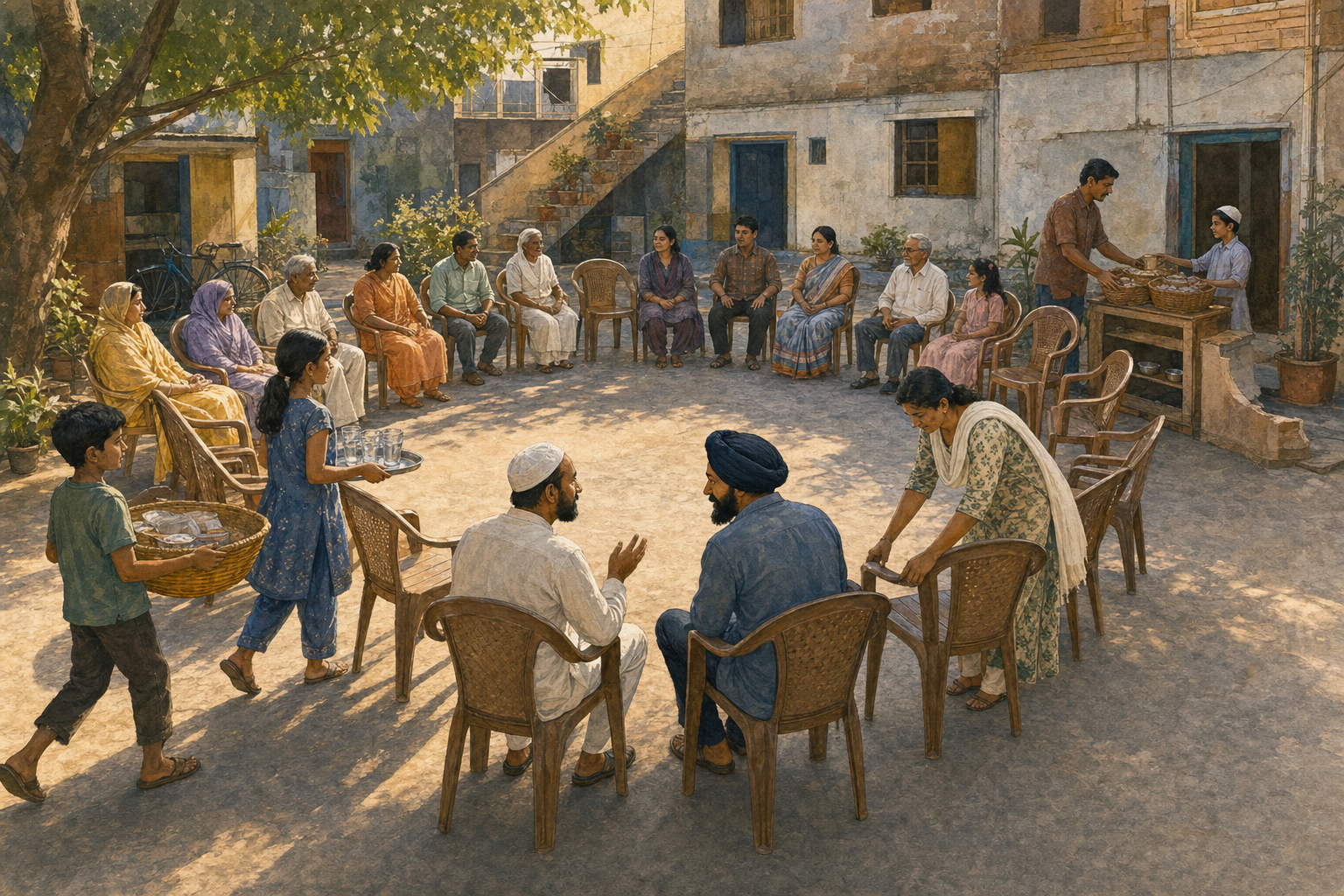
The racialized Aryan-Dravidian binary and a modern generalization about a religious community are not the same claim. They do share a dangerous method: a limited fact about a word, event, speaker, or institution is expanded into a moral judgment about millions of people.
There are also two circles of unity to protect. Hinduism, Buddhism, Jainism, and Sikhism have interwoven histories and ethical resonances, but unity does not make their teachings interchangeable. Hindu-Muslim civic and interfaith trust is a wider relationship; it does not require either community to conceal disagreement or accept an unfair allegation. In both circles, solidarity becomes durable only when difference can be named without turning difference into inherited guilt.
Use the same grammar of fairness every time:
- Name the person, statement, institution, or policy you are criticizing. Do not substitute an entire faith or civilization for the actual actor.
- Describe the position accurately before opposing it. Context may not excuse a claim, but it is necessary if your criticism is to be truthful.
- Distinguish criticism of an idea from contempt toward the people associated with it.
- Apply a symmetry test: would you accept this evidence and wording if the accusation targeted your own community?
- Do not use harmony as a reason to ignore white supremacy, casteism, Hinduphobia, or communal profiling. Name the wrong precisely and keep collective blame out of it.
This discipline matters especially when a public figure speaks about a community. Greater reach brings a greater duty to avoid sweeping claims, but a careless statement still belongs to the speaker; it does not become evidence against everyone who shares the speaker’s religion. Critique becomes more constructive when it targets verifiable words and ideas instead of assigning motives to whole groups.
Dharmic virtues give this discipline practical form. Satya requires an accurate account of what was said and what the evidence establishes. Ahimsa restrains deliberate distortion and dehumanizing speech. Karuna asks you to listen closely enough to understand the concern before answering it. None of these virtues requires passivity. They make disagreement more exact.
A pro-Hindu response should therefore be pro-truth. You need not accept a false allegation in order to appear tolerant, and you need not demean Muslims, Dravidians, Dalits, northerners, southerners, or any other community in order to appear strong. Civilizational confidence is most credible when it can defend Dharma without borrowing the racial categories that colonial and supremacist ideologies imposed.
Key takeaways
- Arya in Sanskrit carries an ethical sense such as noble or honorable; it is not an ancient biological race label.
- Keep lexical, linguistic, historical, genetic, and moral claims separate. Evidence for one does not automatically prove the others.
- Migration and Out of India interpretations should be examined through transparent methods, while racial superiority remains outside the bounds of legitimate inference.
- Criticize the exact claim, speaker, or institution. Do not convert an individual statement into communal guilt.
- Use Satya, Ahimsa, and Karuna as working rules for accurate representation, restrained speech, and serious listening.
The next time a colonial identity claim reaches you, copy the exact sentence before replying. Mark where it moves from fact to inference, from inference to value judgment, or from one person to an entire community. Challenge the earliest unsupported move. If the conversation survives that precision, it can produce understanding; if it does not, you have still defended the historical record without helping contempt spread.
References
- DharmaRenaissance Blog — How the ‘Aryan Race’ Myth Persists: Colonial Pseudoscience, White Supremacy, and Dharmic Unity
- DharmaRenaissance Blog — A.R. Rahman’s BBC Row: Constructive Lessons for Hindu-Muslim Harmony and Dharmic Unity
