

If you are trying to understand why Pakistan’s politics so often appears to define the country against India, do not begin with the claim that Pakistanis lack culture or belonging. That confuses a society with the doctrine of its state. Begin with a narrower question: what national story did Pakistan’s governing institutions need after Partition, and who gained power from keeping India at the centre of that story?
This distinction changes how you read military rule, Islamization, Kashmir and repeated confrontations with Bharat. It also keeps criticism aimed where it is strongest: at state ideology and the military establishment, rather than at every Pakistani citizen or at Islam as a faith.
Separate civilizational inheritance from state doctrine
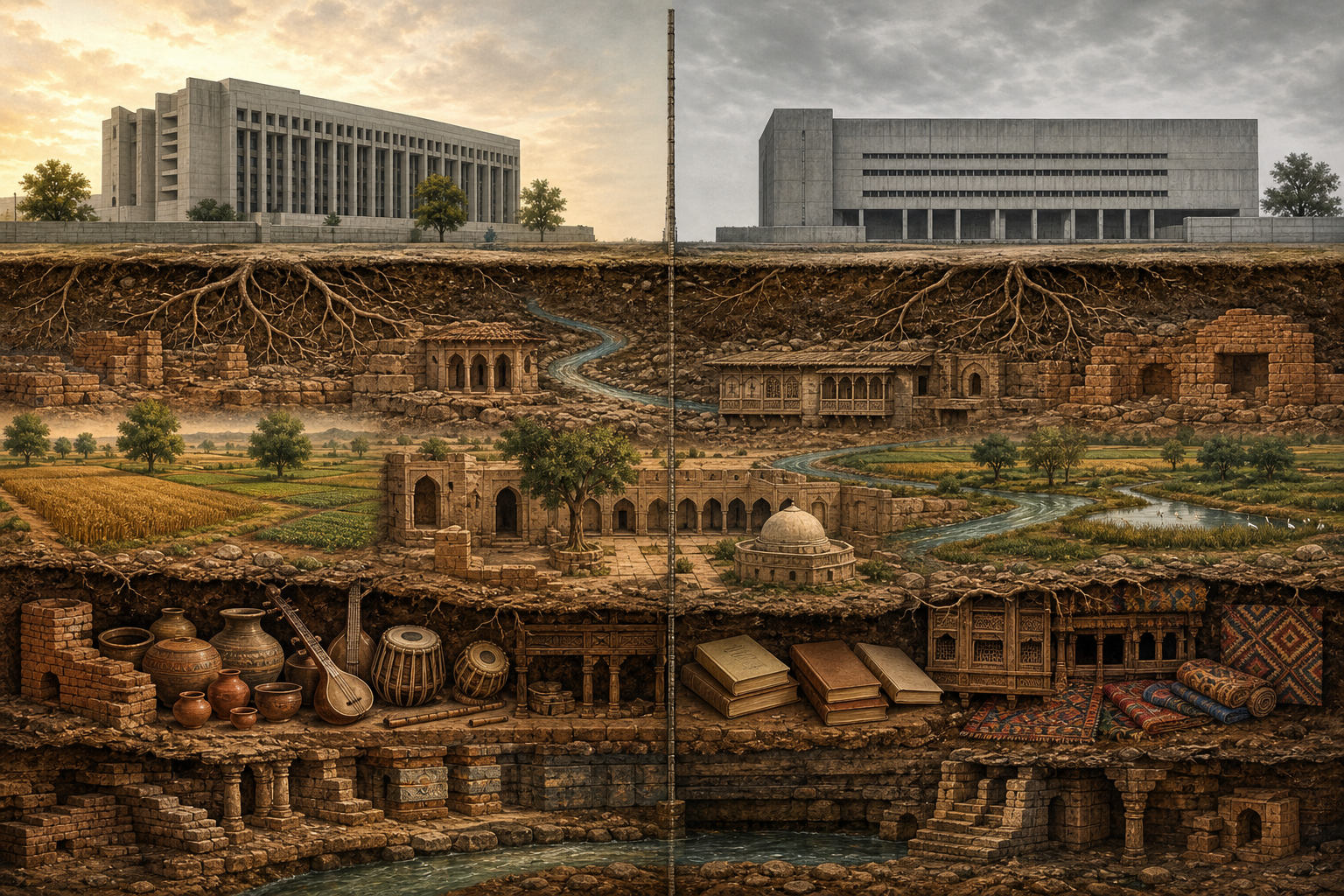
Partition created a new sovereign border. It could not erase the histories, memories and cultural inheritances formed over centuries on the subcontinent. A political state may choose a new official narrative, but it cannot make its society civilizationally unrelated to the land surrounding it.
That is the tension at the heart of Pakistan’s identity problem. The state was justified through the Two-Nation Theory, which treated the Muslims and Hindus of pre-Partition India as separate nations requiring separate political destinies. Yet religious distinction alone did not supply a complete account of Pakistan’s culture, territory or future. The new state still had to explain what it was for, not merely whom it had separated from.
A useful way to examine the issue is to distinguish three layers that are often collapsed into one:
- Civilizational inheritance: the accumulated history and cultural memory of the land and its peoples. A border can divide political authority without making this inheritance disappear.
- Religious belonging: the faith through which individuals and communities understand themselves. Muslim identity need not be identical to a permanent political conflict with India.
- State doctrine: the story promoted by institutions to justify policies, define threats and establish who is entitled to rule.
Pakistan’s difficulty becomes clearer when the third layer tries to control the first two. In a formulation attributed to General Zia-ul-Haq, Egypt and Turkey could remain themselves without becoming aggressively Islamic, whereas Pakistan risked being absorbed by India’s civilizational presence if it did the same. The revealing element is not simply the emphasis on Islam. It is the premise that Pakistan could remain distinct only through an assertive religious opposition to India.
When you encounter a claim about Pakistan’s “Islamic identity,” therefore, ask a second question: is it describing the religious life of its people, or is it prescribing an India-facing doctrine for the state? Those are different claims, with different political consequences.
Why an India-centred identity served military dominance
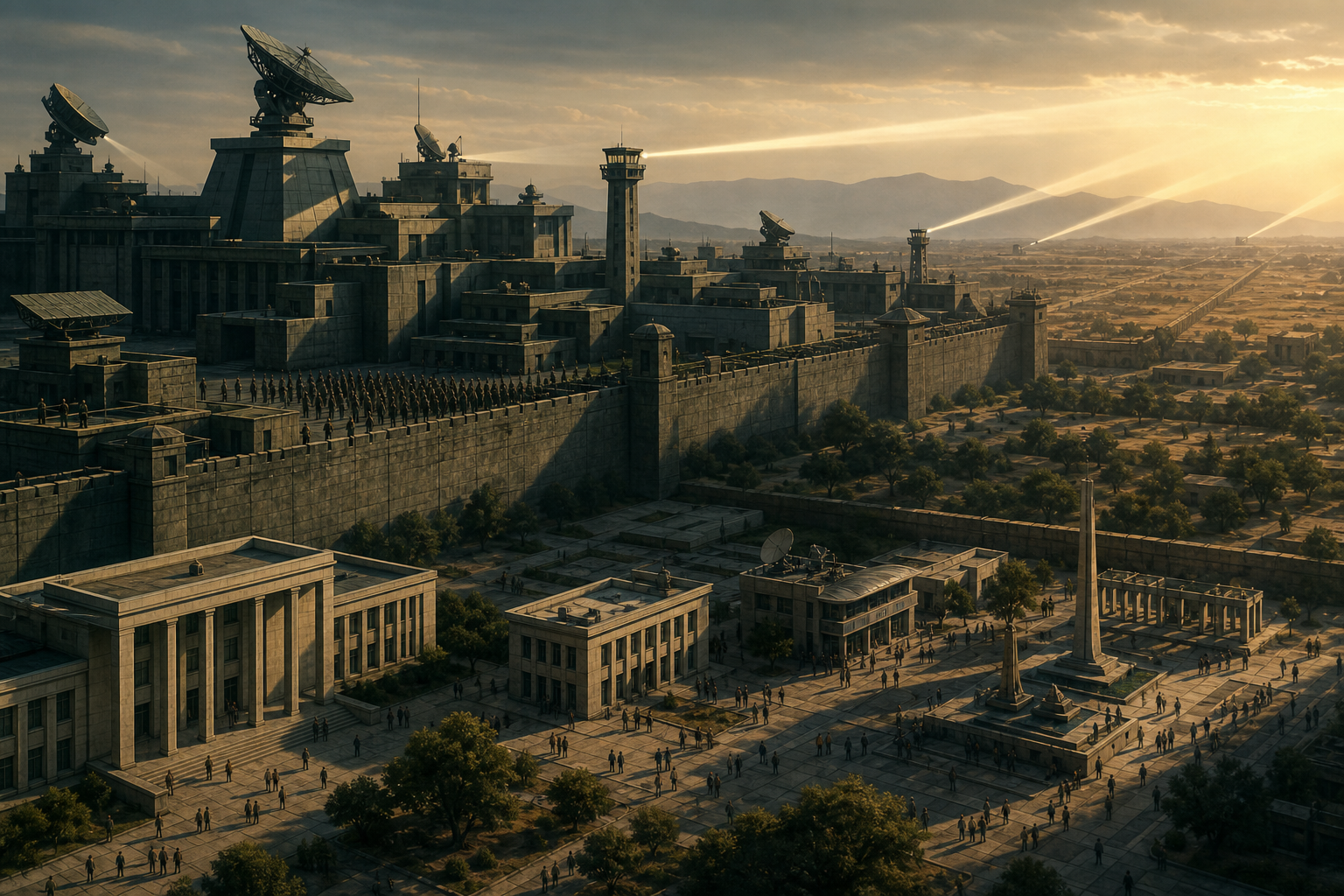
The Pakistani military did not invent every disagreement with India. Partition, Kashmir and the violence surrounding the creation of the two states produced real disputes. But a continuing dispute can also become an institution’s permanent justification for power.
After the military seized control of Pakistan’s state machinery in 1958, hostility towards India offered more than a foreign-policy position. It allowed the military to present itself as the indispensable guardian of the nation. Stephen Cohen described this as a military-bureaucratic vision being imposed on Pakistan while axiomatic distrust of India became part of the governing system.
The mechanism is a reinforcing political loop:
- India is presented as an enduring threat to Pakistan’s existence, not merely as a neighbouring state with which Pakistan has disputes.
- The institution claiming the greatest ability to resist that threat acquires a privileged place within the nation.
- Civilian accommodation with India can then be portrayed as weakness, surrender or disloyalty.
- When confrontation fails, the failure does not necessarily discredit the doctrine. It can instead be used to demand greater unity, vigilance and military influence.
This explains why military setbacks need not produce a durable change of direction. If opposition to India is merely a policy, failure invites revision. If opposition to India is treated as proof of Pakistan’s nationhood, revision begins to look like an attack on the nation itself.
When you assess a Pakistani security narrative, do not ask only whether its stated concern is real. Ask what political arrangement follows from the way that concern is framed. Does the narrative permit an elected government to negotiate, compromise and change course? Or does it make the military the permanent interpreter of the national interest?
Four confrontations that tested the founding narrative
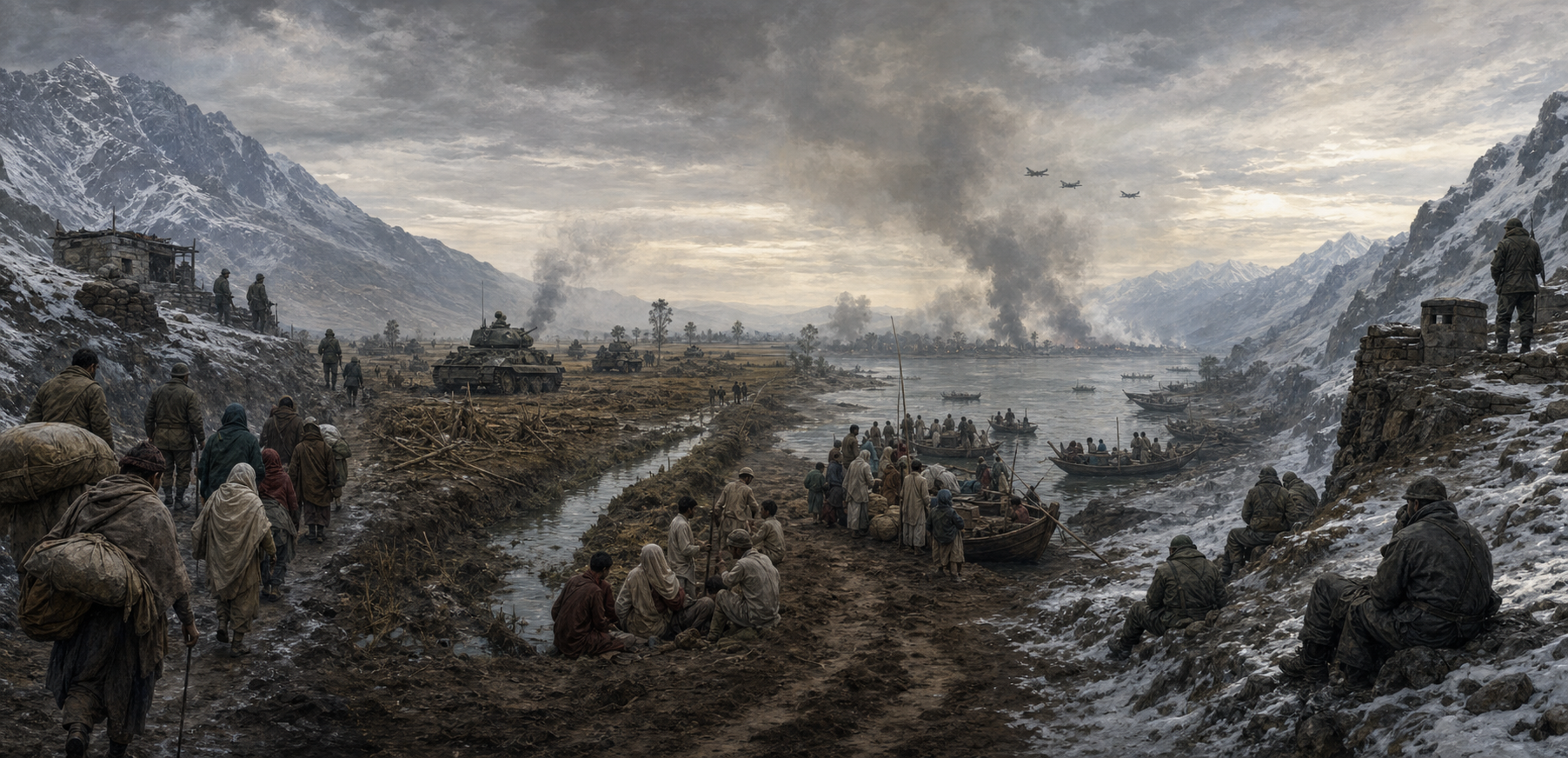
A chronology is more useful than a collection of slogans. Four episodes show how the attempt to secure Pakistan against India repeatedly strengthened the institution directing the confrontation, even when the outcome weakened Pakistan’s larger national claim.
| Episode | What was attempted or exposed | What you should notice |
|---|---|---|
| October 1947 Kashmir invasion | Pakistan’s state machinery moved against Kashmir while the new government in Delhi was still coping with the immediate consequences of Partition. | The India relationship became confrontational at the beginning of the new state’s life, before a stable civilian national compact had matured. |
| 1965 war | General Ayub Khan attempted to wrest Kashmir from an India thought to be exhausted after its 1962 defeat. | A perceived moment of Indian weakness encouraged another military gamble rather than a re-examination of the India-centred strategy. |
| 1971 war | Pakistan’s dismemberment dealt a severe blow to the proposition that religion by itself could sustain one state for the Muslims of South Asia. | A shared religious category had not resolved the problem of political nationhood. The foundational claim required more than repeated assertion. |
| 1999 Kargil conflict | The operation exposed the elected government’s limited control over decisions made by the military leadership during dealings with India. | The civil-military imbalance was not incidental to India policy; it was visible within the making of that policy. |
These episodes do not prove that every Pakistani institution, leader or citizen held one unchanging view. They do reveal a recurring pattern in which military initiatives against India survived their own failures as an organizing principle.
The decisive moment in this sequence is 1971. A state founded as a homeland for South Asian Muslims lost its eastern wing despite the shared religious identity invoked at Partition. That outcome did not make Islam unimportant to Pakistanis. It demonstrated that religion alone could not settle questions of political representation, state legitimacy and national cohesion.
Use 1971 as a test whenever the Two-Nation Theory is presented as a complete explanation of nationhood. If the theory cannot explain why a shared Muslim identity failed to preserve one Pakistani state, it cannot carry the entire weight later placed upon it.
The costs of making India the permanent opposite

A country can oppose a neighbour on a specific border, security or diplomatic question while still defining its own aims positively. The deeper problem begins when the neighbour becomes the reference point through which nearly every national choice is interpreted.
An India-centred identity imposes several costs on Pakistan:
- Strategy becomes reactive. Success is measured by whether India is obstructed, pressured or embarrassed, rather than by whether a policy builds a more stable Pakistan.
- Military failure becomes politically survivable. The institution can present another confrontation as necessary because the permanent threat remains, even when earlier ventures failed.
- Civilian diplomacy becomes suspect. An elected leader seeking accommodation with India risks colliding with a national story in which vigilance against India is treated as a condition of survival.
- External dependence becomes easier to rationalize. A larger power can offer arms, diplomatic cover or strategic utility while using Pakistan in its own competition with India.
- A positive national story is crowded out. Energy spent proving that Pakistan is not India is energy unavailable for explaining what Pakistan seeks to become on its own terms.
The sharpest allegations go beyond conventional rivalry. Critics contend that the anti-India mission expanded into the sponsorship of terrorism inside India and the cultivation of anti-India power centres in India’s neighbourhood. These are claims about the conduct of state machinery and must be stated with that precision. They should not be converted into a collective accusation against Pakistan’s entire population.
The same precision is needed when discussing China. Pakistan may gain support from a powerful partner, but support does not automatically produce strategic autonomy. The critical view is that Pakistan’s fixation on India created an opening for China to treat it as a proxy, weapons market and dependent client in China’s own rivalry with India. Whether one accepts every part of that characterization or not, it identifies the right question: does an alliance enlarge Pakistan’s independent choices, or does it make Pakistan useful mainly as an instrument against Bharat?
You can apply a simple counterfactual test to any policy. Imagine that competition with India were removed from the calculation. Would the policy still advance a clearly stated Pakistani objective? If the answer is unclear, the policy may be sustaining an oppositional identity more than a national interest.
How to discuss Pakistan’s identity with precision
Serious criticism becomes weaker when it treats Pakistan, its army, its governments, its religious communities and its citizens as interchangeable. The distinction is not a courtesy added to the analysis. It is necessary for understanding how power actually works.
- Name the actor. Say “the military establishment,” “an elected government,” “a particular ruler” or “a state doctrine” when that is what you mean. Do not assign an institutional decision to an undifferentiated people.
- Distinguish faith from instrumentalized faith. Islam can be a sincere source of personal and communal identity without requiring permanent hostility to India. The relevant criticism concerns the use of an aggressive religious posture to validate state separation and military authority.
- Do not confuse shared civilization with identical sovereignty. Recognizing the subcontinent’s connected inheritance does not by itself decide what today’s borders should be. It does, however, expose the artificiality of pretending that Partition erased everything preceding it.
- Test positive content. Ask what the national vision promises its own people beyond security against India. A durable identity needs purposes that remain meaningful even when the external enemy is absent.
- Follow institutional incentives. When a threat narrative persists after repeated strategic failures, examine which institution retains authority because the narrative persists.
- Keep contested claims properly bounded. Criticism of terrorism sponsorship, proxy relationships or military dominance should identify the alleged policy and responsible institution. Precision makes the case more credible and harder to dismiss as hostility towards an entire population.
Key takeaways
- Pakistan’s identity problem is not an absence of culture; it is the difficulty of building a positive state doctrine from a founding logic centred on separation from India.
- The military’s rise after 1958 made the India threat useful as both a security narrative and a justification for institutional dominance.
- The confrontations of 1947, 1965, 1971 and 1999 should be read as tests of the political system, not merely as disconnected military episodes.
- The 1971 rupture showed that shared religion alone could not guarantee one coherent nation-state.
- The best way to evaluate Pakistan’s policies is to ask whether they serve a positive domestic purpose independent of frustrating India.
- Critique is strongest when it separates Pakistani citizens and Muslim faith from the conduct of the military establishment and state machinery.
The next time a Pakistani policy is explained as necessary because of India, run four checks: identify the decision-maker, name the positive Pakistani objective, ask whether civilians can revise the policy, and test whether it would still make sense without India as the permanent opposite. That will tell you far more about Pakistan’s post-Partition identity than another round of patriotic slogans.
References
