
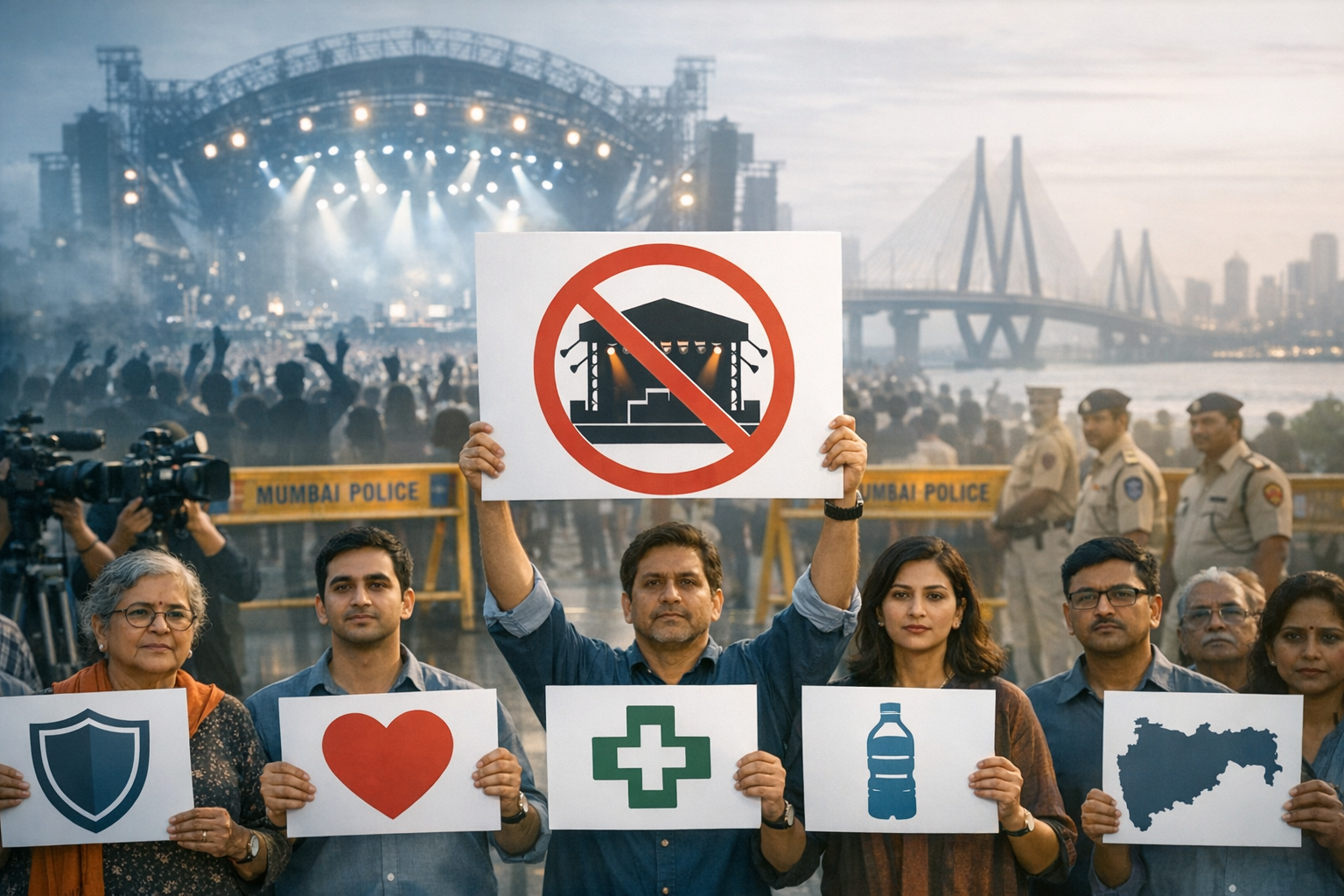
The Dadar protest led by the Nasha Virodhi Sangharsh Abhiyan has sharpened public debate in Mumbai over youth safety at large-scale music events. In the aftermath of the reported death of a young attendee at a music concert in Worli, the collective called for a permanent ban on the Sunburn Festival across Maharashtra and for legal action against organisers and officials they believe failed to ensure adequate safeguards.
Framed as a public health and governance question rather than a cultural one, the demonstration channels widespread anxiety among parents, educators, and community leaders about drug abuse among youngsters. The campaign situates the Worli incident within broader patterns observed at nightlife and festival settings globally, urging Maharashtra authorities to adopt prevention-first policies that place youth safety at the centre of event management and oversight.
Sunburn Festivalone of India’s most recognisable electronic dance music brandshas historically attracted significant footfall and economic activity. Protesters argue, however, that the scale and perceived risk environment of EDM events justify the most stringent oversight. Their principal demand is categorical: a state-wide, permanent ban alongside time-bound inquiries into potential compliance gaps at high-footfall music events.
Any response must operate within India’s legal architecture. The Narcotic Drugs and Psychotropic Substances (NDPS) Act, 1985, criminalises production, trafficking, and consumption of illicit substances while also providing Section 64A immunity from prosecution to individuals who voluntarily seek treatment for addiction. State police and municipal licensing regimes govern permissions, security, crowd control, and vendor operations for mass gatherings, creating multiple points at which prevention and enforcement canand shouldinterlock in Maharashtra.
Public health literature on mass gatherings emphasises a layered defence model. At a minimum, risk assessments should address crowd density thresholds, ingress and egress capacity, hydration and cooling stations, medical triage with trained paramedics, rapid transport linkages to tertiary hospitals, and clear public-address protocols. For festivals where psychoactive substance risks are plausibly elevated, international best practices additionally point to staff training in overdose recognition and response, on-site medical observation areas for hyperthermia and dehydration, and unambiguous amnesty pathways that prioritise life over stigma.
India already hosts guidance relevant to these tasks. The National Disaster Management Authority’s crowd management guidelines outline planning, communication, zoning, and emergency drills for mass events. Translating such principles to music festivals in Maharashtra would entail pre-event multidisciplinary tabletop exercises with organisers, Mumbai Police and state police units, civic authorities, and private medical providers, followed by real-time command-and-control rooms during the event and mandatory post-event incident reviews.
From a regulatory design standpoint, Maharashtra could institute a conditional licensing framework for high-footfall music events. Licenses might be predicated on independent third-party safety audits, live compliance dashboards shared with police and health authorities, mandatory CCTV retention, age verification and wristbanding protocols, vendor accountability contracts, and a zero-tolerance stance on sales or facilitation of contraband under the NDPS Act. Graduated sanctionsranging from heavy fines and multi-year debarments to criminal referrals where warrantedcreate credible deterrence without resorting immediately to blanket prohibitions.
Protesters in Dadar nonetheless insist that risk has crossed an unacceptable threshold and that only a permanent ban on Sunburn will convey the necessary societal resolve. This position draws emotive force from the human cost of the Worli incident: for many families, the headline is not footfall or tourism revenue but the irreplaceable loss of a life and the fear that similar tragedies can recur. That lived reality explains why calls for the strictest possible remedy resonate widely across Mumbai and Maharashtra.
A complementary perspective prioritises youth empowerment alongside enforcement. Schools, colleges, and community organisationsincluding those rooted in Hindu, Buddhist, Jain, and Sikh traditionscan collaborate on evidence-based education about substances, peer support networks, and safe-by-design recreational alternatives. Framed through the dharmic values of ahimsa, seva, and personal responsibility, such initiatives strengthen protective factors without stigmatising young people or alienating cultural communities.
Balancing rights and responsibilities remains essential. Cultural expression and freedom of assembly, protected under Article 19 of the Constitution of India, are subject to reasonable restrictions in the interests of public order, decency, and morality. A durable policy therefore requires transparent criteria: what risk indicators trigger a ban, what remedial steps allow reinstatement, and how due process is assured for organisers and public officials subject to investigation.
Data transparency can lift the debate above conjecture. Maharashtra could mandate anonymised incident reporting for all large events, covering medical cases, crowd crush near-misses, security interventions, and compliance breaches. A state-level repository, overseen by an independent review panel, would permit year-on-year benchmarking and help determine whether targeted regulation is workingor whether categorical bans are justified by evidence.
In enforcement terms, coordinated policing remains pivotal. Focused screening at entry points, canine units where appropriate, surveillance of high-risk zones, and rapid coordination with narcotics units can raise the perceived and actual risk of attempting contraband activity. Clear public messaging that attendees who seek medical help will not face punitive action for doing so, consistent with the spirit of Section 64A, can also save lives and encourage early intervention.
Whatever final course the Maharashtra Government adopts, the Dadar protest led by Nasha Virodhi Sangharsh Abhiyan has surfaced legitimate questions that demand a timely and rigorous answer. The path forward can honour the pain felt in Worli, protect Maharashtra’s youth, and preserve socially valuable cultural spacesif policy is anchored in compassion, accountability, and measurable safety outcomes.
Seen through a dharmic lens, the shared duty is clear: safeguard life, uphold social harmony, and address suffering at its root. When civil society, event organisers, law enforcement, and health systems act together, Maharashtra can set an example for India on how to reconcile cultural vibrancy with uncompromising youth safety.
Inspired by this post on Hindu Jagruti Samiti.
