
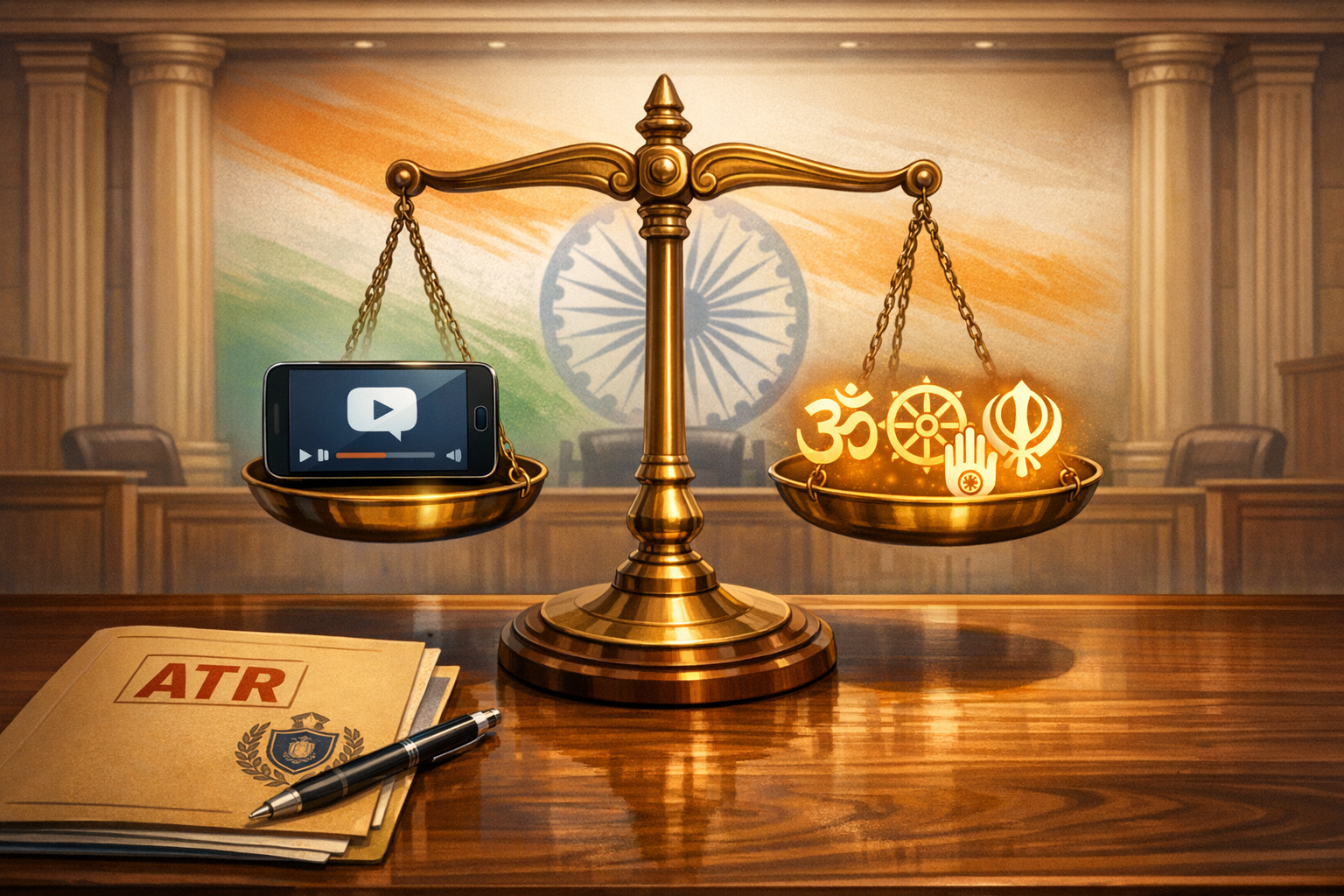
Reports on June 12, 2026 indicate that a Delhi court has sought an Action Taken Report (ATR) from the police on a complaint alleging that a video by YouTuber Dhruv Rathee hurt Hindu sentiments. The request for an ATR is a preliminary procedural step; it neither presumes the truth of the allegations nor determines guilt, but seeks clarity on whether any cognizable offence appears disclosed and what measures, if any, law enforcement has already undertaken.
In practice, magistrates frequently call for ATRs or status reports under the Code of Criminal Procedure (CrPC) to evaluate the trajectory of a complaint. Depending on the facts placed before the court, subsequent routes may include directions under Section 156(3) CrPC to investigate and, if warranted, register an FIR; an inquiry under Section 202 CrPC before issuance of process; or closure at the threshold where no offence is disclosed.
The legal matrix that typically frames allegations of insult to religion includes several provisions of the Indian Penal Code: Section 295A (deliberate and malicious acts intended to outrage religious feelings), Section 153A (promoting enmity between different groups), Section 505(2) (statements creating or promoting enmity, hatred or ill-will), and Section 298 (uttering words with deliberate intent to wound religious feelings). Where content is distributed online, the Information Technology Act, 2000, the Information Technology (Intermediary Guidelines and Digital Media Ethics Code) Rules, 2021, and the blocking framework under Section 69A may also be relevant in narrowly tailored circumstances.
This legal architecture operates within the constitutional balance between Article 19(1)(a) (freedom of speech and expression) and the reasonable restrictions allowed by Article 19(2), including public order, decency, morality, and incitement to an offence. Simultaneously, Article 25 affirms freedom of conscience and the right to freely profess, practice, and propagate religion for all persons, underscoring the equal dignity of Hindu, Buddhist, Jain, and Sikh traditions in India’s plural republic.
Supreme Court jurisprudence has clarified thresholds for applying these penal provisions. In Ramji Lal Modi v. State of Uttar Pradesh (1957), the Court upheld Section 295A while confining its reach to aggravated, intentional acts. In Manzar Sayeed Khan v. State of Maharashtra (2007), the Court emphasized mens rea and a proximate link to public disorder for offences such as Section 153A. Shreya Singhal v. Union of India (2015) distinguished advocacy and discussion from incitement, striking down Section 66A of the IT Act. In Amish Devgan v. Union of India (2020), context, intent, and good faith were recognized as salient considerations when assessing allegedly offensive speech.
Following an ATR request, common procedural pathways include police verification of the complaint; registration of an FIR if cognizable offences appear disclosed in line with Lalita Kumari v. Government of Uttar Pradesh (2013); a closure or action-noted report where the ingredients of an offence are absent; court-directed investigation under Section 156(3) CrPC; or an inquiry under Section 202 CrPC prior to issuance of process. At each stage, remedies such as anticipatory bail, quashing petitions under Section 482 CrPC, and writ jurisdiction remain available to affected parties.
Without adjudicating the merits of the complaint or the content of the video, the episode reflects heightened judicial attention to digital speech that intersects with faith. For high-reach creators such as Dhruv Rathee, it illustrates both the societal sensitivity surrounding sacred traditions and the legal responsibilities that accompany mass communication in a large, diverse democracy.
For many viewersfrom college campuses to family living roomsthe line between critique and contempt can feel personal when sacred narratives are involved. Recognizing that emotional reality while insisting on factual rigor is essential to maintaining both compassion and clarity in public discourse. Such an approach supports religious coexistence in India by enabling robust debate about ideas while discouraging disparagement of communities.
Platform governance also plays a role. Intermediaries operating under the IT Rules, 2021 maintain grievance redressal mechanisms, designated compliance officers, and notice-and-takedown processes. These obligations do not permit prior censorship, but they do enable structured responses to user complaints and lawful orders, thereby reducing escalation risks without undermining legitimate expression.
Responsible digital citizenship benefits from steady norms: distinguishing critique of ideas from disparagement of believers; providing context, citations, and good-faith framing; avoiding sensational thumbnails and captions that overstate claims; and responding promptly to reasoned feedback. Combined with due process, these practices advance both free speech and religious harmony across dharmic traditionsHinduism, Buddhism, Jainism, and Sikhism.
In the immediate term, the ATR will clarify whether the police view the complaint as disclosing a cognizable offence, what initial steps have been taken, and what investigative or procedural course is proposed. Whatever the next steps, the broader principle remains constant: freedom of expression and reverence for faith are co-constitutive values in India’s Constitution and can be advanced together through accuracy, empathy, and mutual respect.
Because the detailed complaint and the contested video are not reproduced here, no conclusions are drawn on the factual or legal culpability of any party. The discussion outlines the general legal framework that typically applies when courts seek an Action Taken Report on allegations of hurt religious sentiments.
Finally, the wider social context includes concerns about Hinduphobia and the misrepresentation of Hindu practices in public discourse. Addressing such issues through lawful means, civil engagement, and accurate scholarship strengthens trust among dharmic communities and aligns with the constitutional commitment to equality, fraternity, and religious coexistence in India.
Inspired by this post on Struggle for Hindu Existence.
