

If you can pay a vegetable seller, a taxi driver or a neighbourhood temple by scanning a small QR code, you already know what UPI changed. The harder question, ten years after its public rollout, is why this Indian system became ordinary life while so many digital-payment products remained optional conveniences.
The answer matters beyond technology. UPI shows how Bharat can build national infrastructure without forcing everyone into one bank, one app or one language. It also gives you a practical standard for judging the next decade: preserve interoperability, strengthen trust and never confuse transaction volume with a finished inclusion project.
The numbers describe a habit, not a pilot
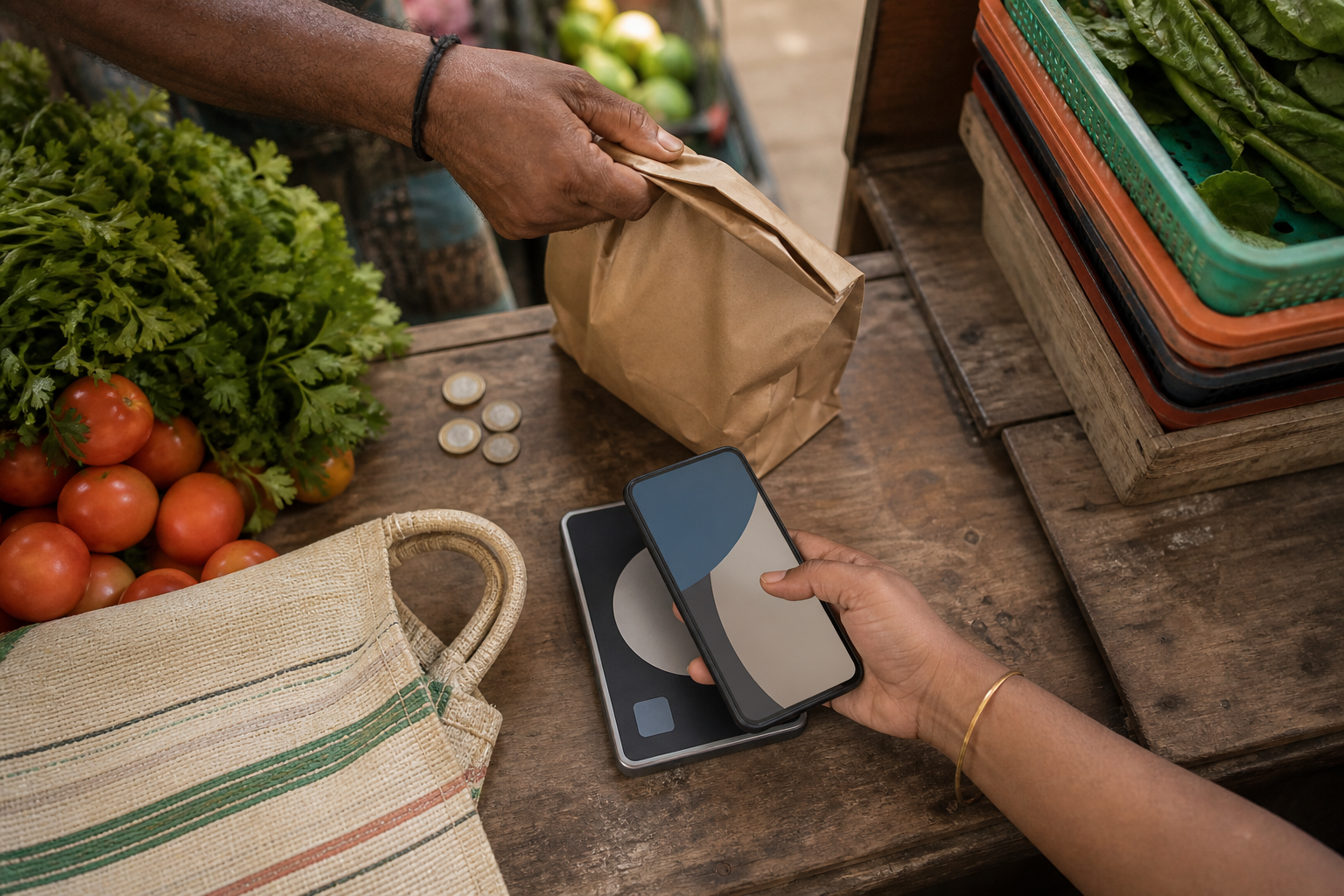
UPI began its public journey in August 2016 with 21 member banks and about 90,000 transactions in its first month. By July 2026, it was handling 2,365.8 crore transactions in a single month, moving ₹29.87 lakh crore. The network had expanded to 741 banks.
Those figures tell you more than a familiar growth story. A payment method becomes infrastructure when people stop treating it as a special event. The decisive achievement is not that an urban professional can pay through a smartphone. It is that the same basic transaction can sit inside a tea stall, a family shop, a large business and a bank’s consumer app without each participant joining the same private wallet.
UPI now accounts for roughly 84 to 85 percent of India’s retail digital-payment volume. Read that description carefully. It is a share of retail digital payments, not a claim that 84 to 85 percent of all retail commerce is digital, that cash has disappeared or that the same proportion of Indians uses UPI. Keeping the denominator straight prevents a genuine achievement from being turned into a misleading slogan.
The practical test of scale is therefore not the anniversary total alone. Notice where UPI has become the assumed option: whether a small merchant displays a working QR code, whether customers from different banks can pay it and whether the merchant can verify the credit without depending on the payer’s screen. Those ordinary behaviours reveal adoption more clearly than an app-download count would.
Interoperability turned choice into a growth engine

Early digital wallets commonly operated as closed loops. The payer and recipient often had to participate in the same company’s system. That model makes every new user ask two questions: does the other person have my wallet, and will this merchant accept it? Each incompatible network adds friction.
UPI changed the unit of competition. It was built as an open, API-based protocol through which bank-backed applications could transact across participating banks and apps. The user could choose a suitable interface while the merchant did not need a separate acceptance arrangement for every consumer brand. Settlement remained within regulated banks.
Interoperability was empirically identified as the primary driver of adoption in research published through an IMF Fintech Note in June 2025. The mechanism is straightforward. A user may prefer one app because of trust, language or ease of use, while a family member prefers another. The merchant does not have to resolve that disagreement. A common payment protocol lets both choices reach the same acceptance point.
This distinction should change how you choose a UPI app. Do not assume that the largest consumer brand owns the network or is the only way to reach a merchant. Compare the things that actually differ at the app layer: whether you understand its prompts, whether recipient details are displayed clearly, whether transaction history is easy to retrieve and whether support and dispute options are easy to find. Interoperability gives you permission to judge the interface instead of following a network-effect illusion.
A merchant can apply the same principle. Display a proper UPI QR rather than presenting payment as exclusive to one app, and test it with more than one participating app before relying on it during a busy period. Confirm that the displayed payee name matches the intended account. The point of an interoperable standard is lost if a badly labelled or untested acceptance setup recreates confusion at the counter.
Bharat’s deeper achievement was institutional coordination

It is tempting to tell UPI’s history as the triumph of one application or one inventor. That misses the architecture. Technologists Nandan Nilekani and Pramod Varma helped shape the technical approach, while former RBI governor Raghuram Rajan and NPCI’s A.P. Hota are associated with the institutional groundwork. Banks supplied the regulated account and settlement layer. Consumer applications competed above it. Merchants and citizens completed the system by using it.
The arrangement separated two jobs that are often bundled together. Consumer-facing companies could improve interfaces and compete for users, but they did not have to become the final custodians of the whole banking relationship. Regulated institutions continued to carry the systemic settlement function. That division allowed innovation at the edge without making every colourful app a separate financial island.
For a Dharmic readership, the useful civilizational lesson is not a forced spiritual metaphor. It is the practical possibility of unity without uniformity. Hundreds of banks, several applications, many languages and very different kinds of merchants can participate because they follow a shared protocol. Diversity is preserved at the point where people make choices; coherence is enforced where systems must communicate.
That is a more demanding form of national confidence than merely preferring an Indian brand. It asks whether Bharat can define rules that are open enough for participation, precise enough for machines and trustworthy enough for daily economic life. When you evaluate another digital public project, ask four concrete questions: Can people change service providers without abandoning the network? Can a small participant reach users of other providers? Is the regulated responsibility clear? Can innovation occur without breaking compatibility?
UPI also offers a lesson to countries observing Bharat’s rise. A nation does not necessarily need one government-built super-app or one private monopoly to achieve coordinated scale. It can establish a common transactional language and allow multiple institutions to build usable services around it. The transferable insight is the architecture of participation, not the visual design of any particular Indian app.
Use UPI with the discipline its scale now requires

Convenience can make a financial action feel casual. The money is not casual. UPI’s success means users and merchants should treat a QR payment with the same care they would apply to any bank transaction, even when the amount is small.
Before you approve a payment
- Read the recipient name shown by your app after scanning the QR code. A sticker can be replaced, an account can be selected incorrectly and a familiar location does not guarantee that the digital destination is correct.
- Check the amount and whether the screen represents a payment or a request to collect money. Approving a collect request sends money out of your account; it is not a step required merely to receive an ordinary payment.
- Enter a UPI PIN only inside the payment flow you deliberately initiated or reviewed. Do not share the PIN or disclose it to someone claiming that it is needed to release an incoming payment.
- If a transaction is pending or appears to have failed, inspect its status and your account record before paying again. Repeating the payment immediately can create a second successful debit if the first transaction was merely delayed.
- Use the app’s recorded transaction details and your bank’s official support route for a dispute. Do not rely on a phone number supplied in an unsolicited message or by an unknown person at the other end of a call.
These checks are deliberately brief. If a payment flow makes it difficult to see the recipient, amount or transaction status, that is a reason to reconsider the app. UPI gives you application choice; use that choice to reward clarity rather than tolerating a confusing interface.
Before a merchant treats the sale as complete
- Verify the credit through the merchant’s own application, bank record or authorised payment notification. A screenshot on the customer’s phone is not proof that money reached the intended account.
- Keep the QR code physically visible but regularly check that it has not been covered or replaced. Confirm that a test scan displays the correct business or account name.
- Retain the transaction reference when resolving a mismatch. Do not ask a customer to expose a PIN, one-time password or other confidential credential; none of those details proves that your account was credited.
- Maintain a backup way to accept payment. An interoperable network reduces dependence on one consumer app, but a phone, data connection, bank service or acceptance device can still be unavailable at the moment of sale.
At national scale, the same discipline becomes policy. High transaction volume does not eliminate the need for fraud prevention, reliable grievance handling, resilient bank connections or accessible interfaces. It raises the cost of neglecting them. Nor does a bank-account-based smartphone payment system, by itself, prove that every person has suitable connectivity, digital confidence or meaningful access to formal finance. The next inclusion claim should be measured directly rather than inferred from the size of the payment stream.
Key takeaways for UPI’s second decade
- Scale is real, but read it accurately. July 2026’s 2,365.8 crore transactions show extraordinary use; the 84 to 85 percent figure refers specifically to retail digital-payment volume.
- Interoperability is the central design achievement. Users can choose among compatible apps while merchants retain a common acceptance path.
- The app is not the entire system. Consumer interfaces compete above an account and settlement structure anchored in participating regulated banks.
- Unity did not require uniformity. UPI coordinated hundreds of banks and varied user interfaces through a shared protocol rather than one compulsory consumer brand.
- Convenience must be paired with verification. Users should check the recipient and amount; merchants should verify credit in their own records rather than trusting a screenshot.
- The next test is quality, not volume alone. Resilience, understandable dispute handling, safety and genuinely broad access should determine whether UPI’s second decade deepens the first decade’s achievement.
The next time you scan a UPI code, pause long enough to read the payee name before approving the debit. When you judge a new payment rule or product, ask whether it preserves cross-app choice and clear bank responsibility. Small acts of verification protect you now; insisting on interoperability and accountability protects what Bharat built.
References
