
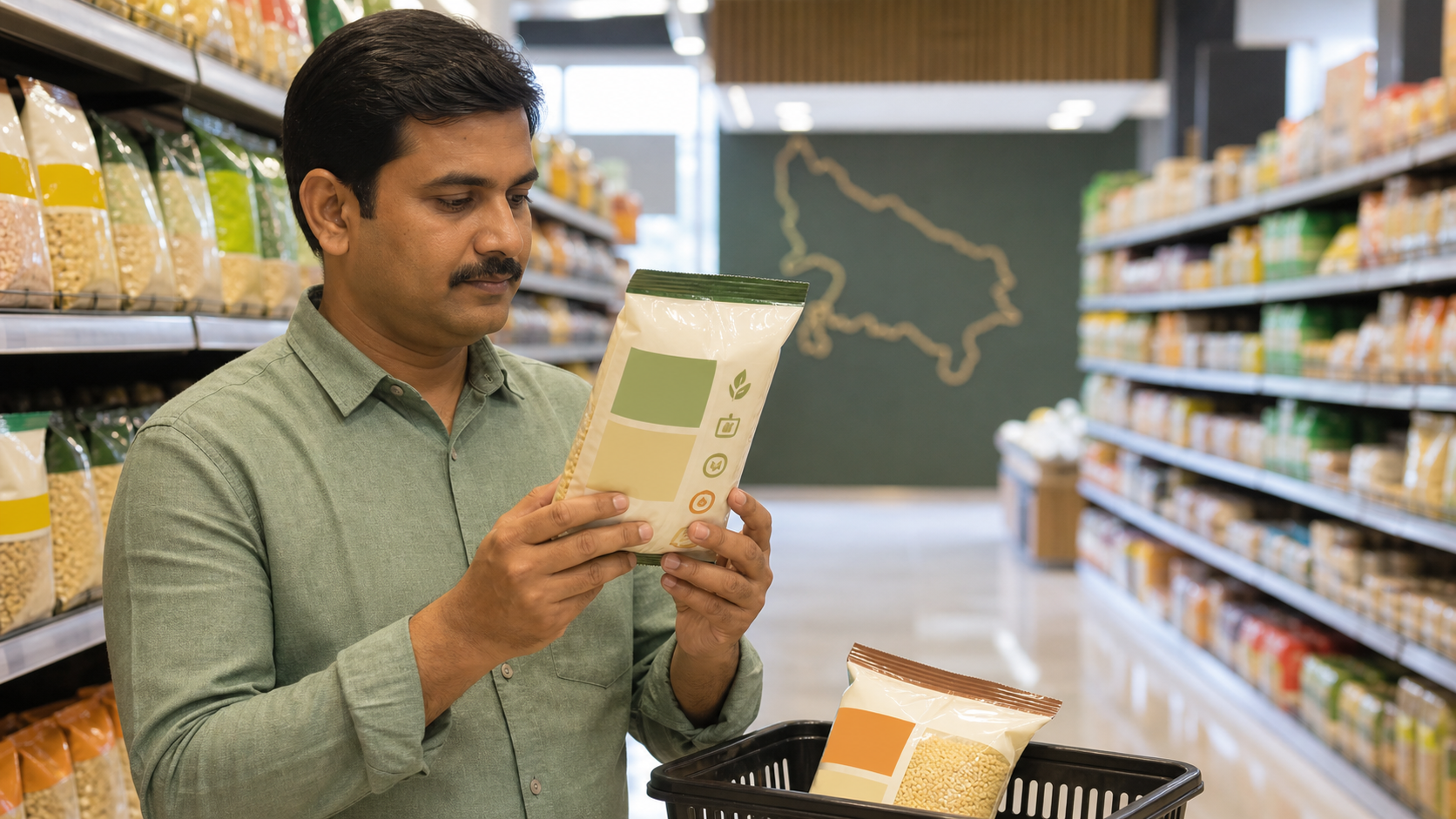
If you find a halal mark on a product offered for sale in Uttar Pradesh, do not let one logo answer five different questions. You need to separate the product’s legal route, its safety and quality marks, its ingredients, your dietary rules, and your personal ethical or religious choice.
That distinction gives you a calm way to shop and a defensible way to manage stock. It also prevents an important policy debate from collapsing into rumours about product safety or hostility toward a community.
Key takeaways
- Uttar Pradesh announced restrictions in late 2023 covering halal-certified products intended for domestic consumption within the state, while export-linked use was allowed to continue under national law.
- The stated scope reaches production, storage, distribution, and sale. For a business, checking the retail shelf alone is not enough.
- A halal mark is a faith-linked certification claim. It does not replace FSSAI compliance, the green or brown dietary symbol, a relevant ISI mark, or the ingredient declaration.
- If you are a shopper, read and document the package, ask the retailer a precise question, and choose an alternative if the claim does not meet your needs. Do not confront staff or tamper with stock.
- If you manufacture, distribute, or sell affected goods, classify every relevant stock-keeping unit by destination and obtain current legal guidance before producing, relabelling, moving, or selling uncertain inventory.
What Uttar Pradesh restricted, and what that does not tell you
In late 2023, the Uttar Pradesh government announced restrictions on the production, storage, distribution, and sale of halal-certified products for domestic consumption within the state, with export-linked use continuing under national law. Two facts therefore matter together: whether the product carries the relevant certification and whether the goods are meant for the Uttar Pradesh domestic market or for export.
Calling this simply a ban on halal food loses important information. The issue is certification, and halal references can appear on non-food goods such as soaps and garments. The announced restriction also addresses several stages of the supply chain rather than only the final transaction at a shop counter.
Certification status and product safety remain separate questions. A halal logo does not establish that a product is safer, and the restriction does not by itself establish that the underlying product is unsafe. For food, FSSAI compliance remains the first safety-related check. The green or brown symbol addresses a different dietary classification, while an ISI mark applies to quality or conformity in relevant product categories.
The export exception should not be treated as a loose label that can be attached to any disputed stock. A business relying on it needs a documented export route and must still follow the applicable national requirements. Likewise, a logo on a package cannot tell you the applicable penalty, notice procedure, product-category interpretation, or present court status. Businesses facing those questions should consult the operative government order and current legal counsel before acting.
Use this five-check routine when you read a product label

The fastest way to make a sound purchase is to inspect labels in a fixed order. Each check answers a different question, so do not allow an optional certification mark to distract you from a mandatory or personally decisive disclosure.
- Identify the product’s market route. Is it being offered for ordinary domestic sale in Uttar Pradesh, or is it clearly part of an export-linked supply chain? A shopper should not assume that a domestic retail item qualifies for the export exception merely because a seller says it is also exported.
- Check the applicable safety framework. On food, look first for FSSAI compliance information. On a non-food product, use the safety and regulatory disclosures relevant to that category. A religious mark is not a substitute for either.
- Check the dietary classification you actually follow. Use the green or brown symbol where applicable, then read the ingredient declaration. A vegetarian symbol, vegan claim, and halal claim are not interchangeable.
- Look for product-specific quality marks. An ISI mark matters only in categories for which it is relevant. Do not assume that the presence of one mark verifies every other claim printed on the package.
- Apply your household’s values last and deliberately. Halal, vegan, cruelty-free, and eco-friendly claims answer different ethical or religious concerns. Decide which claims are necessary for you instead of treating a crowded label as a single endorsement.
If you find a halal mark on a domestic retail shelf
First, read every side of the package. Confirm that you are looking at the physical product being sold, not an old online image or a promotional photograph. Note the exact brand, product name, pack size, batch or lot information, seller, location, and date. If photography is permitted, a clear image of the complete label is more useful than a cropped image of the logo.
Then ask the store manager a narrow question: is this item intended for domestic sale in Uttar Pradesh, and has its certification status been reviewed under the state’s restriction? A cashier may not control inventory compliance, so request escalation without turning the exchange into an accusation. If you want to raise the matter with a consumer or enforcement channel, provide the product details rather than making claims about motives you cannot establish.
If your immediate concern is personal choice, you do not need to resolve the whole policy dispute before leaving the shop. Choose a comparable product whose statutory, dietary, and ethical labels you understand. Do not open, cover, peel, or damage the disputed package; that creates a new problem without clarifying compliance.
Businesses need destination control, not a shelf-only check

A retailer may first notice the issue at checkout, but the announced scope begins much earlier. Manufacturers, warehouse operators, distributors, online marketplaces, and physical shops all need to know which version of a product is moving toward which destination.
| Stock classification | Immediate control | Decision required |
|---|---|---|
| Uttar Pradesh domestic stock | Review the package and certification record before further production, storage, distribution, or sale. | Confirm whether the product falls within the operative restriction and what corrective process is lawful. |
| Documented export-linked stock | Keep the destination, customer, shipment, and packaging records connected to the stock. | Verify that the export exception and applicable national rules cover the actual transaction. |
| Destination or label status uncertain | Place the stock on a reversible administrative hold and stop automated dispatch. | Obtain a written classification from the responsible compliance reviewer or legal adviser before relabelling, moving, or selling it. |
A useful internal register should work at stock-keeping-unit level, because different pack sizes or destination packs can carry different artwork. Record the product name, SKU, label version, halal-certification status, intended destination, warehouse location, quantity, reviewer, decision date, and supporting document. A product name alone is too broad if the domestic and export packs differ.
- Inspect the artwork actually printed on current inventory rather than relying only on a catalogue or enterprise-system description.
- Separate domestic and export-linked stock physically and in the order-management system. A warehouse sign is not enough if an online order can still allocate the wrong unit.
- Temporarily block ambiguous SKUs from replenishment and automatic dispatch while their status is reviewed.
- Do not cover, erase, or replace a certification mark without approval. An improvised correction can create misleading packaging or another compliance failure.
- Send the same written instruction to manufacturers, distributors, warehouses, marketplace teams, franchisees, and store managers so the decision does not break at a handoff.
- Keep a dated decision log. If the legal position or official interpretation changes, you need to know which stock was approved under which understanding.
Customer-facing staff also need a short, neutral response. They should be able to explain that halal certification, food safety compliance, vegetarian classification, and quality certification are separate matters; identify who handles compliance questions; and avoid inventing a legal answer at the counter.
A Dharmic response should be firm, accurate, and non-hostile
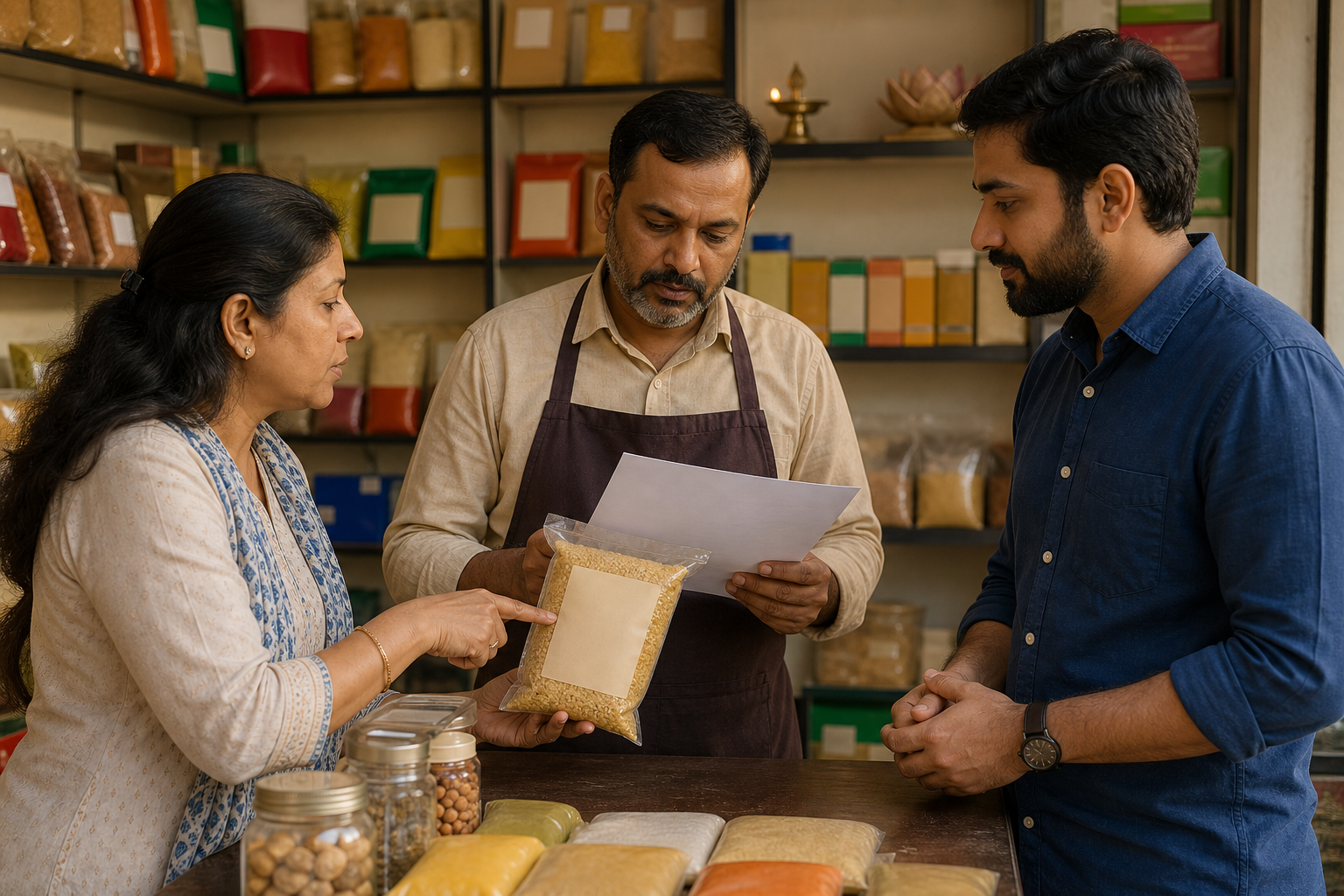
A pro-Hindu position does not require silence about faith-linked commercial certification. You can ask why a religious mark appears on an everyday product, whether it is necessary for the relevant market, who verifies it, and whether consumers receive enough information to make an uncoerced choice. Market transparency is a legitimate public concern.
Ahimsa also applies to speech, public conduct, and foreseeable social consequences. Criticise a certification system, a labelling practice, or a government rule with precise evidence. Do not turn the existence of a logo into a claim about the character of a Muslim neighbour, worker, cashier, or shopkeeper. That leap neither protects Hindu interests nor improves enforcement.
Hindu, Buddhist, Jain, Sikh, and Muslim dietary practices are not identical, and respectful coexistence does not require pretending that they are. A fair framework lets people preserve distinct disciplines while making commercial claims clear, limited, and verifiable. It should protect a Hindu or Jain consumer’s right to avoid a certification just as seriously as it protects another consumer’s ability to seek one where the law permits it.
Questions that deserve exact public answers
- What exact wording, logo, certificate, or commercial claim triggers the restriction?
- Which product categories and supply-chain activities are covered by the operative order?
- What records distinguish genuine export-linked stock from goods intended for domestic sale?
- Which authority receives consumer complaints and which authority decides contested classifications?
- What correction process is available for old packaging or stock whose status is uncertain?
- How can consumers report possible non-compliance without harassment, vigilantism, or unsupported public accusations?
For your next purchase, use the same order every time: applicable safety information, dietary symbol, ingredients, product-specific quality marks, and then optional faith or ethical claims. For your next shipment, classify its destination in writing before it moves. Precision gives Hindu consumers more meaningful choice, gives honest businesses a workable compliance path, and leaves less room for either evasion or communal suspicion.
References
