
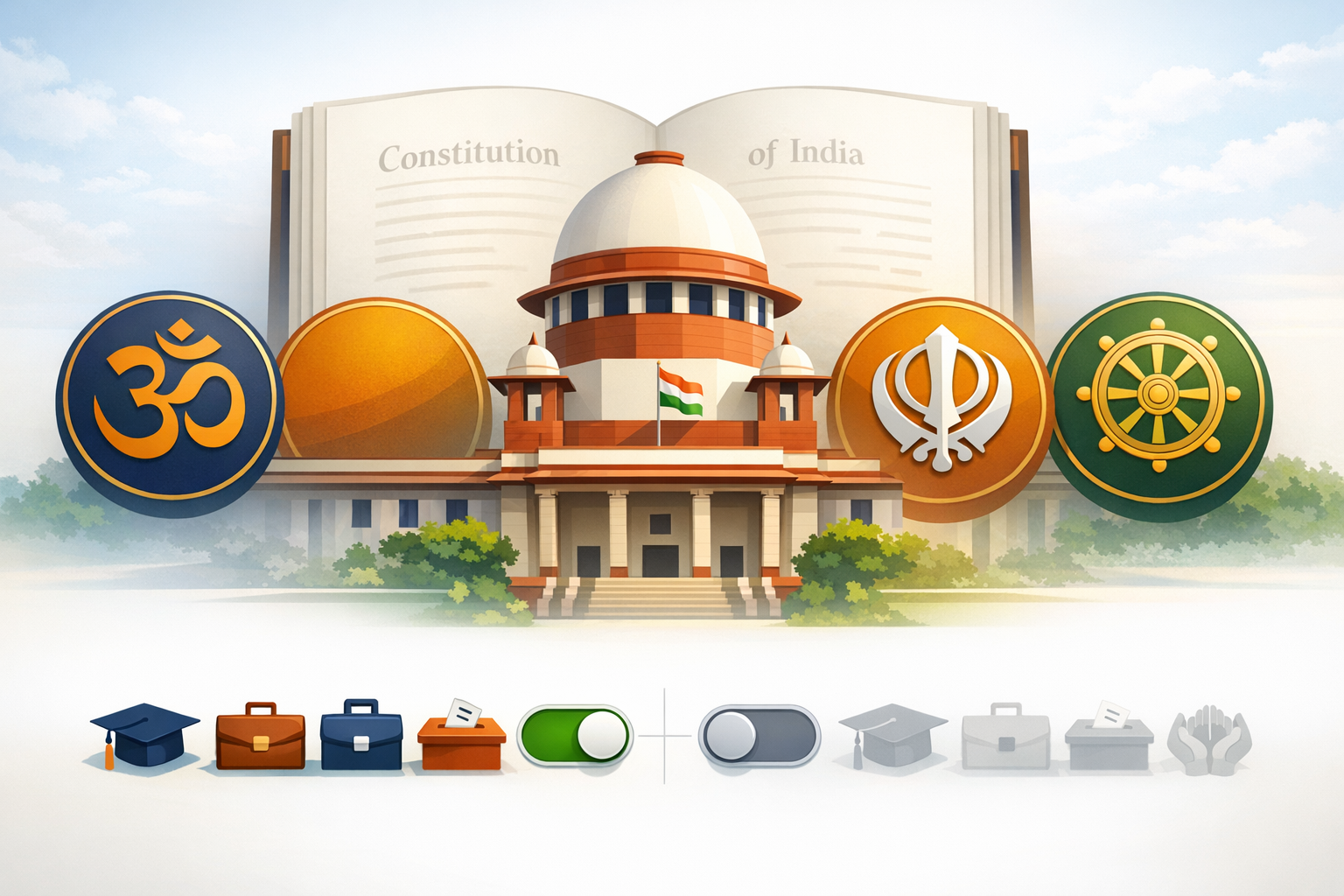
In March 2026, the Supreme Court of India reaffirmed a long-standing constitutional position: eligibility for Scheduled Caste (SC) recognition extends, under current law, to persons professing Hinduism, Sikhism, or Buddhism, and ceases upon conversion to any other religion. The decision does not create a new rule so much as it reiterates the existing legal framework anchored in Article 341 of the Constitution and the Constitution (Scheduled Castes) Order, 1950, as amended in 1956 (including Sikhs) and 1990 (including Buddhists). In practical terms, SC-specific entitlementssuch as reservations in education and public employment, political representation in SC-reserved constituencies, and targeted welfare schemesbecome unavailable from the point of conversion to a non-recognized faith.
The constitutional architecture is straightforward. Article 341 empowers the President to specify which castes or groups shall be deemed Scheduled Castes for a given state or union territory, and empowers Parliament to add to or subtract from those lists. The judiciary applies that framework; expansion of religious coverage (for instance, to faiths not currently recognized under the Order) requires legislative change, not judicial reinterpretation. This delineation preserves institutional clarity: the Supreme Court interprets the Constitution and the Presidential Order; the political branches revise those instruments when policy or evidence so warrants.
The controlling text remains explicit. The Constitution (Scheduled Castes) Order, 1950, as amended, provides that “no person who professes a religion different from the Hindu, Sikh or Buddhist religion shall be deemed to be a member of a Scheduled Caste.” The Supreme Court’s 2026 pronouncement operates within this language, emphasizing that the legal test is one of present religious profession at the relevant time for claiming an SC benefit (for example, the date of admission, recruitment, or election nomination), subject to well-established jurisprudence on reconversion and community acceptance.
Jurisprudence has been notably consistent. In Soosai v. Union of India (1985), the Supreme Court upheld the constitutionality of limiting SC status by religion within the 1950 Order, reasoning that the remedy addresses historical disabilities rooted in the practice of untouchability in specific social contexts. In matters of reconversion, decisions such as S. Anbalagan v. B. Devarajan (1984) and Kailash Sonkar v. Maya Devi (1984) recognized that a person may regain SC or ST status upon genuine reversion to a recognized religion coupled with acceptance by the community and continuity of the relevant social disabilities. The Court’s 2026 articulation aligns with this line of authority.
What does “conversion ends benefits” mean administratively? First, the person becomes prospectively ineligible for SC reservations and schemes as of the date of conversion to a non-recognized religion. Second, the SC certificate is liable to cancellation by the competent authority once the change is verified. Third, where the eligibility date matters (such as the date of application or nomination), institutions may invalidate the benefit if ineligibility existed at that time. While statutes and service rules vary, misrepresentation can trigger disciplinary or penal consequences; transparent disclosure at the time of any change in religion is therefore vital.
The decision leaves intact the pathway for those who reconvert to Hinduism, Sikhism, or Buddhism to seek restoration. Restoration typically requires evidence of birth into an SC community, bona fide reconversion, and social acceptance by that community, together with the persistence of relevant social disabilities. Documentary proof (earlier SC certificate, community attestations, and verification by scrutiny committees) plays a central role, and state-level procedures apply. The Supreme Court has repeatedly emphasized substance over form: a merely formal or opportunistic declaration does not suffice; the test is sociological as well as legal.
The policy rationale is rooted in social justice. SC reservations are a focused remedy to counter the historical practice of untouchability and related caste-based discrimination. While patterns of social exclusion can manifest across communities, the constitutional schemevia the 1950 Order as amendedtargets that remedy to contexts where the disabilities historically crystallized. The inclusion of Buddhists in 1990, acknowledging the Ambedkarite movement and the continuity of social disadvantage post-conversion, illustrates how Parliament has previously recalibrated eligibility in response to evidence.
The position of Jainism deserves careful and respectful attention from the standpoint of Dharmic unity. Jainism is a Dharmic tradition alongside Hinduism, Buddhism, and Sikhism. Its current non-inclusion within the SC framework is a function of the 1950 Order’s present terms, not a judgment on spiritual kinship or philosophical proximity. The constitutional design remains open to legislative reassessment; evidence-driven policy deliberationssensitive to lived realities and community submissionsshould continue in a spirit of unity across Dharmic traditions.
At the same time, the freedom of religion guaranteed by Article 25 remains fully intact. The Supreme Court’s clarification concerns statutory eligibility for a specific affirmative-action category; it neither restricts individual conscience nor prescribes belief. The legal consequence is narrowly tailored: a shift in religious profession, where the law predicates recognition on professed faith, may alter access to a legislated remedy. Individuals contemplating conversion are best served by clear, pre-conversion counselling on the civil consequences of that choice, so that spiritual journeys and legal expectations are aligned.
For universities and recruiting agencies, the ruling underscores procedural vigilance. Admissions and appointments that rely on SC status must verify the candidate’s current religious profession at the relevant date and ensure that scrutiny committee protocols are followed. Institutions should maintain robust, privacy-respecting workflows to handle post-conversion disclosures and certificate cancellations, minimizing disruption while maintaining legal compliance. Election authorities must apply the same logic to nominations from SC-reserved constituencies, assessing eligibility as of the nomination date.
For families, the implications are concrete. Students navigating competitive admissions rely on predictability; prospective changes in eligibility should be promptly recorded to avoid last-minute disqualifications. Employees in reserved posts should keep service records current and consult department guidelines if a change in religious profession occurs. Community organizations and legal-aid groups can play a bridge roleoffering neutral, rights-based guidance that respects personal faith decisions while ensuring awareness of administrative requirements.
From a policy perspective, clarity on SC eligibility can coexist with broader, religion-neutral measures that capture multidimensional disadvantage. Expanding quality education, strengthening scholarships tied to income and location, and refining the Economically Weaker Sections (EWS) framework can complement caste-based remedies without diluting their purpose. Evidence from social audits, caste census analyses where applicable, and independent commissions can guide Parliament should it revisit the 1950 Order’s scope, including the effect of conversion on continuing social disabilities.
Importantly, the Court’s reiteration should be read as a legal clarification, not a cultural division. Hindu, Buddhist, Jain, and Sikh traditions share deep philosophical bonds across centuriesnonviolence, compassion, and the pursuit of liberation among them. The present constitutional arrangement addresses a particular historical harm; it does not speak to the intrinsic unity of Dharmic traditions or the mutual respect that undergirds them. Public discourse benefits when legal specificity is kept distinct from civilizational kinship.
There is also an administrative ethics dimension. Conversionswhether to or from recognized religionsshould never be induced by promises or threats tied to state benefits. Transparent counselling, standardized disclosures, and grievance-free avenues for certificate verification reduce scope for misunderstanding and misuse. Such guardrails protect the integrity of reservations while honoring the individual’s freedom of conscience.
Looking ahead, a data-rich approach can align constitutional fidelity with social empathy. Rigorous field studies on post-conversion discrimination, regional variance in social acceptance, and the real-world operation of scrutiny committees can inform calibrated legislative responses. Where the evidence shows persistent disabilities despite religious change, Parliament has the constitutional tools to respond; where it does not, the remedy should remain targeted and proportionate.
For those directly affected, three practical takeaways follow. First, eligibility for SC benefits is assessed with reference to the Constitution (Scheduled Castes) Order, 1950, as it currently stands. Second, conversion to a religion outside Hinduism, Sikhism, or Buddhism makes a person prospectively ineligible for SC-specific entitlements; prompt disclosure and certificate regularization are essential. Third, genuine reconversion and community acceptance can, in appropriate cases, support restoration, subject to state procedures and judicially recognized tests.
The Supreme Court’s clarification ultimately strengthens legal certainty. It reinforces the specific purpose of SC reservationsredressing a historically entrenched social wrongwhile leaving space for Parliament to recalibrate based on evolving evidence. Anchored in constitutional text and mindful of Dharmic unity, this clarity enables citizens, institutions, and policymakers to act with both precision and compassion in the shared pursuit of dignity and social justice.
Inspired by this post on Struggle for Hindu Existence.
