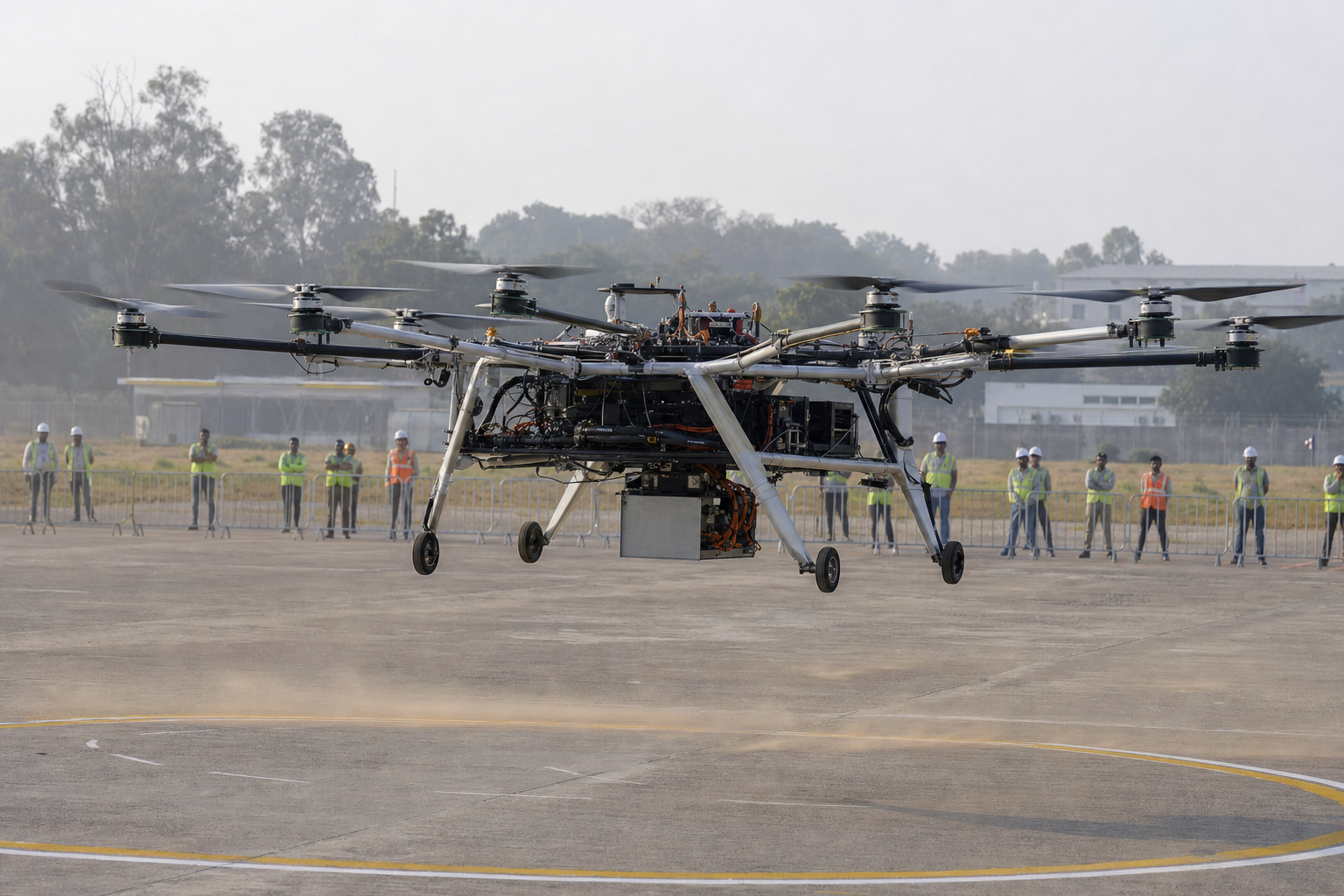
If you saw “air taxi trials” and wondered whether commuters in Bharat are about to rise above urban traffic, keep one distinction in view: Sylla 1.0 has demonstrated controlled electric hover at meaningful scale. It has not demonstrated a passenger-ready air-taxi service.
That distinction does not diminish the achievement. It tells you exactly why the milestone matters, what remains unknown, and what evidence you should demand before treating any future launch date as credible.
What Sylla 1.0 actually accomplished
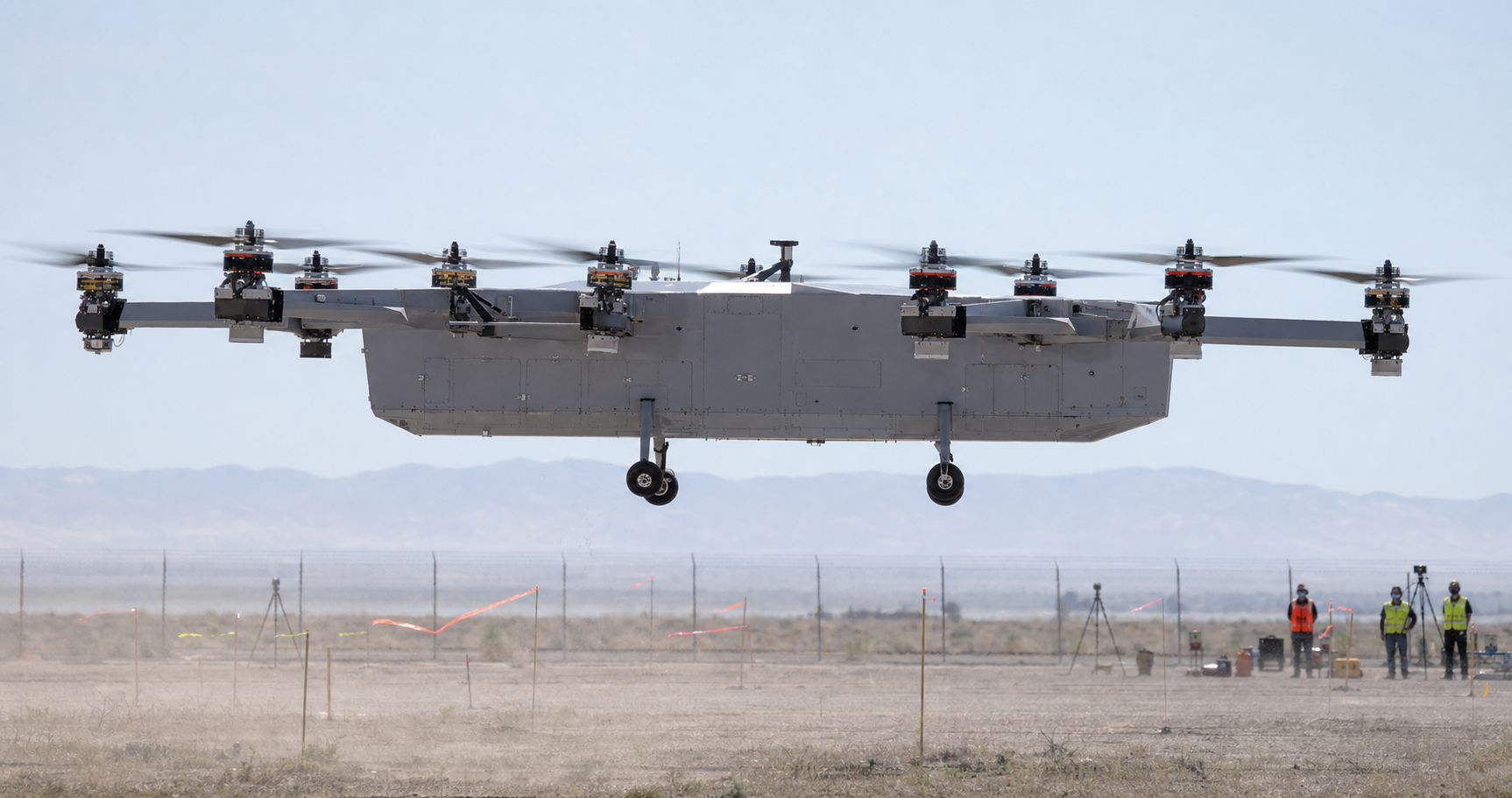
Bengaluru-based Sarla Aviation announced on July 1 that its Sylla 1.0 technology demonstrator had completed more than 18 hours of flight across over 500 test points. The six-month campaign took place at Taneja Aerodrome near Hosur and concentrated on three foundational capabilities: vertical lift, hover control and structural performance.
Each capability answers a different engineering question. Vertical-lift testing asks whether the integrated aircraft can generate enough controlled thrust to leave the ground and remain aloft. Hover-control testing asks whether the control system can hold attitude and position, respond to commands and manage disturbances. Structural testing asks whether the airframe behaves as intended under the loads encountered within the tested envelope.
Passing those stages means Sarla has moved beyond drawings, isolated component tests and a ground-bound mock-up. A physical aircraft has repeatedly lifted its own mass while its propulsion, power, control and structural systems worked together.
The scale matters. At a reported 700 kilograms, Sylla 1.0 is being presented as the heaviest electric aircraft in India to achieve sustained vertical hover. Lifting a lightweight rig for a brief demonstration and accumulating controlled hover time with a 700-kilogram aircraft are not equivalent achievements.
Read the numbers precisely, however. More than 18 hours means accumulated flight time across the campaign, not an 18-hour flight. A test point normally represents a planned condition, manoeuvre or measurement objective; it is not another name for a complete flight. Do not convert “over 500 test points” into “over 500 flights,” and do not infer mission range from aggregate hover time.
Why a successful hover is not yet an air taxi
Hover is indispensable for an electric vertical-takeoff aircraft, but it is only one part of an air-taxi mission. A commercial aircraft must do more than rise, remain stable and descend under controlled test conditions. It must complete its intended journey repeatedly, carry its designed payload and establish an acceptable safety case across normal and abnormal situations.
Sylla 1.0 is described as a half-scale technology demonstrator. That label is important. Its purpose is to reduce uncertainty and teach the engineering team what works before the commercial aircraft is complete. It is not merely a small air taxi awaiting passenger seats.
Scaling an aircraft changes more than its dimensions. Mass, structural loads, aerodynamic behaviour, propulsion requirements, battery demands and thermal management do not all change in identical proportions. Results from a half-scale demonstrator can guide a full-scale design, but they cannot automatically certify or validate it.
The announced milestone does not establish several things a prospective passenger, city planner or investor would need to know:
- It does not state the payload or number of passengers a commercial aircraft will carry.
- It does not establish the range, speed or usable flight time of the intended air taxi.
- It does not show the full operational mission, including sustained forward flight and repeated takeoff-and-landing cycles.
- It does not demonstrate how the aircraft responds to component failures, difficult weather or other off-nominal conditions.
- It does not amount to regulatory approval for passenger operations.
- It does not establish a route network, vertiports, fares or a date when customers can book a flight.
These are not criticisms of a hover demonstrator. They are boundaries around what has been proved. If somebody uses this trial alone to claim that commercial service is imminent, the claim runs ahead of the available evidence.
The weight, test hours and development pace tell different stories
The headline numbers become more useful when you stop treating them as interchangeable measures of progress.
The 700-kilogram figure speaks primarily to physical scale. It indicates that the team has integrated and controlled a substantial electric vertical-lift machine. It does not disclose useful payload, full-scale takeoff weight or commercial capacity.
The 18-plus flight hours speak to accumulated exposure. Repeated operation gives engineers opportunities to identify inconsistent behaviour, compare commanded and measured responses, and refine the aircraft. The total does not reveal the longest flight, the severity of individual tests or the life expectancy of a production aircraft.
The 500-plus test points speak to the breadth of a planned campaign. They suggest that the team evaluated many defined objectives rather than staging a single publicity hop. Their real value depends on which conditions were tested, what acceptance criteria applied and how the aircraft performed against them.
The development pace speaks to prototyping ability. Sarla reportedly moved from concept to the flying demonstrator in less than a year, with a programme budget below $13 million. That is evidence of a lean, fast demonstrator effort. It is not a reliable estimate of what certification, production tooling, infrastructure or commercial operations will cost.
Budget comparisons are especially easy to misuse. A technology-demonstrator programme and a mature company’s total expenditure toward certifying and manufacturing an operational aircraft do not necessarily include the same work. Before accepting any claim that one developer is dramatically cheaper than another, check whether the figures cover the same stage, scope and period.
Experience also helps explain the pace. Around 30 percent of Sarla’s team came from established global eVTOL companies, including Lilium, Volocopter and Wisk. Bringing that knowledge into a Bengaluru programme is valuable capability formation. The useful test of that experience, however, remains the quality and repeatability of each successive aircraft.
How to judge the next Sylla announcement
The next press release will probably contain another milestone and another collection of impressive numbers. You can evaluate it without either dismissing Indian innovation or accepting promotional language at face value. Work through these questions in order:
- Which aircraft flew? Determine whether the update concerns Sylla 1.0, another subscale demonstrator, a full-scale prototype or a design intended to match the production configuration. Progress on one should not be silently transferred to another.
- What part of the mission was demonstrated? Separate tethered or free hover, climb, descent, forward flight, manoeuvring and a complete representative mission. “Flew successfully” is too broad to answer this question.
- How much repeatability was shown? Look for cumulative hours, number of flights, repeated cycles and the range of tested conditions. A dramatic first flight proves feasibility; repetition begins to show reliability.
- What changed after the test? A useful update should identify the engineering objective and what the result enables next. A milestone with no stated learning or next gate may be more ceremonial than technical.
- What safety evidence accompanied performance? Look for information about redundancy, failure handling, battery and thermal behaviour, emergency procedures and the expansion of the test envelope. Passenger safety cannot be inferred from a stable promotional flight.
- Where is the approval process? Distinguish an internal development target from a regulator-approved plan. Certification and operational permission are separate from the ability to fly a prototype.
- Does an operating system exist around the aircraft? A viable service also needs suitable takeoff and landing sites, charging, maintenance, airspace coordination and a workable operating model. The aircraft is central, but it is not the whole network.
This checklist protects you from two common errors. The first is treating every flight as proof that passengers are around the corner. The second is dismissing a demonstrator because it cannot yet do the job of a certified aircraft. Good aerospace programmes advance through bounded tests; the honest question is whether each test retires a real risk.
Key takeaways for Bharat’s aviation watchers
- Sylla 1.0 completed a real integrated-flight milestone: sustained vertical hover by a reported 700-kilogram electric aircraft.
- More than 18 accumulated flight hours and over 500 test points indicate a structured campaign, not 500 flights or an 18-hour endurance capability.
- The tested aircraft is a half-scale technology demonstrator, so its results reduce engineering uncertainty but do not establish passenger readiness.
- The sub-one-year development pace and reported sub-$13-million budget show rapid prototyping; they do not forecast the full cost or timetable of certification and commercial operation.
- The next decisive evidence should connect a more representative aircraft to a complete mission, repeated operation, safety testing and a defined approval path.
For Bharat, the durable achievement is not a promise that air taxis will arrive immediately. It is the growth of a domestic team capable of designing, integrating and flight-testing a substantial electric aircraft while drawing global eVTOL experience into Bengaluru.
Watch the next gate, not merely the next headline. Ask which aircraft flew, which part of the mission it completed, how often the result was repeated and what risk was retired. Celebrate the engineering that is real, and reserve commercial confidence for the evidence still to come.