

If you feel drawn to Bhadrakali, your real question may not be whether the Divine Mother is powerful. It may be how to approach her without turning devotion into fear, spectacle, or a collection of rituals taken out of context.
In Kali Yuga, the useful purpose of Bhadrakali worship is not to chase extraordinary experiences. It is to bring fear, anger, temptation, and moral confusion before the Mother, then leave prayer prepared to make a clearer dharmic choice.
What Bhadrakali means when the age itself is confused
Bhadrakali’s fierce form is easy to misunderstand. Fierceness does not mean uncontrolled rage, and divine protection does not give a devotee permission to indulge personal hostility. Her terrible aspect confronts darkness; her auspicious purpose is the protection and restoration of dharma.
This matters especially in an age marked by spiritual decline and moral confusion. Bhadrakali is understood as present through all four yugas, assuming forms suited to the needs of each age. The Mother has not become absent in Kali Yuga. The difficulty is that human attention, judgement, and resolve are more easily scattered.
Your worship should address that actual difficulty. When resentment feels like justice, ask her to expose the difference. When fear disguises itself as prudence, ask for courage. When convenience competes with duty, ask for the strength to choose dharma. When anger is justified but threatens to become cruelty, ask that it be disciplined rather than merely intensified.
This changes the shape of prayer. Instead of asking Bhadrakali to destroy a person you dislike, place the hatred, deception, cowardice, or attachment involved before her. Ask for protection from wrongdoing, including your own capacity to rationalize it. Protection is not only the removal of an external obstacle; it can also be the clarity that prevents you from becoming part of the obstacle.
Grace does not eliminate responsibility. If you already know the truthful action, worship should help you take it. If you have caused harm, devotion should move you toward correction. If you face injustice, prayer should steady you for disciplined action rather than replace action.
Build a daily practice that does not depend on spectacle
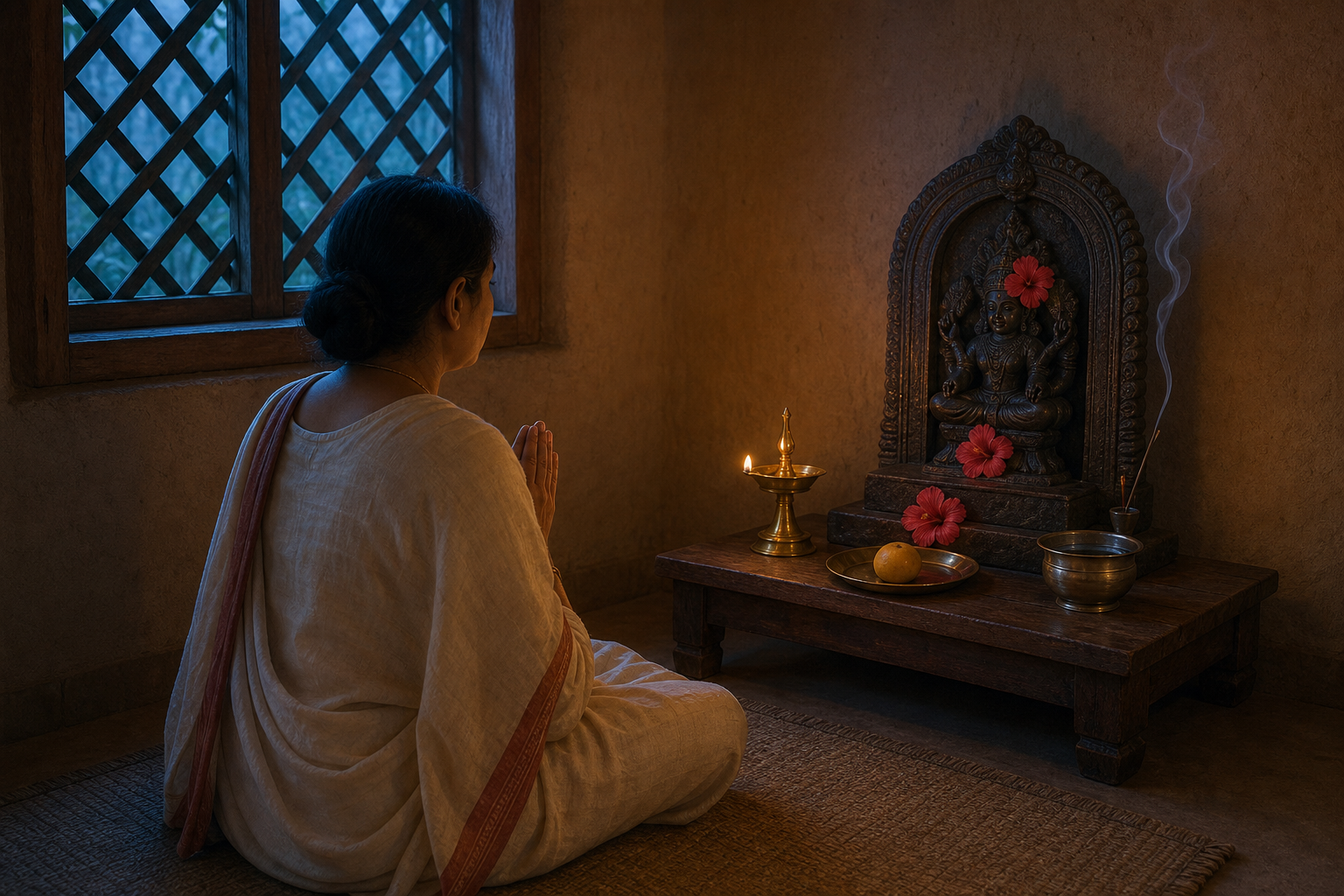
If your family, temple, or guru has given you a Bhadrakali practice, follow that tradition rather than assembling a competing routine from unrelated fragments. If you have no established practice, begin with ordinary devotion. A simple practice performed attentively is a sounder starting point than an elaborate rite you do not understand.
- Choose a clean, stable place. Use a picture or devotional symbol you can approach respectfully. You do not need to purchase unusual objects merely to begin praying.
- Create a clear boundary around the practice. Wash, silence your phone, sit down, and let the transition itself tell your mind that this is not another distracted activity.
- Make only offerings you understand. Water or a flower is sufficient for a simple household prayer. If you light a lamp, keep it attended and place it where clothing, children, animals, and surrounding objects cannot reach the flame.
- Name the condition honestly. Tell the Mother what is clouding your judgement: fear, anger, grief, indecision, temptation, or attachment to an outcome. Specific honesty is more useful than dramatic language.
- Pray in words you understand. You may repeat Bhadrakali’s name with attention or offer a plain prayer such as, “Mother Bhadrakali, cut through fear and falsehood. Protect my discernment. Give me the courage to do what dharma requires, without hatred or pride.” This is ordinary prayer, not a claim to an initiatory mantra.
- Sit quietly before deciding what comes next. Do not hunt for a vision or omen. Identify a concrete dharmic action you can carry into your ordinary life: speak the truth, complete a neglected duty, apologize, refuse a dishonest demand, seek wise counsel, or stop feeding a harmful quarrel.
- Close with gratitude. If you used a flame, extinguish it safely. Carry the chosen action with you instead of treating the end of puja as the end of worship.
Keep the practice brief enough to sustain without resentment or display. Regularity trains attention; unnecessary complexity often gives the restless mind more places to hide. Add observances only when you understand their purpose and can maintain them respectfully.
When you visit a Bhadrakali temple, follow its local discipline. Forms of worship can differ across regions and sampradayas. Watch how devotees enter, ask the priest or a knowledgeable elder when you are uncertain, and do not assume that a household routine belongs inside a temple or that a temple rite should be reproduced at home.
Use three tests to keep fierce devotion grounded
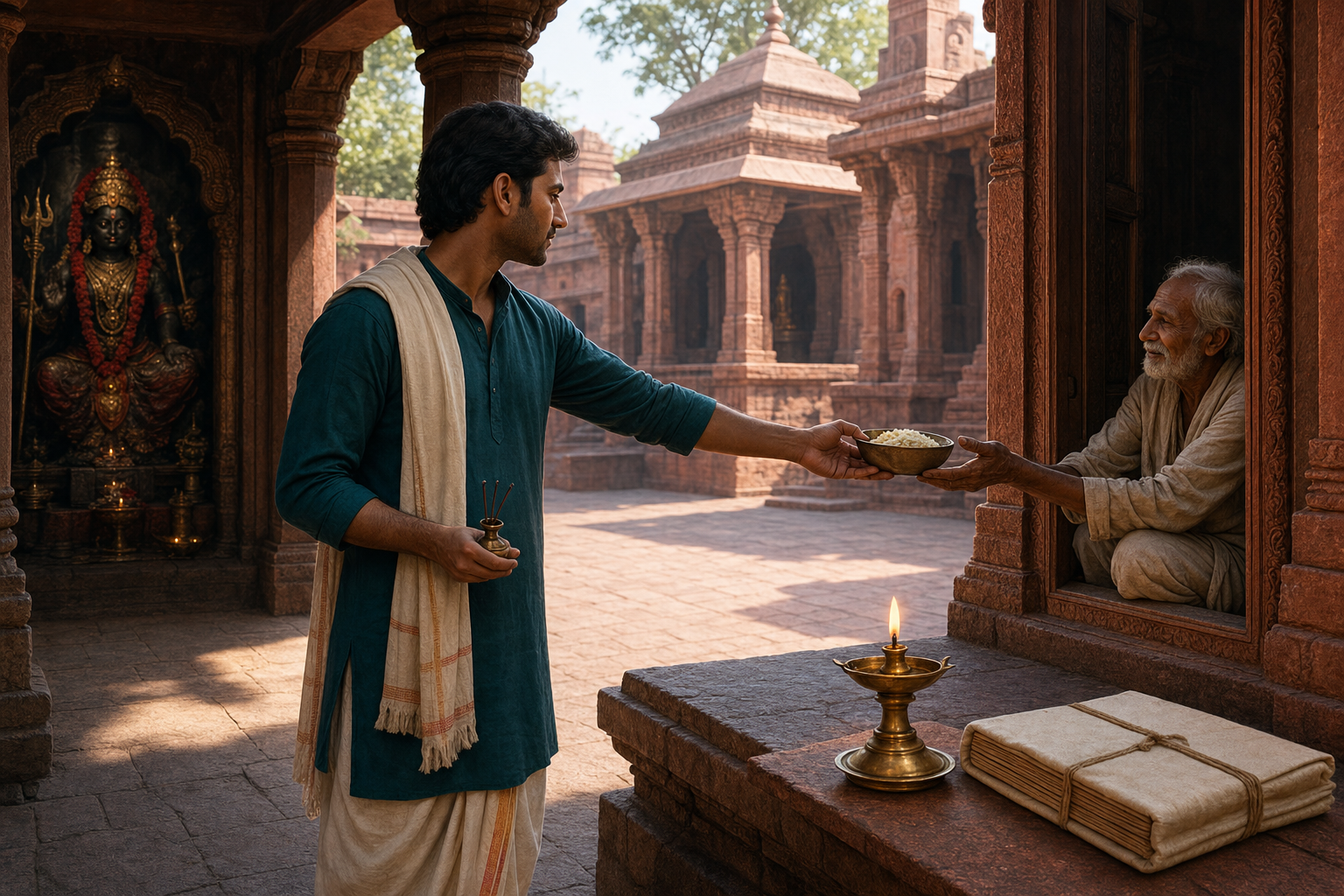
Fear is not proof that worship is working
Do not interpret every setback, dream, broken object, or uneasy feeling as Bhadrakali’s anger. A practice that makes you compulsively search for omens has lost its centre. Return to a simple prayer, ordinary duties, and guidance from a trusted tradition. The Mother who destroys darkness need not be turned into another source of superstition.
Promises made in panic are especially unhelpful. Do not make vows whose meaning, cost, or consequences you have not considered. Devotion should make your conduct more responsible, not bind you to impulsive bargains.
Lineage-specific practice is not a do-it-yourself experiment
Bhadrakali worship may appear in temple, household, Agamic, and lineage-based settings. Their procedures are not automatically interchangeable. Do not assume that every mantra found online is intended for uninitiated use, or that seeing part of a rite qualifies you to reproduce it.
Seek competent guidance before attempting practices involving initiatory mantras, complex ritual sequences, fire, substances, transgressive elements, or offerings whose significance you do not understand. This is not because sincere household prayer is forbidden. It is because a specialized discipline should be learned as a whole, with its ethical restraints and interpretive framework intact.
Your conduct is the practical test
Judge the direction of your worship by what happens to your choices. Are you becoming more truthful when truth is costly? More courageous without becoming reckless? Better able to protect someone vulnerable without humiliating an opponent? Less willing to excuse your own adharma?
If devotion makes you boastful, vindictive, or eager to frighten others with claims of divine power, correct course. Bhadrakali’s fierceness is not a religious costume for the ego. Nor is it a mandate for sectarian hostility. The first darkness placed before her should be the darkness that distorts your own judgement.
This does not require passivity. Dharma can demand firm boundaries, resistance to wrongdoing, and protection of the innocent. The distinction is between disciplined strength and personal vengeance. Before acting, ask what you are protecting, whether your account of the situation is truthful, and whether the means you intend to use remain answerable to dharma.
Key takeaways
- Approach Bhadrakali as the protective Mother whose fierceness confronts darkness and restores dharmic clarity.
- Use Kali Yuga as a diagnosis of spiritual confusion, not as an excuse for fatalism, panic, or careless conduct.
- Begin with a clean place, a simple offering, understandable prayer, quiet attention, and a concrete dharmic action.
- Do not use worship to sanctify a personal vendetta or to avoid correcting your own conduct.
- Learn initiatory mantras and specialized rites from a competent tradition rather than copying fragments from online material.
- Measure progress through truthfulness, disciplined courage, fulfilled duty, and reduced attachment to hatred or display.
Begin with the practice you can repeat without fear or performance. At your next prayer, place the decision that most troubles you before Bhadrakali, name the dharmic duty you already recognize, and carry it out before adding anything more elaborate.