If you are trying to decide whether West Bengal has truly entered a new political era, do not let a swearing-in headline do all the thinking for you. On 8 May 2026, Suvendu Adhikari was expected to take oath on 9 May as the state’s first BJP Chief Minister, but that expectation remained subject to formal confirmation by Raj Bhavan and the ordinary government-formation process.
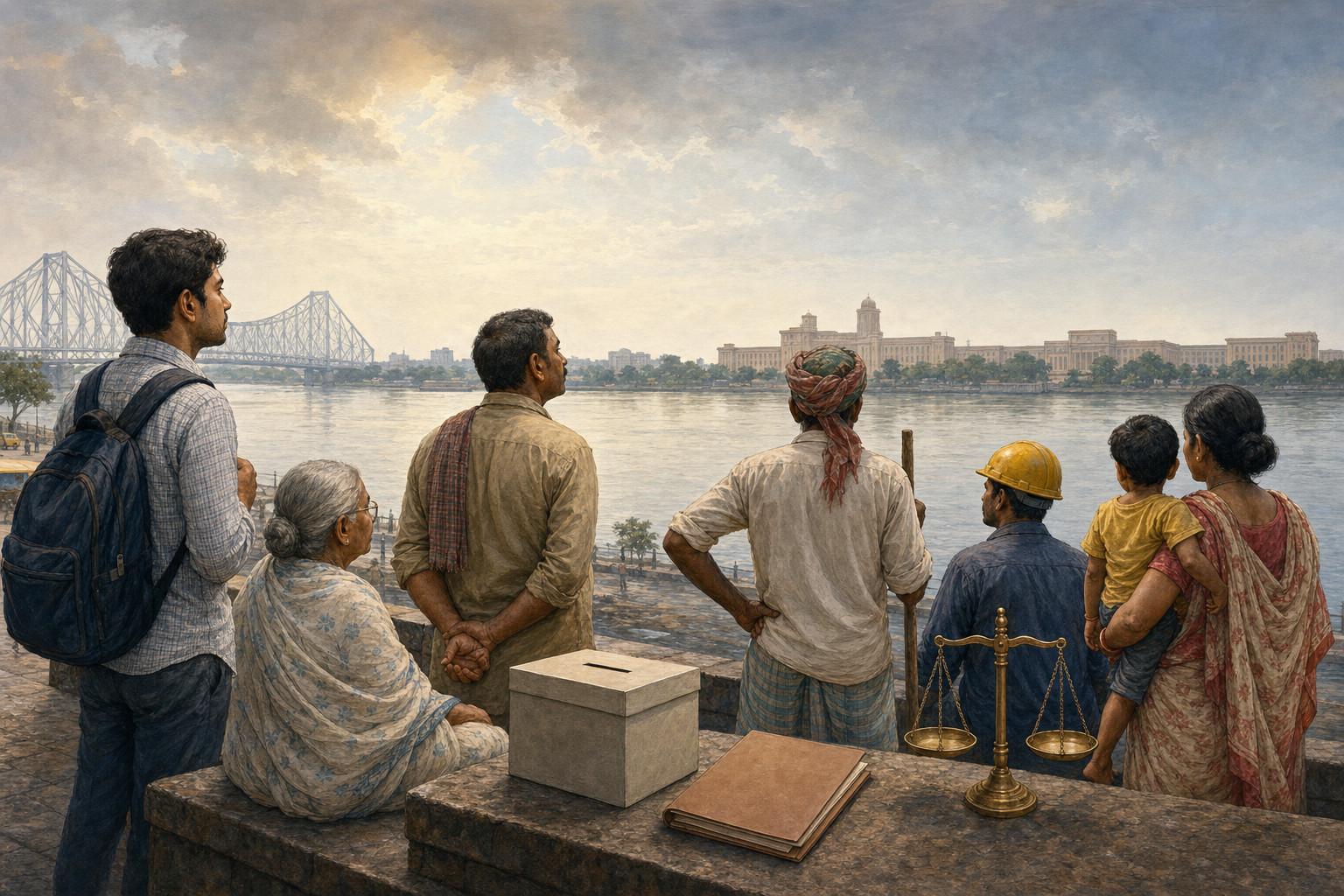
For you as a voter, worker, business owner or member of a Dharmic community, two questions matter. Has power been transferred constitutionally? And if it has, will the new executive replace partisan dominance with rajadharma: lawful authority, equal protection and competent service? The second question will determine whether a change of party becomes a change of governance.
Key takeaways
- Verify the Governor’s invitation, the oath and the Assembly majority before treating an anticipated transfer as a completed fact.
- Judge a Hindutva-oriented government by equal enforcement of law, not by symbolism or protection reserved for supporters.
- Follow the chain from infrastructure and finance to orders, production, wages and jobs; announcements alone are not economic outcomes.
- Demand consent, an appeal route and public audits when welfare databases are cleaned or combined.
- Measure results district by district, including border areas, rural Bengal, the Sundarbans, the northern hills and communities outside Kolkata.
The first test is a verifiable Assembly majority
West Bengal has a 294-member Legislative Assembly, so 148 members constitute a simple majority. That number matters more than rallies, television declarations or photographs from an oath ceremony.
Under Article 164 of the Constitution, the Governor appoints the Chief Minister. In the ordinary formation process, the Governor invites the leader who appears able to command the House, while the Chief Minister and Council of Ministers take the oaths prescribed in the Third Schedule. If the numbers are disputed, the decisive evidence belongs on the floor of the Assembly. The Supreme Court’s ruling in S.R. Bommai v. Union of India and later trust-vote jurisprudence reinforce that principle.
If you want to distinguish constitutional completion from political expectation, check the sequence rather than relying on a single event:
- Confirm that the Election Commission’s certified results and notifications establish the composition of the House.
- Look for Raj Bhavan’s formal invitation and an official record of the Chief Minister’s oath.
- Confirm the swearing-in of the Council of Ministers rather than assuming that every announced name has taken office.
- Where support is contested, look for the Assembly’s recorded confidence vote and its result.
An oath begins an executive tenure; it does not manufacture a legislative majority. A party whip can organize members, but only proceedings in the House can settle a contested confidence question. Until the formal steps can be verified, the accurate description is an anticipated transition. Once they are complete, arguments about whether the change is politically welcome should no longer be confused with whether it is constitutionally valid.
Adhikari’s political past raises the delivery bar
Suvendu Adhikari would not enter Nabanna as a stranger to Bengal’s administrative and party systems. He emerged as an organizer during the Nandigram movement of 2007-08, built influence in Purba Medinipur, served as a TMC parliamentarian and minister, joined the BJP in December 2020, won Nandigram in 2021 and became Leader of the Opposition.
That history should affect how you assess him. A leader with experience in government, opposition and mass organization does not need a long apprenticeship in the mechanics of state power. He can reasonably be asked to identify administrative blockages quickly, distinguish the state from the ruling party and turn campaign commitments into dated government decisions.
The transition would be historically significant if completed. West Bengal moved through Congress-led periods in the early post-independence decades, 34 years of Left Front rule from 1977 to 2011 and uninterrupted TMC government from 2011. A BJP executive would open a fourth major political chapter rather than merely producing a routine change of chief minister.
Historical scale, however, is not administrative performance. Watch the first binding decisions: which portfolios receive priority, whether law-and-order directions apply across party lines, whether grievance channels are usable, and whether major promises appear in budgets, departmental orders and implementation schedules. A speech tells you what a government wants associated with its name. An order with a responsible department and public reporting tells you what it has agreed to be judged on.
Hindutva must be measured as rajadharma
The anticipated change has been described as a Hindutva shift. In Bengal’s political setting, proponents increasingly present Hindutva as a civilizational and cultural framework grounded in Dharmic values, social order and national integration. That claim creates an obligation, not an exemption: power must protect social order through impartial law.
Rajadharma, in practical political terms, means that the ruler’s duty is wider than the ruler’s coalition. A government can affirm Hindu civilizational memory without making public safety, welfare or administrative access depend on religious identity or party affiliation. Bengal’s public life includes Hindu, Buddhist, Jain, Sikh and other traditions. Dharmic confidence becomes durable when it is strong enough to be fair.
The immediate standard should therefore be concrete:
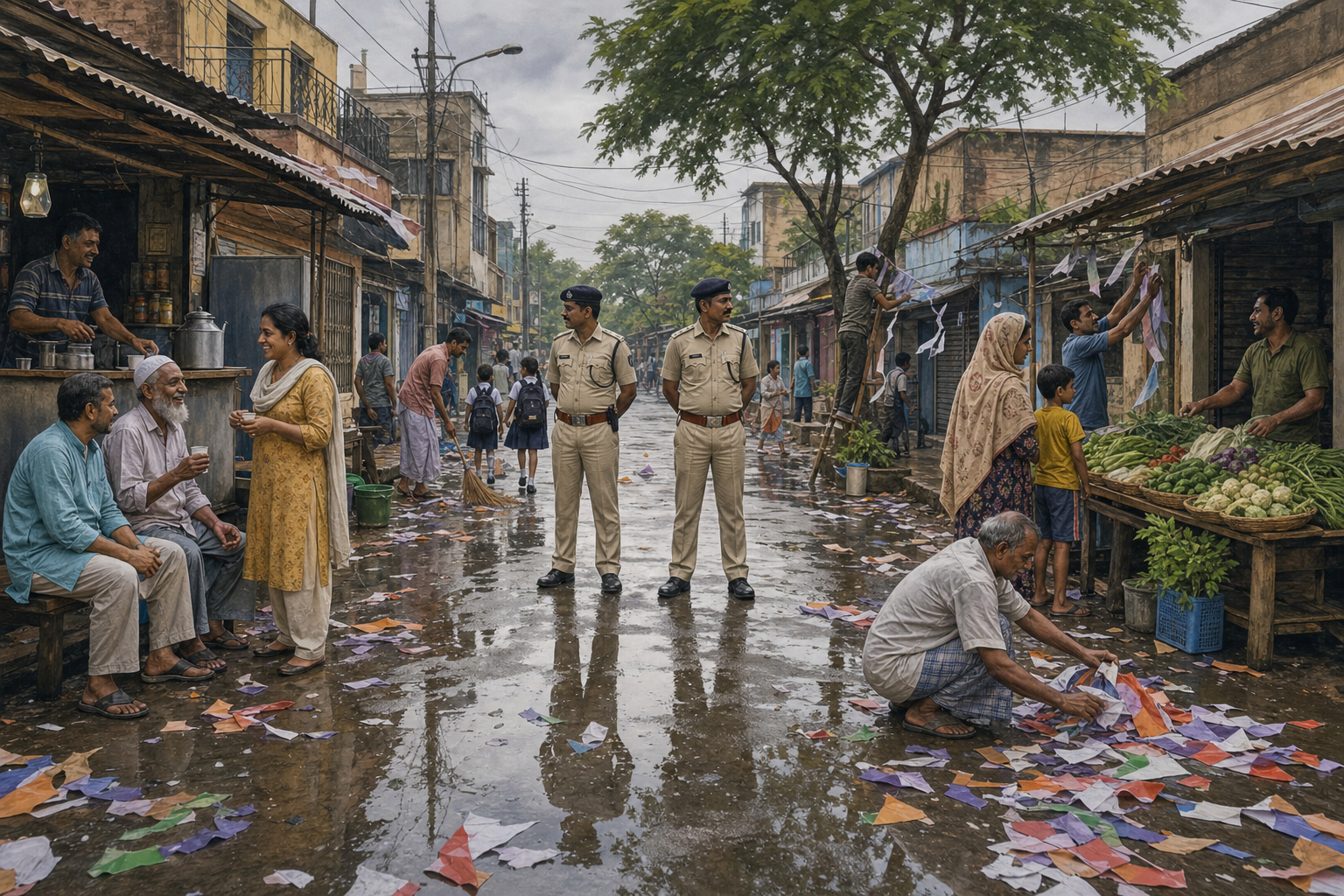
- Political violence must receive the same police response whether the accused or injured person belongs to the government, the opposition or no party at all.
- A complaint mechanism should give citizens a reference, a route of escalation and a way to see whether action was taken.
- Local peace committees should include Hindu, Buddhist, Jain, Sikh and other community representatives, and they should meet before tensions become emergencies.
- Officials should be evaluated on lawful delivery rather than their usefulness to a party organization.
- Religious and cultural freedom should operate alongside equal access to schools, hospitals, benefits, permits and police protection.
This is where slogans either mature into statecraft or collapse into factionalism. A temple committee, an opposition worker, a minority household and a street vendor should all be able to approach the state without first proving political loyalty. If protection depends on affiliation, the first promise of a new order has already failed.
Zero tolerance for violence must also mean zero selective tolerance. Publishing grievance routes, reporting action consistently and using genuinely representative peace committees would do more for Hindu security and communal confidence than theatrical confrontation. Democratic competition ends when the votes are counted; citizenship does not.
Follow the economic chain from corridors to household income
West Bengal has geographical advantages that a government does not need to invent. The Kolkata-Haldia port complex, the Eastern Dedicated Freight Corridor connection near Dankuni and routes toward the Northeast and the Bay of Bengal can support logistics, manufacturing and export-oriented small businesses. Geography becomes an economic asset only when the links between infrastructure, firms and workers function reliably.
Logistics and MSMEs need an execution chain
Do not score progress by memoranda or ceremonial launches alone. Trace each initiative through permissions, finance, usable premises, transport connections, production and employment. A warehouse that cannot connect efficiently to road, rail, port or customs is a building, not a logistics strategy.
The most credible approach would build on Bengal’s existing economic geography: engineering around Howrah, logistics around Siliguri and agro-processing in Medinipur. For each cluster, ask what obstacle is being removed. Howrah firms may need modern estates, certification and technology upgrades. Siliguri’s value depends on dependable multimodal movement. Agro-processing needs storage, cold chains, rural roads and access to buyers.
Small manufacturers are especially sensitive to cash-flow delays. The useful measures are not mysterious: working-capital access, transparent state procurement, prompt payment, plug-and-play industrial estates, quality certification and design or technology support. Coordination with Union credit guarantees, production incentives where applicable and skilling programs can help, but only if businesses can understand the eligibility rules and receive decisions predictably.
Agriculture policy must reach the farm gate
Bengal’s rice, vegetable and jute economies require different interventions, but they share one problem: value is often lost between production and sale. Better aggregation, storage, direct marketing, cold chains, rural roads and flood-resilient irrigation can improve the producer’s position. You should judge these programs by the facilities that become usable in a named block or district, not by a statewide sanction that never reaches the farm gate.
Jute deserves a complete chain of policy attention. Farmers need a dependable cultivation and retting ecosystem; mills need modernization; workers need viable production; and buyers need diversified products and predictable procurement. Treating only one link leaves the rest exposed. A credible jute plan should therefore connect farmers, retting infrastructure, modernized mills, product diversification and procurement.
Federal cooperation is part of the jobs plan
Centre-state alignment can shorten delivery chains, but party alignment must not become an excuse for opacity. Disputes involving fiscal transfers, scheme branding, compliance audits or sanctioned funds should be placed on a public action list. Joint dashboards between Nabanna and Union ministries should show the amount approved, the amount released, the implementing department and the stage reached. That lets you separate a state delay from a Union delay instead of accepting whichever accusation is loudest.
The Bangladesh border belongs in this economic framework as well as the security framework. More orderly movement through Petrapole-Benapole and other formal crossings can lower trade friction and support local livelihoods. Professional enforcement must simultaneously address trafficking and illicit flows through due process. The sound objective is neither a porous border nor a needlessly obstructed one, but secure connectivity in which lawful trade becomes easier and unlawful movement harder.
Demand a district-by-district social contract
A statewide announcement can conceal local failure. The practical safeguard is to ask what changes in your municipality, block, school, clinic or benefit account. This is especially important during a political transition, when old schemes may be renamed, reviewed, integrated or audited.
Welfare cleanup must improve accuracy without making legitimate families disappear inside a database. A single consent-based beneficiary registry, portable entitlements, publication of funded programs and independent social audits can reduce ghost entries and leakage. But consent and correction are essential. If two databases disagree, the affected person needs notice, a human appeal route and time to provide records before support is stopped.
In education, watch whether the government moves teacher-recruitment litigation toward lawful resolution, corrects imbalanced pupil-teacher deployment and improves buildings and digital access in rural and peri-urban schools. The number of appointments announced is not enough; vacancies must be filled through a process that can survive legal scrutiny, and teachers must reach the schools where students actually need them.
In health, the decisive question is whether care works as a network. Stronger primary facilities, functioning referrals and dependable emergency response can prevent patients from entering the system too late. Expanding cancer and cardiac services beyond Kolkata matters because a nominally available treatment can still be inaccessible when travel, lodging and lost wages make it unaffordable.
Urban investment also needs visible local outcomes: reliable water, drainage, waste collection and public transport. Around metro and suburban rail nodes, simpler building permissions and transit-oriented redevelopment can concentrate homes and work near transport. Brownfield renewal can limit needless outward sprawl, protect peri-urban agriculture and reduce the cost of extending infrastructure.
Climate risk makes district-level planning unavoidable. The Sundarbans and coastal districts face cyclones and saline ingress, while the northern hills and Dooars face landslides and river erosion. Mangrove restoration, resilient embankments and appropriate drainage should appear in funded work plans, maintenance schedules and local preparedness measures. A capital project is not resilient merely because resilience appears in its title.
You can turn these expectations into a simple public-accountability habit:
- Write down the exact promise and the department responsible for it.
- Save the government order, budget line, tender or dashboard entry that turns the promise into an official commitment.
- Identify the district-level result that should follow: a functioning facility, a paid invoice, a completed road link, a staffed clinic or a resolved benefit claim.
- Record what remains unknown instead of filling the gap with party claims, opposition claims or social-media repetition.
Do not wait for the next election to begin this record. Start when the government is constitutionally formed, and update it when binding decisions or verifiable local results appear. Give a new administration the space to govern, but do not give any administration a blank cheque.
If West Bengal’s transition is completed, its historic meaning will be settled quickly; its governing meaning will take longer. Support the measures that strengthen Dharmic confidence, equal law, productive work and national integration. Question every measure that substitutes affiliation for citizenship or ceremony for delivery. That is how you help turn a political victory into accountable rule.