
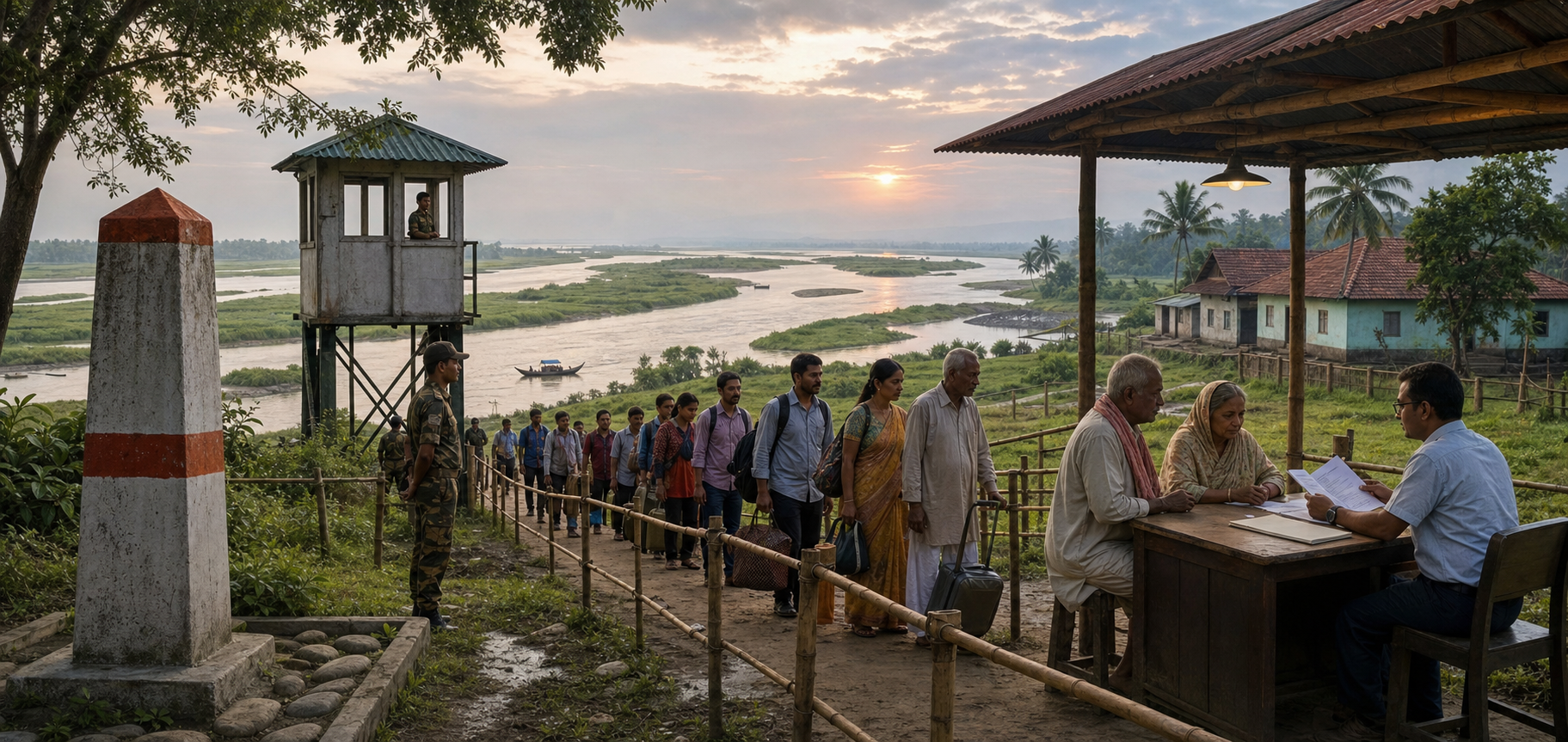
If a political speech tells you Eastern India must choose between secure borders and constitutional compassion, do not accept the choice. A serious state can prevent irregular entry, protect persecuted refugees, and give every person a fair process before imposing the legal label of foreigner.
Your harder task is distinguishing workable security policy from identity theatre. That requires more than deciding whether you support or oppose Hindutva. You need to know which law is being invoked, who would be affected, what evidence would count, and whether a wrong decision could be corrected.
Key takeaways for reading the politics clearly
- The Citizenship Amendment Act, the National Register of Citizens, the National Population Register, and detention arrangements are different instruments. A claim that merges them should immediately make you cautious.
- Border anxiety in Eastern India has a factual foundation, but the political interpretation of that anxiety is contested. A long, riverine border and a history of displacement do not prove the legal status of any present-day resident.
- Hindutva gains traction here through more than rhetoric. Refugee aspirations, security concerns, local welfare networks, and dissatisfaction with existing parties can reinforce one another.
- Support for persecuted Hindu, Sikh, Buddhist, Jain, Parsi, and Christian refugees does not require collective suspicion of Indian Muslims or weaker procedural rights for anyone.
- Before supporting a citizenship proposal, apply three tests: clear legal authority, demonstrable necessity, and proportionate methods with notice, evidence, appeal, and legal assistance.
Separate the four instruments that political rhetoric merges

Citizenship disputes in the region operate through a dense legal structure that includes the Citizenship Act, 1955, the Foreigners Act, 1946, the Passport (Entry into India) Act, 1920, and the Foreigners (Tribunals) Order, 1964. These laws do not perform the same function. Treating them as one all-purpose citizenship law makes both political debate and personal decision-making less reliable.
| Instrument | What it does | What it does not establish |
|---|---|---|
| Citizenship Amendment Act, 2019 | Creates an accelerated route to citizenship for specified persecuted Hindu, Sikh, Buddhist, Jain, Parsi, and Christian migrants from Bangladesh, Pakistan, and Afghanistan who entered India on or before 31 December 2014. | It does not create a new register for checking the citizenship of every resident. |
| Assam NRC | Attempted to identify eligible citizens in Assam using the Assam Accord’s cut-off of 24 March 1971 and a large documentary verification exercise. | It is not the same policy as the CAA, and Assam’s exercise does not by itself determine anyone’s status in another state. |
| National Population Register | Functions as an administrative population database. | It cannot be treated as a citizenship verdict merely because citizenship rhetoric has become attached to it. Any status consequence requires an explicit legal basis and due process. |
| Detention arrangements | Provide custody for declared foreigners pending deportation or repatriation under the applicable legal framework. | A detention centre is not supposed to replace identification, adjudication, appeal, or an individual assessment of whether custody is necessary. |
The distinction matters because each instrument answers a different question. The CAA asks whether a person within a defined religious, national, and arrival-date category may receive an easier path to citizenship. An NRC asks who can establish eligibility for inclusion in a citizenship register. The NPR records population information. A Foreigners Tribunal adjudicates a reference concerning an individual’s status. Detention concerns custody after a legal determination, not the political identity of a neighbourhood.
Assam demonstrates the consequences of ignoring these distinctions. Its final NRC list, published in August 2019, left around 1.9 million applicants outside the register. Appeals, review questions, and continuing policy disputes mean exclusion from that list should not be described casually as a final moral or legal verdict on 1.9 million people.
Use a four-question rule whenever a leader, television debate, or forwarded message makes a citizenship claim: Which instrument is involved? What statutory criteria apply? Who makes the decision? Where can an error be challenged? If those questions receive only slogans, you have not been given a policy explanation.
Why the border question converts into Hindutva support

Eastern India’s border problem is not imaginary. India shares a 2,217-kilometre border with Bangladesh, much of it riverine. Seasonal erosion, cross-border kinship, labour demand, and older movements of displaced people complicate administration. The Partition of 1947 and the 1971 Liberation War also left migration histories that do not fit neatly into present-day campaign categories.
That reality creates a legitimate demand for controlled borders, action against traffickers, and reliable migration records. It does not settle how the problem should be narrated. Infiltration rhetoric converts an administrative challenge into a civilizational conflict. It can place a persecuted refugee, an irregular labour migrant, a smuggler, and a citizen with incomplete papers inside the same threatening category even though the law must distinguish among them.
Recognition matters to refugee communities
For many refugee families, the CAA is not an abstract ideological symbol. It promises the possibility of legal closure after years of uncertain status. The Matua community, composed predominantly of Namasudra refugee families with a strong presence in Nadia and North and South 24 Parganas, illustrates why this promise can carry substantial political weight.
If you want to understand this constituency, begin with the unresolved household question rather than a party label: Will the law finally recognise the family’s place in Bharat? A campaign that gives a credible answer to that question gains more than a vote. It gains the moral authority associated with ending displacement and restoring belonging.
That does not make every implementation claim correct. Eligibility still turns on the statutory criteria, including country of origin, community, persecution, and arrival date. Political assurances should never be mistaken for an individual citizenship decision.
Organisation turns a national message into local trust
Sangh-affiliated organisations have paired identity and border-security messages with tuition centres, health camps, relief distribution, and other local welfare activity. This combination matters. An organisation encountered through practical help is more persuasive than one seen only during an election.
The mechanism is cumulative. A family may value a welfare service, identify with a civilizational message, worry about uncontrolled migration, and want legal recognition for refugee relatives at the same time. Hindutva politics can hold those concerns together in one political story. Its opponents weaken their own case when they answer only the rhetoric while ignoring the service network and the unresolved citizenship problem underneath it.
Electoral growth shows salience, not a single cause
The BJP greatly expanded its West Bengal vote share and organisation between 2014 and 2021, while Tripura underwent a rapid party-system transformation from 2018. Assam’s difficult NRC experience kept citizenship at the centre of political attention. These trajectories show that security and identity appeals can mobilise voters, but they do not prove that every voter moved for the same reason.
When assessing a constituency, look for the actual combination present there: proximity to the border, refugee settlement histories, confidence in local administration, documentation insecurity, welfare networks, and dissatisfaction with regional parties. Hindutva advances most effectively when several of these pressures align. Calling the result communal polarisation alone misses why the coalition holds; calling it a pure security mandate misses the emotional and religious framing that helps assemble it.
Test any citizenship proposal before you support it

A citizenship policy can carry irreversible consequences for status, liberty, livelihood, and family life. Do not judge it only by the problem it promises to solve. Examine how an official would apply it to an actual person whose records are old, inconsistent, inaccessible, or written in another language.
- Demand a precise legal category. Ask whether the proposal concerns citizenship applicants, refugees, suspected foreigners, people omitted from a register, or persons already declared foreign. If a speaker slides between these groups, the claimed solution may not fit the legal problem.
- Identify the authority and cut-off. Ask for the Act, rule, order, and applicable date. A security concern, however serious, is not itself a legal standard for cancelling someone’s status.
- Inspect the burden of proof. Find out which records will be accepted, how family links must be established, and how spelling or language discrepancies will be handled. A system that assumes perfect archives will produce unequal errors.
- Follow the correction path. Notice, a meaningful hearing, understandable reasons, access to records, legal assistance, and judicial review are functional safeguards. They are how the state distinguishes a genuine foreigner determination from an administrative mistake.
- Apply legality, necessity, and proportionality. Even a lawful objective does not justify every method. Officials should use the least intrusive measure that can achieve the stated security purpose.
- Ask for measurable accountability. Aggregate information on references, tribunal outcomes, reversals, detention periods, and repatriations allows citizens to judge whether the system is accurate or merely expansive.
The usual status process in the affected northeastern framework can move from local verification to a reference before a Foreigners Tribunal and then to a verdict subject to judicial review. At each stage, poor documentary literacy, inaccessible land, birth, or school records, and language barriers can change the outcome. Those burdens fall especially heavily on poor households, women, and elderly people whose lives were not documented with a future citizenship proceeding in mind.
If your household receives a citizenship notice
Do not rely on a rally promise, a party worker’s verbal assurance, or a social-media interpretation. A missed procedural deadline can have legal consequences even when a politician says your community will be protected. Seek a lawyer experienced in citizenship or foreigners law, or a credible legal-aid service, as early as possible. General political analysis cannot determine an individual’s legal status.
- Preserve the notice, envelope, acknowledgement, and every page supplied with it. Record the date received and the next stated deadline.
- Make copies of relevant land, birth, and school records before submitting anything. Keep the originals secure and obtain a receipt whenever an authority takes custody of a document.
- Create a simple chronology linking names, relationships, places, and dates across the available records. Flag spelling variants rather than trying to conceal them.
- Tell counsel early if an archive is inaccessible or a record was lost. The difficulty needs to be addressed in the proceeding, not discovered after an adverse order.
- Arrange interpretation or language assistance before the hearing if the person concerned cannot fully understand the proceeding.
- Never alter a record or pay a fixer who promises a guaranteed outcome. A fabricated correction can damage an otherwise valid case.
These steps do not guarantee inclusion or citizenship. They reduce the avoidable risk that a valid case fails because the family cannot present its history coherently or respond on time.
A dharmic state can be firm without becoming indiscriminate
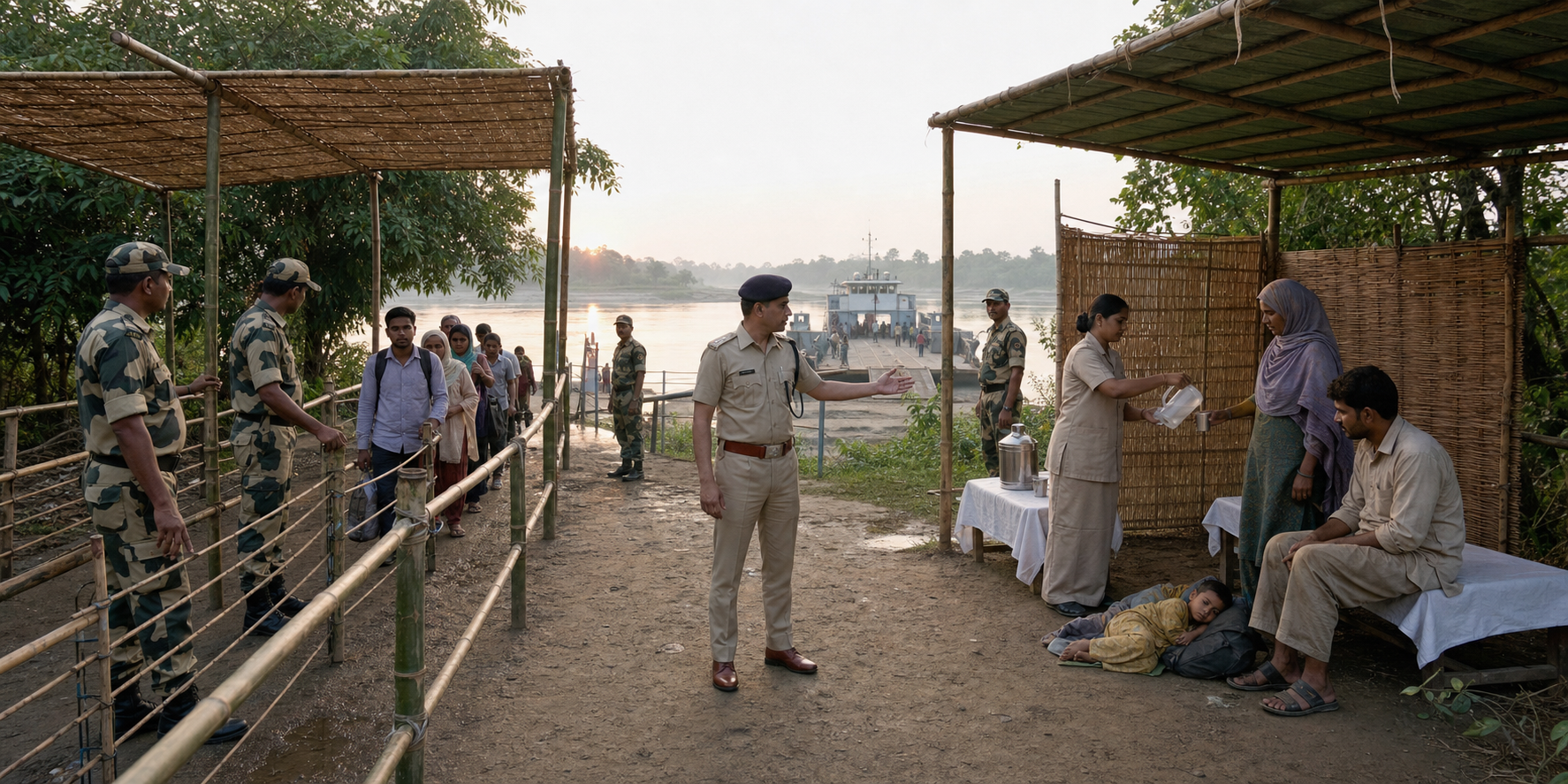
Ahimsa does not require open borders. Karuna does not require the state to ignore illegal entry. Dharma does require power to be exercised truthfully, justly, and with restraint. That means protecting the country and the vulnerable without converting a religious identity, surname, accent, or neighbourhood into proof of foreignness.
This approach also rejects a false opposition at the heart of the debate. Bharat can recognise the historical suffering of persecuted Hindu, Sikh, Buddhist, Jain, Parsi, and Christian refugees while defending the citizenship and legal dignity of Indian Muslims. One obligation does not cancel the other. The state’s credibility depends on doing both.
- Prevent unlawful entry at the border. Concentrate enforcement on vulnerable stretches, smuggling routes, trafficking networks, and document fraud instead of treating whole communities as investigative shortcuts.
- Administer refugee relief through stated law. Apply the CAA’s defined criteria consistently and explain the evidence applicants must provide. Beneficiary communities need a usable process, not indefinitely repeated promises.
- Make adjudication intelligible. Give the person notice, access to the case against them, language assistance, legal counsel, reasons for the decision, and a realistic opportunity to seek review.
- Use detention only when individually necessary. Reporting obligations, bond-based supervision, community release, and case-specific risk assessment should be considered before custody.
- Enforce humane custody standards. Where detention follows a declaration, the 2019 Model Detention Centre Manual calls for minimum standards involving infrastructure, healthcare, legal access, family safeguards, and children’s education. A statutory power to detain is not permission to neglect.
- Reduce irregular movement through diplomacy. River management, sensitive-border fencing, joint patrols, information-sharing on traffickers, and lawful seasonal labour channels address the mechanisms that slogans leave untouched. The 2015 Land Boundary Agreement demonstrates that difficult border legacies can be handled through sustained India-Bangladesh negotiation.
West Bengal’s resistance to detention-centre demands and the Union government’s insistence on statutory obligations also expose a federal question. Citizens should demand clarity about which level of government is responsible for identification, tribunal administration, custody, welfare standards, and repatriation. Centre-State conflict cannot be allowed to turn affected people into political hostages.
Before you endorse the next manifesto promise or forward the next infiltration claim, write down four answers: the instrument, the affected legal category, the required proof, and the route of appeal. Support firm enforcement when those answers are precise. Demand correction when they are not. That is how citizenship policy can defend Bharat without weakening the justice that gives Bharat’s civilizational claims their meaning.
References
