
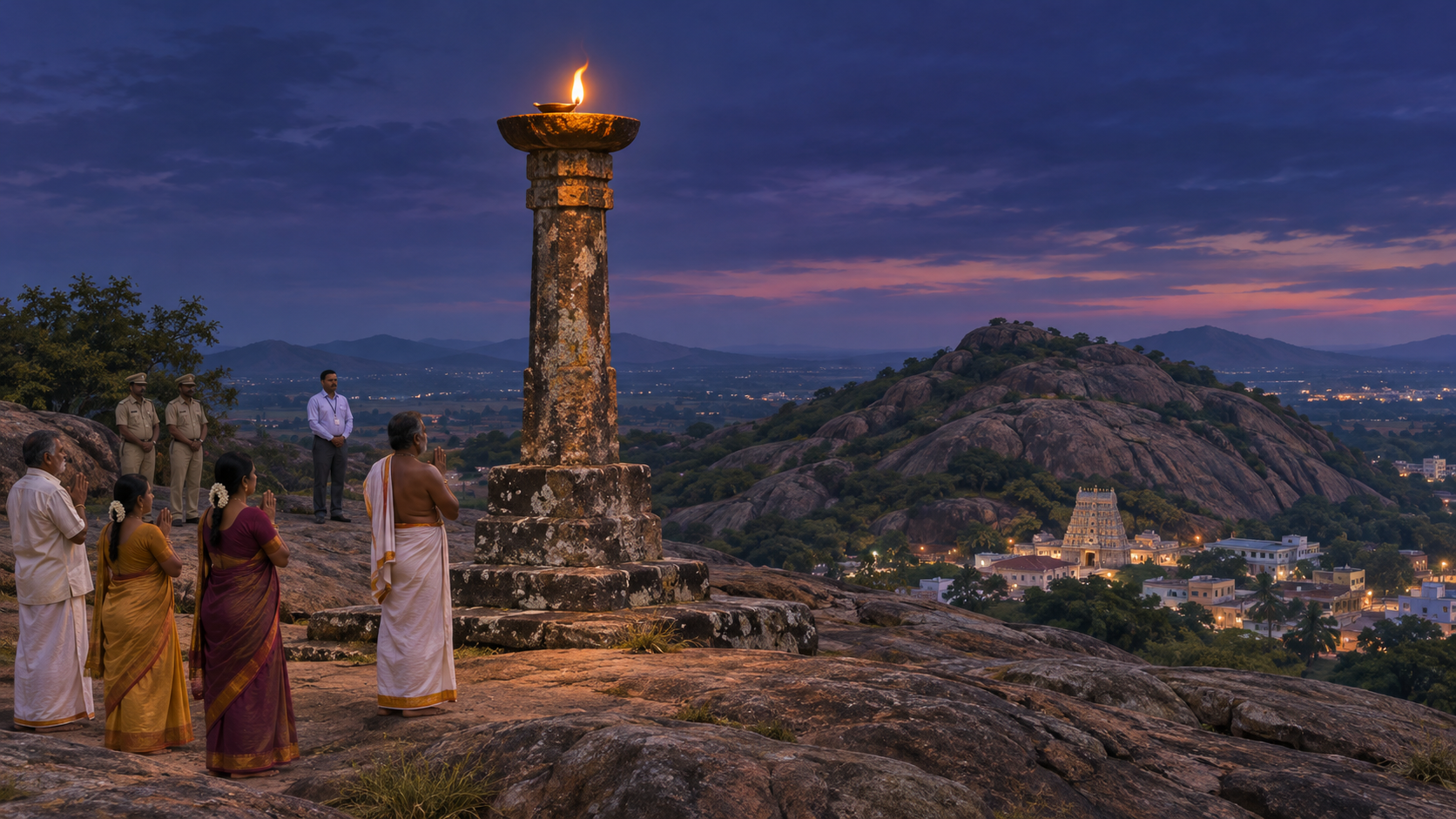
If you came here to find out whether Karthigai Deepam was finally lit at the disputed Deepathoon on Thiruparankundram Hill, the answer is yes. The ceremony reportedly took place after a gap of decades, following a Supreme Court order.
That is a meaningful restoration of Hindu ritual practice. It is also a legally specific event whose significance should not be inflated beyond the facts. You can welcome the lighting, understand why it matters, and still refuse to turn an incomplete account into claims about ownership, unrestricted access, or future arrangements.
The narrow fact at the centre of the dispute
Karthigai Deepam was lit at the disputed Deepathoon after decades, pursuant to a Supreme Court order. Tight security surrounded the ceremony, and retired judges supervised the ceremonial lighting.
Each part of that account carries a different meaning. The lighting establishes that the ritual was actually performed at the contested location. The long interruption makes its resumption culturally significant. The Supreme Court order places the event within a legal process. Security and judicial supervision show that the authorities treated implementation as sensitive and controlled.
The safest description is therefore precise: this was a court-directed ceremonial lighting at the Deepathoon under supervision. That sentence says enough. It does not need to be enlarged into a sweeping declaration that the known facts cannot support.
What the lighting establishes – and what it does not
The immediate result is concrete. A Hindu observance that had not been performed at that disputed site for decades was performed there. For devotees concerned about the disappearance of customary worship through prolonged non-use, that difference matters: the tradition moved from memory and demand back into practice.
But a ceremonial result and a complete settlement are not necessarily the same thing. Without the operative text of the Supreme Court order, you should not assume that the event conclusively determined every question concerning the hill. The confirmed facts do not, by themselves, tell us whether the directions were limited to one festival, whether they created a continuing annual arrangement, who may approach the site in the future, or what security conditions may apply.
They also do not establish the full extent of any party’s title, jurisdiction, or access rights. A direction permitting or requiring a particular ritual act may be important without deciding all those wider questions. The exact wording of the order is what separates a lasting legal rule from a one-time implementation measure.
Before accepting a broader claim about the judgment, ask five exact questions:
- What act did the operative order require or permit?
- Did it identify the precise location at which the lamp had to be lit?
- Did it address participation by devotees, or only performance by designated persons?
- Was the direction limited to that ceremony, or did it govern future Karthigai Deepam observances?
- What administrative or security conditions accompanied the direction?
If a circulating message cannot answer those questions from the order itself, treat its broader legal conclusions as unverified. Celebration does not require overstatement.
Why ritual continuity matters in a Dharmic society
A living tradition survives through practice. A lamp, procession, recitation, pilgrimage, or annual vrata is not preserved merely because people remember that it once occurred. It remains alive when a community can perform it, pass on its meaning, and return to it at the appointed time.
That is why the resumption at Thiruparankundram should not be dismissed as a small symbolic gesture. The Deepam is an embodied act of worship. Restoring the act at the location in dispute reconnects religious memory with physical practice. For Hindus who worry that a long interruption will gradually be treated as evidence that a custom never existed or no longer matters, performance has a significance that rhetoric cannot replace.
The manner of restoration matters too. Here, the legal route produced an order and the ceremony proceeded under supervision. That offers a practical lesson for cultural advocacy: preserve evidence, define the requested ritual precisely, pursue remedies through lawful institutions, and insist that an order be implemented in observable terms.
This kind of discipline protects the cause from two common failures. A vague demand can be acknowledged without producing a usable result. An exaggerated victory claim can later collapse when someone reads the actual order. A narrowly framed, enforceable outcome may look less dramatic, but it can restore a real practice.
How devotees and advocates should respond now
If you want to support the restoration without spreading claims that may later prove false, use a simple sequence.
- State the accomplished fact first. Say that Karthigai Deepam was lit at the disputed Deepathoon after decades pursuant to a Supreme Court order, with retired judges supervising the ceremony.
- Separate worship from the unresolved legal questions. Do not convert the performance of one ceremony into an unsupported claim about complete ownership, unrestricted entry, or every future festival.
- Look for the operative order. A headline, video clip, or celebratory message cannot substitute for the directions the parties were legally required to follow. The operative paragraphs matter more than commentary about the result.
- Preserve reliable records. Keep the order, official notices, dated photographs, and full recordings if they become publicly available. Short clips can omit the restrictions or supervision that defined the event.
- Use exact language in public discussion. Words such as “lighting,” “access,” “possession,” “title,” and “annual right” do not mean the same thing. Use only the term supported by the evidence you have.
- Do not turn a ritual-rights dispute into collective hostility. Focus criticism on a decision, restriction, administrative failure, or legal position that can be identified. General attacks on a religious community neither clarify the case nor protect Hindu practice.
If you are considering a visit, do not infer ordinary public access from the fact that the supervised ceremony occurred. Tight security indicates that the event operated under controlled conditions. Check current instructions from the relevant temple and local authorities before travelling, especially if your plan depends on reaching the disputed location.
Key takeaways
- Karthigai Deepam was reportedly lit at the disputed Thiruparankundram Deepathoon after a decades-long interruption.
- The ceremony followed a Supreme Court order and took place under tight security with retired judges supervising.
- The event is a meaningful restoration of Hindu ritual practice at the contested site.
- The known facts do not establish the full scope of ownership, public access, future festival arrangements, or other rights concerning the hill.
- The exact operative directions should govern every broader legal claim made about the outcome.
- Devotees can defend the achievement most effectively by documenting it carefully, speaking precisely, and pursuing continuity through lawful means.
The next useful step is not louder speculation. It is to obtain and preserve the Supreme Court’s operative directions, compare future arrangements with those directions, and watch whether the restored lighting becomes a secure continuing practice. Honour the Deepam by defending both its sacred meaning and the factual discipline needed to keep it burning.


References

Leave a Reply
You must be logged in to post a comment.