
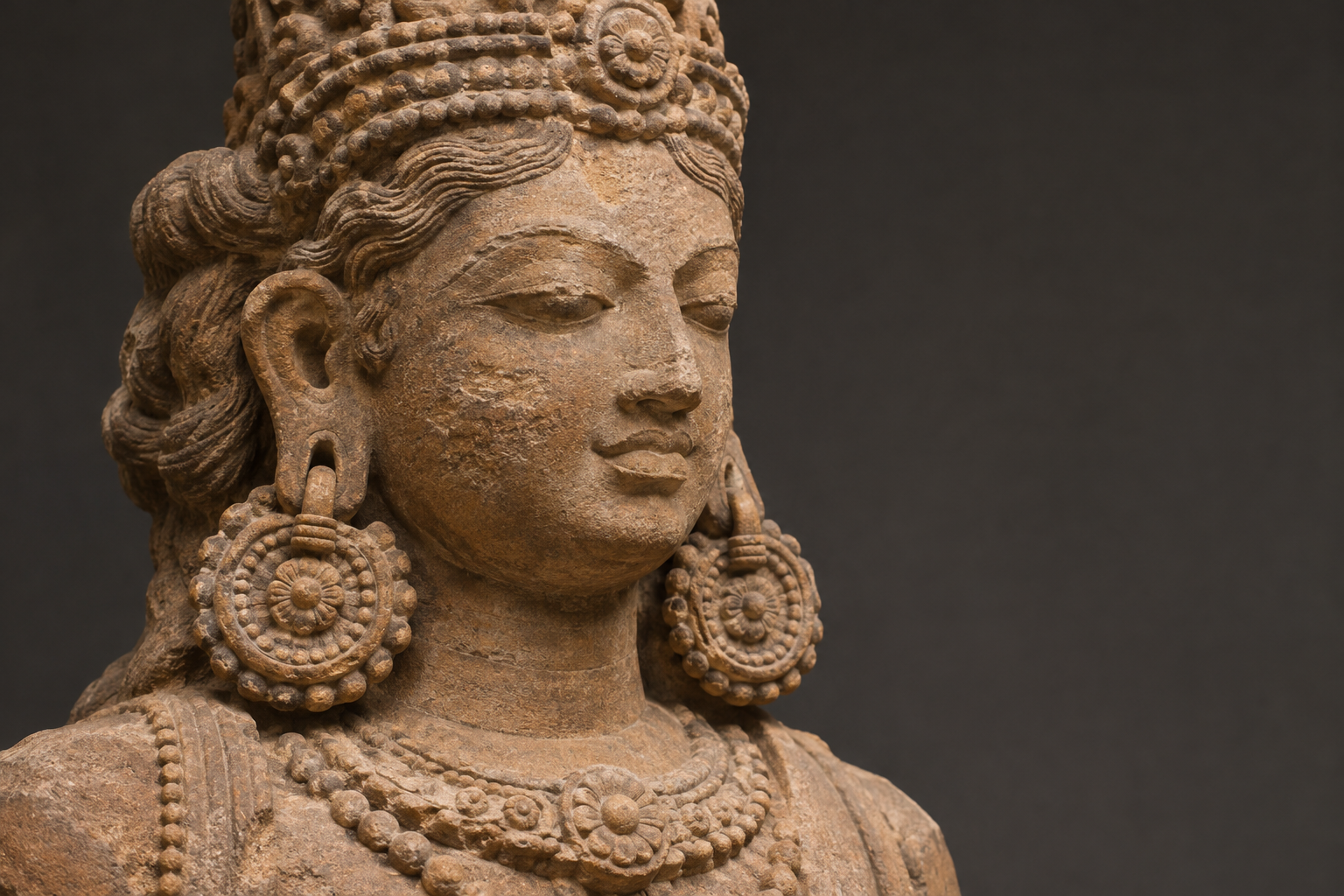
An ear ornament in a Hindu sculpture can look so distinctive that you want it to identify the deity, period, or hidden teaching at once. That is usually more weight than one detail can bear.
You will reach a sounder reading by separating three tasks: observing what the sculptor represented, classifying it within the traditional vocabulary, and interpreting it in the context of the complete image. Kundala belongs first to classification. That distinction helps you recognize the ornament without turning it into a claim the sculpture cannot support.
Begin with the category, not a single shape
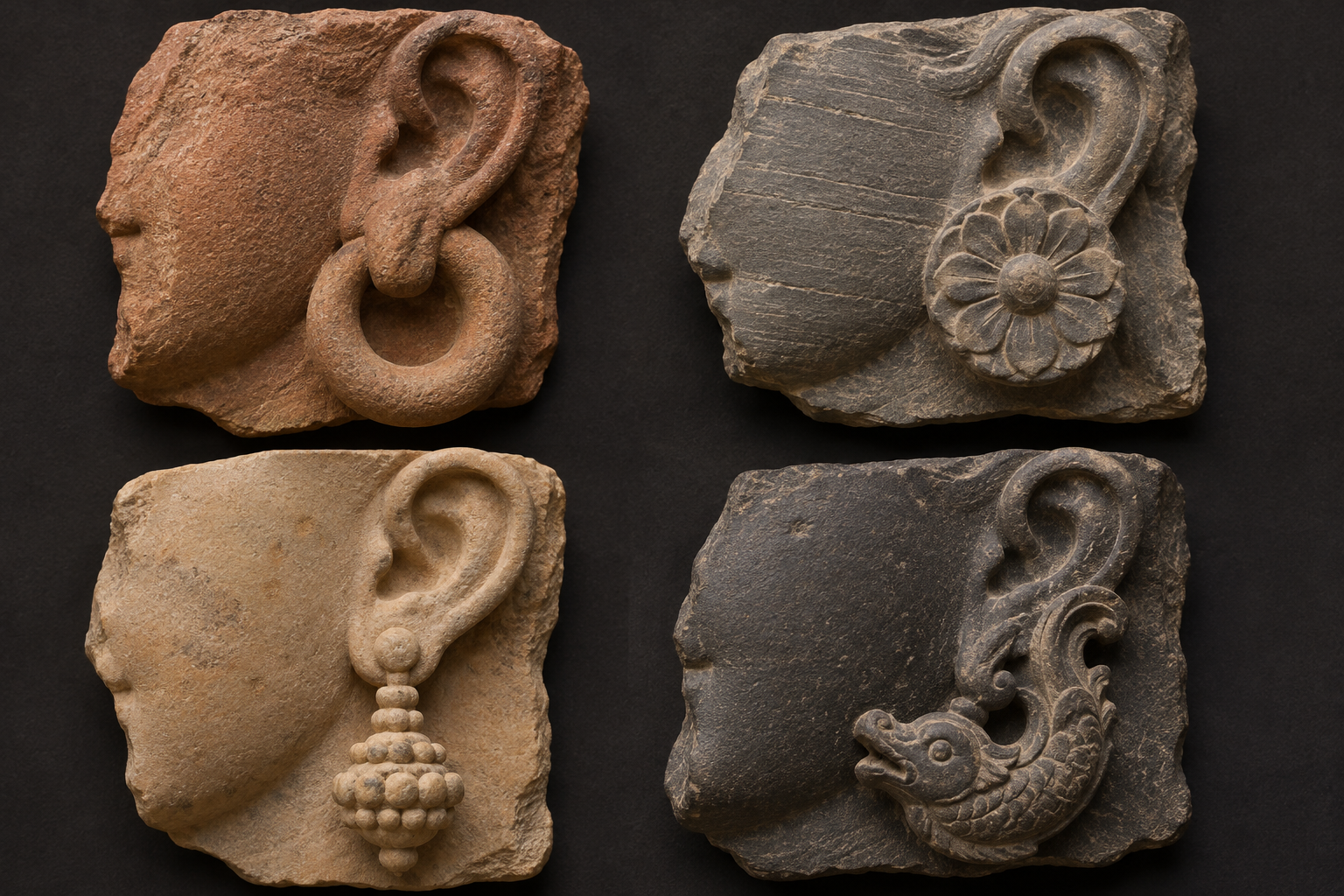
Kundala is a broad term for an ear ornament suspended from or attached to the earlobe in Hindu sculptural tradition. It does not designate one fixed design. If two sculptures show visibly different ornaments at the ear, both can still fall within the kundala category.
The term therefore tells you what kind of ornament you are looking at and where it is worn. By itself, it does not establish the object’s precise design, material, date, regional origin, or theological meaning. Think of kundala as a family name within the vocabulary of sacred adornment, not as the name of one unchanging model.
Kundala is also counted among the principal karna-abharanas addressed in shastras concerned with iconometry and iconography. This matters because the ear ornament is treated as part of the image’s ordered visual language. It is not merely an incidental accessory noticed by modern viewers.
Do not turn that prescription into an assumption that every sculpture follows one universal template. A shastric category can accommodate variation. The practical rule is simple: when a label identifies kundala, read it first as ear ornament, and adopt a more specific identification only when the sculpture’s context or a reliable catalogue supplies one.
Read the sculpture in three separate passes
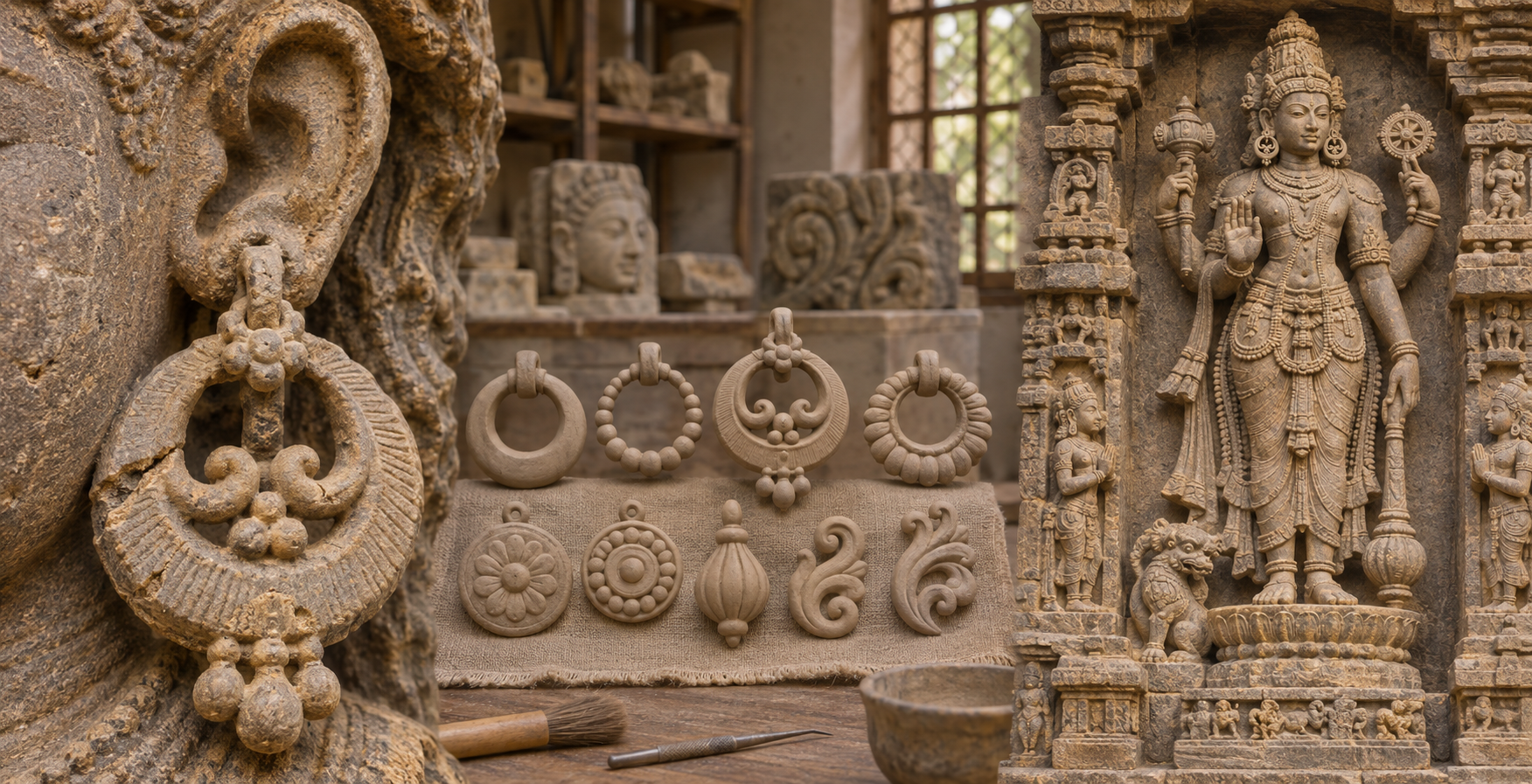
A disciplined sequence keeps observation from being contaminated by an attractive interpretation. Use these three passes whether you are standing in a temple, viewing a museum object, or studying a photograph.
- Observe the carving. Trace the ornament from the earlobe outward. Note whether it appears attached directly to the lobe or suspended from it. Check whether both ears are visible, whether their ornaments match, and whether weathering, breakage, restoration, hair, or the viewing angle hides the point of attachment.
- Classify the object. If the feature is clearly an ornament worn from the earlobe, kundala is an appropriate category-level identification. If the relevant area is damaged or obscured, record it as a possible ear ornament rather than forcing certainty.
- Interpret it in context. Examine the entire figure: posture, hand gestures, held objects, headdress, other ornaments, accompanying figures, and architectural placement. Let those features work together before proposing an identity or symbolic reading.
Keep the three layers separate in your notes. An observation might be: a form attached to the earlobe extends below it. The classification might be: the figure wears kundala. The interpretation might be: the ornament contributes to the figure’s deliberately adorned presentation, while no more specific meaning can be established from this feature alone.
This method is especially important when the two ears appear different. The difference may be intentional, but it may also result from damage, an incomplete view, or unequal preservation. Record the asymmetry first. Explain it only after checking the rest of the image and any trustworthy documentation.
Know what kundala can and cannot establish
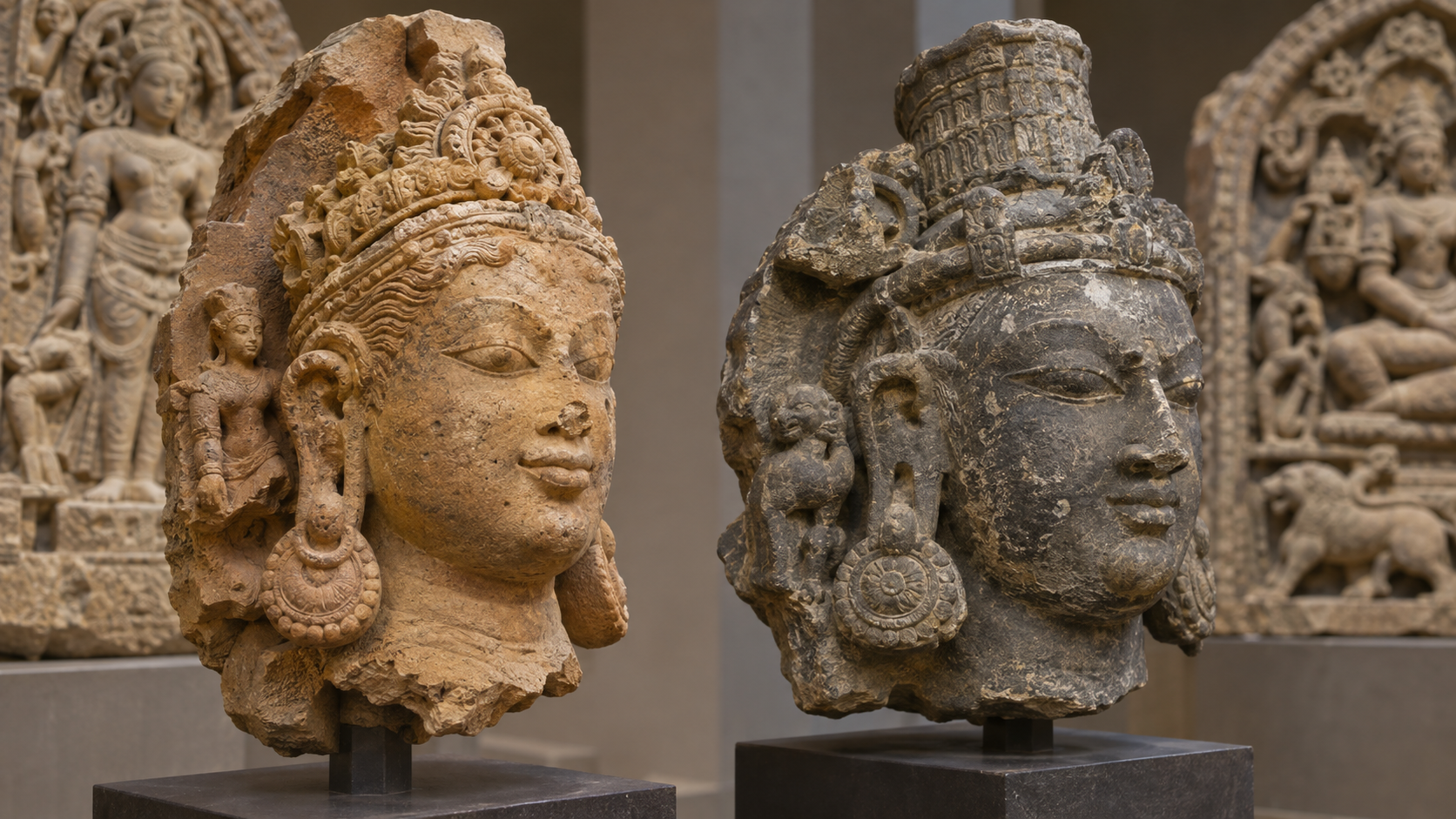
Conclusions the sculpture can support
- The figure has been represented with an ornament at the earlobe.
- The ornament can be classified within the broad kundala category when its attachment or suspension is visible.
- Ear adornment belongs to a larger, systematically treated vocabulary of karna-abharana in Hindu iconographic tradition.
- The kundala should be read alongside the rest of the figure rather than isolated from the total composition.
Claims that require corroboration
- The original material represented by the carving. Stone may depict an ornament, but appearance alone does not prove whether the imagined object was gold, another metal, a jewel, or something else.
- The identity of a deity or sacred figure. Kundala may contribute to an identification, but the category is too broad to function as a unique name tag.
- An exact date, region, dynasty, or workshop. Those conclusions require evidence beyond the presence of an ear ornament.
- A fixed symbolic equation, such as the claim that every kundala always represents one cosmic principle. Such a reading needs support from the relevant tradition, a named text, an inscription, or the complete iconographic program.
- A deliberate meaning for every apparent difference between the right and left ornaments. Preservation and viewpoint must be ruled out first.
Symbolism is where an attentive viewer can most easily overreach. Sacred art is meaningful, but that does not make every visual element a one-to-one code with a universal translation. From the ornament alone, the secure reading is narrower: kundala identifies a recognized form of ear adornment within Hindu sculptural practice. A more exact theological interpretation should be presented as tradition-specific and supported, not assumed.
Use a field checklist when examining an image
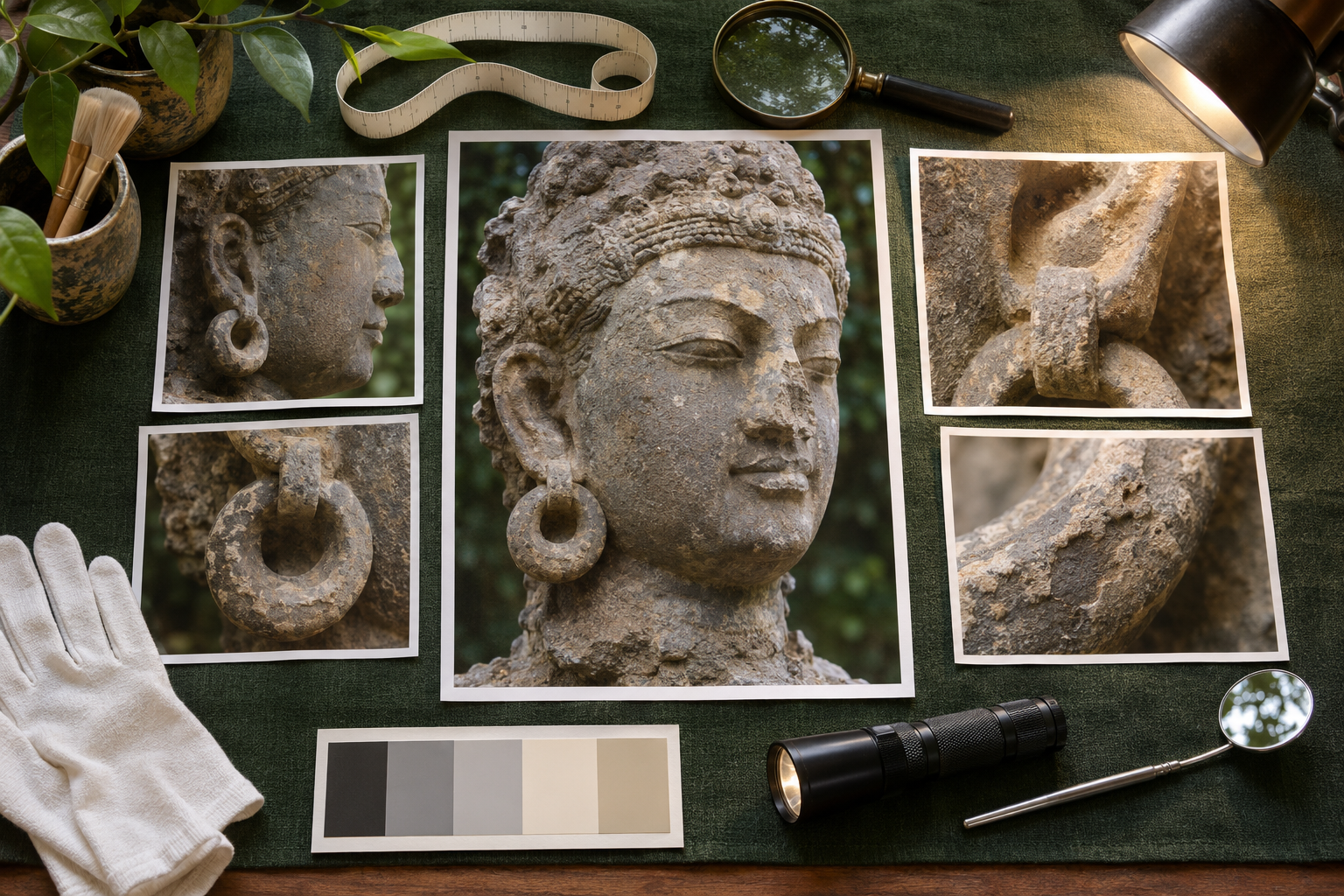
If you want a description that another reader can verify, gather the context before writing the interpretation. This short checklist works for temple visits, museum study, photographic archives, and online catalogues.
- View the full figure before concentrating on the ear. A close-up without context can conceal the very features needed for identification.
- Record the right and left sides separately. Do not write symmetrical unless both ornaments are visible and comparable.
- State whether the ornament is attached to the lobe, hangs from it, or cannot be traced because the carving is damaged or obscured.
- Describe visible form before applying a name. Use plain observations about outline, extension, surface detail, and preservation.
- Check for loss, cracks, later repairs, or a viewing angle that may alter the apparent shape.
- Copy the wording of any temple notice or museum label exactly, but keep that supplied identification distinct from what you can see yourself.
- Record the figure’s gestures, attributes, headdress, accompanying figures, and placement. These provide the context in which kundala becomes meaningful.
- If photography is permitted, take one image of the whole sculpture and separate details of both ears. A single tight crop is rarely enough for later verification.
A concise record can follow this order: object or figure; visible condition; ear-ornament observation; category-level identification; contextual interpretation; remaining uncertainty. For example, you can record that a figure wears an ornament suspended from the earlobe, classify it as kundala, and then state that its exact design and symbolism remain undetermined. This is more useful than a confident label that conceals how little the image actually reveals.
The same discipline improves captions and devotional writing. You can respectfully acknowledge that a sacred figure is richly adorned without assigning an unsupported cosmic meaning to the earring. Precision does not diminish reverence. It prevents a living iconographic tradition from being reduced to invented symbolism.
Key takeaways
- Kundala is a broad category of earlobe ornament, not one fixed visual design.
- Identify attachment or suspension at the earlobe before applying the term.
- Separate what you observe, how you classify it, and what you infer from it.
- Do not use kundala alone to determine a figure’s identity, date, region, material, or precise symbolism.
- Read the ornament as one element in the complete iconographic ensemble.
When you next encounter a Hindu sculpture, pause at the ears but do not stop there. Describe the visible ornament, classify it at the level the evidence allows, and then return to the whole figure. That sequence will give you a reading that is both more careful and more faithful to the sophistication of Hindu sacred art.
References

Leave a Reply
You must be logged in to post a comment.